The costliest mistake is paying for a studio name as though it guarantees who made every frame. When you see anime studios explained through actual credits, Ghibli, Kyoto Animation, and MAPPA stop looking like three versions of the same company. Kyoto Animation builds continuity around employed, salaried staff and substantial in-house production, while MAPPA operates multiple production lines and coordinates many projects at once. Studio Ghibli organizes feature films around directors, long schedules, and film-specific teams rather than a permanent television pipeline. None of those models means every credited task stays inside one building, and a lead studio’s logo is never a complete map of the labor.
Assuming the logo identifies everyone who made the show
Viewers often say that a studio “animated” a series as if its permanent employees performed every production task. The wording seems reasonable because marketing materials, streaming pages, and databases usually place one studio name beside the title. In practice, the lead company may manage planning, schedules, supervision, key creative decisions, and delivery while outside companies and freelancers handle parts of key animation, in-betweening, backgrounds, coloring, photography, computer graphics, or an entire episode. That makes the end credits a production map, not ceremonial small print.
The uncomfortable part is that there is no safe industry-wide percentage proving that “most” labor on every anime is subcontracted. Credits vary by episode and project, and they do not always identify employment status. What they do demonstrate is that anime subcontracting is routine enough that dozens of external names may appear under specialized departments. A studio comparison that ignores those contributors turns a networked production into a misleading auteur story.
The Money Behind a Single Episode explains the production pipeline and where its budget moves. Here, the useful lesson is narrower: the studio named in advertising is usually the coordinator and primary production identity, not necessarily the employer of everyone listed.
| Credit wording | What it usually indicates | What it does not prove |
|---|---|---|
| Animation Production | Lead company responsible for delivering the animation | That every frame was made by employees |
| Production Assistance | Another company supported production work | That it handled only minor tasks |
| Key Animation | Artists created important poses and motion drawings | Whether each artist was salaried or freelance |
| In-between Animation | Artists completed drawings between key poses | That the work occurred in Japan |
| Background Art | A person or company produced painted environments | That the lead studio owns the art department |
| Photography/Compositing | Visual layers were assembled into finished shots | That the work involved a camera |
What to do instead: Read the departmental credits before attributing an entire episode to the logo on its poster.
Treating subcontracting as evidence of bad animation
Once viewers discover outsourcing, they sometimes swing to the opposite conclusion and treat every outside credit as a warning. That also misses how anime is made. A specialist background studio, compositing company, or digital-paint team may have a long relationship with the lead producer and provide precisely the expertise the project needs. The real risk comes from weak coordination, unrealistic scheduling, missing supervision, or late retakes—not from the existence of a contractor.
Subcontracting can distribute expertise and capacity, but it can also push schedule pressure farther down the chain. You cannot determine which happened by counting company names alone. Look for repeated partners, clearly assigned departments, animation directors who keep drawings consistent, and whether the same production-assistance company returns across episodes. Those patterns reveal more than a simple inside-versus-outside distinction.
A long credit list can indicate a healthy specialist network, a production in trouble, or both at different stages. The names alone do not settle the question.
What to do instead: Judge how outside work was supervised and integrated, not merely whether it existed.

Turning Kyoto Animation’s employment model into an industry rule
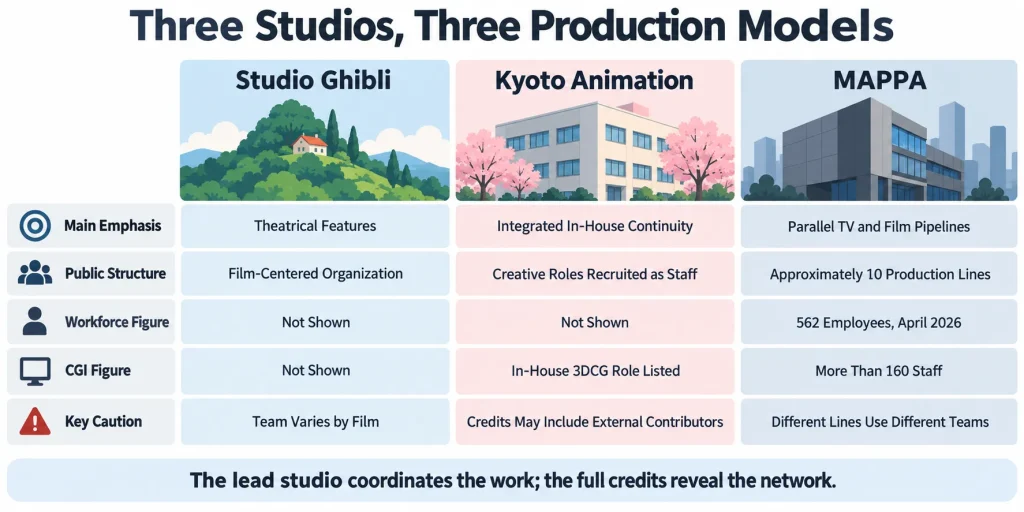
Kyoto Animation is frequently contrasted with studios that pay freelance animators by completed cut or drawing. Its recruitment pages present animation, digital paint, backgrounds, photography, and computer graphics as company professions and advertise employee benefits, allowances, training, and internal career development. That supports the description of a studio built around salaried staff rather than a workforce assembled almost entirely through piecework. It does not mean every person touching every Kyoto Animation title is necessarily a permanent employee.
This distinction matters because Kyoto Animation salaries change the incentives around training and continuity. When people remain within the organization, production knowledge, drawing standards, and working relationships can accumulate across projects. The company also states that it handles most animation-related activity itself, extending from production into publishing and merchandise. That degree of integration is unusual enough to shape what viewers recognize as the studio’s consistency.
The half-informed mistake is saying, “Kyoto Animation proves anime studios employ their animators normally.” It proves that this company has built a more integrated model. It does not establish the employment arrangement at another studio or even the status of every name in one Kyoto Animation credit sequence.
What to do instead: Describe Kyoto Animation’s salaried, in-house structure as a specific company model, not the default for Japanese animation.
Reducing MAPPA to a list of famous titles
MAPPA attracts attention through recognizable productions, but comparing titles alone hides the defining feature of its organization: parallel capacity. The company says its production division uses approximately ten production lines, with teams preparing budgets and schedules, gathering staff, commissioning work at each stage, collecting materials, and delivering completed video. Its official company profile lists 562 employees as of April 2026, while its CGI division alone reports more than 160 staff members. That is not one crew moving from show to show; it is a large organization operating several pipelines.
MAPPA was established on June 14, 2011, and its official profile names Masao Maruyama as chair. Maruyama had previously co-founded Madhouse, so MAPPA belongs to an institutional lineage rather than appearing from nowhere. The company now contains production, CGI, two-dimensional animation and direction, rights, licensing, and administration divisions, plus regional operations in Sendai and Osaka.
The obvious risk of parallel production is assuming that a large staff or many lines automatically remove schedule pressure. Capacity, deadlines, subcontractor availability, revisions, and overlapping delivery periods still determine what individual teams experience. The opposite claim—that simultaneous titles prove every employee works on all of them—is equally careless.
| Studio | Organizing emphasis | What its name tells you | What still requires credits |
|---|---|---|---|
| Kyoto Animation | Employed staff, training, in-house continuity | A comparatively integrated production identity | Any external companies and project-specific contributors |
| MAPPA | Multiple production lines and departmental scale | A company capable of managing parallel projects | Which team, freelancers, and contractors handled an episode |
| Studio Ghibli | Director-led theatrical production | A feature-film production culture | Temporary staff, partners, digital work, and outside specialists |
What to do instead: Compare MAPPA by production line and project team, not by combining every current title into one imaginary crew.

Imagining Studio Ghibli as a sealed workshop
Ghibli’s films can feel unusually unified, which encourages the idea that the entire movie was handcrafted by one permanent group under one roof. Strong direction and visual control produce that impression, but aesthetic unity is not the same as organizational isolation. Feature animation still requires editing, sound, recording, music, digital processing, distribution, and specialized visual work beyond the core drawing team. Individual films can also bring in project staff and outside collaborators.
The more useful difference is cadence. A theatrical film can organize labor around one major delivery, while a television studio must repeatedly deliver episodes to a broadcast or streaming schedule. That changes how revisions, asset reuse, episode direction, and production assistance are managed. It does not automatically make film production humane or television production careless, but it makes direct comparisons unreliable.
Ghibli is also associated strongly with individual directors and producers. Viewers often transfer every creative decision to the studio brand, even when credits assign screenplay, direction, animation supervision, art direction, music, and other responsibilities to different people. The brand helps sell the film; the credits explain the division of authorship.
What to do instead: Treat Ghibli as a feature-production organization with project-specific credits, not a single artist working under a collective signature.
Confusing the animation studio with the owner
A viewer sees a studio make a successful show and assumes that the same company owns the characters, controls international licensing, and receives most downstream revenue. The assumption feels natural because American audiences often associate a production company with the property itself. Japanese animation is frequently financed through a 製作委員会, seisaku iinkai, literally “production committee,” in which publishers, broadcasters, music companies, distributors, advertising businesses, and other investors divide risk and rights. The animation studio may be a committee investor, a contracted producer, or both.
This difference changes how you interpret a hit. Strong streaming numbers or merchandise sales do not reveal how much revenue reaches the animation company or individual artists. Conversely, a studio can gain reputation and future contracts from a title without owning the underlying intellectual property. Why the Studio Rarely Owns the Show covers the financing and rights structure in detail instead of treating a credit line as an ownership certificate.
MAPPA says its rights division participates in production committees and operates licensing businesses for intellectual property where it holds relevant rights. That wording itself shows why blanket statements fail: participation and ownership depend on the individual project.
What to do instead: Check the copyright notice and production-committee credit before saying the animation studio owns a series.

Comparing a movie team with a television cour
Another half-informed comparison begins with real knowledge but uses the wrong unit. A viewer compares the polish of a Ghibli feature with a weekly television episode and concludes that one studio simply cares more. A feature and a television cour face different running times, delivery structures, revision opportunities, and financing arrangements. Even two television series can have very different preparation periods and staff availability.
A クール, kūru, meaning a television programming block or “cour,” organizes broadcast production into seasonal runs. Why So Many Shows Stop at Twelve explains that scheduling structure and why a short stopping point does not necessarily mean cancellation. The relevant comparison is therefore movie against movie, or similarly structured television production against television production. Studio reputation cannot erase format.
The same caution applies to individual scenes. A spectacular action cut may have been assigned to a specialist animator, while a quiet acting episode may prioritize facial expression and timing. Counting explosions is not a production analysis. Different deliverables spend labor in different places.
What to do instead: Compare works with similar formats, schedules, and production demands before ranking their studios.
Reading credits as if every name were a department employee
Credits tell you who contributed, but they do not reliably state every contributor’s employment contract. A person listed under key animation may be a permanent employee, a fixed-term worker, or a freelancer hired for selected cuts. A company name may represent a full outsourced section, while a group of individually listed artists may also have been coordinated externally. Turning the credit roll into an employee directory produces false labor claims.
This is where Kyoto Animation’s public recruitment structure helps: it provides direct evidence that the company hires for specialized creative roles and offers employee systems. MAPPA’s official profile similarly documents internal production and creative departments. When no comparable primary information exists, employment status should remain unknown.
Japanese credits may render personal names in kanji without an English reading. If you need to understand a foreign contributor’s katakana rendering, the site’s name converter with 898 checked names is a reference tool, not evidence of who employed that person. Names identify contributors; corporate disclosures and verified interviews establish working arrangements.
What to do instead: Separate the factual statement “this person is credited” from the unverified claim “this person was employed by the lead studio.”
Blaming the studio for dialogue choices it did not make alone
Studio discourse often absorbs every part of the finished show. Viewers praise or blame the animator for honorifics, dialect, subtitle wording, dubbing, music, or censorship even when those decisions belong to writers, directors, localization teams, broadcasters, licensors, or distributors. The studio remains central, but production authorship is divided by department and territory. A US streaming subtitle can differ from the Japanese script without the animation staff changing anything.
Japanese Honorifics in Anime explains what endings such as -san, -kun, and -chan signal. Anime Speech Styles, and What Subtitles Cannot Carry covers character voice and localization loss. Those language questions should be linked to their own evidence rather than folded into claims about animation-studio labor.
The same principle protects subcontractors from misplaced blame. A compositing company cannot fix a weak licensing subtitle, and a freelance key animator does not decide the international release calendar. Follow the responsibility named in the credits.
What to do instead: Attribute each decision to the department, committee member, or distributor responsible for it.
Expecting a studio name to guarantee one visual style
Fans learn to recognize studio brands and then expect every project to look alike. This seems reasonable when marketing emphasizes a familiar company name, yet directors, character designers, art directors, animation directors, episode directors, and outside animators can change from title to title. MAPPA’s multiple production lines make that especially clear: two projects can share a corporate parent without sharing the same daily team. Even a more integrated company such as Kyoto Animation changes its visual language to fit the director and material.
A “house style” may come from recurring staff, training, tools, color workflows, supervision, or management preferences. It is a tendency, not a binding template. Subcontracted artists can adapt to the production’s design sheets, while an in-house director can deliberately break from familiar work. The brand tells you where coordination sits; it does not predict every artistic choice.
The habit that prevents most studio myths is to read one complete episode credit before making a claim. Start with animation production, then identify production assistance, animation directors, key animation, backgrounds, finishing, CGI, and compositing. After that, check the committee line for ownership. The logo becomes useful only when placed back inside the network that produced the work.
What to do instead: Use the studio name as the beginning of the investigation, not the final answer.
FAQ about Japanese anime studios
Does Kyoto Animation employ all of its animators on salary?
Kyoto Animation publicly recruits animators and other creative specialists as part of its company workforce and describes employee benefits, allowances, training, and internal career systems. This supports the studio’s reputation for a salaried, integrated core staff. It does not prove that every contributor credited on every project has identical employment terms. Project credits must still be checked for outside participants.
How many production lines does MAPPA operate?
MAPPA’s official company page says its production division works with approximately ten production lines. Each project team manages budgets, schedules, staff gathering, work requests, material collection, and final delivery. The company reported 562 employees as of April 2026. These figures should be rechecked before publication because staffing and internal organization can change.
Was MAPPA founded by someone from Madhouse?
MAPPA was established on June 14, 2011, and its official company profile lists Masao Maruyama as chair. Maruyama was a co-founder and producer at Madhouse before establishing MAPPA. That history helps explain MAPPA’s producer-led identity and ability to assemble teams around varied projects. It does not mean the two companies have the same workforce or production model.
Does Studio Ghibli outsource animation?
Ghibli films have used outside companies and project-specific contributors for specialized production work. However, the amount and type vary by film, so there is no responsible universal percentage. Read the full film credits instead of treating the Ghibli name as proof that every task was performed internally. Strong centralized direction can make a networked production look stylistically seamless.
Are subcontractors always listed in anime credits?
Not necessarily with enough detail to reconstruct every contractual relationship. Credits identify many participating artists and companies, but employment status, secondary subcontracting, and the exact volume of work may remain unclear. A credit list is better evidence than promotional shorthand, but it is not a complete payroll or contract archive. Claims about working conditions require additional primary documentation.