
The costliest mistake is treating a Japanese colleague’s pause as permission to keep selling. You repeat the proposal, soften the price, add another benefit, and finally ask for an immediate answer. What looked like helpful clarification can turn hesitation into pressure and leave the other person choosing between an unwanted commitment and an uncomfortable refusal.
Silence in Japanese conversation is not a secret code, and it does not always mean “no.” It may carry refusal, respect, uncertainty, embarrassment, or the simple fact that someone is thinking. Context matters more than duration alone. The practical rule is uncomplicated: when a pause appears, do not assume that communication has stopped.
Turning hesitation into accidental agreement
An American visitor proposes a plan and hears no immediate objection. Wanting to make the exchange easier, the visitor continues: “So that works for you?” If the other person responds with はい, hai, literally “yes,” the visitor may treat the matter as settled. Yet hai can acknowledge that the message was heard without confirming agreement with its content.
This mistake is expensive because the two participants may leave with different understandings. The American thinks a reservation, deadline, or business decision has been accepted. The Japanese listener may believe they merely showed attention while avoiding a blunt contradiction. A pause followed by hai therefore needs context, especially when the proposal creates work, cost, or obligation.
This is why Politeness Is a System, Not a List of Words matters: politeness depends on timing, relationship, implication, and burden, not vocabulary alone.
| What you notice | What it may mean | What it does not prove |
|---|---|---|
| A pause before hai | Thought, discomfort, or careful acknowledgment | Final agreement |
| A quiet hai without details | “I heard you” | “I accept the plan” |
| No direct objection | Reluctance to confront | Approval |
| A delayed answer | Consultation or uncertainty | Rejection by itself |
What to do instead: Ask a neutral confirmation question, then stop talking: “Would you prefer time to consider it?”
Making concessions before anyone asks
Some Americans know that pauses matter in Japan, yet they apply that knowledge mechanically. The other person becomes quiet, so they assume negotiations have begun and immediately offer a discount, an easier deadline, or extra service. This half-informed response turns cultural awareness into self-imposed bargaining pressure.
The pause may have had nothing to do with price. Your counterpart could be checking whether the proposal is operationally possible, considering who must approve it, or deciding how to phrase a concern politely. An unsolicited concession changes the subject and can make your original offer appear inflated.
The uncomfortable part is that filling silence can cost real money. It also teaches the other side that waiting will cause you to negotiate against yourself. In a formal meeting, a calm pause may simply provide room for thought.
“No immediate answer” is information, but it is not permission to invent the answer.
What to do instead: Hold your original position until the other person identifies a specific concern.

Asking the same question in progressively stronger ways
When a request receives hesitation, an American speaker may repeat it with new wording: “Would Tuesday work? Is Tuesday difficult? Should I put you down for Tuesday?” Each version seems clearer and more accommodating. To the listener, however, the repetition may remove the space needed to decline.
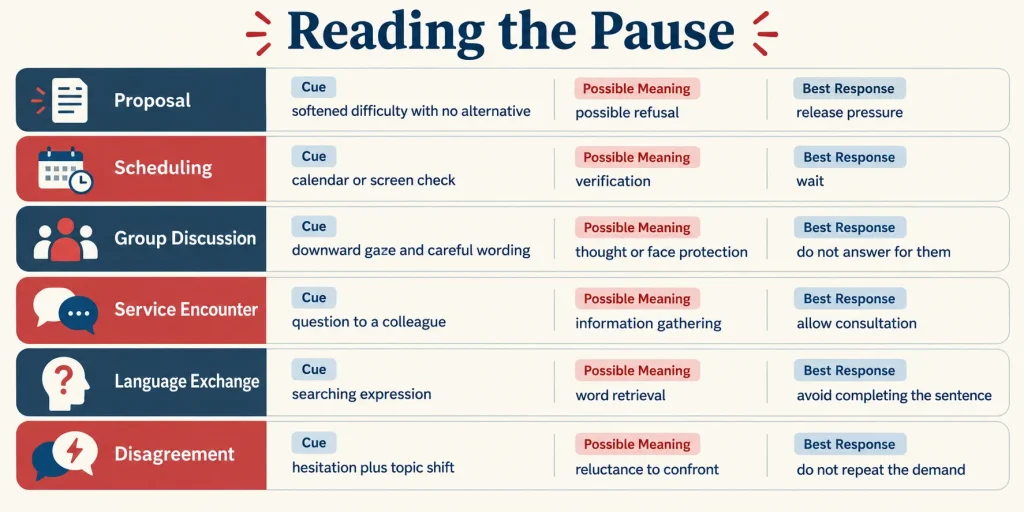
A Japanese response such as ちょっと難しいです, chotto muzukashii desu, literally “it is a little difficult,” often functions as a softened negative in context. The phrase does not mathematically equal “no” in every setting, but pushing for a stronger answer can force the listener to become more direct than the relationship normally permits.
A useful distinction is whether the response offers a path forward. “Tuesday is difficult, but Thursday is possible” continues the negotiation. “Tuesday is a little difficult,” followed by silence and no alternative, gives you much less reason to keep pressing.
What to do instead: Accept the first softened obstacle and offer an exit: “Understood—we can leave it there.”
Performing Japanese-style silence without listening
Another half-informed error is deciding that “Japanese people value silence” and becoming theatrically quiet. The visitor counts a few seconds, avoids ordinary reactions, and waits for the technique to work. This can feel unnatural because silence is not a negotiation trick detached from facial expression, status, topic, and prior conversation.
Listening in Japanese frequently includes short acknowledgments called 相づち, aizuchi, literally “mutual hammer blows.” These responses show that you are following the speaker without taking over the turn. Total stillness may therefore appear less attentive than a restrained “そうですか,” sou desu ka, literally “is that so?”
The Japanese politeness levels guide explains how register changes with relationship and setting. Silence cannot repair speech that is too casual, too commanding, or otherwise mismatched to the situation.
What to do instead: Stay responsive with eye contact or a brief acknowledgment, but do not seize the floor.
Treating every pause as a hidden refusal
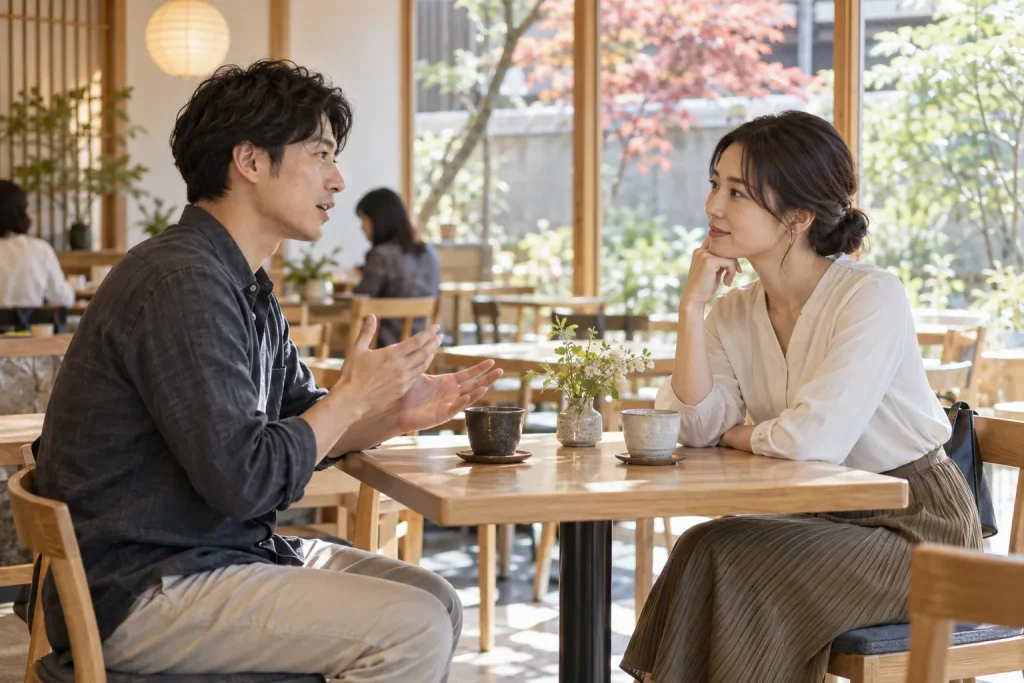
Learning about indirect refusal in Japanese can create a new problem: visitors begin hearing “no” in every delay. A hotel employee checks a screen, a friend searches for the right English word, or a colleague reviews a calendar—and the American withdraws the request before an answer arrives. Supposed sensitivity becomes impatience in another form.
Silence is ambiguous by nature. Research on intercultural communication warns that its meaning cannot be separated from the immediate interaction. Look for surrounding evidence: an apology, a hesitant expression, a softened negative, an alternative proposal, or a request to wait.
| Surrounding cue | More cautious reading | Sensible response |
|---|---|---|
| The person checks information | Verification may be underway | Wait |
| An alternative is proposed | The original request may not work | Consider the alternative |
| “It may be difficult” with no alternative | A soft refusal is plausible | Release the pressure |
| A question follows the pause | More information is needed | Answer only that question |
| Visible confusion | Language or context may be unclear | Clarify once, briefly |
The phrasebook with 337 phrases in 25 situations is useful when you need a precise expression. It should support observation, not replace it.
What to do instead: Read the pause together with the next words and actions, never as a standalone translation.
Apologizing repeatedly to rescue the atmosphere
Americans sometimes sense discomfort and begin apologizing: “Sorry, I didn’t mean to pressure you. Sorry, was that rude?” The intention is considerate, but repeated apologies place a fresh burden on the listener. Now the other person must answer the request and reassure you that nothing terrible happened.
すみません, sumimasen, literally “it is not finished,” can apologize, attract attention, or acknowledge an imposition. Its flexibility is explored in The Word You Will Use Fifty Times a Day. That does not mean repeating it will improve every silence.
A single, proportionate apology may be right after an interruption or overly forceful question. Continuing until you receive reassurance merely changes the kind of pressure being applied. Your discomfort does not have to become the other person’s task.
What to do instead: Apologize once when necessary, simplify the request, and give the conversation room to reset.

Filling a thoughtful pause with another person’s answer
In group settings, a manager or confident traveler may answer for a quieter participant. “I think she means Thursday,” or “He probably agrees.” This feels efficient, particularly when the group is waiting, but it transfers ownership of the answer to the fastest speaker.
Status makes the damage worse. A junior employee may find it difficult to correct a senior person’s public interpretation. Once someone has announced what the silence “means,” disagreement requires both rejecting the proposal and correcting the speaker.
The same problem appears in casual travel. A companion asks a restaurant employee a question, waits briefly, and then supplies a guessed answer. The employee loses the opportunity to check, explain, or ask someone else. For practical expressions in service situations, Essential Japanese Phrases for Travelers covers the language; the missing skill is allowing time for the reply.
What to do instead: Let the person addressed answer for themselves, even when someone else could answer faster.
Demanding explicit closure from a relationship built on restraint
The final mistake is insisting that every exchange end with an American-style verbal resolution. You ask whether everything is settled, whether anyone is offended, and whether the relationship is still good. The search for certainty can create precisely the tension you hoped to eliminate.
Japanese communication is not universally indirect, and Japanese individuals differ in age, personality, profession, region, and experience abroad. Still, direct emotional confirmation may feel excessive when behavior already shows that the interaction has moved on. A completed task, a revised plan, or a normal continuation of conversation may carry more useful evidence than a forced declaration.
This is also why gratitude can sound weightier than its English equivalent. Arigatou Literally Means This Rarely Happens explains the cultural and linguistic background without reducing every exchange to a literal translation.
The habit that prevents most mistakes is to leave one conversational beat unclaimed. Listen for the words that surround the silence, observe what happens next, and ask one neutral question only when a decision genuinely requires clarification.
What to do instead: Stop chasing verbal certainty once words and subsequent actions provide a workable answer.
FAQ about pauses in Japanese conversation
Does silence always mean no in Japan?
No. Japanese conversational silence can accompany refusal, thought, uncertainty, embarrassment, respect, or attentive listening. The surrounding language and action determine the most plausible interpretation. A softened obstacle with no alternative makes refusal more likely, while checking a calendar or consulting a colleague suggests that an answer is still being prepared.
Is hai always an affirmative answer?
No. はい, hai, literally “yes,” may confirm receipt or understanding rather than acceptance of a proposal. If agreement matters, ask for practical confirmation without demanding a stronger emotional response. A date, action, or next step is usually clearer than repeatedly asking, “So that is a yes?”
Should I wait exactly three seconds?
No universal timing rule is supported by the research reviewed for this article. The fixed meta description uses a three-second gap as an editorial illustration, not a scientific threshold. How to handle silence in Japan depends on context, and silently counting can make your behavior feel staged.
What can I say when someone seems hesitant?
You can offer space: “Please take your time,” “We can discuss it later,” or “It is fine if this does not work.” If you need Japanese wording for a specific travel situation, use the site’s phrasebook rather than improvising a complicated sentence. Keep the invitation genuine and do not immediately repeat the original request.