
Type “Chinese zodiac compatibility” into a search box and you’ll get a thousand pages telling you the Rat and the Horse are a disaster and the Dragon and the Monkey are made for each other. Almost none of them mention where those pairings come from.
They come from geometry. Not from anything about rats, horses, dragons or monkeys — from the shape of a twelve-point circle. Once you can see that, the whole system becomes much more interesting and considerably less mystical.
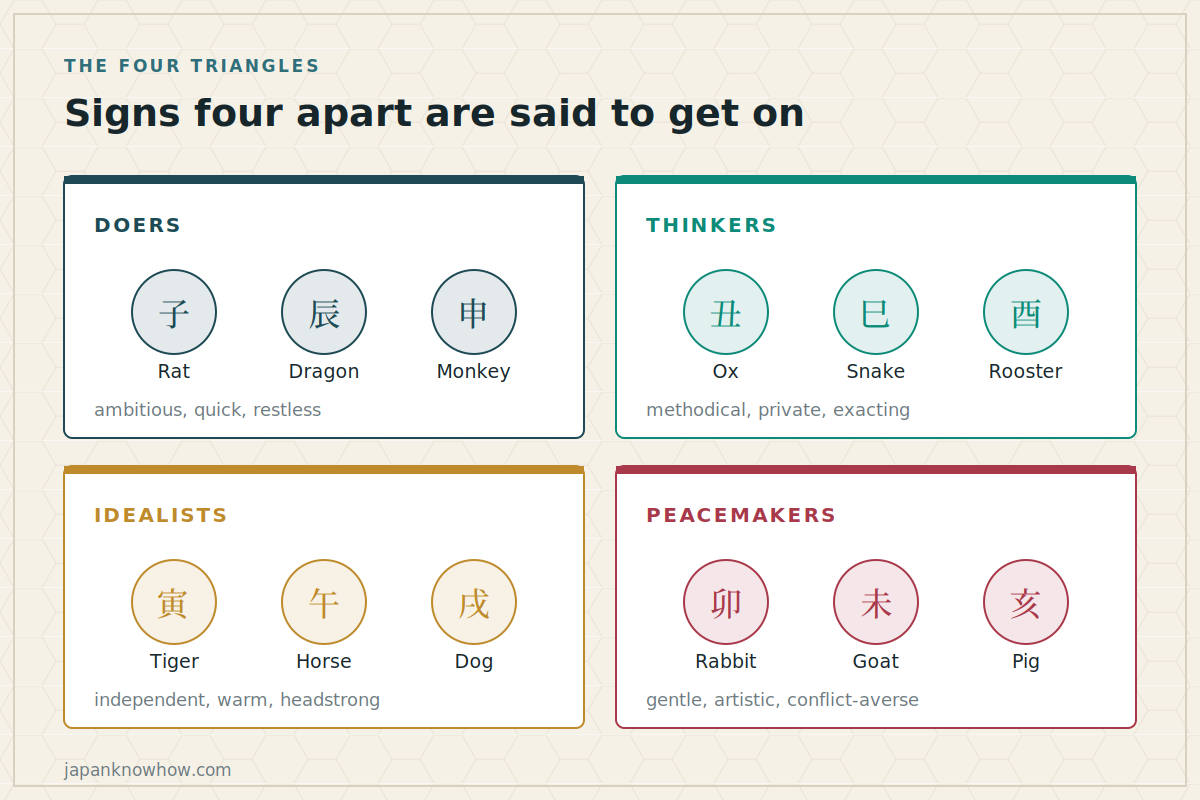
The four triangles
Take the twelve signs arranged in a circle. Start anywhere and count four forward, then four again, and you land back where you began having drawn an equilateral triangle. Do that starting from each of the first four signs and you’ve partitioned all twelve into four groups of three, with nothing left over.
These are the trines, and they’re the “compatible” groupings:
| Group | Signs | Traditional character |
|---|---|---|
| First trine | Rat, Dragon, Monkey | Driven, quick, restless — the doers |
| Second trine | Ox, Snake, Rooster | Methodical, private, exacting — the thinkers |
| Third trine | Tiger, Horse, Dog | Independent, warm, headstrong — the idealists |
| Fourth trine | Rabbit, Goat, Pig | Gentle, artistic, conflict-averse — the peacemakers |
The traditional reading is that signs in the same trine share a temperament and therefore get along — they want similar things and irritate each other in familiar ways. It’s a tidy idea, and the fact that it falls straight out of counting by fours is not usually advertised.
The six clashes
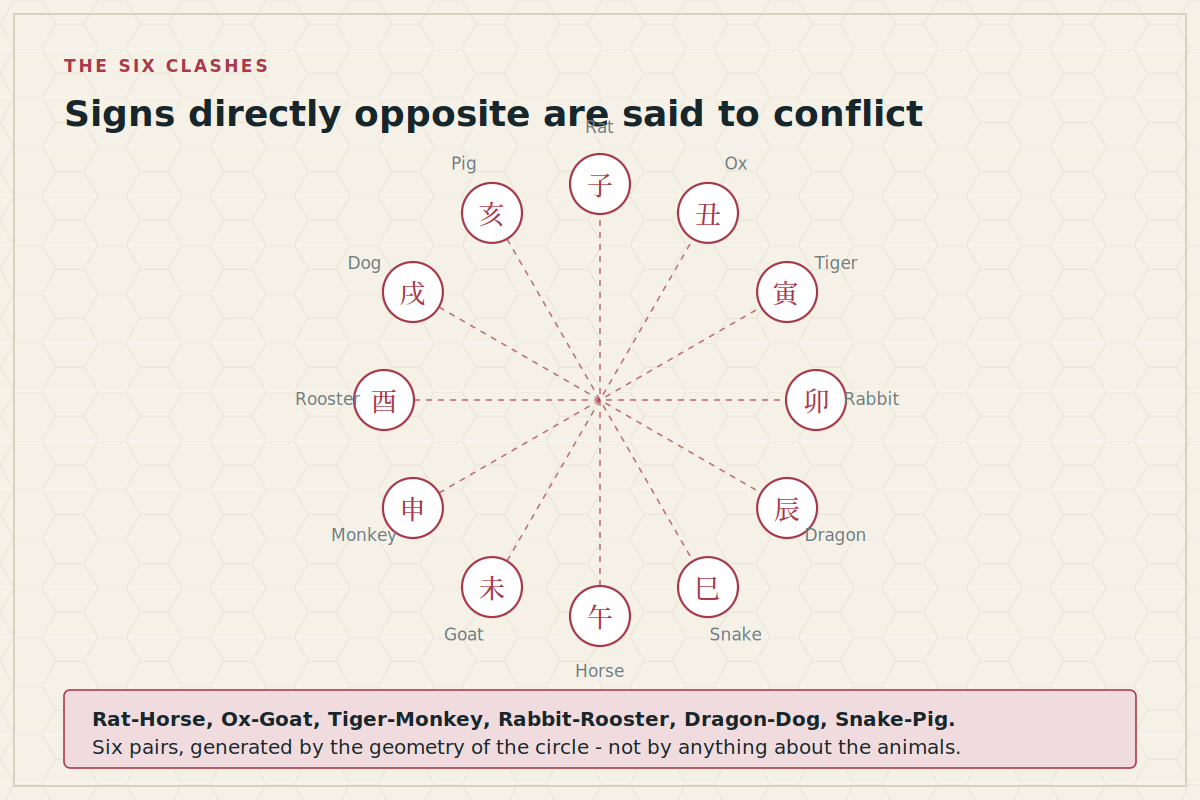
The same circle produces the opposite relationship. Signs directly across from each other — six apart — are the clashes, said to pull in incompatible directions:
- Rat and Horse
- Ox and Goat
- Tiger and Monkey
- Rabbit and Rooster
- Dragon and Dog
- Snake and Pig
Six pairs, covering all twelve signs exactly once. Again: generated by the circle, not by the animals.
There’s a third relationship worth knowing about, less often mentioned in English coverage — the harm or secret enemy pairings, which sit at a different offset and are traditionally treated as friction that doesn’t announce itself. Different lineages of practice give slightly different lists, which is a decent hint about how firm any of this is.
Where the elements come in
Practitioners rarely stop at the animal. The five-element cycle running underneath adds a second layer: two people whose elements sit next to each other on the generating cycle — Water and Wood, say — are read as supportive, while elements on the overcoming cycle — Water and Fire — are read as friction.
Combine both layers and you get a much finer-grained system, and also a much more forgiving one, because a clash on the animal can be softened by a supportive element pairing. That flexibility is a feature of the tradition rather than a bug; it’s how any working divination system stays useful. The mechanics of the element cycles are in our article on the five elements.
How seriously is this taken?
Honestly: it varies enormously, and the honest answer is more interesting than either “not at all” or “completely.”
In most of urban East Asia today it functions roughly the way Western star signs do — a conversation opener, a light frame for teasing a friend, something you know about yourself without organising your life around it. Zodiac compatibility appears in dating-app profiles, in magazine features, in the small talk of a first meeting.
But it hasn’t always been decorative, and in places it isn’t now. Matchmaking traditions in several East Asian cultures have consulted the eight characters of a birth chart — animal, element and more — as one input into arranging a marriage. And the Japanese Fire Horse superstition is the clearest evidence anywhere that a zodiac belief can move real behaviour: Japanese births dropped about 25% in the 1966 Fire Horse year because couples deliberately avoided having a daughter. That’s not small talk. The whole story is in our piece on Japan’s eto.
Signs four apart get on; signs six apart clash. It is the geometry of the circle, which is worth knowing before you take it seriously.The thing most compatibility articles leave out
The layer most articles skip: the birth hour
Serious practice does not read compatibility from the year alone. The traditional chart uses four pairs of stems and branches — for the year, the month, the day and the hour of birth — which is where the phrase “eight characters” comes from.
The hour matters because the twelve branches also divide the day: each animal governs a two-hour block, starting with the Rat from 11pm to 1am. Your birth hour therefore gives you a second animal, sometimes called the inner or secret animal, and traditional readings treat it as describing the private self against the year animal’s public one.
Two consequences follow. First, two people born in the same year can have quite different charts, which is the obvious objection to year-only compatibility and one the tradition itself answers. Second, any reading that asks only for your year is using a twelfth of the available information — worth remembering when a site gives you a confident percentage.
We deliberately don’t build the hour layer into our calculator. It requires an accurate birth time most people don’t have, and the further into chart interpretation a tool goes, the more it implies a precision it cannot support.
Using it well
A few practical notes, in the spirit of enjoying the thing without being misled by it.
- Check your sign first. If you were born in January or early February, you may be looking up the wrong animal entirely — and every compatibility reading built on it will be wrong too. The check takes seconds and is described in the article on the floating new year.
- Expect disagreement between sources. Different traditions weight the animal, the element and the birth hour differently. A site that gives you one confident percentage is hiding that.
- Treat it as a lens, not a verdict. The trines describe four recognisable temperaments, and thinking about which one you and someone else resemble is a reasonable prompt for a conversation. It is not evidence about a relationship.
- Don’t use it to decide anything that matters. This is the one we’d underline. A system generated by counting to four around a circle should not be casting a vote on who you date, hire or marry.
What our zodiac tool gives you is the factual layer: the animal and element for any birth date, with the Lunar New Year boundary handled correctly, plus the trine and clash groupings so you can see where you sit in the circle. What it doesn’t do is score a relationship out of ten, and that’s deliberate — the reasoning is on our tools page. For the wider picture of how the twelve signs work, start with the main zodiac guide.