Japan is one of the safest countries in the world to travel in, and that is exactly why it’s worth spending five minutes on this page before you go. The phrases here are the ones you’ll never use — until the evening you do, when you will not be in a state to look them up.
Three numbers, four situations, and a handful of sentences. Screenshot the ones you want.
The three numbers
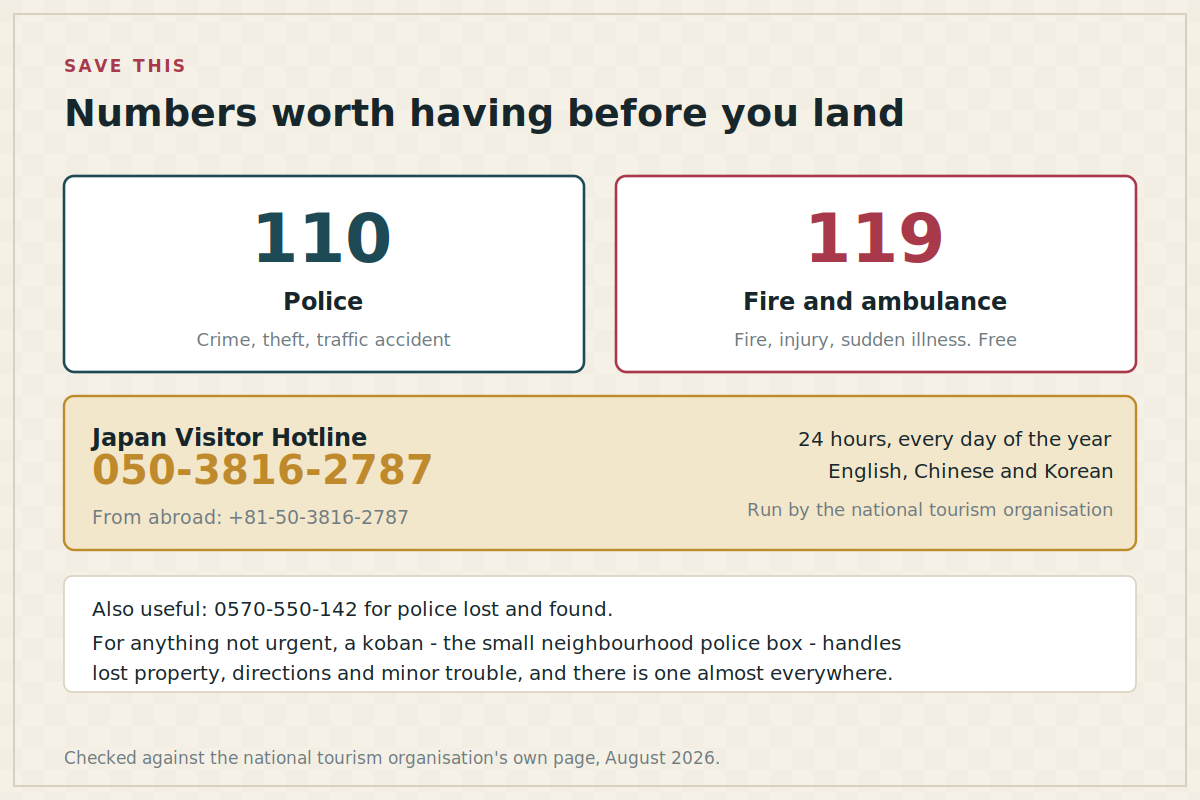
110 — police. Crime, theft, a traffic accident. Free from any phone, including one with no SIM.
119 — fire and ambulance. Fire, serious injury, sudden illness. Ambulances in Japan are free — you are not billed for the ride, though hospital treatment itself is charged. Do not hesitate over cost.
050-3816-2787 — the Japan Visitor Hotline. Run by the national tourism organisation, staffed 24 hours a day, every day of the year, in English, Chinese and Korean. From outside Japan it’s +81-50-3816-2787. This is the number for anything that isn’t an immediate emergency but needs a person: a medical question, a natural disaster, being stuck.
Both emergency lines have interpretation available, though connecting one takes a moment. Say eigo onegaishimasu — English, please — and wait.
What to say first
| Japanese | Reading | Meaning |
|---|---|---|
| 助けてください | tasukete kudasai | please help |
| 救急車を呼んでください | kyūkyūsha o yonde kudasai | please call an ambulance |
| 警察を呼んでください | keisatsu o yonde kudasai | please call the police |
| 英語を話せますか | eigo o hanasemasu ka | do you speak English? |
| 病院はどこですか | byōin wa doko desu ka | where is the hospital? |
| 気分が悪いです | kibun ga warui desu | I feel unwell |
Note that these are all in the polite register. That’s deliberate — you may be saying them to a police officer, a doctor or a stranger, and the polite form is right for all three. The reasoning is in our article on politeness levels.
Four situations
You’re lost
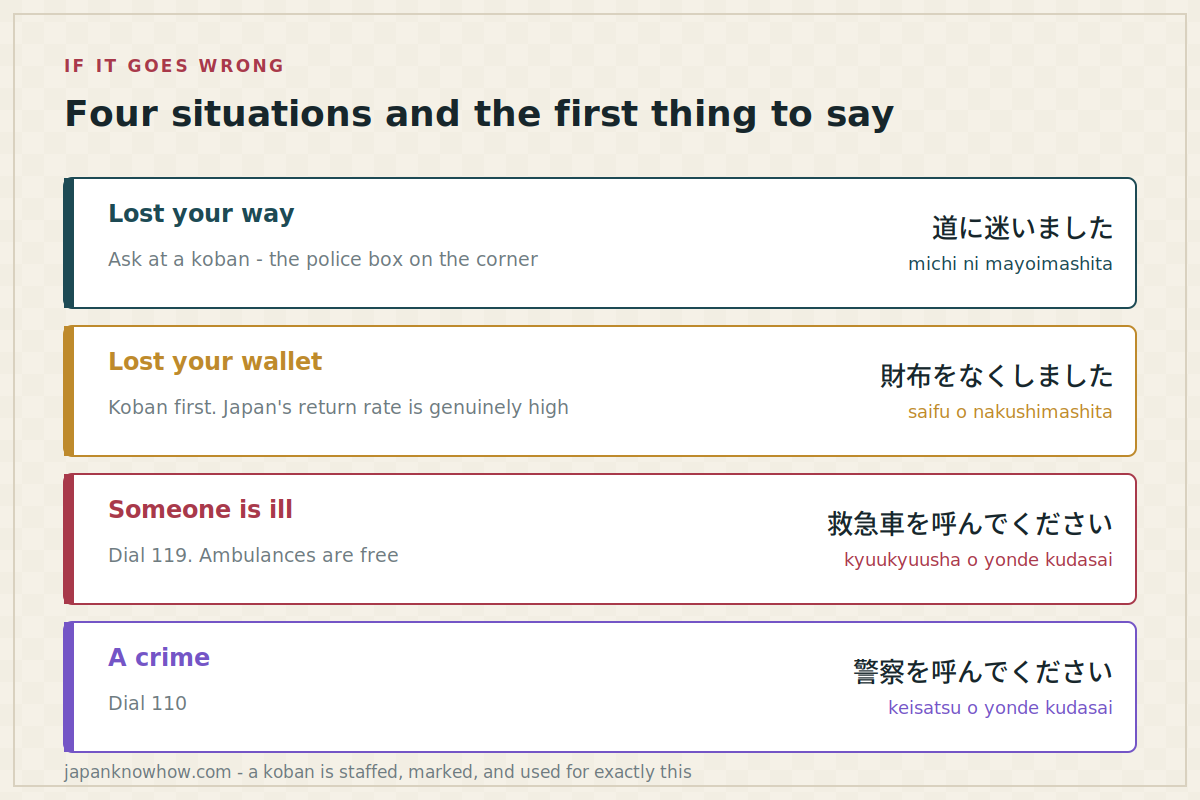
Michi ni mayoimashita — I’ve lost my way. Then show a map or an address on your phone.
The place to ask is a kōban, 交番 — the small neighbourhood police box you’ll find near stations and major intersections. They are staffed, they exist substantially to give directions, and using one for that is completely normal rather than an imposition.
You’ve lost something
Saifu o nakushimashita — I’ve lost my wallet. Swap the noun: 携帯 keitai phone, パスポート passport, かばん kaban bag.
Go to a kōban, or to the station office if you left it on a train. Japan’s lost-property system is genuinely exceptional — items handed in are logged and held, and the recovery rate for wallets and phones is high enough that it’s worth reporting rather than writing off. Report it the same day.
For a lost passport you’ll also need your embassy, and a police report first — the kōban will produce one.
Someone is ill or hurt
Dial 119. Say kyūkyūsha onegaishimasu — ambulance, please — then your location. If you can’t describe where you are, read out the address from a nearby vending machine or utility pole; both carry location markers, and this is a standard trick.
For something that needs a doctor but not an ambulance, the Japan Visitor Hotline can direct you to a facility that takes English speakers. Hotel front desks are also very good at this.
A crime, or a traffic accident
Dial 110. For anything non-urgent, a kōban again. Get a police report if there is any chance of an insurance claim — Japanese insurers and your own will both want it.
A kōban is staffed, marked, and used by Japanese people for exactly this. Walking into one is not an escalation.The thing most visitors do not realise
Natural events
Worth a paragraph because it is the one category where Japan differs meaningfully from home.
Earthquakes are routine and almost all are minor. If one starts: stay inside, get away from windows, get under a table if it’s strong. Do not run outside — falling debris is the greater risk. Buildings are engineered for this and Japanese construction standards are among the strictest anywhere.
Phones sold in Japan receive an automatic early-warning alert; foreign phones may not. Free apps from the national broadcaster and the tourism organisation provide the same alerts in English, and they’re worth installing on the plane. Typhoon season runs roughly June to October and mostly means trains stopping rather than danger.
The things that make this easier
- Screenshot this page’s table before you fly. Showing a phone screen works when speaking does not.
- Save the three numbers as contacts, so you aren’t typing under pressure.
- Carry your hotel’s card. Every hotel has one with the address in Japanese; it solves being lost and being in a taxi at once.
- Know your nearest kōban. Ten seconds on a map when you check in.
- Have travel insurance details offline. Japanese hospitals will treat you; payment is a separate conversation and usually upfront.
Pharmacies and medication
The one piece of preparation that genuinely catches travellers out, and it has to happen before you fly.
Japan restricts several medications that are sold over the counter in the United States. Products containing pseudoephedrine — common American cold and sinus remedies among them — and certain codeine preparations are controlled, and bringing them in can cause real problems at the border rather than mild inconvenience. Larger quantities of ordinary prescription medication may require an import certificate obtained in advance.
The rules change and depend on the specific drug and quantity, so the only reliable move is to check your own medications against the current guidance from a Japanese embassy or consulate before you travel, and to carry prescriptions in their original packaging with a doctor’s letter. This is not a case where a website — ours included — should be your source; the same principle as everything else on our editorial standards page.
For everyday needs, a 薬局 yakkyoku pharmacy or the larger drugstore chains carry Japanese equivalents of most common remedies, and staff are used to pointing. Useful words: 頭痛 zutsū headache, 熱 netsu fever, 風邪 kaze a cold, 痛い itai it hurts. Pointing at the part that hurts and saying itai desu gets you a long way.
One reassurance
The odds are you will use none of this. Japan’s rate of violent crime is very low, its emergency services are fast, and its culture around lost property is close to unique. The reason to read the page is that the cost of preparing is five minutes and the cost of not preparing is trying to translate “ambulance” at two in the morning.
For the everyday phrases that fill the rest of a trip, start with the ten essential phrases. The situational lists for restaurants and stations cover where you’ll spend most of your Japanese.