Anime, Japanese lessons, and ordinary conversation are often treated as interchangeable sources of the same language. They are not. If can you learn Japanese from anime is your starting question, the honest answer is yes for listening and vocabulary, but no as a complete model for speaking.
The comparison turns on five axes: how authentic the speech is, which registers you hear, how vocabulary is presented, whether you can safely repeat a line, and how much active work the material demands. These axes matter because recognizing Japanese and choosing appropriate Japanese are different skills. Genre, animation quality, and episode length may affect motivation, but they do not tell you whether a sentence belongs in an actual conversation.
| Comparison axis | Anime alone | Anime with Japanese subtitles | Structured lessons and conversation |
|---|---|---|---|
| Listening | Rich, fast audio with context | Audio linked to visible Japanese | Controlled input plus correction |
| Vocabulary | Memorable but genre-dependent | Easier to identify and verify | Selected for practical usefulness |
| Speech register | Often casual or stylized | Easier to notice, not automatically safer | Register is explained directly |
| Speaking model | Unreliable without checking | Better for analysis than imitation | Best place to practice production |
| Work required | Easy to watch passively | Requires pausing and note-taking | Requires study and interaction |
Can you learn Japanese from anime alone?
Anime alone gives you sustained exposure to rhythm, reduced sounds, hesitation, emotional emphasis, and sentence endings. Those are real parts of Japanese, even when the scene is fictional. Repeated viewing may help you notice where one word ends and another begins, particularly when you already know the grammar.
Its strongest advantage is memory. A word attached to an action, expression, or important plot turn is easier to recall than an isolated dictionary entry. That makes learning Japanese through anime useful for reinforcing vocabulary you have encountered elsewhere.
The weakness is selection. Anime teaches whichever words its story needs. A cooking series may repeat ingredients and kitchen verbs, while a fantasy series may spend its linguistic budget on ranks, spells, invented institutions, and dramatic threats. Frequency inside one show is not proof that an expression is common outside it.
The larger problem is that you receive almost no correction. You can understand a line while missing who is allowed to say it, to whom, and under what circumstances. Entertainment supplies context, but it does not pause to explain the social decision behind the grammar.
Anime with Japanese subtitles changes the task
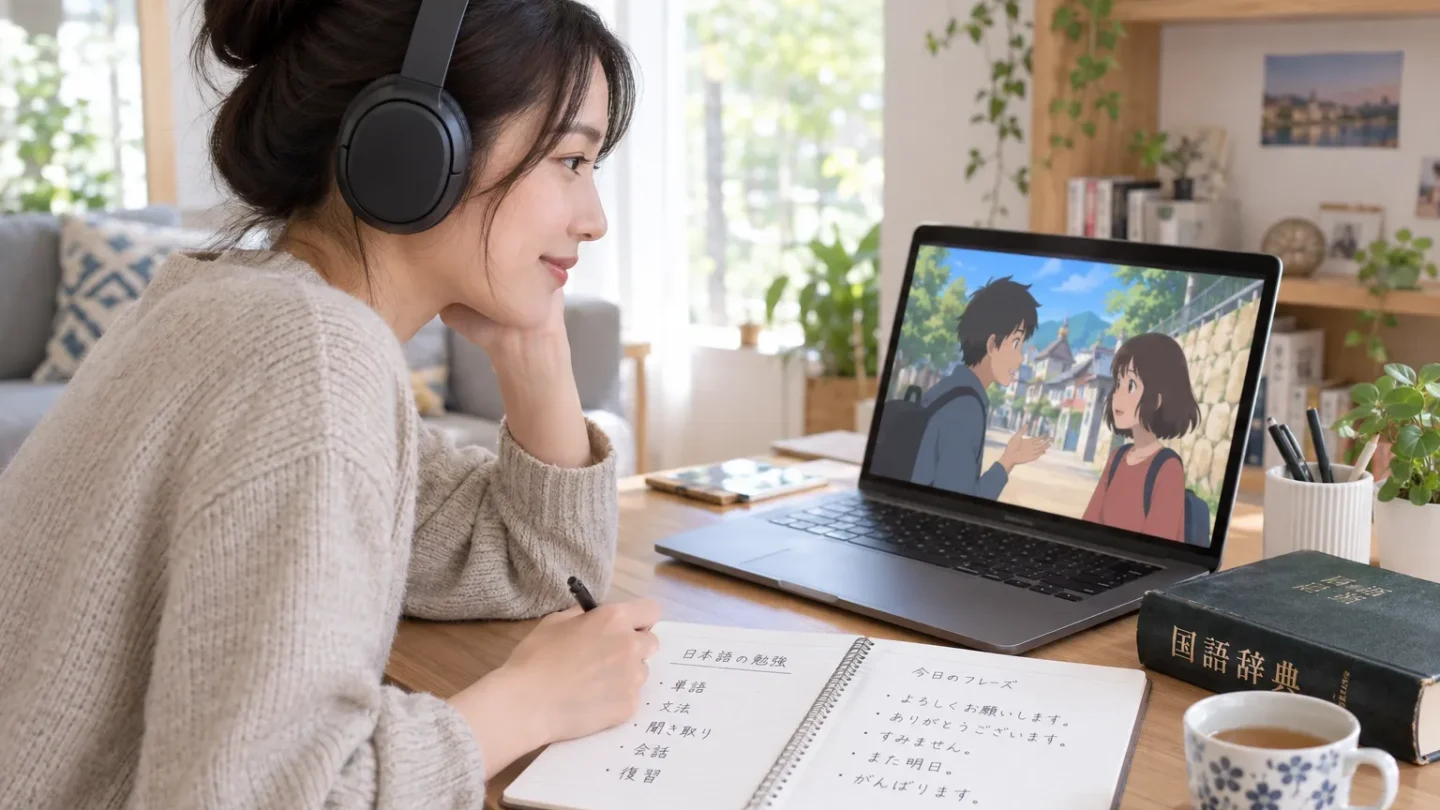
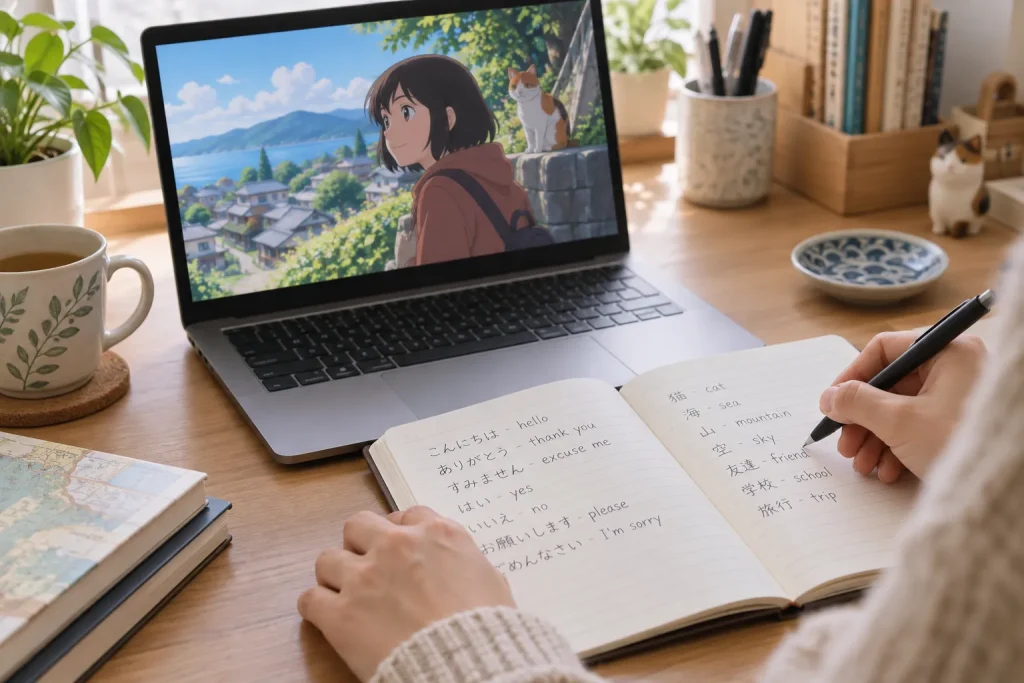
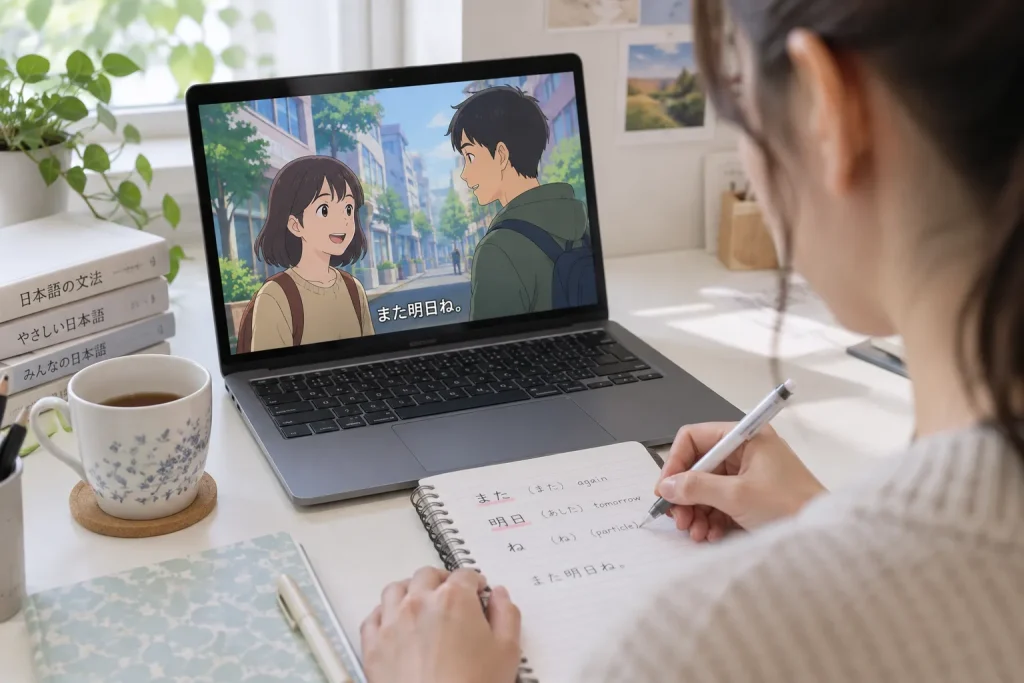
Japanese subtitles turn sound into searchable language. Instead of guessing that you heard shiranai, you can check whether the line was 知らない, shiranai, “do not know,” or a different expression swallowed by fast delivery. The text also exposes particles, verb endings, and kanji that English subtitles may omit.
Research on second-language audiovisual input supports the broader value of on-screen text for vocabulary learning. A 2022 meta-analysis by Yanxue Montero Perez found that captioned and subtitled video generally benefits vocabulary learning, with same-language captions producing the largest overall effect among the compared formats. That finding concerns audiovisual language learning broadly, not anime specifically, but it supports using Japanese subtitles for learning rather than relying only on an English translation.
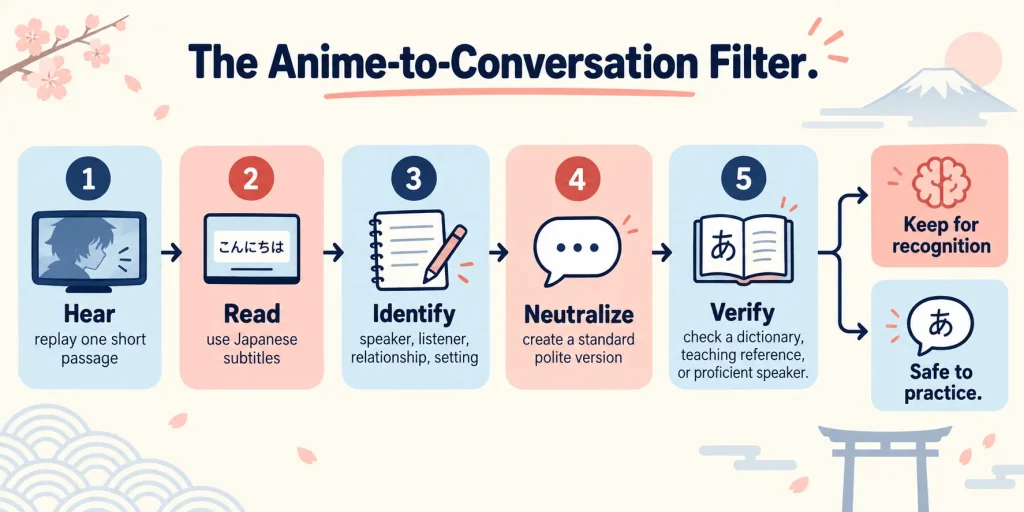
Use a short, repeatable protocol:
- Watch a compact passage once without pausing and identify the situation.
- Replay it with Japanese subtitles and write down only the line you want to investigate.
- Mark the unknown word, grammar ending, speaker, listener, and emotional setting.
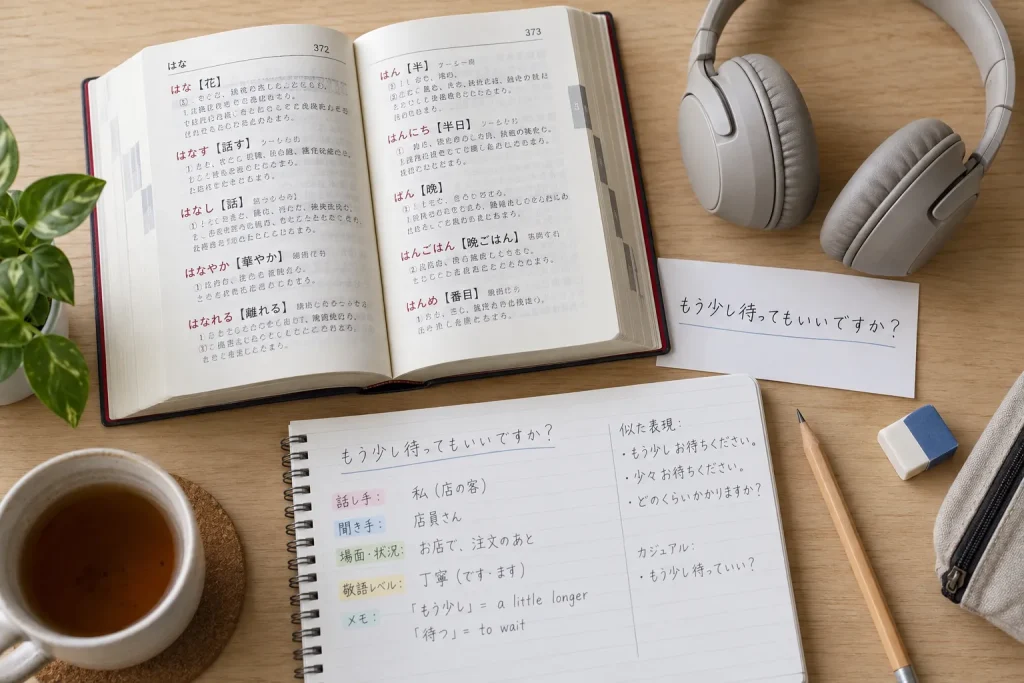
- Check the expression in a dictionary or reliable teaching reference.
- Replay the line, then shadow it for listening practice without assuming it is socially reusable.
- Write a neutral version you could plausibly say in ordinary life.
This is not a speed-watching method. If you stop for every unfamiliar noun, the story disappears and the notebook fills with low-value vocabulary. Select lines that recur, connect to grammar you are studying, or solve a listening problem you have noticed more than once.
Understanding a character’s line is evidence that you learned to recognize it. It is not yet evidence that you should say it.
The site’s Anime Speech Styles, and What Subtitles Cannot Carry examines the pronouns, endings, and social signals that an English translation often flattens. Use that guide when the written line is clear but its attitude is not.
Structured study covers the parts fiction leaves off-screen
A course, textbook, tutor, or conversation partner usually provides less spectacular Japanese and more usable Japanese. You practice clarification, requests, introductions, turn-taking, and repair—the language needed when a conversation does not follow a script.
Structured study also keeps reading separate from speaking. You can learn to recognize a rough command or an archaic pronoun without adding it to your active vocabulary. That distinction prevents the familiar learner error of reproducing a line accurately in the wrong room.
Polite language is where the difference becomes costly. 丁寧語, teineigo, “polite language,” respectful language, and humble language depend on relationships and institutional roles. Anime contains these forms, especially in workplace, school, historical, and service scenes, but many action-driven stories devote far more dialogue to peers, rivals, families, and enemies.
The brief’s claim that polite registers “barely appear” is therefore too absolute. They do appear, sometimes extensively. The defensible point is that an uncontrolled viewing diet does not provide systematic, balanced practice in choosing them.
For the visible relationship markers that precede many names, Japanese Honorifics in Anime: -san, -kun, -chan and the Rest explains what the suffix contributes and why subtitles sometimes drop it. The article covers the system instead of turning this comparison into another honorific list.
Why character speech is not a neutral sample
The central concept is 役割語, yakuwarigo, literally “role language.” Linguist Satoshi Kinsui uses the term for recognizable bundles of vocabulary, grammar, pronunciation, pronouns, and sentence endings that evoke a social or fictional type.
A character can sound elderly, aristocratic, rural, masculine, refined, bookish, foreign, or delinquent before the plot explains any of those traits. The language is doing characterization. It may draw on real variation, but it is organized for instant recognition rather than documentary accuracy.
Later work by Kinsui distinguishes broad role language from キャラクター言語, kyarakutā gengo, “character language,” which can be more individual and less reducible to a standard type. This distinction matters because not every unusual line represents a reusable stereotype. Some speech is written for one character’s identity alone.
English subtitles often preserve the proposition while discarding the social package. Several characters may all receive “I know” even if their Japanese pronouns and endings mark different ages, genders, personas, or levels of roughness. That makes subtitles adequate for following the plot but incomplete as a guide to anime speech patterns.
The result is an asymmetry: anime can teach you to recognize characterization long before it teaches you to speak appropriately. That is useful knowledge, provided you label it correctly.
What each source does best
The safest division of labor is simple: anime supplies listening material, Japanese subtitles expose its form, and structured practice decides what enters your speech.
| Skill you want | Primary source | Anime’s supporting role | Required check |
|---|---|---|---|
| Hear natural speed | Anime or other native video | Repeated listening in context | Compare audio with Japanese text |
| Build vocabulary | Japanese-subtitled scenes | Provides memorable situations | Check frequency, meaning, and register |
| Learn kanji readings | Reading materials and dictionaries | Shows familiar words in subtitles | Confirm the word rather than guessing |
| Speak politely | Lessons and guided conversation | Provides examples to analyze | Check relationship and setting |
| Understand characters | Anime itself | Shows language, voice, and behavior together | Separate characterization from ordinary usage |
| Improve pronunciation | Native audio plus feedback | Supplies shadowing material | Get correction before fixing a habit |
The Japanese text matters more than the English subtitle when you are studying form. The English line answers “What does this moment mean?” The Japanese line helps answer “What did this character actually say?”
That does not mean English subtitles are harmful. They are useful when the scene is above your level or when you need to confirm the plot before examining one sentence. The mistake is treating a smooth translation as a word-for-word transcript.
Where the differences stop mattering
You do not need to classify every sentence before enjoying a show. Common nouns, basic verbs, numbers, routine reactions, and clearly visible actions can reinforce Japanese regardless of whether the material came from a classroom dialogue or an animated scene.
The distinction also matters less when your goal is comprehension rather than production. If you want to follow a fantasy story, recognizing a grandiose royal pronoun is worthwhile even if you will never use it. Passive vocabulary is allowed to be much broader than active vocabulary.
Names are another area where fiction can support reading without dictating conversation. Character Names in Japanese: Meaning, Kanji and Readings explains how creators use written forms and readings. If you only need a conventional katakana rendering of your own name, the name converter with 898 checked names is the appropriate tool; an anime character is not a transliteration standard.
Finally, enjoyment is not a defect in the method. A series that keeps you returning to Japanese has educational value even when each viewing session produces no vocabulary list. The problem begins only when exposure is counted as complete speaking practice.
The difference that embarrasses learners
The most dangerous gap is not vocabulary. It is stance: how a line positions the speaker toward the listener.
A learner may copy 俺, ore, “I,” aggressive imperatives, blunt sentence endings, or an exaggerated feminine or elderly style because the meaning is clear and the delivery sounds confident. The copied Japanese can be grammatically intact and still make the speaker sound theatrical, rude, oddly intimate, or as if they are performing a character.
The same issue appears in quieter lines. A sentence between childhood friends may be too direct for a customer, supervisor, new acquaintance, or host family. Correct subtitles cannot solve that decision because the risk lies in transferring language from one relationship to another.
Before promoting a line from recognition to active use, ask:
- Who says it?
- Who receives it?
- What is their relationship?
- Is the scene ordinary, comic, ceremonial, historical, or confrontational?
- Would a teaching reference present the same form to a beginner?
- Can you rewrite it with です, desu, and ます, masu, the standard polite endings?
If you cannot answer those questions, keep the expression in your listening vocabulary. You lose nothing by understanding more than you say.
Which method should you pick?
Choose anime alone when your immediate goal is entertainment, listening exposure, or recognizing words you already study. Choose anime with Japanese subtitles when you can read kana and want to investigate short passages rather than translate entire episodes.
Choose structured lessons and real conversation when your goal is speaking to teachers, coworkers, store staff, hosts, or strangers. Add anime as listening practice, not as the syllabus.
Genre still affects what you hear. How Web Novels Took Over the Season explains why so much current fantasy shares narrative machinery, while The Ghibli Films the Merchandise Never Shows points toward films with different settings, ages, and conversational textures. Neither category is automatically more “authentic”; each gives you a different sample.
The shortest workable choice is:
- Watch for listening.
- Read to identify.
- Check the register.
- Practice neutral speech.
- Get human correction.
The anime-to-conversation filter
FAQ
Is anime Japanese completely fake?
No. The grammar, words, pronunciation, and many conversational features are Japanese, but writers select and intensify them for characterization. The useful question is not whether a line is real, but where it would sound appropriate.
Should beginners watch with English or Japanese subtitles?
Use English subtitles to establish the scene when comprehension is low. Use Japanese subtitles when studying the sound, spelling, and grammar of a short passage. Switching deliberately is more useful than declaring either option universally correct.
What kind of anime is best for learning Japanese?
A contemporary story about ordinary relationships generally offers more transferable vocabulary than a fantasy or historical drama. However, no genre guarantees balanced practice in polite speech, and apparently ordinary characters may still use stylized language.
Should I repeat lines aloud?
Yes, if you treat repetition as listening and pronunciation practice. Do not automatically reuse the line with another person until you have checked its register and relationship.
Can anime replace a textbook or teacher?
It can replace neither systematic explanation nor corrective feedback. It can make both more effective by giving you abundant listening material and memorable examples.
What should I write in an anime vocabulary notebook?
Record the Japanese line, the target word, its meaning, the speaker and listener, the setting, and whether the expression is recognition-only or suitable for active practice. That final label is more valuable than collecting another dramatic quotation.