You have to decide whether to accept the small dish, ask about the charge before sitting, or choose another restaurant. Getting that decision wrong usually adds ¥300–¥500—about $2–$3.25 at the September 11, 2026 exchange rate—for every person at the table, so the otoshi charge Japan izakaya visitors meet can make the bill look larger than the food they remember ordering.
The right choice depends on three things: whether the charge was disclosed, how many people are in your group, and whether you want the izakaya experience or merely an inexpensive meal. The plate is usually お通し, otōshi, literally something “passed through,” and functions much like a per-person seat charge accompanied by a small appetizer.
What exactly is the otoshi on your table?
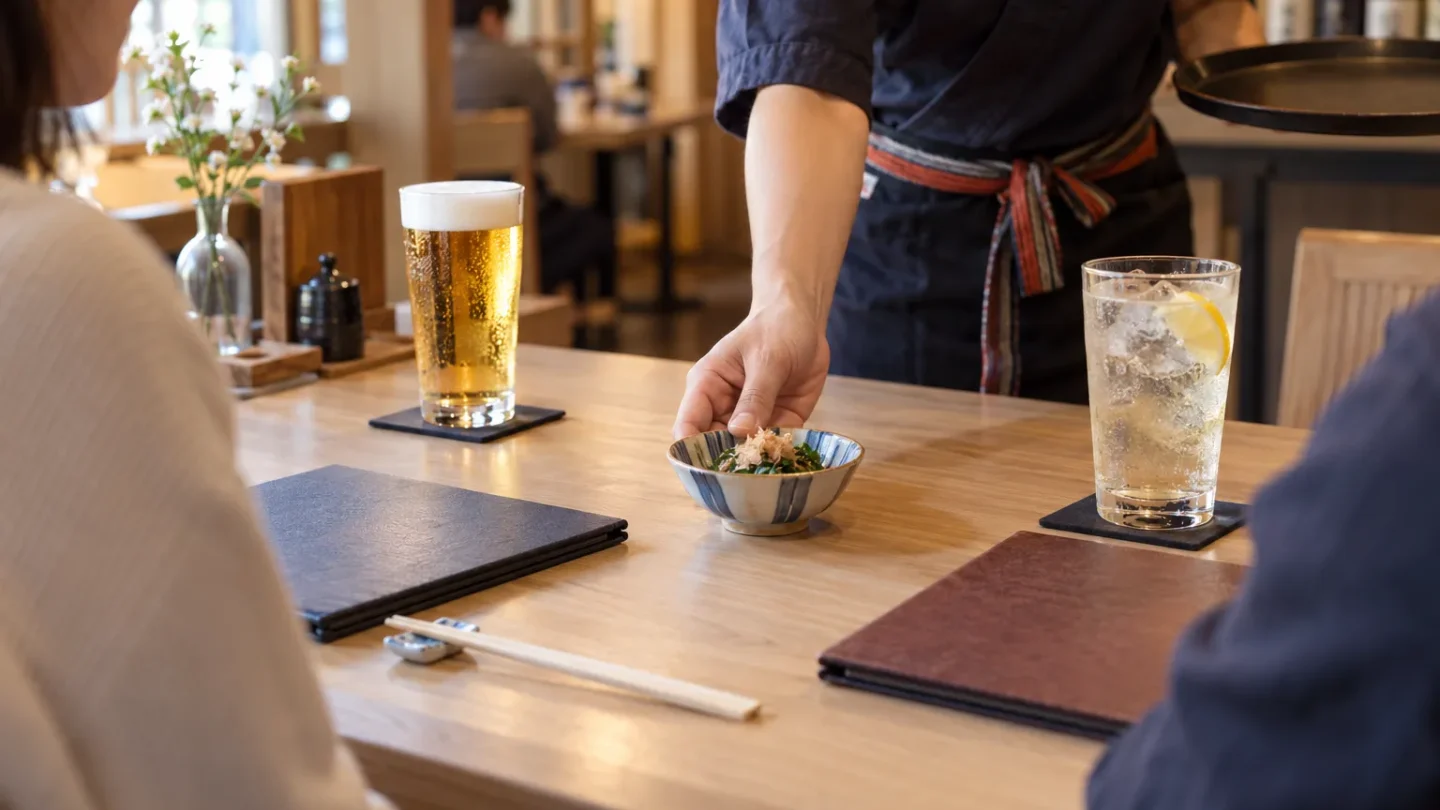
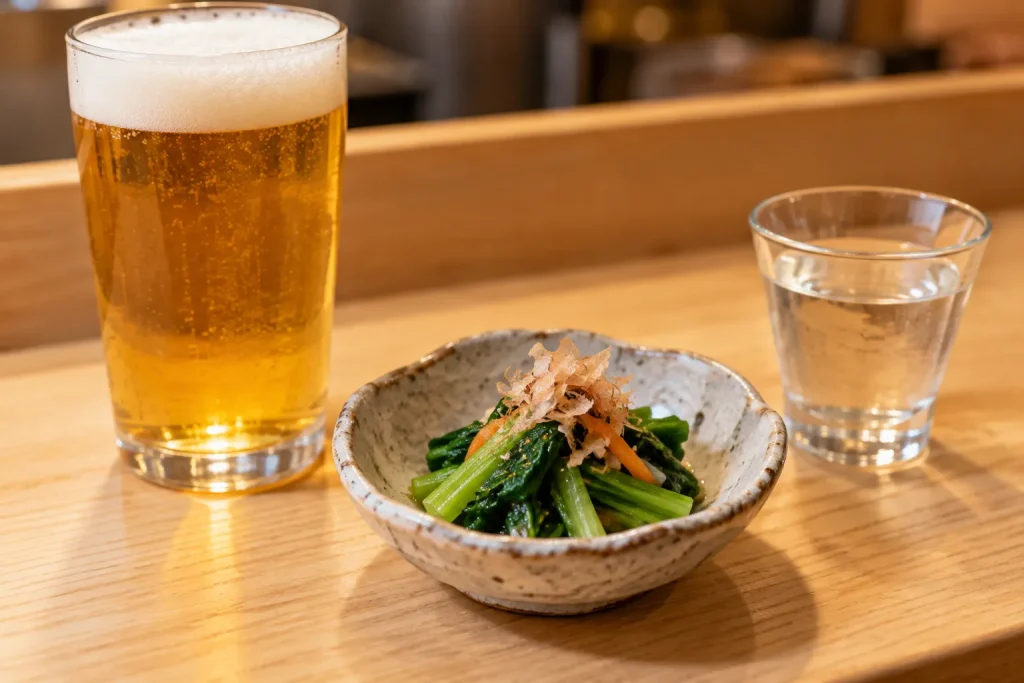
An otoshi charge is common at 居酒屋, izakaya, literally “sake shop where you stay,” meaning a casual drinking establishment that serves shared food. Soon after you sit down, staff place a small prepared dish in front of each diner. You did not select it from the menu, but it normally appears on the bill.
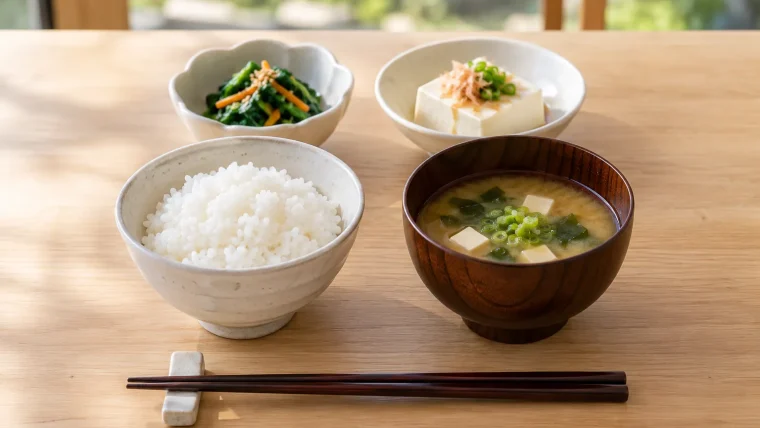
The contents vary. You might receive simmered vegetables, tofu, dressed greens, potato salad, fish, pickles, or another small portion prepared that day. The dish signals that your table is open and gives you something to eat while drinks and ordered food are being prepared.
Calling it a “free appetizer” is inaccurate. Calling every instance a scam is also too simple. In most ordinary izakaya, the plate represents a known house charge, but the customer still needs a reasonable way to learn that the charge exists and what it costs.
The nationwide industry guidance available in 2026 places a typical basic charge around ¥300–¥500 including tax, although individual restaurants can charge less or considerably more. At the September 11 exchange rate, that range is approximately $1.95–$3.25 per person. The menu, booking page, or entrance notice—not the national average—decides what you will actually pay.
For the larger sequence of entering, ordering, eating, and settling the bill, Ordering, Paying and the Rules Nobody States is the main guide. Here, the only question is how to recognize and handle the unexplained first plate.
Should you accept the dish and stay?
Accepting the otoshi is the simplest option. It costs the listed per-person charge, but it lets the meal proceed without negotiation and gives you the ordinary service format that the restaurant has chosen.
This suits you if you deliberately came for an izakaya evening, expect to order drinks and several shared plates, and have already included the charge in your budget. A ¥400 charge—about $2.60—matters less when you plan to spend the evening at the table than when you only want one inexpensive bowl of food.
The uncomfortable part is that the dish may not be something you would have ordered. It can also create a dietary problem. If you avoid meat, fish, shellfish, eggs, or another ingredient, never assume the tiny plate is harmless simply because it looks like vegetables.
Ask before eating:
お通しは何ですか。
Otōshi wa nan desu ka.
“What is the otoshi?”
For an allergy, state the ingredient before accepting the plate. The site’s phrasebook includes 337 phrases, including ordering and allergies, so use the relevant allergy wording rather than relying on “I cannot eat this” after the dish arrives.
Should you ask to decline it?
You can ask, but removal is not guaranteed. Some restaurants will cancel the dish and charge if you decline before eating; others treat the fee as a mandatory seat or service charge attached to every seated customer.
The useful phrase is:
お通しは断れますか。
Otōshi wa kotowaremasu ka.
“Can I decline the otoshi?”
Ask before you settle into the table and before anyone eats the food. If staff say the charge is required, your real choice is to accept the restaurant’s terms or leave politely before ordering. Arguing after finishing the dish gives you a much weaker practical position.
This option suits a solo diner or small group willing to ask a direct question. It also suits someone with dietary restrictions who cannot safely accept an unknown dish. What it costs is a brief conversation and the possibility that the answer will be no.
Do not simply push the untouched plate to the side and assume the charge has disappeared. An uneaten otoshi may still appear on the bill because the fee is connected to occupying the seat, not to how much of the appetizer you consumed.
Should you choose a restaurant without otoshi?
Yes, if price certainty matters more than the traditional izakaya format. Some chains explicitly state that they do not collect either an otoshi fee or a seat charge. Sekai no Yamachan, for example, states on its official menu information that it charges neither, although it requires each customer to order a drink.
A restaurant without otoshi suits families, larger groups, travelers ordering only a small amount, and anyone who dislikes paying for food they did not choose. You give up nothing essential about eating in Japan. You are choosing a different business model, not refusing a cultural obligation.
You can also choose a ramen shop, food hall, casual set-meal restaurant, or counter-service establishment where prices are visible before purchase. At many ramen shops, Paying Before You Sit Down means your order total is settled at a vending machine and no mystery appetizer arrives.
The cost tradeoff is straightforward. A no-charge venue may require a drink, impose a minimum order, or price menu items differently. Check the whole set of terms instead of treating “no otoshi” as automatically cheaper.
| Option | What it costs | What you receive | Best suited to |
|---|---|---|---|
| Accept the otoshi | Usually ¥300–¥500 per person, about $1.95–$3.25 | Seat plus a small prepared dish | A full izakaya evening |
| Ask to decline | Possibly ¥0, if the restaurant agrees | Price clarity; no unwanted plate | Dietary needs or a small order |
| Choose a no-charge venue | No otoshi, but another condition may apply | Predictable bill | Families, groups, strict budgets |
| Leave before ordering | No meal cost if handled immediately | Freedom to choose clearer terms | An undisclosed or unacceptable charge |
Where is the otoshi charge written?
Look at the small print before the food list, near the drink rules, at the bottom of a menu page, or in the reservation conditions. On booking platforms, it may appear under restaurant details rather than beside the dishes.
Search for these terms:
- お通し, otōshi — the small compulsory or customary starter;
- お通し代, otōshi-dai — otoshi fee;
- 席料, sekiryō — seat charge;
- チャージ, chāji — charge;
- テーブルチャージ, tēburu chāji — table charge;
- サービス料, sābisu-ryō — service fee.
These labels can overlap, but they are not perfectly interchangeable. An otoshi fee normally comes with food. A seat or table charge may not. A restaurant can also list more than one type of fee, so never assume that seeing a small plate means there cannot be another charge.
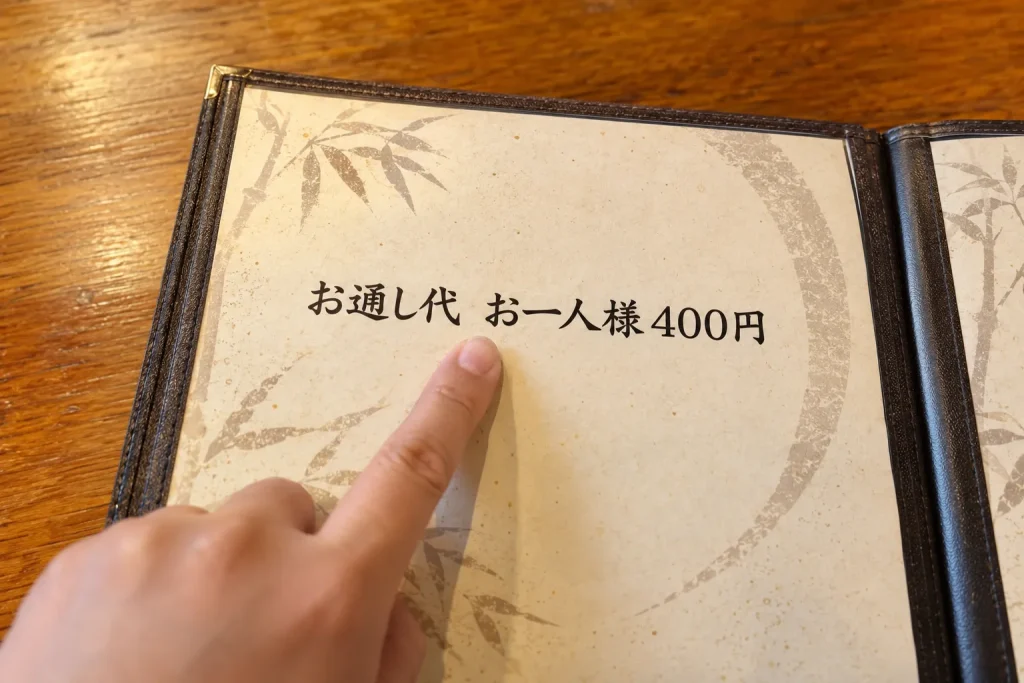
The clearest notice looks like お通し代 お一人様400円, otōshi-dai ohitori-sama yonhyaku-en, meaning “otoshi charge: ¥400 per person.” The words お一人様, ohitori-sama, “per honored person,” tell you to multiply, not divide, the amount.
A menu can also state that the charge applies only after a certain hour or only to customers ordering alcohol. If the condition is unclear, point to the line and ask whether it applies to everyone at your table.
The related article The Small Dish You Never Ordered and Must Pay For follows the otoshi within a complete izakaya ordering sequence. This page focuses on deciding whether that restaurant’s charging model fits your meal.
When does the number of diners change the answer?
The fee is normally calculated per person, so group size is the fastest variable that changes the decision. A small amount on one diner’s bill becomes noticeable when multiplied across a table.
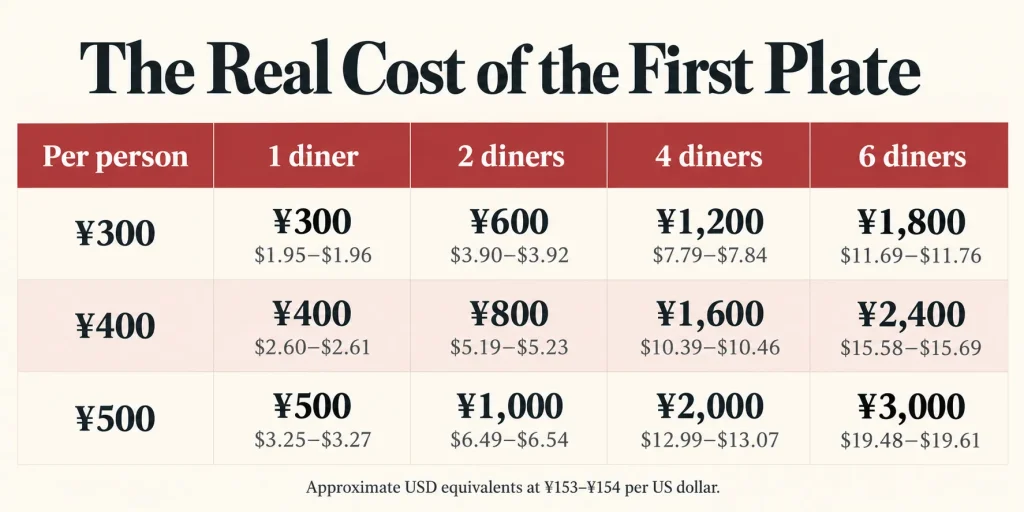
Using the stated ¥300–¥500 typical range:
| Group | At ¥300 each | At ¥400 each | At ¥500 each |
|---|---|---|---|
| Solo diner | ¥300, about $1.95 | ¥400, about $2.60 | ¥500, about $3.25 |
| Two diners | ¥600, about $3.90 | ¥800, about $5.20 | ¥1,000, about $6.50 |
| Four diners | ¥1,200, about $7.80 | ¥1,600, about $10.40 | ¥2,000, about $13 |
| Six diners | ¥1,800, about $11.70 | ¥2,400, about $15.60 | ¥3,000, about $19.50 |
The threshold is not cultural; it is budgetary. If the total charge is small beside the food and drinks you intend to order, accepting it is easy. If the charge approaches the price of another dish your group would prefer, choose a restaurant that discloses a lower fee or no fee.
Children are another reason to ask. Restaurants do not follow one universal national rule on whether every child receives and pays for an otoshi. Confirm the policy for your actual party before sitting rather than assuming that an unused seat is free.
How does your planned order change the choice?
The smaller your intended order, the larger the charge becomes as a share of the bill. A solo visitor who wants one drink and one plate may find a ¥500 otoshi poor value. Someone ordering several rounds of drinks and shared dishes may barely notice the same amount.
Consider three hypothetical profiles using a disclosed ¥400 charge:
- A solo diner plans to order ¥1,600 of food and drinks. Adding one ¥400 otoshi produces a ¥2,000 subtotal before any other disclosed fees. The otoshi is one-fifth of that subtotal.
- Two friends plan to order ¥5,200 together. Two ¥400 charges add ¥800, producing ¥6,000. The increase is meaningful, but each person also receives a small plate.
- A group of four expects ¥12,400 in food and drinks. Four charges add ¥1,600, bringing the subtotal to ¥14,000. The absolute addition is larger even though the group may consider it acceptable for a longer evening.
These are illustrations, not claims about average izakaya spending. The decision turns on your own intended order and the restaurant’s printed charge. Do the multiplication before sitting if the budget is tight.
For help identifying what you might actually order, Japanese Food for Beginners: How to Read a Menu explains common menu categories without repeating the billing rules here.
What if the plate conflicts with an allergy or diet?
Do not eat first and investigate later. Otoshi changes daily in many establishments, so yesterday’s tofu does not prove that today’s dish contains no fish stock, shellfish, egg, or meat.
Say the ingredient clearly and ask whether the dish contains it. If the kitchen cannot confirm safety, ask for the plate to be removed and clarify whether the charge still applies. A restaurant may be able to substitute another item, but it is not safe to assume that it will.
A food preference and a medical allergy are not the same operational request. If cross-contact matters, state that explicitly. The site’s separate guide to vegetarian dining and allergies covers the vocabulary and limits; this article does not turn the otoshi question into a general dietary guide.
Refusing the food does not automatically cancel a mandatory seat charge. Ask both questions: can the dish be replaced, and will the listed fee remain? That gives staff a concrete decision to answer.
What should you check when the bill arrives?
Look for the same Japanese term you saw on the menu. The bill may abbreviate お通し to 通し, or it may use 席料 or チャージ. Count how many units were added and compare that number with the diners covered by the policy.
A normal check follows this sequence:
- Find the charge label.
- Confirm the amount per person.
- Count the charged diners.
- Multiply the fee by that number.
- Ask about any difference before paying.
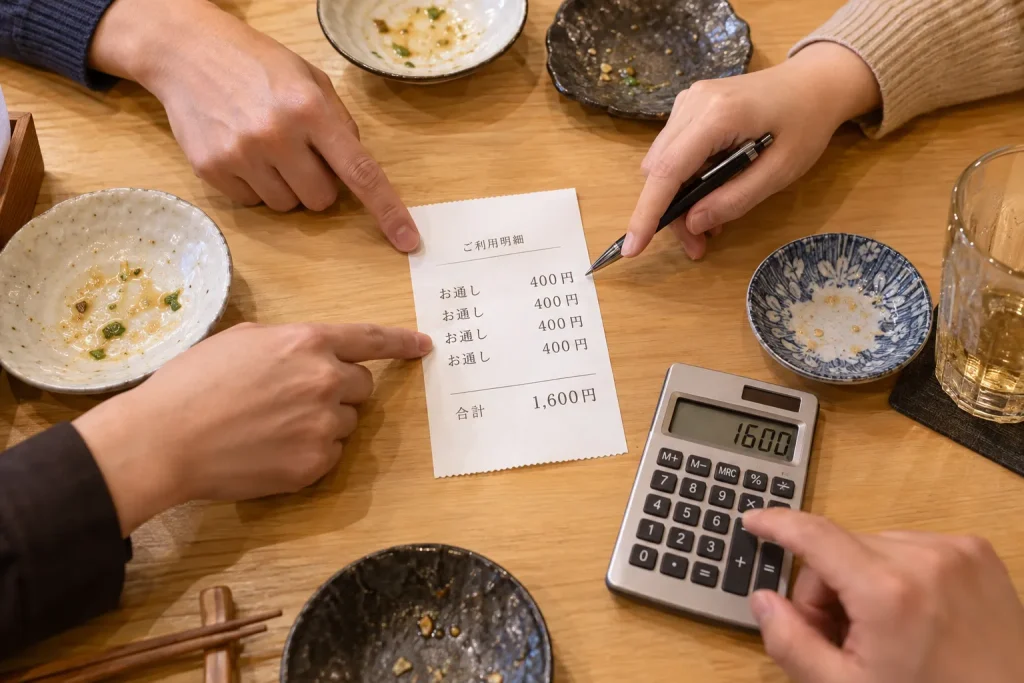
For example, four listed ¥400 charges total ¥1,600. That is not an extra ¥1,600 dish accidentally added to the table; it is four individual charges. If five units appear for four diners, point to the line and ask staff to check.
Keep the question neutral:
この料金は何ですか。
Kono ryōkin wa nan desu ka.
“What is this charge?”
Do not begin by accusing staff of fraud. A calculation error is possible, but an unfamiliar line is not proof of one. Give the restaurant a chance to identify the charge and correct the quantity if necessary.
Which mistakes make the bill feel unfair?
The most common mistake is sitting before checking the small print. Once drinks have been served and the otoshi has been eaten, leaving over the fee is no longer a clean decision.
The second is assuming that unrequested means free. In the American restaurant model, food placed on the table without an order may look complimentary. In an izakaya, the opening plate can be the visible part of a seat charge.
The third is dividing the fee across the table. If the menu says お一人様, the amount applies to each covered person. A ¥500 line for four adults means ¥2,000, not ¥500.
The fourth is assuming every izakaya uses the system. Some do not charge for otoshi at all, while others use a seat charge, table charge, service fee, minimum drink requirement, or a combination. “Izakaya” describes a style of establishment, not one national price contract.
The dish itself also does not guarantee value. A small serving you dislike can still carry the listed fee. That is the uncomfortable bargain: you are partly paying for the table and service format, not freely selecting every mouthful.
How should you decide before sitting down?
Check the entrance menu, digital menu, or booking conditions for izakaya cover charge wording. If nothing is visible, ask お通しはありますか, otōshi wa arimasu ka, “Is there an otoshi?” Follow with いくらですか, ikura desu ka, “How much is it?”
If the answer fits your budget, enter and treat the plate as part of the meal. If the charge is unacceptable, unclear, or unsafe for your diet, decide before ordering. Staff would generally rather receive a clear question at the door than an angry dispute after the table has been used.
The short rule is:
If the fee is disclosed and acceptable, stay and include it.
Otherwise, ask before sitting—or choose another restaurant.
Mini-FAQ
Can you refuse otoshi in Japan?
You can ask, but the restaurant does not have to remove a mandatory seat charge. Ask before eating and preferably before ordering. If staff say the charge applies to every seated customer, decide whether to stay.
Is otoshi always ¥300–¥500?
No. That is a commonly cited 2026 range for ordinary izakaya, not a legal ceiling or national tariff. The restaurant’s current menu determines the price, and some venues charge more or nothing at all.
Is otoshi the same as a table charge?
Not exactly. Otoshi normally includes a small dish, while a seat or table charge may be charged without food. A restaurant may use the terms loosely or list separate fees, so read all charging conditions.
Does every person pay?
Often, but policies for children, nondrinkers, course customers, and other cases differ by establishment. Look for お一人様, meaning “per person,” and ask if you are unsure who is covered.