The most expensive mistake is ordering premium-colored plates while assuming that every dish costs the chain’s advertised base price. To understand kaiten sushi how it works today, start with the price key on your table or touch panel—not with the food moving past you.
回転寿司/かいてんずし, kaiten-zushi, literally “rotation sushi,” is still translated as conveyor-belt sushi. Yet the old picture of customers freely taking everything from a circulating belt is no longer a dependable rule. Following the widely reported tampering incidents in 2023, major chains expanded touch-panel ordering, protected or direct-delivery systems, and camera-based monitoring.
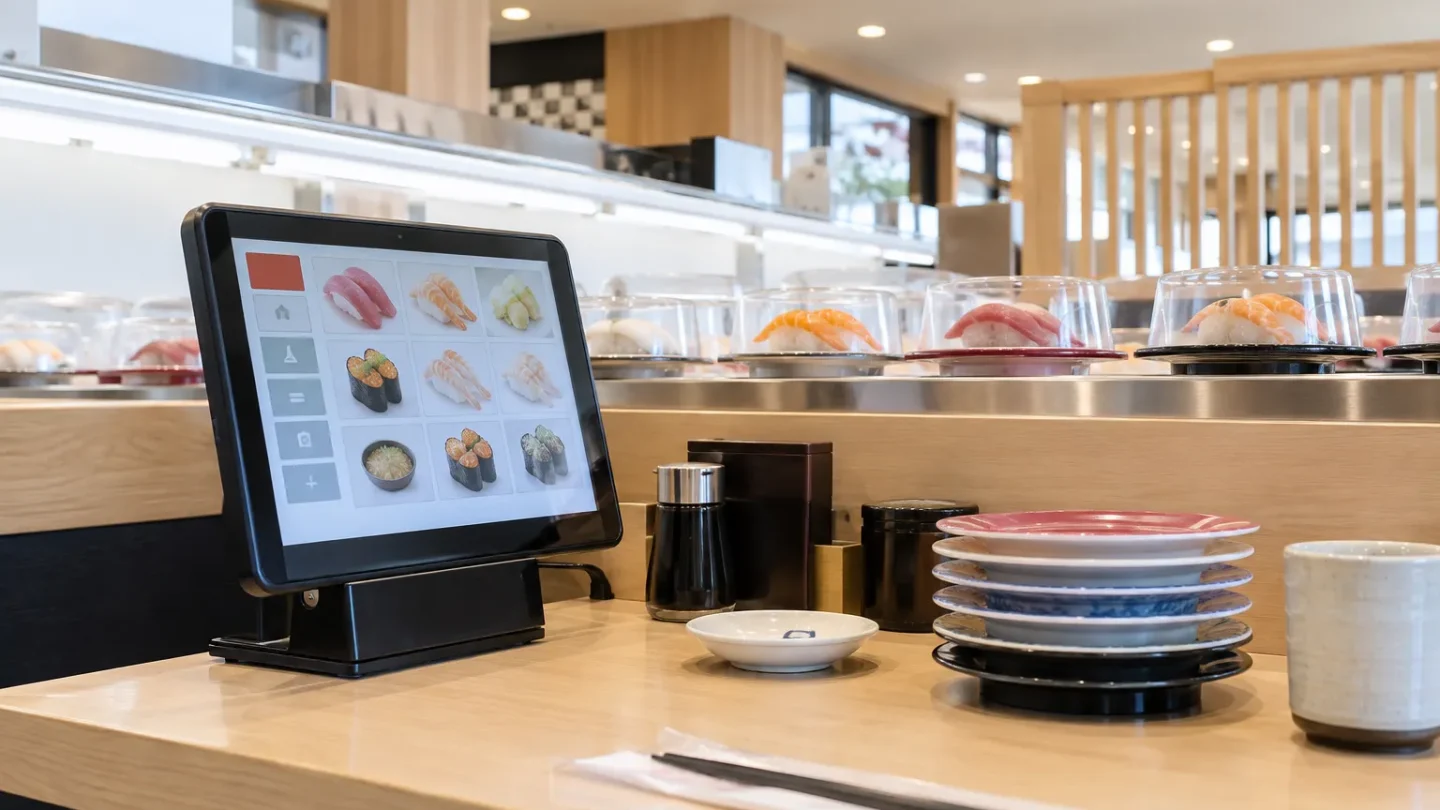
The change is real, but it is not uniform. Kura Sushi still operates a covered circulating system in many restaurants, while Sushiro has introduced デジロー, Dejirō, its digital conveyor display, at selected locations. Other stores rely heavily on made-to-order dishes delivered to your seat. The screen, lane, plate, and checkout method all need to be read together.
The modern belt may be a delivery device, a protected display, a digital screen, or a combination of all three.
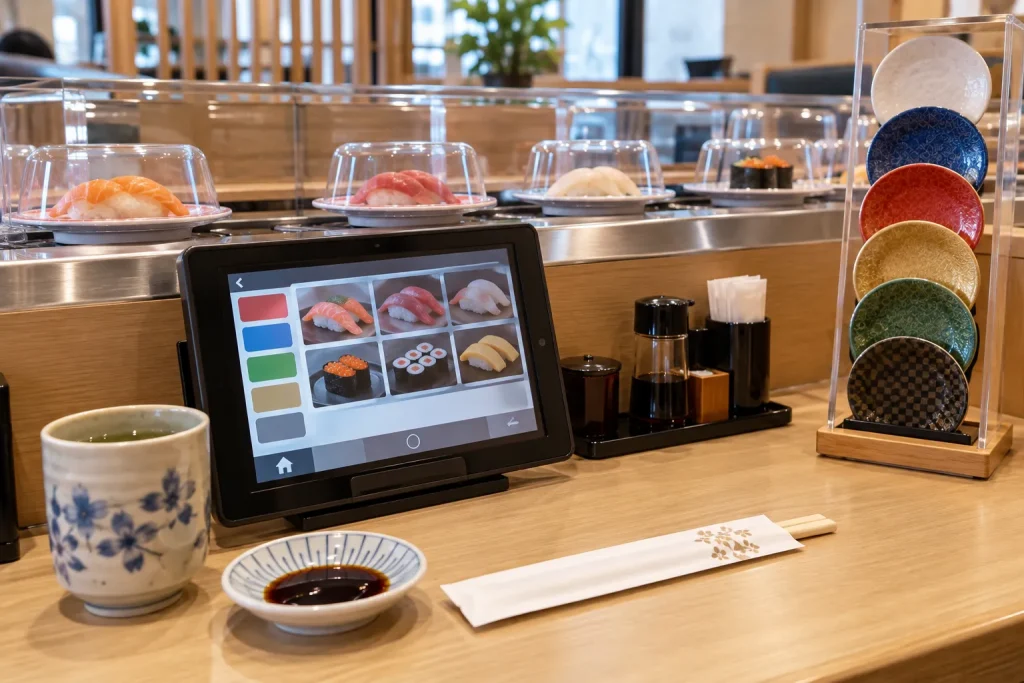
Mistake 1: Believing the Lowest Advertised Price Applies to Every Plate
You see a low starting price outside the restaurant and mentally multiply it by the number of plates you expect to eat. That seems reasonable because conveyor sushi was built around simple per-plate pricing.
The missing word is “from.”
A chain may use several store-price categories, and the same menu can contain base, intermediate, premium, side-dish, dessert, and promotional prices. Kura Sushi’s official menu, checked on September 10, 2026, separated restaurants into four starting-price groups. That alone is enough to show why a national advertisement cannot tell you the exact price at the branch in front of you.
Plate color may encode the charge, but color is not a national standard. A red plate at one chain does not have to cost the same as a red plate elsewhere. Some touch-panel orders also arrive on serving trays while the actual price is shown only on the screen.
| What you see | What it usually indicates | What you must verify |
|---|---|---|
| Basic plate color | Entry-level menu tier | Price at this branch |
| Different color or patterned plate | Higher menu tier | Amount shown on the menu |
| Bowl, cup or separate tray | Side dish or dessert | Item price on the screen |
| Promotional dish | Limited or premium item | Campaign price and availability |
| Two plates beneath one item | Chain-specific presentation | Whether both plates form the charge |
The general restaurant sequence—entering, ordering, calling staff and paying—is covered in Ordering, Paying and the Rules Nobody States. Here, the important point is narrower: the plate is part of the price label, not free tableware.
What to do instead — sushi plate colors: Open the branch-specific price guide before ordering and match every unfamiliar plate to the amount displayed on the touch panel.
Mistake 2: Returning an Unwanted Plate to the Moving Lane
You lift a dish, change your mind and put it back. In a self-service cafeteria, that can feel harmless if you have not touched the food.
At conveyor-belt sushi, removing the plate is the decision. Returning it raises an obvious hygiene problem, and a monitoring or plate-tracking system may already have registered what happened. If the plate reached your table through a dedicated delivery lane, sending it away can also interfere with the restaurant’s order process.
The 2023 incidents made this rule more visible, not newly invented. Videos showing customers interfering with shared food and utensils damaged trust in the entire format. Kura Sushi subsequently publicized an AI-supported camera function designed to detect suspicious plate movement on its lanes.
That does not mean every camera is recording your meal in the same way or that every chain uses identical technology. It means you should assume that the lane is managed equipment, not a toy or a place to undo a selection.
For readers who want the distinction between the rice-based dish and slices of fish served without it, Sushi vs Sashimi: The Difference Is the Rice covers the food terminology without repeating restaurant procedure.
What to do instead — conveyor belt sushi etiquette: Once you remove a plate, keep it at your seat and ask staff for help if there is a genuine problem with the order.
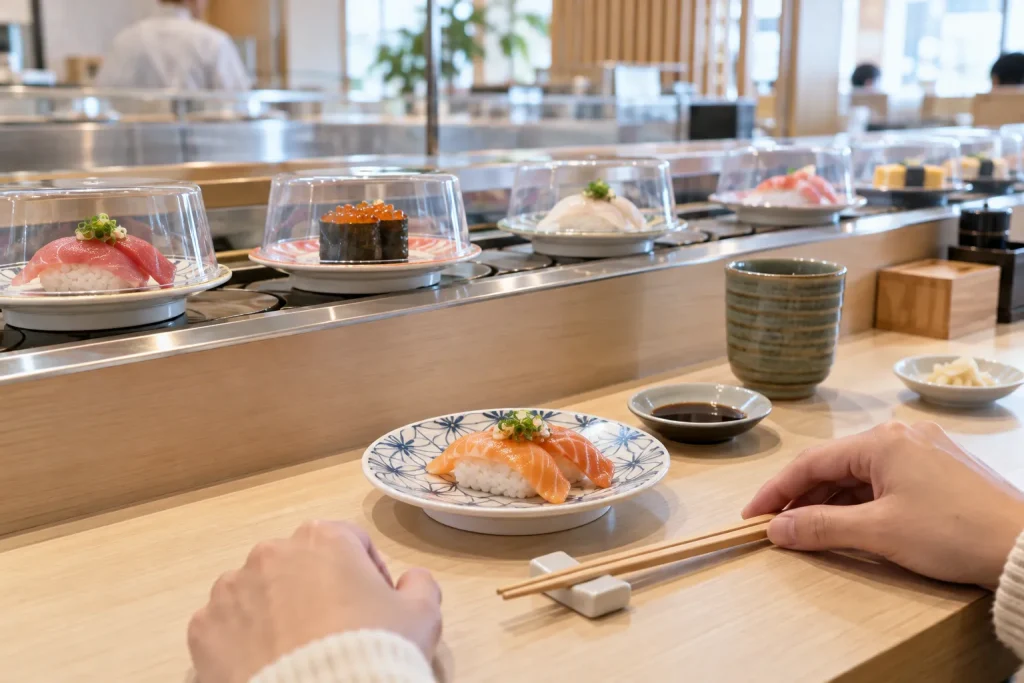
Mistake 3: Taking a Dish That Was Ordered by Another Table
You have researched newer sushi restaurants and know that ordered dishes arrive on a separate lane or marked tray. Then a perfect plate stops in front of you, so you assume it must be yours.
That is the half-informed mistake. Depending on the restaurant, an order may stop at your seat, pass through a shared lane with a table marker, trigger a sound, or appear under an order notice on the screen. A dish merely passing close to you is not proof that it belongs to you.
Taking someone else’s order creates two problems. The other table waits for food that the system may mark as delivered, while your own bill or plate count may no longer match what you ate.
Use the screen as the controlling record. Check the dish name, quantity, arrival notice and table position before lifting anything delivered as a custom order.
| Signal | Likely meaning | Safe response |
|---|---|---|
| Screen shows an arrival message | Your order is approaching or has arrived | Match the item name |
| Tray stops at your seat | Order assigned to your table | Remove only the listed dishes |
| Plate passes without your alert | General circulation or another order | Leave it alone |
| Chime sounds at a nearby seat | Delivery event in your area | Check your own screen |
| Item differs from your order history | Possible delivery error | Call staff |
If the touch panel is difficult to navigate, the phrasebook with 337 phrases, including ordering and allergies is more useful than guessing. It can help you prepare a short request without duplicating the tool inside this article.
What to do instead — touch panel sushi: Take a delivered plate only after its name and arrival notice match the order shown for your table.
Mistake 4: Assuming the Belt Is Still a Fully Open Buffet
The restaurant calls itself kaiten-zushi, so you expect an endless row of uncovered dishes available to anyone. That expectation comes from a real historical model, but it is no longer a safe description of every major-chain restaurant.
After the 2023 scandal, chains did not adopt one universal replacement. Instead, they developed different combinations:
- touch-panel ordering with direct delivery;
- covered plates on a circulating lane;
- cameras that monitor plate movement;
- digital images replacing some physical circulating dishes;
- limited conventional circulation alongside made-to-order service.
Sushiro’s store finder, checked on September 10, 2026, specifically allowed customers to filter for locations offering Dejirō. That proves the digital system is location-dependent rather than a feature that can be assumed at every branch.
The uncomfortable fact is that “conveyor-belt sushi” now describes a restaurant category better than a single operating mechanism. You may sit beside a physical lane and still order nearly everything from a screen.
What to do instead — Japanese sushi restaurant: Spend a moment watching how dishes are delivered at that branch, then follow the instructions shown on its panel.
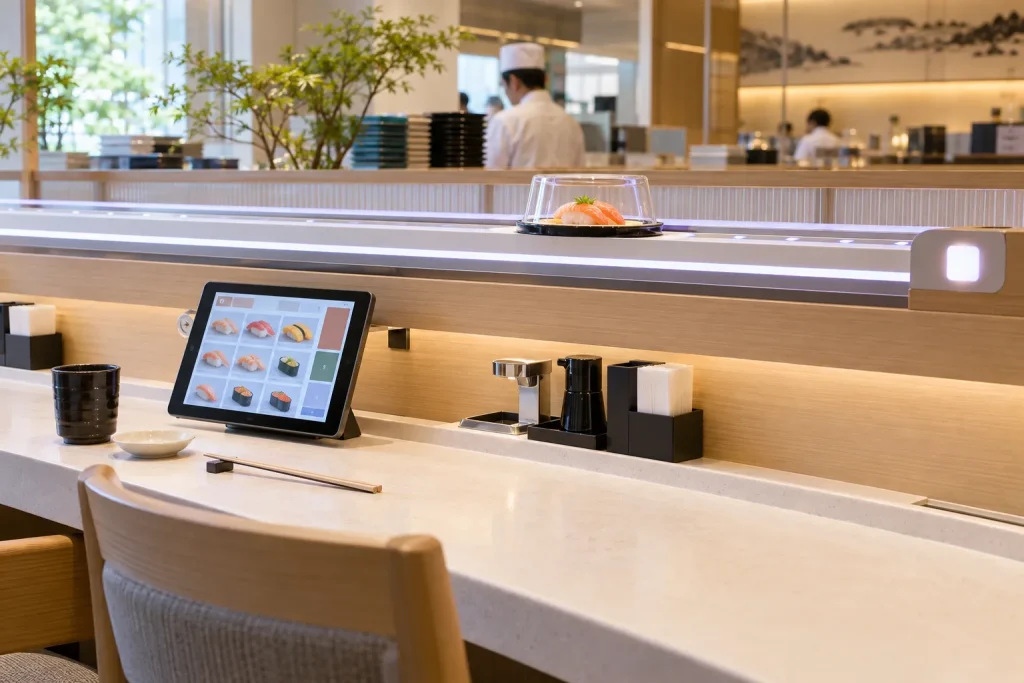
Mistake 5: Using Plate Color Without Reading the Screen
A careful traveler learns that plate color determines the price. The traveler then ignores the digital menu because the color system appears to contain all necessary information.
This is the second half-informed error. The principle is correct, but modern menus complicate it. Prices may vary by restaurant category, temporary campaign, serving format and item. A bowl of noodles or dessert cup does not fit neatly into a stack of colored sushi plates. A special dish may also arrive on a holder that is not the object counted at checkout.
Treat the displayed amount as primary and the plate color as a physical reminder. Before confirming an order, the panel should show the individual price and quantity. Read both, especially when a photograph presents several pieces together.
Japanese Food for Beginners: How to Read a Menu explains the wider menu vocabulary. For this meal, you only need to recognize the item, price, quantity and order button.
What to do instead — kaiten sushi prices: Confirm the amount on the screen first and use the plate color only as a second check.
Mistake 6: Feeding Plates Into the Wrong Checkout System
You finish eating and begin reorganizing the plates. Perhaps you place them back on the delivery tray, carry them toward the register, or insert them into a slot because you saw that system at another chain.
Restaurants count plates differently. Staff may scan or count a stack at the table, tagged plates may be read electronically, or the table may have a plate-return slot. At Kura Sushi, the return slot is integrated into the chain’s table system, but that does not make it standard elsewhere.
This matters because your used plates are part of the bill. Hiding one under a bowl, moving plates to another table or sending them into an unfamiliar opening can complicate the count.
Keep plates visible and separated from bowls or cups until you understand the branch’s method. If there is a return slot, insert only the items the instructions identify as acceptable. Cups, chopsticks, bowls and serving hardware do not automatically belong there.
What to do instead — sushi plate counting: Leave used dishes at your place until the table instructions or staff make the counting method clear.
Mistake 7: Treating Shared Condiments as Part of the Entertainment
Hot-water taps, tea powder, soy sauce, ginger and condiment containers make the table look self-contained. A first-time visitor may experiment with everything before deciding what to use.
The equipment is functional and shared. The hot-water tap can release very hot water, while communal containers must remain clean for the next customer. Never touch a bottle opening, return used food to a container, place chopsticks into shared ginger, or interfere with food traveling on the lane.
The cultural rule is not elaborate: handle shared items only in the way required to serve yourself. The post-scandal cameras do not replace that responsibility.
Do not assume that dietary needs can be solved by visually inspecting a passing plate. Ingredients, sauces and shared preparation areas are separate questions. Use the panel’s official allergen information and ask staff when the consequence of a mistake matters.
The restaurant may look casual, but allergies are not a casual translation exercise.
What to do instead — sushi restaurant rules: Use shared equipment only for its stated purpose and ask staff about ingredients instead of relying on appearance.
Mistake 8: Walking to the Register Before Closing the Table
You finish the last plate and head for the exit register. This resembles paying at many American casual restaurants, but some Japanese chains require a checkout request or table-confirmation step first.
The touch panel may have a 会計/かいけい, kaikei, “check or account,” button. Pressing it can call staff, finalize the plate count or produce the information needed at a self-checkout machine. Leaving the table before that process is complete can mean walking to the register without a finalized bill.
This differs from a ramen shop where you often pay at a machine before sitting down. Paying Before You Sit Down explains that separate system. It also differs from an izakaya, where The Small Dish You Never Ordered and Must Pay For explains why an automatic appetizer appears on the bill.
At conveyor sushi, the practical sequence is:
- Stop ordering.
- Check the order history.
- Keep all countable dishes visible.
- Select the checkout command.
- Follow the table or staff instructions.
- Take the issued check or table code to the payment point if required.
What to do instead — conveyor sushi checkout: Finalize the meal at the table before approaching the register or payment machine.
One Habit That Prevents Nearly Every Mistake
Read the screen before touching the lane.
That habit prevents you from taking another table’s dish, ordering the wrong quantity, overlooking a premium price, returning food to circulation, or arriving at checkout before the bill is ready. It also solves the central problem with old advice: restaurant systems now differ by chain and sometimes by branch.
A plate still carries information. Its color may identify a price tier, its position may show whether it is circulating or specially delivered, and its final location may determine how it is counted. But the plate is no longer the whole interface.
The touch panel tells you what the branch is doing today.
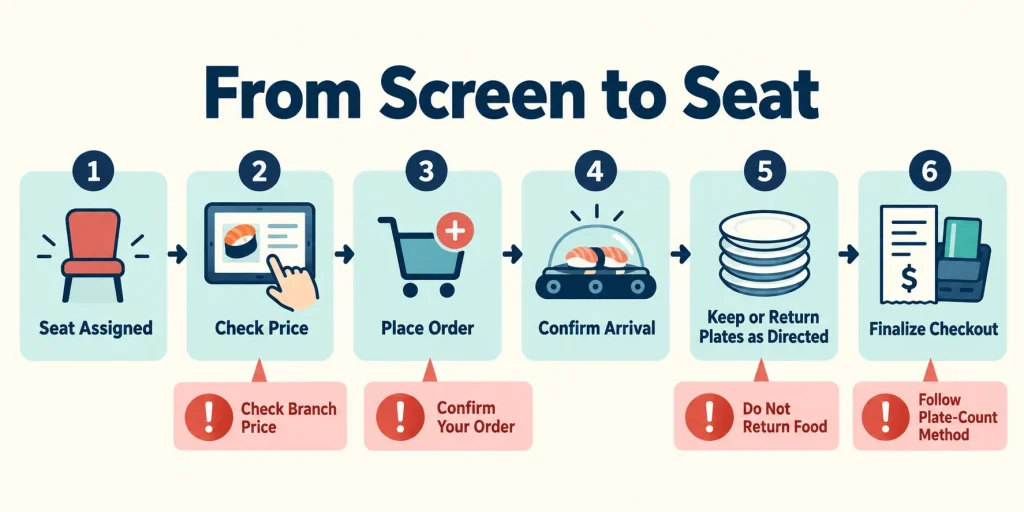
Data shown:
| Stage | Customer action | System signal | Main error prevented |
|---|---|---|---|
| Entry | Accept assigned seat | Table number or panel activation | Sitting at an unassigned place |
| Price check | Open branch menu | Item price and plate tier | Assuming one universal price |
| Order | Confirm item and quantity | Order-history entry | Duplicate dishes |
| Delivery | Wait for arrival notice | Sound, message or stopped tray | Taking another table’s food |
| Eating | Keep accepted plates | Visible stack or return system | Incorrect plate count |
| Checkout | Select 会計/kaikei | Bill confirmation | Reaching the register too early |
Frequently Asked Questions
Do sushi plates still circulate after the 2023 scandal?
At some restaurants, yes. Kura Sushi continues to use covered circulating plates, while other restaurants emphasize touch-panel orders and direct delivery. Sushiro’s Dejirō system is available at selected branches rather than universally. Check the system at the restaurant you enter.
Are cameras installed at every conveyor-belt sushi restaurant?
No verified primary source supports that universal claim. Kura Sushi publicly introduced an AI-supported monitoring function after the 2023 incidents, but chains use different equipment. Ordinary security cameras, plate-tracking cameras and AI detection systems should not be treated as interchangeable.
Does every plate color have the same price across Japan?
No. Colors and prices are chain-specific, and some chains divide branches into different price categories. The touch panel or price guide at your restaurant is the controlling source.
Can I take anything that passes my seat?
Only if it belongs to general circulation or is clearly identified as your order. Do not remove a dish marked for another table.
What if I take the wrong plate?
Keep it at your table and call staff. Do not put it back on the circulating or delivery lane.
Should I place empty plates into a slot?
Only where the restaurant provides a plate-return system and its instructions say to do so. At other restaurants, leave plates stacked for counting.
How do I ask for the bill?
Look for 会計/かいけい, kaikei, “check,” on the touch panel. The next step may involve staff, a printed check, a table code or a self-payment terminal.