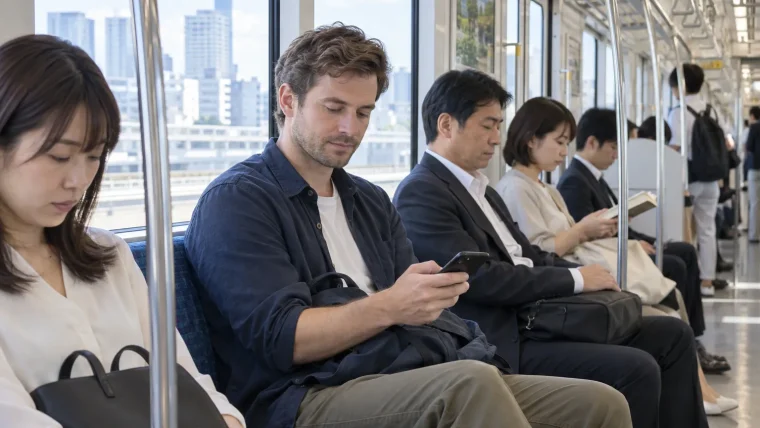
Japanese does not offer a single word that safely replaces English “you” in every conversation. If you are learning how to address someone in Japanese, the pattern repeats throughout an ordinary day: omit the person entirely when the meaning is clear, use a surname or title when you know it, and begin with すみません, sumimasen, literally “it is not finished,” when you need a stranger’s attention. あなた, anata, literally “that person over there,” is grammatically correct, but it does not function like a universal polite pronoun. Depending on the relationship and tone, it can create distance, sound pointed, or carry an intimacy that you did not intend.
The safest replacement for “you” is often not another pronoun. It is the person’s name, their role, or no form of address at all.
Early morning: names and titles at work
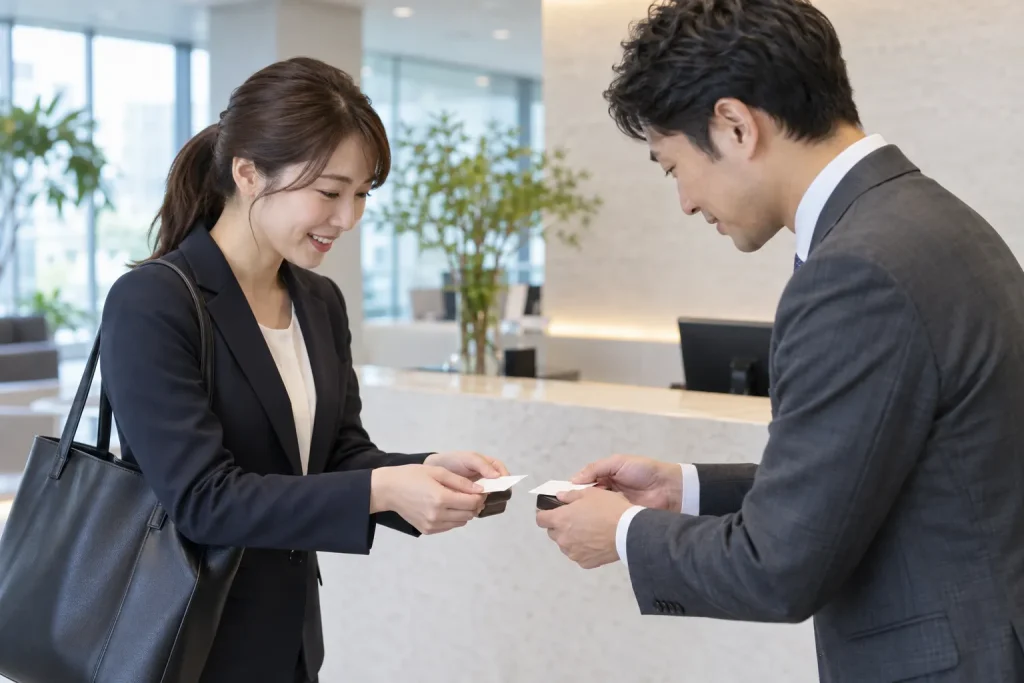
At the start of a workday, Japanese colleagues usually address one another by surname plus さん, san, an honorific without an exact English equivalent. If you meet 田中美咲, Tanaka Misaki, calling her 田中さん, Tanaka-san, is normally safer than calling her anata. A job title may replace the surname when the role is established: 部長, buchō, “department manager,” or 店長, tenchō, “store manager,” can work as direct forms of address. A combined form such as 田中部長, Tanaka-buchō, is also common in workplaces, although individual companies develop their own habits. Before copying a phrase from a textbook, remember that Politeness Is a System, Not a List of Words explains the larger rule: the appropriate expression depends on relationship, setting, and direction of respect.
English encourages speakers to repeat “you” because most requests need an explicit subject. Japanese regularly leaves that subject unspoken when everyone knows who is being addressed. Instead of “Did you check the document?” a colleague can ask 書類、確認しましたか, shorui, kakunin shimashita ka, literally “document, checked?” The missing pronoun does not make the sentence vague in a face-to-face conversation. In fact, inserting anata may make the question feel more accusatory, like stressing “Did you check it?”
| Workplace situation | Natural choice | Form to treat cautiously |
|---|---|---|
| You know the coworker’s surname | 田中さん, Tanaka-san | あなた, anata |
| You address a manager | 部長, buchō, or surname plus title | First name without permission |
| You speak directly in a meeting | Omit the subject when clear | Repeating a second-person pronoun |
| You are unsure of local custom | Listen to how colleagues address the person | Guessing an intimate nickname |
Midmorning: the clerk you do not need to name
A convenience-store or department-store clerk does not usually require a direct label. You can begin with すみません, sumimasen, and follow it with your question: すみません、これはいくらですか, sumimasen, kore wa ikura desu ka, literally “excuse me, as for this, how much is it?” This works because sumimasen opens the interaction while kore, “this,” identifies the object. You do not need to manufacture a Japanese equivalent of “Excuse me, can you tell me how much this is?” The article The Word You Will Use Fifty Times a Day covers the word’s overlapping uses for attention, apology, and acknowledgment.
You may hear 店員さん, ten’in-san, “store clerk plus honorific,” but it is not a universal substitute for “you.” It is useful when referring to a clerk and can be used to get someone’s attention in some casual settings, yet a plain sumimasen is usually smoother for a visitor. お姉さん, onē-san, literally “older sister,” and お兄さん, onī-san, literally “older brother,” are sometimes applied socially to younger adults who are not relatives. These expressions depend heavily on perceived age, speaker identity, and local tone. If you guess wrong, the effort to sound friendly can become more noticeable than simply saying sumimasen.
Noon: calling a waiter without saying “you”
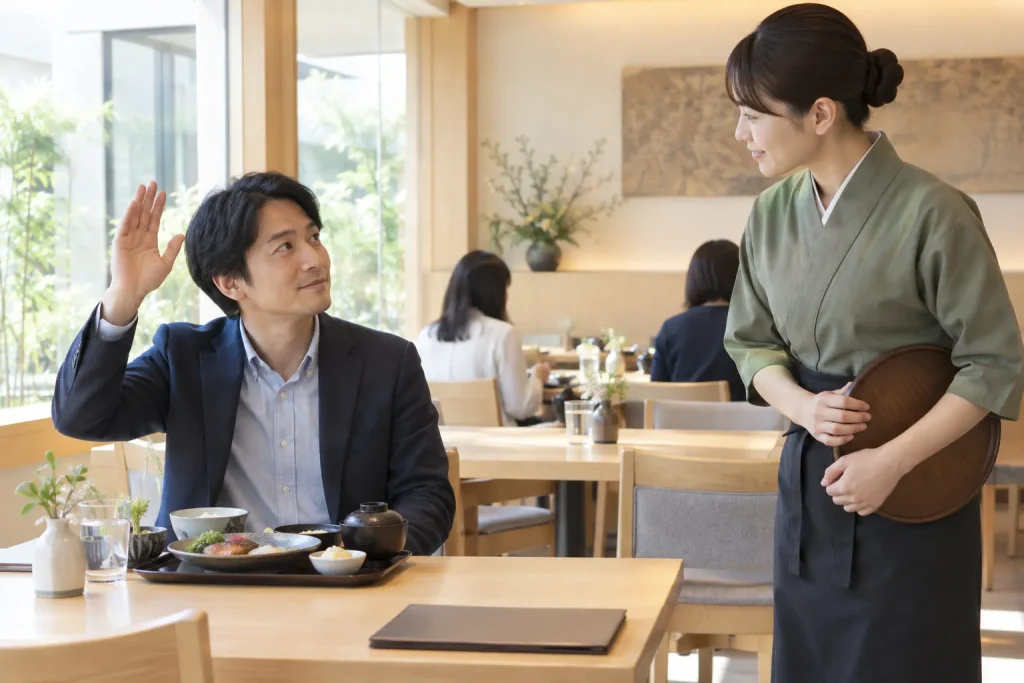
At lunch, getting a server’s attention follows the same pattern. Say すみません, sumimasen, clearly enough to be heard, wait for acknowledgment, and then make the request. A practical sequence is すみません。お水をお願いします, sumimasen. Omizu o onegai shimasu, literally “excuse me; water, request.” In many restaurants, this is more natural than a sentence built around “Could you bring me water?” For complete ordering sequences, Essential Japanese Phrases for Travelers provides the travel essentials without turning each request into a grammar lesson.
A few compact patterns cover most moments in which an English speaker expects to use “you.” The point is not to memorize increasingly elaborate substitutes. You are learning to identify the social role and then say only what the interaction requires. These forms are practical rather than magically polite. Tone, timing, and the burden of the request still matter.
- すみません, sumimasen — use it to open contact with a waiter, clerk, or stranger.
- 田中さん, Tanaka-san — use a known surname plus an appropriate honorific.
- 先生, sensei, “teacher or recognized professional” — use it for a teacher and commonly for a physician.
- 部長, buchō — use an established workplace title when that is the local norm.
- あの, ano, literally “um” or “well” — use it as a hesitation before a polite question, often after sumimasen.
- No address at all — ask the question directly when eye contact and context already identify the listener.
Afternoon: asking a stranger for help
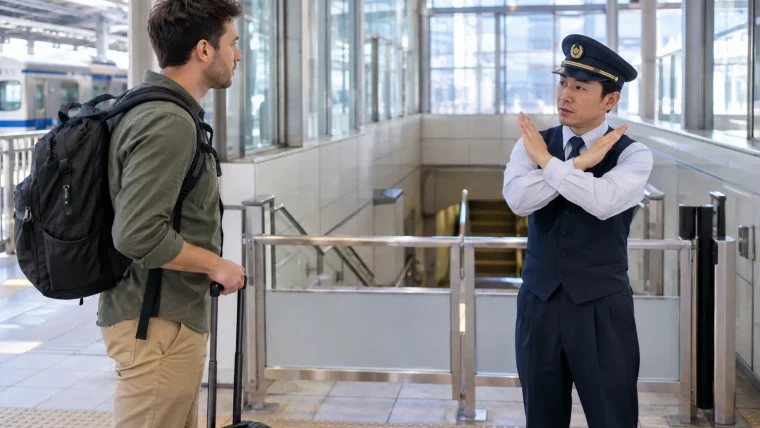
On a station platform, すみません、東京駅はどちらですか, sumimasen, Tōkyō-eki wa dochira desu ka, literally “excuse me, as for Tokyo Station, which direction is it?” is complete without “you.” You can use the same opening when asking whether a seat is free, where a line begins, or which train to take. The listener is obvious because you are looking at and speaking to that person. Adding anata does not make the question more respectful. It merely marks the addressee more explicitly than the situation requires.
If you need several ready-made lines, the phrasebook contains 337 phrases across 25 situations, with separate entries for stations, shopping, restaurants, and trouble. That number describes the tool as checked on September 12, 2026; it is not a claim about how many phrases a traveler needs to memorize. Start with situations instead of collecting “polite words” in isolation. A phrase that works at a ticket window may be oddly distant among friends. A casual form copied from entertainment can be offensive when aimed at an employee or stranger.
| Person or setting | Best opening | What follows |
|---|---|---|
| Stranger in a station | すみません, sumimasen | Your destination or question |
| Clerk behind a counter | すみません, sumimasen | Point to the item and ask |
| Teacher | 先生, sensei | The question or request |
| Coworker whose name you know | Surname plus さん, san | The work-related question |
| Person already speaking with you | Often nothing | Continue the sentence |
| Person whose name you missed | すみません、お名前は…, sumimasen, onamae wa… | Politely ask or confirm the name |
Late afternoon: when anata changes the temperature
The uncomfortable fact is that anata is not simply “rude,” and any rule claiming that it is always forbidden is also wrong. Dictionaries may present it as a neutral second-person pronoun, and it appears naturally in writing addressed to an unspecified reader, including questionnaires, instructions, advertising, and public information. In direct conversation, however, its meaning is shaped by status and distance. Used toward a superior or a person whose name you know, it can sound detached, corrective, or condescending. This is why translating the English pronoun mechanically produces speech that is grammatical but socially miscalibrated.
At the other end of the scale, anata can be intimate. It has been used between spouses, particularly as a wife’s form of address for her husband, with a sense resembling “dear.” That does not make it a useful romantic phrase for every couple, and contemporary usage varies by household, generation, and personal style. The same sound can therefore point toward emotional closeness in one scene and marked distance in another. There is no contradiction: both uses make the relationship more visible than an omitted pronoun would.

Evening: the phrases that become risky when copied
The alternatives to anata are not a ladder on which every lower rung is friendlier. 君, kimi, “you,” may sound affectionate between close people, but it can also position the speaker above the listener. お前, omae, “the person in front,” appears frequently in fiction, arguments, sports teams, and relationships with established familiarity. Used by a visitor toward a stranger, it can sound rough or insulting. あんた, anta, a contracted form of anata, can express familiarity, irritation, or contempt depending on delivery.
Avoid learning these forms as colorful upgrades to ordinary conversation. Entertainment relies on language that reveals personality, conflict, hierarchy, and intimacy quickly, which is exactly why it is risky to imitate without the same relationship. The practical distinction is not “formal word versus casual word.” It is whether you have the social permission to define the other person that directly. If you do not know, return to the name, title, sumimasen, or omission.
The same principle applies to thanks. ありがとう, arigatō, “thank you,” does not become suitable merely because a dictionary gives the correct translation. Arigatou Literally Means This Rarely Happens explains how gratitude is adjusted to the relationship and the weight of what someone did. For a broader comparison of registers, Japanese Politeness Levels, and Which One to Use covers the forms instead of repeating them here. Address terms and verb forms work together, so choosing a title does not rescue a demand delivered in an abrupt tone.
The quiet moments: when nobody needs a label
Much of a Japanese conversation passes without any explicit equivalent of “you.” Once two people are engaged, questions such as 大丈夫ですか, daijōbu desu ka, literally “is it all right?” and どう思いますか, dō omoimasu ka, literally “how think?” identify the listener through context. This is not mysterious mind-reading. English also drops information when it is obvious, as in “Coming?” instead of “Are you coming?” Japanese simply allows omission in more grammatical positions and uses it more routinely.
There is no daily period when special address rules activate, and there are no movable dates for this subject in 2026 or 2027. The day structure in this article maps recurring encounters, not a national calendar. Morning, noon, and evening do not change the grammar; the relationship and setting do. The quiet stretch is therefore most of the day: if the person is already looking at you and your question is clear, nothing needs to replace “you.” Plan to learn names and roles, and avoid treating anata as a politeness switch.
A compact rule for the whole day
When you know a surname, use the surname with the appropriate honorific. When a professional title is conventional, use the title. When you need an unknown person’s attention, say sumimasen and ask the question. When the listener is already clear, omit the form of address. Use anata only after you understand why it fits that specific relationship or impersonal type of writing.
The useful habit is to stop translating “you” before building the Japanese sentence. First ask whether the listener must be named at all. If the answer is yes, choose the name or social role that both people recognize. If the answer is no, move directly to the object, place, or action. That small pause will make your Japanese sound more natural than replacing every English pronoun with a supposedly polite equivalent.
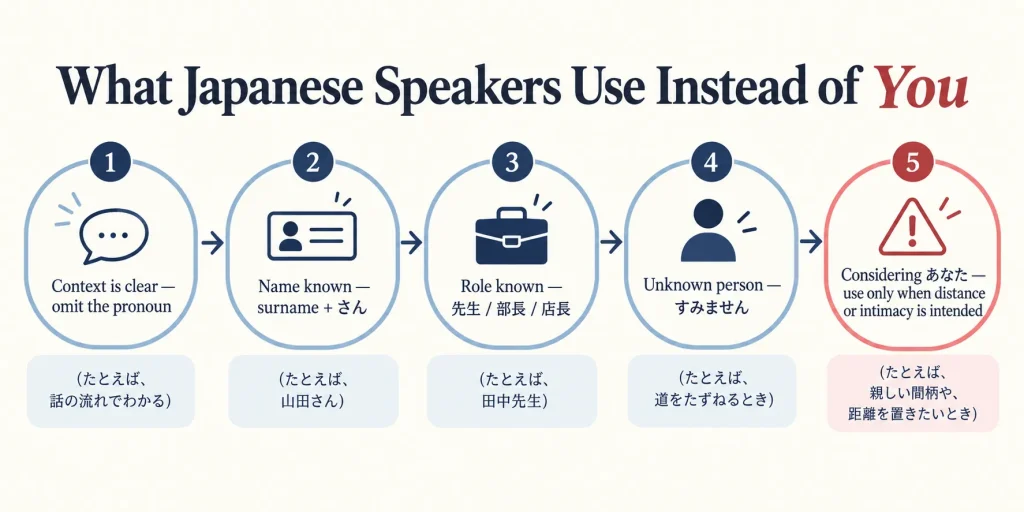
| Decision point | Label shown in the graphic | Recommended action |
|---|---|---|
| The listener is already obvious | Context is enough | Omit the pronoun |
| You know the surname | Name known | Use surname plus さん |
| The role is conventional | Title known | Use 先生, 部長, 店長, or the appropriate title |
| You need a stranger’s attention | No name available | Start with すみません |
| You are considering あなた | Relationship unclear | Do not use it automatically |
| The relationship licenses it | Distance or intimacy intended | Use only with contextual confidence |
Mini-FAQ
Is anata polite Japanese?
It can occur in polite sentences, but it is not a universally polite way to address another person. In direct speech, it may mark distance, emphasize the listener, or sound condescending when used toward someone of higher status. In other contexts, especially impersonal writing, it can be neutral. It may also express intimacy between spouses or partners. Treat it as a relationship-sensitive word, not as the automatic translation of “you.”
What should I call a waiter in Japan?
Begin with すみません, sumimasen, and then state your request. You normally do not need a noun meaning “waiter,” a name, or a second-person pronoun. Speak clearly, but do not shout across the room if you can first make eye contact or raise a hand slightly. A call button may be available at the table in some restaurants. The natural wording depends more on how you request the item than on what you call the server.
What if I cannot remember a coworker’s name?
Avoid substituting anata merely because the name has escaped you. You can omit the address term if the person already knows you are speaking to them. If the name matters, apologize and ask again rather than inventing a title. Business cards, seating charts, email signatures, and introductions can help you confirm the correct reading. Once confirmed, use the surname and the title or honorific customary in that workplace.