
The words you will hear are はい (hai), ええ (ee), うん (un), そうですか (sō desu ka), and なるほど (naruhodo). They appear while someone else is still talking—in a hotel conversation, over dinner, at work, and on the telephone. Aizuchi Japanese listening is the habit of supplying short signals that say, “I am here, and I am following you.”
The proposed rule that these signals land every two or three seconds is too exact. Published studies report different rates for different situations: one cited an average interval of 6.1 seconds in telephone conversations and 9.6 seconds in television interviews. The useful lesson is not to run a timer but to respond several times during a long turn instead of waiting in complete silence.
Aizuchi also does not automatically mean agreement. はい can confirm that you heard a statement while leaving your opinion completely open. That is the trap: an American hears “yes,” but the Japanese speaker may only be saying, “I am still with you.”

What aizuchi Japanese listening actually asks you to do
English speakers use backchannels too: “uh-huh,” “right,” “I see,” and a nod all perform similar work. Japanese conversation usually makes this listener activity more frequent and more visible. The speaker does not necessarily wait for the end of a sentence before receiving it.
You should not interrupt with a new idea. Instead, place a short response at a natural boundary: after a clause, a small pause, a completed detail, or a change in the story. Your voice should be brief enough to support the speaker rather than claim the floor.
A practical pattern is:
- Nod as the speaker begins developing a point.
- Use はい or ええ after a short clause.
- Use そうですか when the speaker supplies new information.
- Use へえ or 本当ですか only when genuine surprise fits.
- Let the speaker continue without adding your own story immediately.
The response belongs inside the speaker’s turn, but it must not compete with that turn.
This behavior is part of a larger system. Politeness Is a System, Not a List of Words explains how timing, hesitation, apology, and attention shape politeness before formal vocabulary enters the conversation.
| Situation | Useful response | What it signals | What it does not guarantee |
|---|---|---|---|
| Someone explains a process | はい, ええ | I am following | I agree with the process |
| Someone gives new information | そうですか | I received that information | I approve |
| A friend tells a story | うん, へえ | Keep going | I want to take the floor |
| Someone makes a strong claim | なるほど | I see the reasoning | You have persuaded me |
| You receive instructions | わかりました | I understood and will act | The request is convenient |
| Someone confirms your memory | そうそう | That is the point | Everything else is correct |
相槌 — aizuchi — alternating hammer blows
相槌 (aizuchi) literally refers to alternating hammer strikes. The image comes from two smiths working in rhythm, one striking after the other. In conversation, the listener’s brief responses keep a similar rhythm without becoming a second speech.
You meet the term in language classes, workplace training, and discussions of Japanese conversation etiquette. You rarely need to say the word during an ordinary trip; you need to perform the behavior.
The common mistake is calling every short Japanese response an interruption. An interruption tries to take control of the conversation. Aizuchi normally tells the current speaker to continue.
A second mistake is repeating one sound mechanically. A sequence of identical はい responses delivered at the same pitch can sound nervous, impatient, or rehearsed. Variation matters more than speed.
はい — hai — yes, present, or acknowledged
はい (hai) is usually translated as “yes,” but its literal conversational job is broader: present, acknowledged, or heard. You meet it when staff call your name, when someone explains a rule, during telephone conversations, and when a clerk checks whether you understand.
The trap is hai meaning Japanese yes. In the middle of another person’s explanation, はい often confirms reception rather than consent. A Japanese colleague can say はい throughout a proposal and disagree after the explanation is complete.
Context separates the meanings:
- After “Are you Mr. Carter?” it can mean “Yes.”
- During instructions, it can mean “I’m following.”
- When your name is called, it means “Present” or “Here.”
- Before a refusal, it may simply acknowledge the question.
- Said once with a firm falling tone, it can confirm a decision.
A study of Japanese listening behavior quoted an advanced learner describing aizuchi as “a response showing that the listener is listening.” That is the safest interpretation of mid-sentence はい unless the speaker later confirms agreement.
This distinction also explains why direct dictionary substitutions often fail. Arigatou Literally Means This Rarely Happens examines another familiar word whose cultural weight is larger than its standard English translation suggests.
ええ — ee — yes or uh-huh
ええ (ee) literally means yes, but during a conversation it often works closer to “uh-huh.” You meet it in polite but relaxed exchanges between adults, especially when one person is telling a story or explaining background.
The common mistake is hearing it as hesitation because the vowel is drawn out. In fact, ええ can be a warm, attentive response. It is softer and less official than a crisp はい.
As a visitor, you can use はい almost anywhere. Use ええ after you have heard native speakers establish a relaxed tone. Avoid filling every pause with it, because exaggerated frequency can sound like imitation rather than attention.
うん — un — yeah
うん (un) literally functions as an informal “yeah.” You meet it among friends, family members, classmates, partners, and adults speaking comfortably with children.
The mistake is using it with hotel staff, an older stranger, or someone you have just met. The problem is not the sound itself; it is the relationship that the sound assumes. うん places you inside a casual register.
If you are uncertain, use はい or a nod. Japanese Politeness Levels, and Which One to Use covers the difference between casual, polite, and formal speech. The short answer for travelers is to live in the polite middle.
Friends sometimes repeat the sound as うんうん (un un). This usually adds attentive warmth, but copying the double form in a formal exchange can sound overly familiar.

そうですか — sō desu ka — is that so?
そうですか (sō desu ka) literally means “Is that so?” You meet it when someone tells you something new: a restaurant is closed, a train route has changed, or a friend has moved to another city.
The mistake is giving it the suspicious English tone of “Is that so?” In Japanese, it often expresses neutral reception rather than doubt. Tone changes everything: a gentle fall sounds understanding, while a sharp rise can sound genuinely surprised.
This is one of the safest common aizuchi for travelers because it does not claim agreement. It tells the speaker that the information has landed. Then you leave enough space for the explanation to continue.
The casual version is そうか (sō ka), but it can sound blunt outside the right relationship. そうなんですね (sō nan desu ne) adds a warmer sense of “Oh, so that is how it is.”
そうですね — sō desu ne — that is so, isn’t it?
そうですね (sō desu ne) literally means “That is so, isn’t it?” You meet it both as a listening response and at the beginning of an answer.
The mistake is assuming it always means agreement. When stretched slightly—そうですねえ—it can buy thinking time, much like “Let me see” or “Well…” in American English. This is another expression whose real use is wider than its dictionary translation.
If someone asks which train is faster, そうですね may introduce a considered answer. If someone comments that the station is crowded, the same phrase may mean “It certainly is.” Listen to what follows before deciding which function it has.
The final ね invites shared recognition; it does not sign a contract.
へえ — hee — really or wow
へえ (hee) is a sound of interest or mild surprise, roughly “Really?” or “Wow.” You meet it when a friend shares an unexpected fact, shows you something unusual, or tells a story with a surprising turn.
The mistake is using it for bad news. A bright へえ after someone mentions an illness or serious problem can sound emotionally mismatched. In that situation, そうですか with a quieter tone is safer.
Pitch and length change the strength of the reaction. A short へえ marks interest. A longer へえー expresses stronger surprise, and an exaggerated version can sound theatrical.
Because it is conversational rather than formal, use it most comfortably with peers. In customer-service situations, a nod and はい are less risky.
本当ですか — hontō desu ka — is it true?
本当ですか (hontō desu ka) literally means “Is it true?” You meet it after information that is genuinely surprising: an event was canceled, someone met a famous performer, or the last train has already left.
The mistake is using it after every ordinary detail. In English, “Really?” can be a nearly empty listener response. Japanese 本当ですか carries more actual surprise and can sound as though you are questioning the statement’s truth.
The casual 本当? (hontō?) belongs with people you know. With a stranger or staff member, the polite form is safer. If the information is merely new rather than difficult to believe, choose そうですか.
なるほど — naruhodo — indeed or now I see
なるほど (naruhodo) literally conveys “indeed” or “now I see.” You meet it when an explanation resolves a question or reveals the logic behind something.
The mistake is using it upward to a teacher, manager, senior colleague, or customer. Because it can sound as though you are evaluating the other person’s explanation and declaring it satisfactory, some speakers find it too judging in status-sensitive situations.
As a traveler, it is comfortable with a guide, friend, or person explaining a practical detail in an equal relationship. With formal staff, そうなんですね or よくわかりました is often smoother.
This does not make なるほど a rude word. It means the relationship and delivery matter. Japanese advice that bans it in every polite exchange is too absolute, but using it constantly can make you sound as though you are grading the speaker.

わかりました — wakarimashita — understood
わかりました (wakarimashita) literally means “understood.” You meet it after hotel instructions, a restaurant explanation, a meeting request, or directions from station staff.
The mistake is using it continuously while the explanation is still unfolding. Unlike a light はい, this phrase sounds more complete. It can indicate that you have understood the instruction and are ready to act.
Say it near the end of an explanation, not after every clause. If you did not understand, do not use it merely to be polite. Ask for repetition instead.
For the broader set of expressions needed on a trip, Essential Japanese Phrases for Travelers covers the small group that handles attention, requests, thanks, and basic problems. The site’s phrasebook with 337 phrases in 25 situations is useful when you need a phrase for one specific moment rather than another general vocabulary list.
そうそう — sō sō — exactly, exactly
そうそう (sō sō) literally means “That, that” and functions as “Exactly” or “That’s right.” You meet it when someone remembers the detail you meant or expresses the point you were trying to reach.
The mistake is treating it as a neutral listening noise. It normally carries real alignment with the specific point just made. That makes it stronger than はい or ええ.
It is also casual. Use it with friends and familiar colleagues, not as your default response to formal instructions. A single そうです is the more controlled polite form when you genuinely confirm that something is correct.
ああ — ā — ah
ああ (ā) literally works as “ah.” You meet it at the moment of recognition, when a person, place, or detail suddenly makes sense.
The mistake is stretching it into a loud performance. A small ああ can show that you recognize the reference. A forceful or descending ああ may sound dismissive, tired, or impatient.
It works well with a nod and a following そうですか. However, beginners do not need to manufacture it. Natural timing matters more than collecting another sound.
Silence is not automatically hostile
The original angle says a silent listener reads as hostile. Research does not support that as a universal rule. Silence has several functions in Japanese interaction, including thoughtfulness, restraint, hesitation, disagreement, and respect.
The narrower claim is useful: during an extended explanation, an American-style listener who remains motionless and silent can appear detached, difficult to read, or unconvinced. The speaker may wonder whether the message has been heard. That effect becomes stronger on the telephone because facial expressions and nodding are unavailable.
Good Japanese listening responses therefore include nonverbal behavior:
- small nods;
- brief eye contact rather than a fixed stare;
- a quiet はい or ええ at a clause boundary;
- an interested そうですか after new information;
- a final わかりました when instructions are complete.
Do not fill a serious pause merely because silence makes you uncomfortable. A pause after bad news, an apology, or a difficult question may be appropriate. Aizuchi supports meaning; it does not erase every silence.
The same attention to context explains why すみません performs several jobs. The Word You Will Use Fifty Times a Day separates its uses as an apology, attention-getter, request opener, and acknowledgment of another person’s effort.
How to practice without sounding mechanical
Do not practice with a metronome set to an imaginary two-second rule. Use recordings in which one speaker tells a story for an extended turn. Listen for clause endings, changes in pitch, short pauses, and moments when a complete detail has arrived.
Then follow this sequence:
- Replay the clip and mark where the listener nods.
- Note which responses acknowledge information and which express surprise.
- Repeat the clip using only はい and nods.
- Repeat it again, adding そうですか and へえ where their meanings fit.
- Record yourself and check whether your responses overlap important words.
- Remove any response that sounds automatic or takes attention from the speaker.
Telephone audio is especially useful because you cannot rely on facial expressions. However, the published frequency of 6.1 seconds in one telephone dataset is descriptive, not a target. Different speakers, topics, and relationships create different rhythms.
Do not learn this behavior from anime alone. Characters interrupt, exaggerate, speak casually, or remain dramatically silent because scripted dialogue has a different job. Real conversation is less polished and more cooperative.
The three expressions worth memorizing
Memorize はい (hai), そうですか (sō desu ka), and わかりました (wakarimashita). Together they cover the useful sequence: “I am following,” “I received that new information,” and “I understand the completed instruction.”
Keep ええ, うん, そうですね, へえ, 本当ですか, なるほど, そうそう, and ああ at recognition level until you have heard how people around you use them. They carry more information about surprise, agreement, familiarity, or status.
The uncomfortable fact is that correct vocabulary can still make you sound cold if you do not show that you are listening. But the fix is not constant noise. Listen actively, respond at meaningful boundaries, and never mistake a stream of はい for acceptance of your proposal.
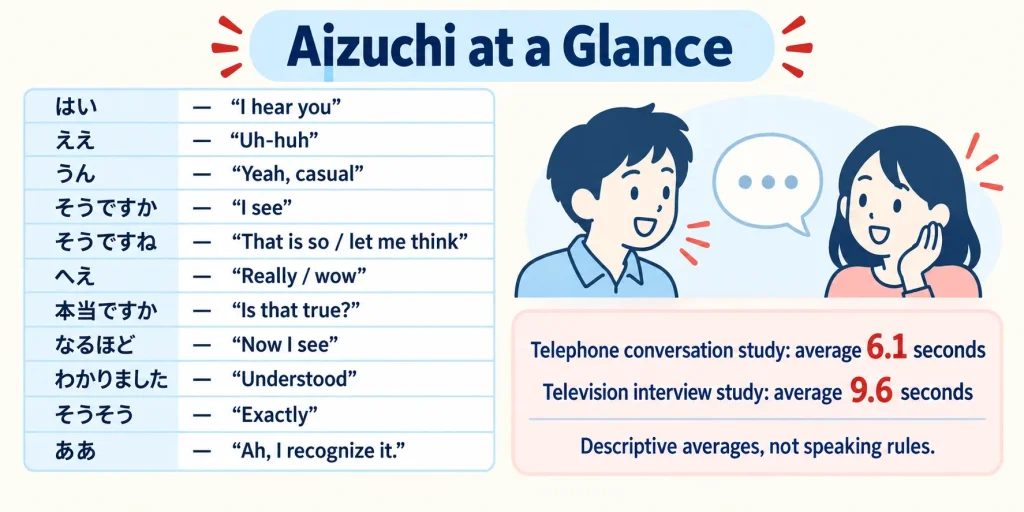
Aizuchi at a Glance
| Expression | Core signal | Agreement level | Best moment | Main trap |
|---|---|---|---|---|
| はい | I hear you | Neutral | During polite explanations | Hearing it as contractual “yes” |
| ええ | Uh-huh | Usually neutral | Relaxed adult conversation | Mistaking the long vowel for doubt |
| うん | Yeah | Context-dependent | Conversation with friends | Using it with strangers or staff |
| そうですか | I see | Neutral | After new information | Giving it a suspicious English tone |
| そうですね | That is so / let me think | Variable | Agreement or before an answer | Assuming it always agrees |
| へえ | Really / wow | Neutral | Genuine mild surprise | Using it for serious bad news |
| 本当ですか | Is that true? | Neutral | Strong surprise | Saying it after routine information |
| なるほど | Now I see | Evaluative | An explanation resolves something | Sounding as though you are grading |
| わかりました | Understood | Accepts the instruction | End of an explanation | Saying it before understanding |
| そうそう | Exactly | Strong | A specific point is correct | Treating it as neutral feedback |
| ああ | Ah, I recognize it | Neutral | Moment of recognition | Sounding bored or dismissive |
Short FAQ
Does はい always mean yes?
No. It can mean yes, but while another person is speaking it frequently means “I hear you” or “I am following.” Wait for the completed response before treating it as agreement.
Should I use aizuchi every two or three seconds?
No fixed interval applies to every conversation. Published examples found longer averages, including 6.1 seconds in telephone conversations and 9.6 seconds in television interviews. Respond to conversational boundaries rather than a stopwatch.
Is silence rude in Japanese?
Not automatically. Silence can signal thought, restraint, respect, discomfort, or disagreement. During a long explanation, however, total silence without nodding can make your attention difficult to read.
Which response is safest for a visitor?
はい is the safest general acknowledgment. そうですか is useful after receiving new information, while わかりました belongs near the end of instructions you genuinely understand.
Can I say なるほど to anyone?
The word is common, but it can sound evaluative when used toward a senior person or customer. In a formal situation, そうなんですね or わかりました may be safer.