You will meet 作品, sakuhin, on Studio Ghibli’s official film pages; 制作, seisaku, in production credits; and 子会社, kogaisha, in the documents explaining who controls the company. Those terms are more useful than another list of cute creatures because this studio ghibli films guide is about what the brand image leaves out.
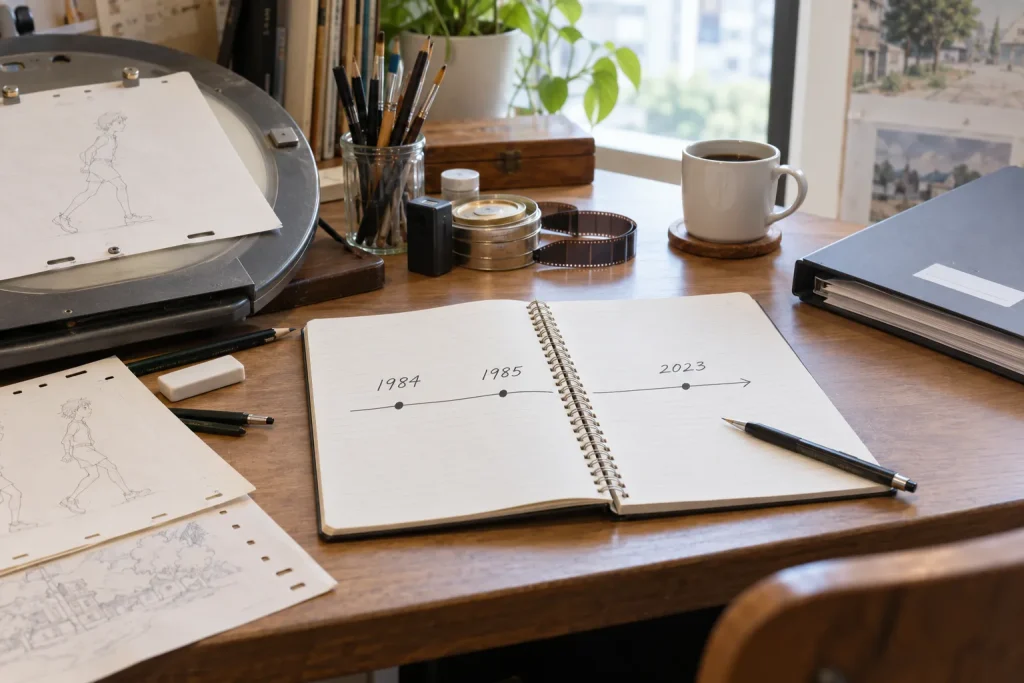
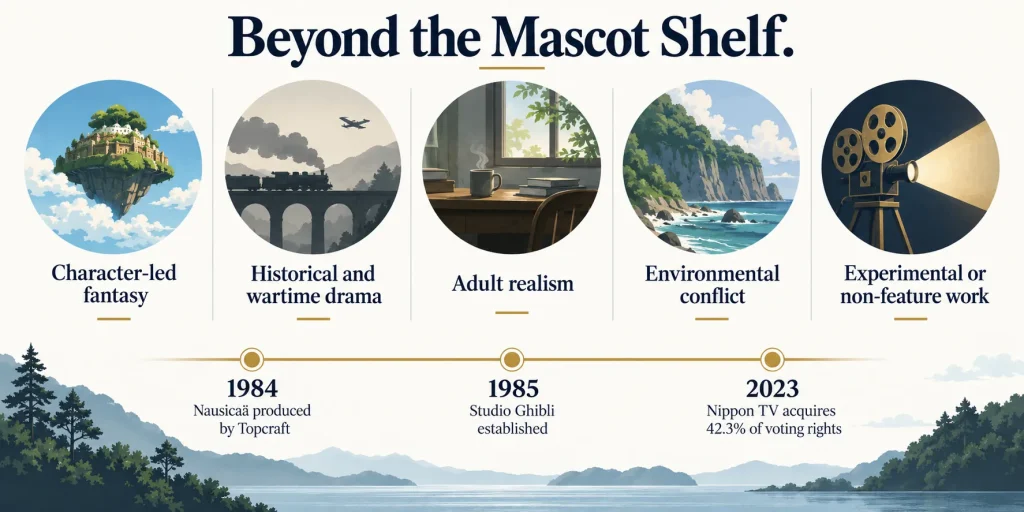
Ghibli did not begin as a factory for gentle fairy tales. It was established in 1985 after the success of Nausicaä of the Valley of the Wind, which had been released in 1984 and produced by Topcraft. Its catalog includes war, ecological collapse, labor, fascism, aging, family resentment, urban development, and adult disappointment.
Totoro is the company symbol, but he is not a reliable summary of the company.
A studio ghibli films guide starts before the studio
作品, sakuhin: “work” or “created piece”
You meet 作品 on Studio Ghibli’s official catalog, where it refers to an individual production. The word can cover more than a theatrical feature, so it should not automatically be translated as “movie.”
The official catalog contained 27 entries when checked on September 11, 2026. However, that total includes On Your Mark, a music video, and productions made for television or involving outside partners. The common mistake is treating the catalog total as a clean count of Ghibli theatrical features.
制作, seisaku: “making” or “production”
制作 appears in credits identifying the organization that physically made the animation. It concerns the creative and technical production process.
This is the word that settles the Nausicaä question. Ghibli’s own catalog identifies the 1984 film as a Topcraft production, while the studio’s history says its success led to Ghibli’s establishment in 1985. Calling it “the first Ghibli production” erases that sequence.
For a clearer view of the labor and financing behind animation, The Money Behind a Single Episode explains how a project moves from funding to finished pictures. It covers production mechanics rather than retelling Ghibli’s corporate history.
“The film comes first, and the merchandise follows.” — Studio Ghibli’s official history, translated from Japanese
The credit words that divide responsibility
製作, seisaku: “manufacture” or “project production”
製作 has the same romanized reading as 制作, but its kanji and industry function differ. In screen credits, 製作 can point toward project ownership, financing, or the body commissioning the production.
The usual mistake is assuming the two spellings are interchangeable decoration. They may sound identical, yet one credit can tell you who created the animation while the other helps identify who organized or funded the project. Why the Studio Rarely Owns the Show examines that separation across the wider anime business.
監督, kantoku: “supervision”
You meet 監督 beside the director’s name. It identifies the person responsible for directing the film, although the literal sense is broader than the English job title.
The mistake is using “Ghibli” and “Miyazaki” as synonyms. Isao Takahata directed Grave of the Fireflies, Only Yesterday, Pom Poko, My Neighbors the Yamadas, and The Tale of the Princess Kaguya. Yoshifumi Kondō, Gorō Miyazaki, Hiromasa Yonebayashi, and other filmmakers also directed works in the catalog.
原作, gensaku: “original work”
原作 appears when a movie is based on a novel, manga, or another existing source. In English credits it is often rendered as “original work” or “based on.”
The mistake is believing every Ghibli story began as an original screenplay. Only Yesterday, Kiki’s Delivery Service, Howl’s Moving Castle, and several other productions adapt earlier works, even when the screen version changes their emphasis substantially.
| Term | Reading | Literal meaning | Where you meet it |
|---|---|---|---|
| 作品 | sakuhin | created work | Official catalogs |
| 制作 | seisaku | making or production | Animation-production credits |
| 製作 | seisaku | manufacture or project production | Financing and ownership credits |
| 監督 | kantoku | supervision | Director credits |
| 原作 | gensaku | original work | Adaptation credits |
| 長編 | chōhen | long work | Feature descriptions |
| 劇場用 | gekijōyō | for theatrical use | Release classifications |
| 興行 | kōgyō | public entertainment business | Box-office discussions |
| 配給 | haikyū | distribution or allocation | Distributor credits |
| 子会社 | kogaisha | child company | Corporate announcements |
| 株式 | kabushiki | shares | Acquisition documents |
| グッズ | guzzu | merchandise | Retail stores |
| キャラクター | kyarakutā | fictional character | Licensing and product categories |
The catalog beyond forest spirits and flying castles
長編, chōhen: “long work”
長編 is used for a feature-length work, whether animated or live action. You meet it in descriptions that distinguish longer productions from short films, advertisements, and music videos.
The mistake is translating it as “epic.” Length does not promise fantasy, spectacle, or adventure. Only Yesterday is a long-form animated film built around memory, office life, farming, and an adult woman reconsidering her choices.
劇場用, gekijōyō: “for theatrical use”
劇場用 identifies a production intended for cinemas. The term describes its exhibition format, not its tone or intended age group.
Ghibli’s official history emphasizes that the studio was unusual because it concentrated primarily on original theatrical features instead of relying on television series. Why So Many Shows Stop at Twelve explains the television structure Ghibli largely avoided.
The films most likely to break the “gentle fairy tale” assumption include:
- Grave of the Fireflies — civilian hunger, displacement, and death during war.
- Only Yesterday — memory, work, social expectations, and an adult decision.
- Ocean Waves — emotionally awkward teenagers without a supernatural solution.
- Pom Poko — habitat destruction, failed resistance, and forced assimilation.
- My Neighbors the Yamadas — domestic friction presented through episodic comedy.
- The Wind Rises — artistic ambition tied to machines built for war.
- The Red Turtle — mortality, isolation, family, and loss with almost no dialogue.
These are not secret films. They are simply harder to turn into plush mascots, lunch boxes, and cheerful storefront displays than Totoro, Jiji, Calcifer, or No-Face.
Why “family film” is an unreliable label
興行, kōgyō: “public entertainment business”
興行 appears in discussions of theatrical performance and box-office success. It refers to the commercial exhibition of a work rather than the artistic genre of the movie.
The mistake is assuming commercial animation must be emotionally safe. My Neighbor Totoro and Grave of the Fireflies were released in Japan as a double feature on April 16, 1988, according to Ghibli’s official catalog. The pairing placed childhood wonder beside wartime death rather than separating “family entertainment” from serious cinema.
配給, haikyū: “distribution”
配給 appears beside the company that delivered a movie to theaters. Its literal sense can suggest allocation or supply, but in a film credit it means distribution.
Do not confuse the distributor with the animation studio, director, or current corporate owner. Those parties can overlap on a project, but the labels answer different questions.
| Film | What the storefront image misses | Useful viewing lens |
|---|---|---|
| Grave of the Fireflies | War destroys children without offering magical rescue | Civilian vulnerability |
| Only Yesterday | The central conflict belongs to an unmarried adult woman | Memory and social pressure |
| Ocean Waves | Emotional damage comes from ordinary behavior | Adolescent selfishness |
| Pom Poko | Transformation cannot permanently stop development | Land and displacement |
| The Wind Rises | Beauty and engineering coexist with military violence | Compromised ambition |
| The Red Turtle | Fantasy does not remove aging or death | Acceptance and loss |
Who owns Studio Ghibli now
株式, kabushiki: “shares”
株式 is the word you meet in acquisition announcements. It refers to shares in a company, not to its films, characters, or physical studio buildings individually.
Nippon Television Network announced on September 21, 2023 that it would acquire shares carrying 42.3 percent of Studio Ghibli’s voting rights. The transaction was scheduled for October 6, 2023, making Ghibli a subsidiary while addressing its management succession problem.
The mistake is describing this as Nippon TV buying “all of Ghibli.” A controlling position does not mean ownership of every share, and it does not make every earlier Nippon TV broadcast a production by the broadcaster.
子会社, kogaisha: “child company”
子会社 is the standard corporate term for a subsidiary. English speakers may hear “child company” as informal or affectionate, but the Japanese word describes a legal and corporate relationship.
The 2023 announcement said Nippon TV would support Ghibli’s management while respecting its creative autonomy. That is the published commitment; it is not proof that ownership can never affect future decisions. Corporate control and artistic authorship should not be collapsed into a comforting slogan.
The company behind the films changed its ownership structure. The films did not retroactively change their makers.
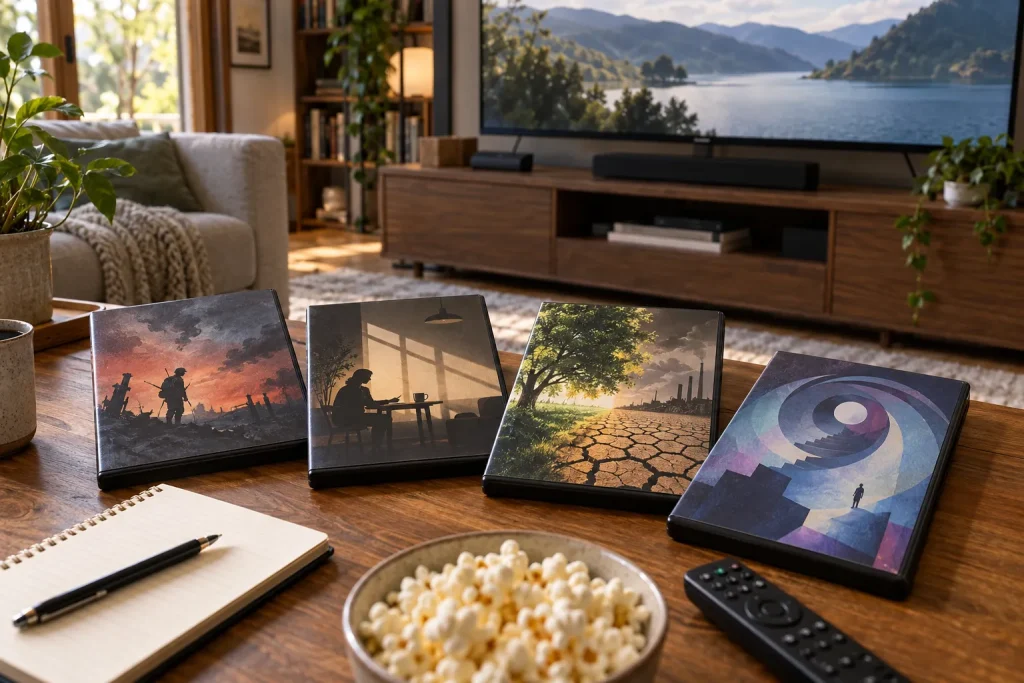
How merchandise creates a smaller Ghibli
グッズ, guzzu: “merchandise”
グッズ comes from the English word “goods,” but Japanese retail usage usually means branded merchandise or fan items. You meet it in museum shops, character stores, limited releases, and online product categories.
The mistake is translating it as every kind of physical product. In anime culture, Studio Ghibli merchandise usually means collectible or licensed items linked to recognizable films and characters.
Ghibli’s own history explains that Totoro plush toys arrived after the movie rather than being designed as part of its initial release campaign. The toys became commercially important, Totoro became the company mark, and a merchandise department followed. However, the studio says it continued to make films first rather than altering stories to create products.
キャラクター, kyarakutā: “fictional character”
キャラクター is borrowed from English, but in merchandising it often means a visually identifiable licensed figure. The word does not necessarily refer to deep characterization or moral personality.
A soot sprite can function as a product character because its silhouette survives on a pin. Taeko’s complicated memories in Only Yesterday cannot be reduced as easily. That commercial difference helps explain the Ghibli movies beyond Totoro that disappear from souvenir-based impressions of the studio.
There is no stable primary-source dataset proving that exactly half of the filmography sits outside a “merchandise canon.” Store inventories change, regional licenses differ, and “outside” needs a measurable threshold. The defensible claim is that a substantial part of the official catalog receives far less character-led visibility than the familiar mascot titles.
Three terms worth keeping
Memorize 制作, seisaku, because it tells you who made the animation. Keep 監督, kantoku, because Ghibli is not the work of one director. Remember 子会社, kogaisha, because it describes the studio’s current relationship with Nippon TV.
The remaining terms can stay recognizable until you need them in credits, catalogs, or company notices. If character names become the problem instead, the name converter with 898 checked names in katakana handles name conversion without duplicating the site’s reference pages. For dialogue choices, Anime Speech Styles, and What Subtitles Cannot Carry explains what characterization can disappear in translation.
Ghibli does include wonder, flight, children, spirits, and extraordinary landscapes. It also includes starvation, stalled adulthood, compromised work, environmental defeat, and families that fail to understand one another. Studio Ghibli beyond Totoro is not a darker alternative canon; it is the catalog that was there all along.
Frequently asked questions
Was Nausicaä the first Studio Ghibli film?
No. Nausicaä of the Valley of the Wind was released in 1984 and produced by Topcraft. Its success helped lead to Studio Ghibli’s establishment in 1985, and Ghibli now includes the film in its official works catalog.
Does Nippon TV own Studio Ghibli?
Nippon Television Network acquired shares carrying 42.3 percent of the voting rights in October 2023, making Ghibli its subsidiary. This is a controlling position, not ownership of every share.
Are Studio Ghibli films made only for children?
No. The catalog contains works centered on war, adult memory, aviation, labor, death, family conflict, and environmental displacement. Some are accessible to younger viewers, but that does not make the entire catalog children’s entertainment.
Why is Totoro used as the studio logo?
Ghibli’s official history says Totoro plush toys became successful after the film’s release and helped support future production costs. The character was subsequently adopted as the company mark.
Is half of Ghibli’s filmography missing from merchandise stores?
That exact fraction cannot be verified from a stable primary-source inventory. Retail catalogs and licensing arrangements change, so the article uses “a substantial part” rather than presenting “half” as measured fact.