The most expensive mistake is buying a separate domestic flight that you cannot use after a delayed transpacific arrival. In a zipair vs jal ana comparison, the financial damage can exceed every meal, seat, and baggage fee combined because separately ticketed airlines normally do not promise to protect the connection. The low-cost international fare reaches Tokyo, but the trip may continue to Sapporo, Fukuoka, Hiroshima, or Okinawa on another reservation. If immigration, baggage collection, customs, an airport transfer, or the inbound delay consumes the connection time, you may need a new domestic ticket and possibly a hotel. The “cheap flight to Japan” was never the entire itinerary.
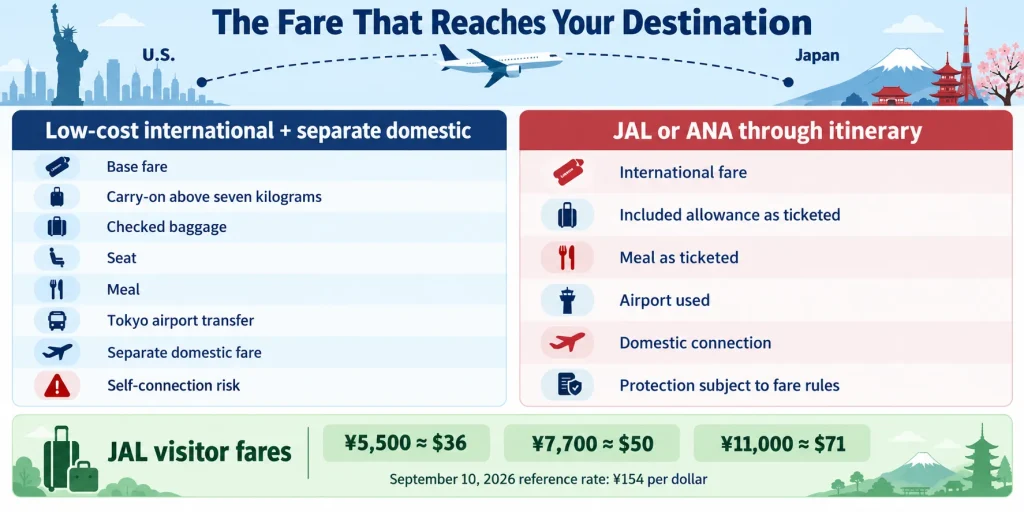
The brief’s proposed ¥7,700 domestic add-on, about $50 at the September 10, 2026 reference rate of roughly ¥154 per dollar, is not a universal benefit attached to every JAL or ANA international ticket. JAL’s Japan Explorer Pass uses several route-based prices, including ¥5,500, ¥7,700, and ¥11,000—approximately $36, $50, and $71 at that reference rate—and requires eligibility conditions that are broader than simply flying internationally on JAL. ANA’s domestic pricing depends on the international fare, origin market, booking channel, route, and any live promotion. The real advantage of a full-service through itinerary is not one magic fare; it is the possibility of pricing and protecting the entire journey together.
Buying two tickets and assuming one protected journey
Travelers often buy the cheapest international flight to Narita and then attach an unrelated domestic reservation. It seems reasonable because each segment is individually inexpensive and both confirmation emails show the same travel date. What it actually creates is a self-connection: you are responsible for entering Japan, collecting checked baggage, clearing customs, changing terminals or airports, checking in again, and reaching the next gate before the second carrier’s deadline. The domestic airline may treat a missed departure according to the rules of that separate fare rather than the cause of your international delay.
A protected connection works differently when the flights are issued as part of one eligible itinerary. The operating carriers and fare conditions determine what assistance applies, but the reservation at least records the segments as one journey. On separate tickets, even two airlines in the same alliance do not automatically assume responsibility for each other. Flights, Airports and the First Two Hours covers arrival formalities and the sequence after landing. Add that sequence to the transfer calculation before treating a domestic departure as reachable.
Two flights on the same screen are not necessarily one contract of carriage.
The potential cost has no honest universal figure. It may be limited to a change fee, or it may become a same-day replacement fare plus accommodation. That range depends on disruption, availability, and fare rules, so inserting a single dollar estimate would manufacture certainty. The important distinction is whether the domestic segment is protected within the ticket you bought.
What to do instead: Compare a protected Japan flight itinerary with the complete self-connection, including a realistic disruption plan.
Assuming every JAL or ANA domestic leg costs ¥7,700
The half-informed mistake is knowing that Japan has visitor fares but remembering only one number. JAL’s official Japan Explorer Pass page lists route groups rather than one nationwide price. As checked on September 10, 2026, published one-way base fares include ¥5,500, ¥7,700, and ¥11,000, or about $36, $50, and $71 at ¥154 per dollar. Taxes and passenger-facility charges can be additional. Eligibility includes residing outside Japan and holding an international ticket to and from Japan, but that international ticket does not have to be issued by JAL.
ANA does not provide a permanent, universal promise that every passenger holding an ANA international ticket can add any domestic flight for ¥7,700. International through-fare construction can make a domestic connection inexpensive or produce no additional base airfare on particular itineraries, while promotions can apply to selected countries and booking periods. Taxes, stopover rules, inventory, and fare conditions still matter. An old article about an “Experience JAPAN Fare” cannot establish the price of a booking made in September 2026. You must price the actual city pair and dates.
| Domestic option | Published structure checked September 10, 2026 | Approximate dollars at ¥154/$ | Important limitation |
|---|---|---|---|
| JAL lower Explorer Pass group | ¥5,500 | $36 | Selected routes |
| JAL middle Explorer Pass group | ¥7,700 | $50 | Selected routes |
| JAL higher Explorer Pass group | ¥11,000 | $71 | Selected routes |
| ANA domestic connection | Itinerary-specific | Not fixed | Depends on origin, fare, route, and offer |
| ZIPAIR domestic connection | No equivalent through domestic network benefit | Not applicable | Requires another airline or ground transport |
| Universal JAL/ANA domestic rate | Does not exist at one verified price | No single total | Price the complete itinerary |
The Explorer Pass can still erase a substantial part of a full-service fare difference when your itinerary includes a costly domestic route. It just does not do so automatically. Availability may be limited, and the eligible route may fall into a higher band than the remembered ¥7,700. A JAL international ticket is not itself the discount mechanism; the fare product and its conditions are. ANA must be checked separately because JAL’s published visitor fare cannot be attributed to its competitor.
What to do instead: Price the exact JAL domestic fare and the exact ANA through fare before treating ¥7,700 as a guaranteed add-on.

Pricing the seat before pricing the luggage
ZIPAIR’s base fare includes a seat on the aircraft and a limited carry-on allowance, while checked baggage is optional. As checked on September 10, 2026, the standard complimentary carry-on allowance is up to seven kilograms, or about fifteen pounds. Additional carry-on weight must be purchased under the airline’s rules, and checked baggage is sold by weight category. Fees depend on the route and when the service is purchased, so a static article cannot safely quote one charge for every U.S.–Japan flight.
JAL and ANA international economy fares generally include checked baggage, but the exact allowance depends on the carrier, route, ticket, cabin, and operating flight. Codeshares can place another airline’s baggage rules into the journey. A traveler comparing only the first search-result price may therefore put a bare ZIPAIR fare beside a JAL or ANA fare that already includes services they will actually use. The comparison becomes meaningful only after the same baggage is assigned to every option.
The worked method uses your live checkout values:
| Cost component | ZIPAIR | JAL or ANA |
|---|---|---|
| Displayed international fare | Enter live fare | Enter live fare |
| Carry-on above included limit | Add current fee if needed | Check ticket allowance |
| Checked baggage | Add selected weight fee | Add only if allowance is exceeded |
| Seat selection | Add chosen seat fee | Check whether selected seat is included |
| Meal | Add preorder cost if wanted | Check service included on the flight |
| Domestic continuation | Add separate flight | Add through fare or eligible visitor fare |
| Comparable trip total | Sum every selected component | Sum fare and nonincluded components |
Suppose one traveler needs no checked bag, accepts any assigned seat, and brings food permitted under the carrier’s rules. The low-cost fare retains most of its advantage. Another traveler checks luggage, selects seats for a family, orders meals, and continues beyond Tokyo. The second traveler is buying a different product even when both people clicked the same base fare. The passenger’s requirements move the total; the airline label does not.
What to do instead: Build a full ZIPAIR baggage fees comparison using the live checkout price for the weight you will actually bring.
Adding a bundle without checking what it replaces
Another half-informed mistake is learning that ZIPAIR sells service packages and assuming the largest bundle recreates a full-service ticket. A bundle can group checked baggage, seat selection, and other options more conveniently than purchasing them separately. It does not necessarily reproduce JAL or ANA’s change rules, connection protection, mileage treatment, airport network, or onboard service. The package name is not evidence that the contracts have become equivalent.
Bundles also create a quieter form of overspending. If you need baggage but do not care about the included seat category or meal, the package can contain benefits you would not have purchased separately. Conversely, adding services one by one without testing the bundle can cost more than the package. ZIPAIR controls the live contents, eligibility, and pricing, which can vary by itinerary. The correct comparison must therefore be made inside the booking path rather than copied from an older review.
This is where Fares by Season, Departure City and Booking Window provides the broader airfare context. A service bundle cannot rescue a poor base fare chosen during an expensive travel period. Nor should a cheap off-season headline price be treated as a year-round quote. The base fare, bundle, taxes, and domestic continuation need the same travel dates.
What to do instead: Test the ZIPAIR fare bundle against buying only the services you need, then compare both totals with full-service fares.

Ignoring the difference between Narita and Haneda
A traveler may compare NRT and HND as if they were interchangeable Tokyo labels. That seems reasonable because both airports serve the metropolitan area and appear in international searches. The mistake becomes expensive when an itinerary arrives at Narita but the onward domestic flight departs from Haneda. The transfer crosses the region, consumes hours rather than minutes, and is not an airside terminal connection.
The problem is not limited to onward flights. Your first hotel, arrival time, train availability, luggage volume, and tolerance for transfers all affect the useful value of each airport. A cheaper Narita fare can remain the best option, particularly if your lodging is convenient to its rail or bus routes. It can also lose its advantage after ground transportation and a difficult late arrival are counted. Two Tokyo Airports, Two Very Different Rides covers the airport-specific transport choices instead of reducing the issue to distance alone.
Airport codes deserve literal attention:
- NRT means Narita International Airport.
- HND means Tokyo Haneda Airport.
- A connection marked NRT–HND includes a ground transfer.
- Checked luggage does not travel between those airports by itself.
- The next airline’s check-in deadline still applies.
If the booking engine presents the transfer inside one itinerary, read what assistance and minimum time the ticket provides. If you build it from separate reservations, assume responsibility until written conditions say otherwise. The Japanese term 乗り継ぎ, noritsugi, literally “transferring onward,” does not imply that every transfer is protected or airside. The airport pair and ticket structure provide that answer.
What to do instead: Treat a Narita to Haneda transfer as a separate journey with transport cost, baggage handling, and buffer time.
Treating the cheapest fare as flexible
Low fares feel easier to abandon because the amount on the search screen is small. The actual problem appears when the date changes, a companion cannot travel, or the itinerary needs to be rerouted. Low-cost fare rules may restrict refunds or changes, and optional services may follow their own refund conditions. A replacement ticket bought closer to departure can cost more than the original saving. JAL and ANA also sell restrictive fares, so “full service” does not automatically mean refundable.
You need to compare like with like. A nonrefundable ZIPAIR fare should be measured against the least expensive JAL or ANA fare you are genuinely willing to accept, not against a fully flexible ticket bought for another purpose. Conversely, a traveler who needs flexibility should include the price of that flexibility in every column. Travel insurance may cover specified events under its policy, but it does not rewrite an airline’s fare rules. Coverage exclusions, documentation requirements, and limits remain separate.
Planning a First Trip to Japan: The Order That Works explains why route and dates should be settled before nonrefundable purchases. The airfare is not the first independent decision when it determines which airport, domestic connection, and first hotel night will work. A cheap fare attached to the wrong itinerary is not a bargain. It is an expensive constraint.
What to do instead: Compare Japan airfare rules for changes, cancellations, and optional-service refunds before paying.
Assuming full service means every service is free
JAL and ANA include more in a typical long-haul economy product than a bare low-cost fare, but “included” has boundaries. Preferred seats, extra-legroom positions, additional baggage, lounge access, upgrades, and certain ticket changes can still cost extra or depend on status. Codeshare flights may use the operating carrier’s service. Aircraft substitutions can change the seat map. Even an included meal does not guarantee that a specific dietary request remains available without advance action.
The mistake happens when travelers stop reading as soon as they see the full-service logo. They may assume every seat can be selected without charge or that baggage rules remain identical across a mixed-carrier itinerary. What it actually causes is a comparison tilted in the opposite direction: the legacy fare is credited with benefits the selected ticket does not contain. The cure is the same as with ZIPAIR—read the fare and service details for the exact flight.
Onboard preference also has a cash limit. A meal, seatback screen, blanket, or included drink may matter on a transpacific journey, but it should not be assigned an imaginary retail value. Use the price you would personally have paid for the alternative. If you would bring your own entertainment and decline a purchased meal, their value in your calculation can be zero. Comparison means pricing needs, not manufacturing enthusiasm for inclusions.
What to do instead: Verify the exact JAL economy fare or ANA economy fare instead of treating the airline brand as the allowance.
Using a rail pass to repair a flight decision
A traveler may discover that the cheap ticket ends in Tokyo and assume the Japan Rail Pass will solve every onward journey. That seems informed because the pass covers substantial parts of the JR network. It can still be the wrong repair. The nationwide pass increased sharply in price in October 2023, excludes some services without supplements, and does not turn every regional itinerary into efficient travel.
Tokyo to a distant island destination cannot be solved by train. Other routes may be possible by rail but consume much of a short trip. A domestic flight can place you closer to the first planned region and eliminate a backtrack through Tokyo. Is the Japan Rail Pass Worth It in 2026? provides the route-by-route calculation instead of assuming that unlimited travel means economical travel. Its conclusion belongs after the itinerary is built, not before.
This mistake can also reverse the domestic-fare comparison. A JAL Explorer Pass route at ¥7,700, approximately $50 at the checked reference rate, may be more useful than a rail pass segment when the destination and schedule suit the flight. A ¥5,500 route, approximately $36, can strengthen that case; a ¥11,000 route, approximately $71, changes the margin. The visitor fare does not always win, but it deserves a line in the spreadsheet. ZIPAIR does not supply a comparable domestic network add-on of its own.
What to do instead: Compare domestic flights in Japan with point-to-point rail prices and travel time before buying any pass.
Forgetting that communication has a cost too
Unbundled travel creates more moments when you must solve a problem yourself. A separate domestic ticket, airport transfer, baggage repurchase, or missed check-in may require conversations with companies that do not share the same reservation. This is not a reason to avoid low-cost travel. It is a reason to recognize that operational simplicity has value, particularly after an overnight flight.
The site’s phrasebook with 337 phrases sorted by situation can help with routine shopping and travel language. It cannot establish that an airline owes rebooking or baggage transfer. Contract questions should be answered from the ticket conditions or by the carrier. If a connection matters, obtain the answer before travel rather than expecting a phrase to create protection at the airport.
One habit prevents most of these errors: build the trip as a door-to-destination total. Include the international fare, the services you will use, arrival airport, ground transport, domestic continuation, ticket protection, and time. Do that once for ZIPAIR and once for the best JAL or ANA itinerary. The lower comparable total—not the lower first number—is the cheaper ticket.