
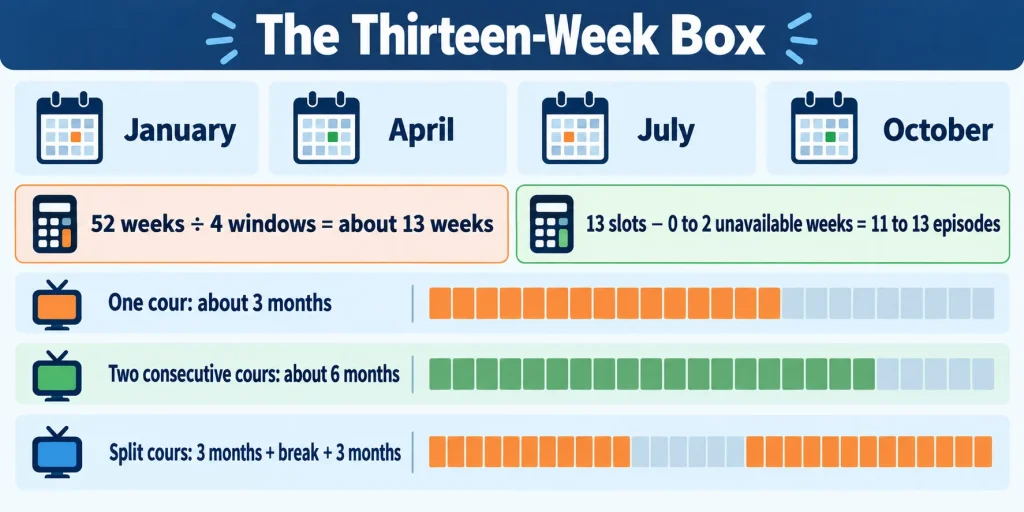
Four recurring windows—January, April, July, and October—organize much of Japan’s television-anime calendar. A single クール, kūru, meaning a roughly three-month broadcast run, usually gives a weekly program enough room for about eleven to thirteen episodes. That calendar answers the search what is a cour anime more accurately than calling a cour another word for “season.” A cour is primarily a scheduling block, while an English-language season may describe a marketed installment, a production order, or every episode released under one title. When a show appears to stop abruptly at twelve, the outer boundary was often established by the broadcast plan before the script reached its final scene.
This does not mean every broadcaster follows a legally fixed anime calendar or that every production purchases an identical package of airtime. January, April, July, and October are industry patterns rather than dates imposed by a national broadcasting rule. Individual programs may premiere during the final days of the preceding month, lose a week to another program, or open with an extended episode. Streaming originals can ignore the grid entirely. Even so, the quarterly model remains the clearest explanation for why so many television series cluster around the same episode totals.
What is a cour in anime scheduling?
The term cour comes from クール, kūru, a Japanese broadcasting term derived from the French cours, or “run.” In current industry use, it describes approximately one quarter of television scheduling. Because most TV anime air once per week, a quarter offers about thirteen weekly positions before interruptions are considered. That produces the familiar range of eleven, twelve, or thirteen installments. The official schedules and episode archives of individual productions provide stronger evidence than treating “twelve episodes” as an inflexible rule.
The year can be divided into four practical anime windows:
| Broadcast window | Approximate calendar span | Available weeks | Common weekly episode range | Basis checked |
|---|---|---|---|---|
| Winter | January–March | About 13 | 11–13 | Quarterly calendar and official series schedules |
| Spring | April–June | About 13 | 11–13 | Quarterly calendar and official series schedules |
| Summer | July–September | About 13 | 11–13 | Quarterly calendar and official series schedules |
| Fall | October–December | About 13 | 11–13 | Quarterly calendar and official series schedules |
| Total annual grid | January–December | About 52 | Four one-cour windows | Gregorian calendar, checked September 10, 2026 |
The arithmetic begins with fifty-two weeks in a standard year. Divide those weeks by four programming quarters and you get thirteen weekly positions per quarter: 52 ÷ 4 = 13. A production that uses all of them can reach thirteen episodes. Remove one slot for a holiday, sports broadcast, special program, delayed premiere, or production interruption and the total becomes twelve; remove two and it becomes eleven. That is where the range comes from, not from a storytelling rule that says an anime plot must climax after three months.
The Money Behind a Single Episode explains the production stages and financing pressures behind each installment. The scheduling point here is narrower: once a committee and broadcaster plan a one-cour television run, writers have to fit the selected material into that available grid. A manga arc that would feel comfortable across fifteen episodes may therefore be compressed, divided, or stopped before its next major section. The schedule does not write the story, but it establishes the box into which the adaptation must fit.

The arithmetic behind a twelve-episode run
Suppose a production is assigned one weekly position across a thirteen-week quarter. Its theoretical ceiling is thirteen broadcasts. If the station reserves one week for a special program, the usable total falls to twelve. If another slot disappears because the premiere starts one week after the quarter begins, the total falls to eleven. You can redo the calculation for any series once you know the premiere date, regular weekday, finale date, and any skipped weeks.
| Scheduling component | Weekly slots added or removed | Running total |
|---|---|---|
| One quarterly window | +13 | 13 |
| One unavailable broadcast week | −1 | 12 |
| Additional interruption, if applicable | −1 | 11 |
| Extended episode | 0 additional slots | 11–13 episodes, with longer runtime |
| Typical one-cour result | 13 minus 0–2 unavailable slots | 11–13 episodes |
This is a counted table rather than a cost table because no primary source publishes a universal price for “one anime cour.” Airtime arrangements differ by station, time slot, region, committee, sponsorship package, and distribution agreement. In some production-committee structures, the program’s backers secure or effectively fund a late-night broadcast slot as part of a larger commercial plan. In other cases, the broadcaster is itself a committee member or rights participant. Printing one yen figure as the price of a cour would turn confidential, project-specific contracts into a fictional national tariff.
That uncertainty is part of the answer. The visible episode count is standardized far more clearly than the financial agreement behind it. A viewer can count twelve released episodes, but cannot work backward to one reliable airtime price. Why the Studio Rarely Owns the Show explains how publishers, broadcasters, music companies, distributors, and other investors may divide rights and risk. That structure also explains why good streaming numbers do not automatically give the animation studio authority to order another cour.
Why thirteen available weeks become twelve episodes
A quarter is not a blank thirteen-cell spreadsheet reserved for one anime. Japanese broadcasters carry news, sports, holiday programming, live events, station specials, and schedule changes. A series may also begin after the first week of the calendar quarter or conclude before the final week. An hour-long premiere occupies one transmission date even when a streaming platform later labels its contents differently. The resulting twelve-episode anime season can therefore be a complete use of the practical schedule rather than evidence that an episode was removed.
Production planning adds another constraint. Animation work proceeds through scripts, storyboards, key animation, backgrounds, compositing, voice recording, editing, and delivery, with several episodes moving through the pipeline at once. A committee may approve only one cour because it limits the initial commitment and creates a defined package for broadcasting, licensing, home video, and international distribution. The creative staff then decide where within the source material that package can end. Sometimes the result feels deliberate; sometimes the audience can see the seam.
Twelve is often a production boundary disguised as a narrative boundary.
That is the uncomfortable part. A final episode can be polished, emotional, and structurally satisfying without being the ending the original story would have chosen. The adaptation may close immediately after a confrontation, use an anime-original transition, or stop before introducing the next arc. This is not automatically evidence of cancellation. It may simply be the end of the episodes ordered and scheduled at that stage.

One cour, two cours, and the split between them
A two-cour order provides roughly six months of television space rather than three. Under the same weekly arithmetic, two quarters offer approximately twenty-six potential broadcast dates before interruptions. Many productions use twenty-four, twenty-five, or twenty-six episodes, although those figures remain patterns rather than mandatory totals. When the two blocks run consecutively, viewers may experience them as one long season. Marketing and streaming services can still label the same run differently.
A 分割2クール, bunkatsu ni-kūru, literally “split two cours,” divides the planned blocks with a gap between them. The first half might air from April through June and the second from October through December, leaving the July quarter open. The break can provide more production time and give promotional campaigns two launch periods. It also keeps the second block within an already announced plan rather than making it equivalent to a newly approved sequel. That distinction is why “Part 2” can return relatively quickly while “Season 2” remains unconfirmed.
The numbers can be compared directly:
- One cour: about three months and usually eleven to thirteen episodes.
- Two consecutive cours: about six months and commonly around twice the one-cour episode count.
- Split cour: two planned blocks separated by at least one non-broadcast period.
- New sequel season: a separate continuation that may require new approval, scheduling, contracts, and production capacity.
- Streaming-only release: no necessary dependence on a Japanese weekly television quarter.
Do not infer the production status from an English streaming label alone. A service may call the second cour “Season 2,” “Part 2,” or simply continue the episode numbering. The Japanese official site and production announcement are better evidence of whether the continuation was planned as part of the same project. Marketing labels describe how a platform packages the show for viewers. Cour language describes how the Japanese run was scheduled or announced.
Why a real sequel can take years
Finishing a successful cour does not leave the same crew waiting beside empty desks for the next order. Directors, episode directors, animation producers, designers, voice actors, and specialist animators move to other contracted work. A sequel needs more than source material and audience demand; it needs financing, a committee decision, a workable broadcast or distribution plan, and compatible staff availability. A production can therefore be commercially valuable without having a second season ready for the following quarter. The calendar that created the first stopping point can also delay the return.
A gap of several years cannot be converted into a universal production formula. No primary source supports a rule such as “a twelve-episode anime requires exactly a fixed number of months to make.” Studios use different pipelines, outsourcing networks, schedules, and episode ambitions. Announcements also happen at different stages: one project may be revealed early, while another remains private until broadcast arrangements are secure. The only dependable dates are the ones released by the production’s official channels.
The committee structure matters again here. A studio can be proud of the work and interested in continuing while lacking control of the underlying manga, music, merchandise, international licenses, or sequel approval. Conversely, a committee can approve another season but wait for the preferred creative team. Viewer enthusiasm is commercially relevant, but it does not reserve a broadcast slot or reassemble the staff. That is why “popular” and “returning soon” are not synonyms.
Broadcast seasons are not American TV seasons
In American usage, a season is usually a labeled group of episodes sold and presented as one installment of a series. Its length can vary widely, and streaming services do not need to fill a weekly broadcast quarter. In Japanese television anime, a cour is a more useful scheduling measure because it tells you how much calendar space the run occupies. One marketed season may contain one cour, two consecutive cours, or two split cours. The vocabulary overlaps, but the units do not.
This comparison also explains why episode thirteen can be a finale without being a cancellation. The production may have delivered exactly the block that was ordered. In the opposite direction, episode twelve can end with an obvious continuation hook even though no public sequel date exists. The hook preserves a route forward; it is not a timetable. You should separate what the story signals from what the production has officially announced.
Language inside the show creates a different kind of confusion, so this article does not duplicate that subject. Japanese Honorifics in Anime: -san, -kun, -chan and the Rest explains what relationship markers communicate, while Anime Speech Styles, and What Subtitles Cannot Carry covers characterization that can disappear in English. If a character’s name sends you toward the site’s name converter, use it only for real-name katakana reference: the tool contains 898 checked names, not a database of fictional-character meanings.

Exceptions that move the total
Not every television anime starts in the first week of January, April, July, or October. Some premieres land at the end of the preceding month, and others begin after the quarter is underway. Episodes may be postponed for production reasons or displaced by another broadcast. Special-length premieres and finales alter total runtime without necessarily changing the number of broadcast dates. Short-form anime can fit several-minute episodes into a slot, while other productions use hour-long specials.
The source format does not determine the count either. A manga with hundreds of chapters can receive one cour, while an original anime with no published source can run longer. Committees select how much material and financial exposure the initial project will carry. A successful first block may support further investment, but it cannot guarantee when the next block will enter production. The anime episode count is therefore evidence of an order and schedule, not a measurement of how much story exists.
Streaming has weakened the old grid without making it irrelevant. A platform-funded original can release every episode at once, use an unusual total, or premiere outside the four familiar windows. A television project distributed internationally by a streamer may still retain its Japanese weekly schedule and cour structure. You need to identify which model applies before using the calendar arithmetic. “On Netflix” does not necessarily mean “made outside broadcast scheduling.”
How to read an official announcement
Start with the Japanese production’s official website or verified announcement rather than an unsourced season chart. Look for 放送, hōsō, literally “broadcast,” 配信, haishin, literally “distribution,” and 全12話, zen jūni-wa, literally “twelve episodes in total.” If the announcement says 第2クール, dai ni-kūru, “second cour,” it identifies another scheduling block. If it says 第2期, dai ni-ki, “second season,” it identifies a new numbered installment. Those labels tell you more than the folder name chosen by an overseas platform.
Use this order when checking a show:
- Confirm whether it is a television broadcast, streaming original, or theatrical project.
- Record the first Japanese broadcast date and regular weekly slot.
- Check whether the official site states a total episode count.
- Look for “second cour,” “split cour,” “Part 2,” or “second season” language.
- Count postponed or preempted weeks separately from produced episodes.
- Treat an unannounced continuation as unknown, even if the finale includes a tease.
The method will not predict a sequel date because staff bookings, financing, and private committee decisions are not visible in the broadcast calendar. It will tell you why the existing run clusters near twelve and whether a announced continuation belongs to the original order. It also prevents a common mistake: treating every midyear pause as cancellation. A planned split is a scheduling decision; an unannounced sequel is a different business decision.
Frequently asked questions
Is a cour always twelve episodes?
No. One cour is a scheduling span of roughly three months, not a guaranteed episode total. A weekly program has about thirteen potential dates in that span, but premieres, specials, holidays, preemptions, and delays can reduce the usable number. Eleven to thirteen episodes is a common range rather than a regulation. Always confirm the total on the production’s official website or home-video listing.
Is a cour the same as an anime season?
Not necessarily. A marketed anime season can contain one cour, two consecutive cours, or a split two-cour plan. Streaming platforms may also relabel parts for their own catalogs. Cour is most useful as a broadcast-calendar unit. Season is a less consistent packaging term.
What does split cour mean?
A split cour is a multi-block production whose broadcast parts are separated by a break. The interruption may provide production time, create a new promotional window, or accommodate broadcast planning. Because the later block can be part of the announced project, it is not automatically a newly approved sequel. Check the official wording and dates rather than relying on a streaming label.
Does twelve episodes mean the anime was canceled?
No. Twelve episodes can be the complete one-cour order planned from the beginning. Cancellation is a separate claim that requires evidence from the rights holders, committee, broadcaster, or studio. An abrupt ending may reflect where the adaptation had to stop within its assigned block. It does not prove that additional episodes once existed and were removed.
Why do some anime have twenty-four or twenty-five episodes?
They often occupy approximately two cours. Two quarterly blocks provide about twenty-six potential weekly dates before interruptions or special scheduling are considered. The production may run continuously or place a break between its halves. The official schedule determines which arrangement applies.
What is the one figure to remember?
Remember thirteen weeks: it is the approximate capacity of one quarterly broadcast window before lost or specially used slots reduce the episode total. Recheck this explanation by September 21, 2027, because streaming-first commissioning and broadcaster practices continue to evolve. For any specific title, verify its official schedule when it is announced. The calendar pattern explains the cluster; it does not replace the production’s own information.