You need to decide whether your Japanese “no” should sound everyday and soft or formal and final. Get that choice wrong and you will probably still be understood, but kekkou desu meaning can feel colder than a beginner expects when a convenience-store cashier merely asks whether you need a bag.
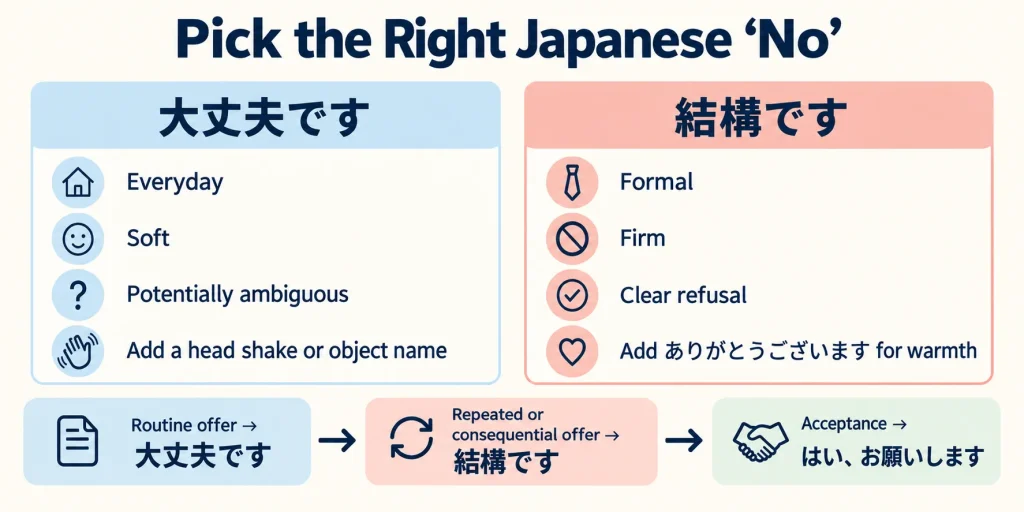
The answer depends on three factors: how routine the exchange is, how clearly you must close the offer, and how much warmth the relationship needs. At a register, 大丈夫です, daijōbu desu, literally “it is all right,” is usually the easier everyday answer. 結構です, kekkō desu, literally “it is sufficient/fine,” is more formal and decisive.
What does kekkou desu mean when you decline?
Kekkou desu can mean “No, thank you,” “That is enough,” or “I do not need it.” In response to an offer, it closes the exchange more firmly than a vague hesitation would.
The phrase is grammatically polite because it ends in です, desu, the polite copula. Polite grammar, however, does not automatically create a warm tone. 結構です can place distance between you and the offer, especially when delivered alone with a flat voice.
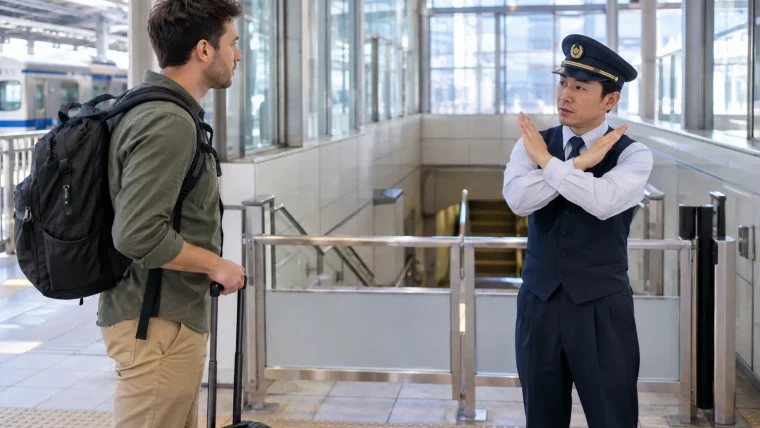
That firmness is useful when someone keeps offering, when a salesperson needs an unmistakable answer, or when accepting would create a real obligation. It costs you softness, but it buys clarity. Adding ありがとうございます, arigatō gozaimasu, “thank you very much,” before or after it restores some warmth:
ありがとうございます。でも、結構です。
Arigatō gozaimasu. Demo, kekkō desu.
“Thank you, but no thank you.”
Do not assume 結構 always means refusal. As 結構な, kekkō na, it can describe something as splendid or satisfactory; as an adverb, it can mean “quite” or “fairly.” Context determines which function is active.
The larger lesson is that politeness cannot be calculated from one vocabulary item. Politeness Is a System, Not a List of Words explains how phrasing, timing, acknowledgment, and tone work together.

Why is daijoubu desu the everyday option?
Daijoubu desu begins from the idea that something is safe, all right, or not a problem. In an offer exchange, it often works like “I’m fine” in American English: you are saying that you can manage without the offered item.
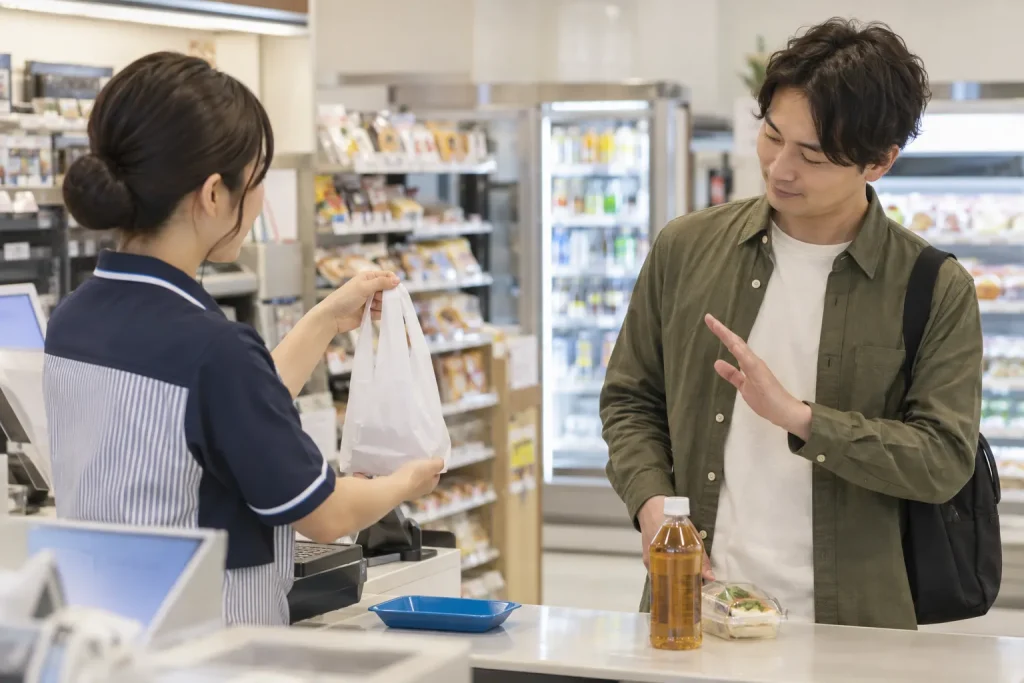
At a コンビニ, konbini, “convenience store,” the cashier may ask whether you need a bag, disposable chopsticks, a spoon, or heating. A small head shake with 大丈夫です usually communicates an ordinary, low-stakes refusal. It sounds less like a formal rejection and more like “I’m good, thanks.”
That is why it suits people who need one safe default for quick transactions. It costs a little precision because the phrase can also mean “Yes, that is okay” or “I am all right.” What it gives you is a softer, more conversational tone.
The ambiguity rarely causes trouble when your gesture and the object make the answer obvious. If the cashier holds up a bag and you shake your head while saying 袋は大丈夫です, fukuro wa daijōbu desu, “I’m fine without a bag,” the intended answer is clear.
The standard beginner mistake is using 結構です for every cashier question because a textbook labels it “no, thank you.” The phrase is not incorrect, and the cashier will not be offended by a visitor using careful Japanese. It is simply heavier than the routine exchange requires.
Which option matches the situation?
The central difference is not “polite versus rude.” Both phrases can be polite. The useful contrast is soft but potentially ambiguous versus firm but potentially distant.
| Deciding factor | Choose 大丈夫です | Choose 結構です |
|---|---|---|
| Type of exchange | Routine, brief, everyday | Formal, persistent, or consequential |
| Main goal | Keep the refusal light | Make the refusal final |
| Risk you accept | Slight ambiguity | Slight coldness or distance |
| Typical listener | Cashier, server, casual acquaintance | Salesperson, formal contact, persistent host |
| Helpful addition | Head shake or name the item | ありがとうございます to add warmth |
| Closest English effect | “I’m good, thanks” | “No, thank you; that will not be necessary” |
Three thresholds can flip the answer. First, if the offer is routine and disappears as soon as you answer, use 大丈夫です. Second, if the listener has repeated the offer or needs an operational decision, move toward 結構です. Third, if the relationship matters more than speed, acknowledge the kindness before giving either refusal.
Japanese speakers also soften refusals by delaying the core “no,” giving a short reason, or using hesitation. Research from the National Institute for Japanese Language and Linguistics notes that speakers may avoid a direct form such as 結構です when declining a well-meant offer, but may choose greater clarity when ambiguity would inconvenience the other person.
For the broader difference between polite endings and relationship-based register, Japanese Politeness Levels, and Which One to Use provides the framework rather than another list of fixed answers.
What should you say to a konbini cashier?
Listen for the object, then give a short answer. You do not need to reproduce the cashier’s full customer-service Japanese.
If you hear 袋, fukuro, “bag,” you can say:
袋は大丈夫です。
Fukuro wa daijōbu desu.
“I don’t need a bag, thanks.”
If the cashier asks 温めますか, atatamemasu ka, “Shall I heat it?” a head shake followed by 大丈夫です works naturally. If you want the service, say はい、お願いします, hai, onegai shimasu, “Yes, please.”
| Cashier’s keyword | What is being offered | Everyday acceptance | Everyday decline |
|---|---|---|---|
| 袋, fukuro | Bag | はい、お願いします | 袋は大丈夫です |
| 温め, atatame | Heating | お願いします | 大丈夫です |
| 箸, hashi | Chopsticks | お願いします | 箸は大丈夫です |
| スプーン, supūn | Spoon | お願いします | 大丈夫です |
| レシート, reshīto | Receipt | お願いします | レシートは大丈夫です |
Naming the object makes the refusal safer. 大丈夫です alone can technically point toward either acceptance or refusal, while 袋は大丈夫です plus a small head shake leaves little work for the cashier.
Do not overperform politeness. The staff member needs a quick operational answer, not an elaborate apology. Essential Japanese Phrases for Travelers supplies the small set of responses worth keeping ready for other routine encounters.
What if daijoubu desu sounds like yes?
This is the real weakness of Japanese polite refusal with 大丈夫です. If someone asks, “Is this okay?” the phrase probably means yes. If someone offers an unnecessary item and you shake your head, it probably means no.
Compare these two exchanges:
ここに座っても大丈夫ですか。
Koko ni suwatte mo daijōbu desu ka.
“Is it okay if I sit here?”はい、大丈夫です。
Hai, daijōbu desu.
“Yes, that is fine.”
In that exchange, 大丈夫です grants permission. At a register, the same words may decline a bag. The listener uses the question, your expression, your gesture, and the presence of はい, hai, “yes,” to interpret the answer.
When ambiguity would cost time or money, name the choice directly. Say 袋はいりません, fukuro wa irimasen, “I do not need a bag,” or 袋は大丈夫です with a head shake. The first is explicit; the second is softer.
Avoid いいです, ii desu, literally “it is good,” as your universal refusal. Depending on intonation and context, it may mean either “No, that’s fine” or “Yes, that’s fine.” Replacing one ambiguous phrase with another does not improve the transaction.
Which phrase works when someone offers food?
At a friend’s home, neither speed nor customer-service efficiency is the main factor. The host has offered care, not merely an object. A bare 結構です may close the offer cleanly but sound unnecessarily detached.
If you have had enough, say:
ありがとうございます。もう十分いただきました。
Arigatō gozaimasu. Mō jūbun itadakimashita.
“Thank you. I’ve already had plenty.”
You can add 大丈夫です if the host asks again. If the offer continues and you need to be unmistakable, 結構です becomes useful—but keep the gratitude around it.
This is also why translations such as “no thanks” are incomplete. English compresses acknowledgment and refusal into two words. Japanese often distributes the same social work across thanks, hesitation, a reason, tone, and the final phrase.
The weight of thanks has its own history and usage. Arigatou Literally Means This Rarely Happens explains why the expression is more than a decorative word attached to the end of a refusal.
What should a first-time visitor actually memorize?
A first-time visitor does not need a scale containing every possible refusal. Memorize one everyday answer, one clear answer, and one acceptance.
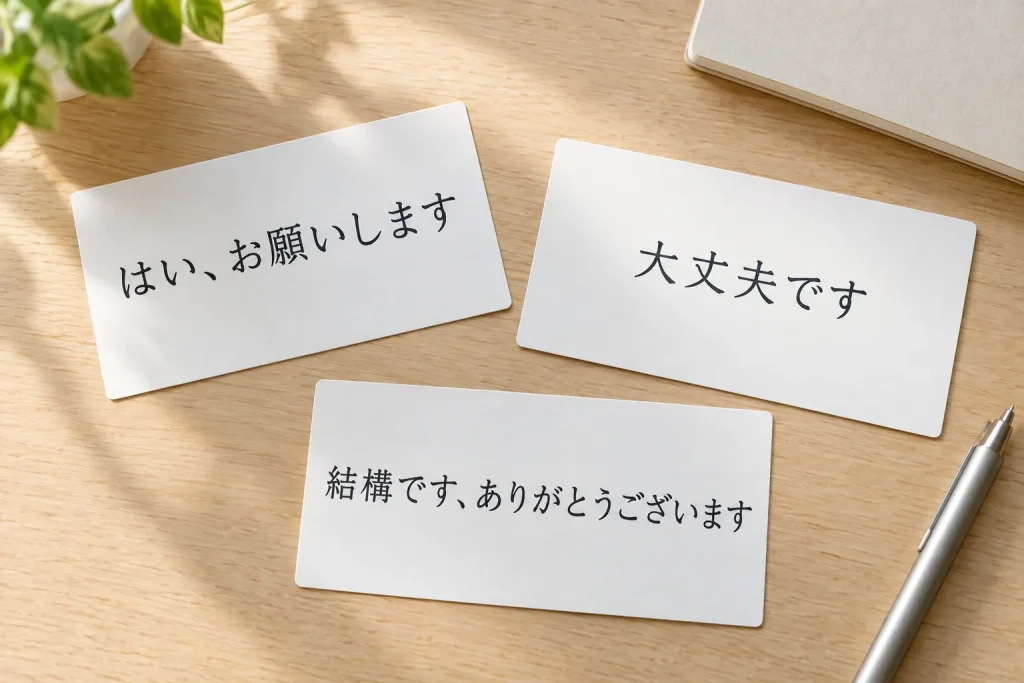
The practical set is:
- はい、お願いします — Hai, onegai shimasu — “Yes, please.”
- 大丈夫です — Daijōbu desu — “I’m fine, thanks.”
- 結構です、ありがとうございます — Kekkō desu, arigatō gozaimasu — “No, thank you.”
Here the “arithmetic” is conversational rather than financial. One acceptance plus one soft refusal plus one firm refusal gives you three outcomes without forcing you to improvise. Add the name of the object whenever the answer could be misread.
For more situations, use the phrasebook’s 337 phrases across 25 situations, each with its own page. It is more useful to open the relevant situation than to turn this comparison into a duplicate master list.
Why do learners default to kekkou desu?
Textbooks favor tidy equivalence. If 結構です appears beside “No, thank you,” it looks like a complete reusable answer. The translation hides the distance that the phrase can create in a small everyday exchange.
Learners also confuse formal wording with universal politeness. Formality increases distance as well as respect. That distance can be helpful in business, with a persistent salesperson, or when you want to close a negotiation; it can feel stiff when someone asks about a plastic bag.
Another mistake is ignoring prosody—the rhythm and intonation of speech. A warm 結構です with thanks and a smile does not land like a clipped 結構です delivered without eye contact. A hesitant 大丈夫です without a gesture can be less helpful than a direct sentence naming what you do not need.
The cost is usually not social disaster. It is friction: the cashier asks again, the host remains uncertain, or your answer sounds more final than intended. Choose for the job the phrase must do, not for the English gloss printed beside it.
What should you say if you have already caused confusion?
Use すみません, sumimasen, literally “it does not end,” but conventionally “excuse me” or “I’m sorry,” then state the object and decision. At a register, すみません、袋はいりません, sumimasen, fukuro wa irimasen, means “Sorry, I don’t need a bag.”
You do not need a long explanation. Repairing the answer with the relevant noun is faster than repeating 大丈夫です more loudly. The phrase The Word You Will Use Fifty Times a Day explains how sumimasen shifts among apology, attention-getting, and gratitude.
If you accidentally accepted something inexpensive, staff will generally correct it if the transaction still can be changed. Point to the item and use a short sentence. Fluency is not required; clarity is.
What should you stop worrying about?
Nobody minds that you learned careful textbook Japanese. A cashier will not spend the afternoon discussing whether your 結構です was slightly stiff. The interaction matters more to you because you are studying it.
Nobody expects a visitor to reproduce customer-service honorifics. The clerk’s language belongs to the staff role; your side can remain short and polite. You also do not need a dramatic bow for a declined bag.
What people notice is whether they can act on your answer. A small head shake, the object’s name, and a clear phrase are more useful than perfect pronunciation without context. If your message is understood and you acknowledge the other person, the exchange has worked.
Mini-FAQ
Is kekkou desu rude?
No. It is a polite, valid refusal, but it can sound formal, firm, or distant when used alone. Add ありがとうございます when you want the refusal to feel warmer.
Can daijoubu desu mean yes?
Yes. It can mean that something is acceptable or that you are all right. In an offer situation, a head shake or naming the unwanted item makes the negative meaning clear.
What is the safest answer at a convenience store?
For a routine offer you do not need, say the object plus は大丈夫です—for example, 袋は大丈夫です. If you want the item or service, say はい、お願いします.