What will the front desk ask when you check in? These Japanese phrases for hotels cover a predictable sequence: your name, reservation, passport, meal arrangements, luggage and checkout, with short answers that work even when the staff’s full sentence is difficult to catch.
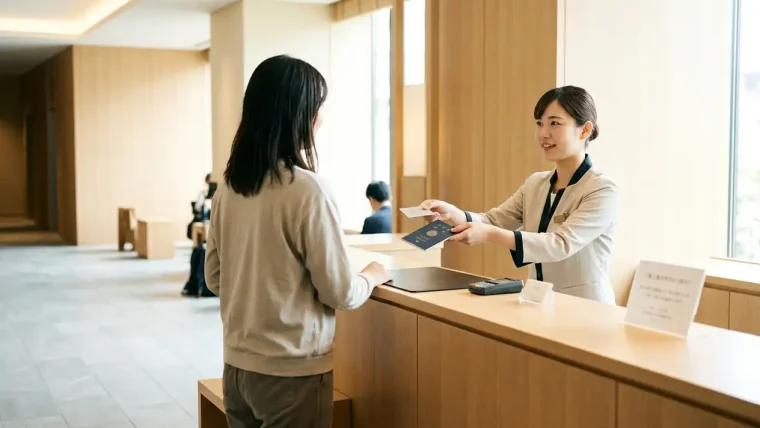
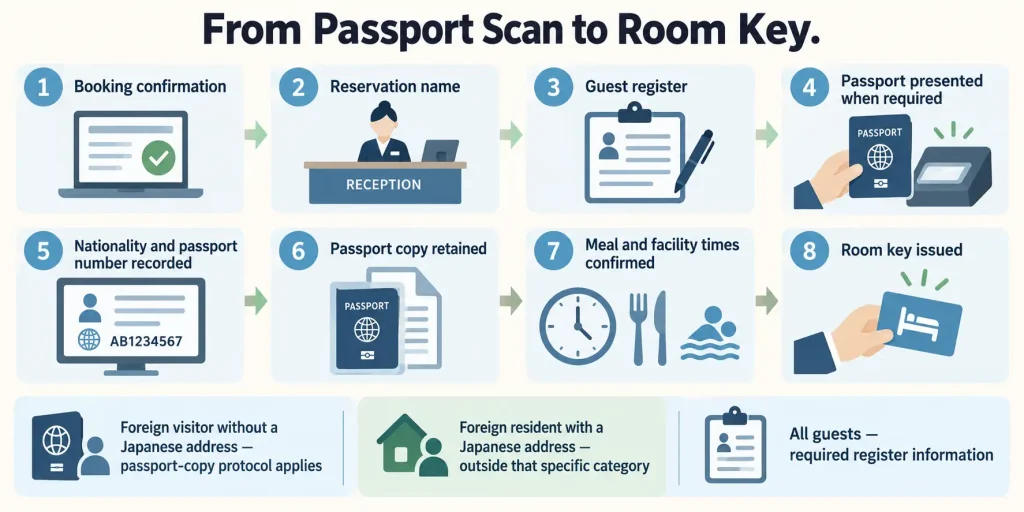
The passport scanner is not an improvised security measure. Under Japan’s lodging-registration rules and national health ministry guidance, accommodation operators record passport information and retain a copy for foreign guests who do not have an address in Japan. That qualification matters: the rule is not simply “copy every non-Japanese person’s passport.”
What do I say when I walk into a Japanese hotel?
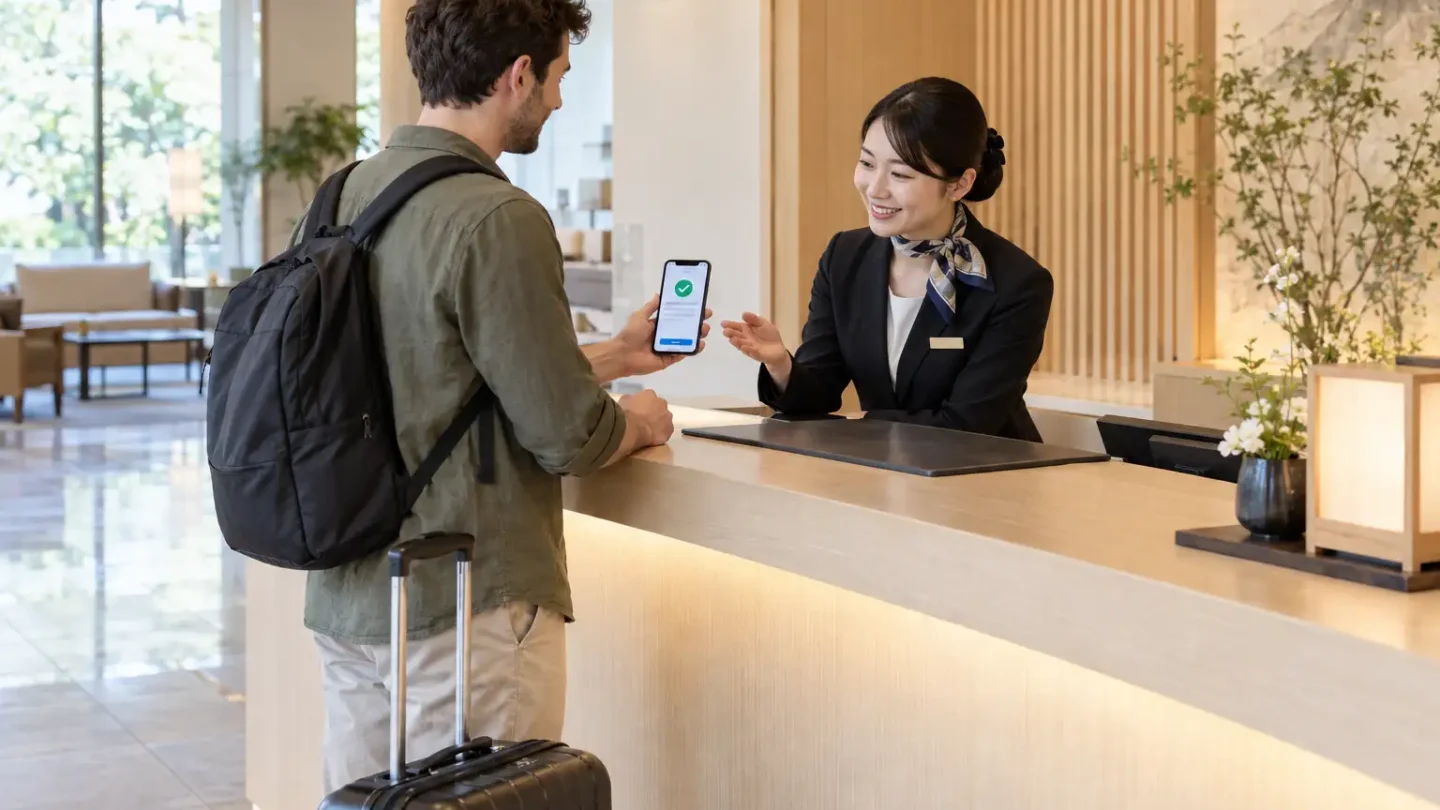
Begin with こんにちは, konnichiwa, “good afternoon,” or こんばんは, konbanwa, “good evening,” depending on the time. Then say:
予約しています。ミヤタです。
Yoyaku shite imasu. Miyata desu.
“I have a reservation. The name is Miyata.”
The essential unit is 予約, yoyaku, “reservation.” You do not need to translate your booking confirmation into Japanese if the property name, dates and reservation number are visible on your phone.
If you arrive in the morning, おはようございます, ohayō gozaimasu, “good morning,” is appropriate. Ohayou, Konnichiwa, Konbanwa: the Clock Decides explains where those greetings change without repeating the entire hotel protocol here.
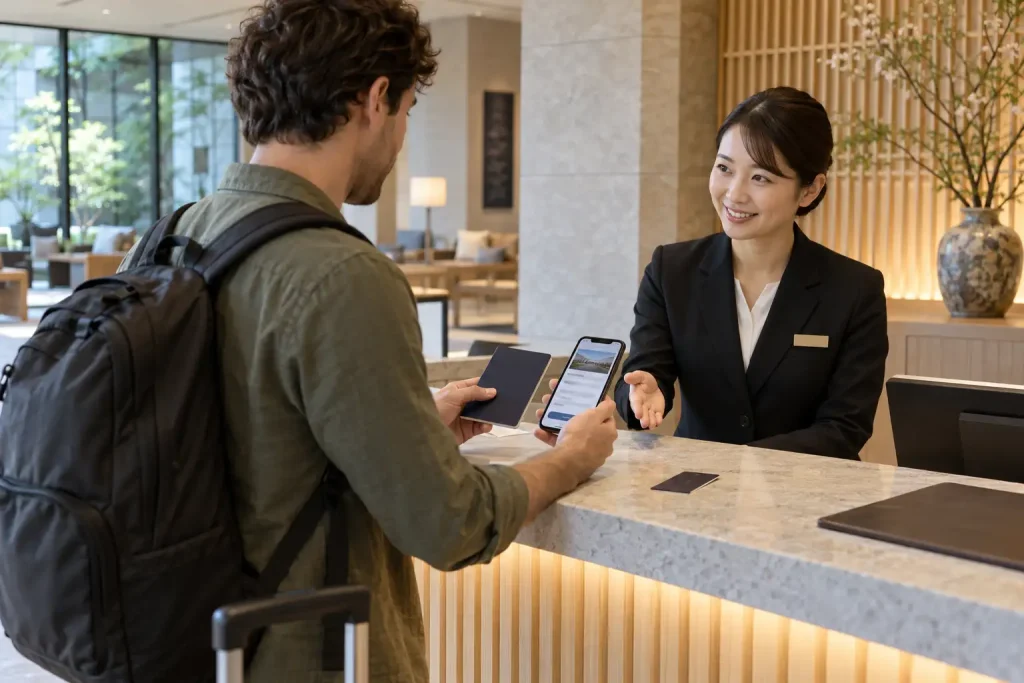
Which Japanese phrases for hotels cover check-in?
Staff may begin with ご予約のお名前をお願いします, go-yoyaku no o-namae o onegai shimasu, “Please give me the name on the reservation.” You can answer with the surname followed by です, desu, “it is.”
They may also ask:
何名様ですか。
Nan-mei-sama desu ka?
“How many guests are there?”
二名です。
Futari desu.
“There are two of us.”
何泊ですか。
Nan-paku desu ka?
“How many nights?”
三泊です。
San-paku desu.
“Three nights.”
The exact wording varies, but the information does not. Show the booking confirmation if you miss the question. Pointing to a written name or date is clearer than repeating English louder.
| Staff may say | Meaning | Short answer |
|---|---|---|
| ご予約のお名前をお願いします。 Go-yoyaku no o-namae o onegai shimasu. | Name on the reservation, please | ミヤタです。 Miyata desu. |
| 何名様ですか。 Nan-mei-sama desu ka? | How many guests? | 二名です。 Futari desu. |
| 何泊ですか。 Nan-paku desu ka? | How many nights? | 三泊です。 San-paku desu. |
| ご住所をお願いします。 Go-jūsho o onegai shimasu. | Your address, please | こちらです。 Kochira desu. — “Here it is.” |
| こちらにご記入ください。 Kochira ni go-kinyū kudasai. | Please fill this in | はい、わかりました。 Hai, wakarimashita. |
Why is the hotel copying my passport?
The guest register is called 宿泊者名簿, shukuhakusha meibo, literally “lodging guest register.” Accommodation operators must record required guest information, while additional rules apply when a foreign guest has no address in Japan.
For that group, the register includes nationality and passport number. Ministry of Health, Labour and Welfare guidance instructs the operator to ask for the passport and keep a copy with the register. A front desk may scan the identification page or photocopy it.
The useful phrase is:
パスポートをお願いします。
Pasupōto o onegai shimasu.
“Your passport, please.”
You can answer:
はい、どうぞ。
Hai, dōzo.
“Yes, here you are.”
If you live in Japan, say:
日本に住所があります。
Nihon ni jūsho ga arimasu.
“I have an address in Japan.”
The uncomfortable detail is that some properties may ask every visibly foreign guest for a passport before establishing whether that person has a Japanese address. The legal distinction is based on residence, not appearance or nationality alone. A resident can calmly state that they have an address in Japan and ask why a copy is needed.
The passport-copy protocol applies to foreign guests without an address in Japan; “all foreign-looking guests” is not the rule.
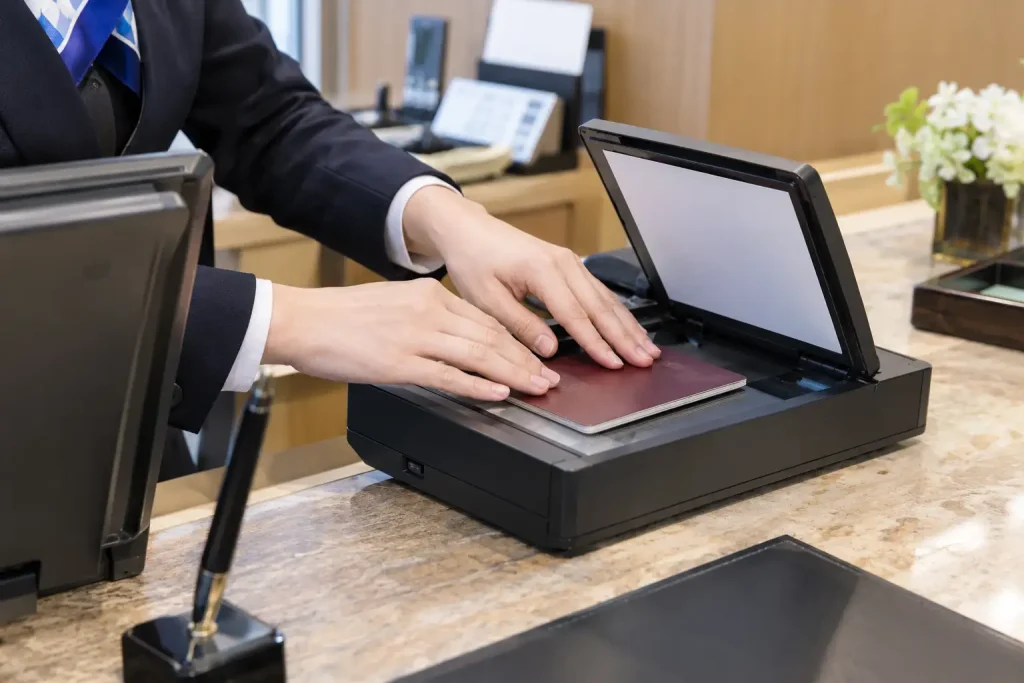
What if I do not understand the receptionist?
Say すみません、もう一度お願いします, sumimasen, mō ichido onegai shimasu, “Excuse me, please say that once more.” This is more useful than pretending to understand and discovering later that breakfast ends before you expected.
You can also ask:
ゆっくりお願いします。
Yukkuri onegai shimasu.
“Please speak slowly.”
書いていただけますか。
Kaite itadakemasu ka?
“Could you write it down?”
英語の案内はありますか。
Eigo no annai wa arimasu ka?
“Is there information in English?”
Hotel staff may use 敬語, keigo, literally “respectful language,” because they are speaking to a customer. Their long sentence may contain only one decision you need to make. Listen for concrete words such as 朝食, chōshoku, “breakfast,” 時, ji, “o’clock,” and チェックアウト, chekku auto, “checkout.”
You do not have to answer in equally elaborate Japanese. Polite desu and masu forms are enough. Japanese Politeness Levels, and Which One to Use explains why service Japanese sounds more formal than the Japanese a traveler needs to produce.
Can the hotel keep my luggage before check-in?
Ask:
チェックイン前に、荷物を預かっていただけますか。
Chekku-in mae ni, nimotsu o azukatte itadakemasu ka?
“Could you keep my luggage before check-in?”
After checkout, replace チェックイン前, chekku-in mae, “before check-in,” with チェックアウト後, chekku auto go, “after checkout.” The key verb is 預かる, azukaru, “to keep in custody.”
Do not assume every property can store bags. Staffless accommodation, capsule facilities and small inns may have limited space or fixed reception hours. Ask before arriving if luggage storage determines your day’s schedule.
If you are collecting a stored bag, say:
預けた荷物をお願いします。
Azuketa nimotsu o onegai shimasu.
“My stored luggage, please.”
Have the claim tag ready if the hotel issued one. The reception process becomes faster when staff can match the tag instead of searching by an English pronunciation of your name.
What does a ryokan ask before showing the room?
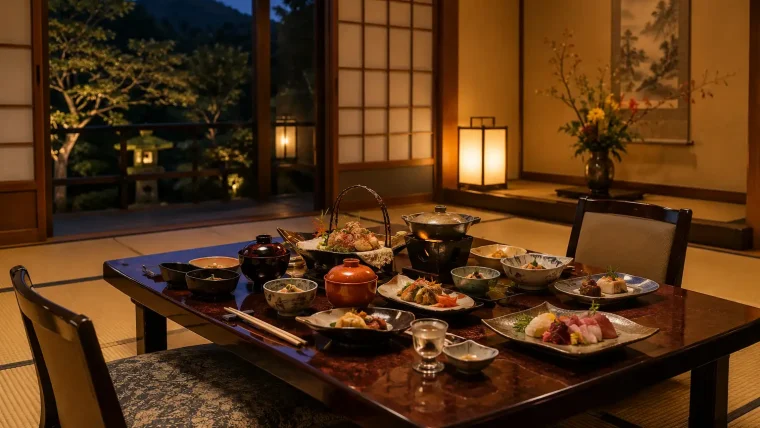
A 旅館, ryokan, literally “travel inn,” may need decisions that a business hotel does not. Staff may confirm dinner time, breakfast time, food restrictions, bathing arrangements and where meals will be served.
The conversation may begin with:
夕食は何時になさいますか。
Yūshoku wa nan-ji ni nasaimasu ka?
“What time would you like dinner?”
六時半でお願いします。
Roku-ji han de onegai shimasu.
“Six thirty, please.”
朝食は七時でよろしいですか。
Chōshoku wa shichi-ji de yoroshii desu ka?
“Is seven o’clock acceptable for breakfast?”
はい、大丈夫です。
Hai, daijōbu desu.
“Yes, that is fine.”
A ryokan meal is often scheduled around the kitchen’s preparation sequence rather than served whenever you enter a dining room. Arriving late without warning can affect dishes prepared for a particular time. If your train is delayed, contact the property instead of assuming dinner can be moved automatically.
| Situation | Useful Japanese | Meaning |
|---|---|---|
| Choose dinner time | 六時半でお願いします。 Roku-ji han de onegai shimasu. | Six thirty, please |
| Confirm breakfast | 七時で大丈夫です。 Shichi-ji de daijōbu desu. | Seven is fine |
| Ask where the meal is | 食事はどこですか。 Shokuji wa doko desu ka? | Where is the meal? |
| Report an allergy | そばアレルギーがあります。 Soba arerugī ga arimasu. | I have a buckwheat allergy |
| Say you do not eat something | 豚肉は食べません。 Butaniku wa tabemasen. | I do not eat pork |
| Ask about the bath | 大浴場は何時までですか。 Daiyokujō wa nan-ji made desu ka? | Until what time is the large bath open? |
Food restrictions should be sent before arrival whenever possible. Saying them when dinner is already being plated does not guarantee that the kitchen can replace stock, broth or sauces. Ordering Food in Japanese, Start to Finish covers restaurant exchanges; a ryokan needs earlier notice because the meal may be included in the booking.
How do I report a problem with the room?
Start with すみません, sumimasen, “excuse me,” name the object and state the problem. You do not need an accusation or a long apology.
エアコンが動きません。
Eakon ga ugokimasen.
“The air conditioner is not working.”
お湯が出ません。
Oyu ga demasen.
“There is no hot water.”
部屋が寒いです。
Heya ga samui desu.
“The room is cold.”
隣の部屋が少しうるさいです。
Tonari no heya ga sukoshi urusai desu.
“The next room is a little noisy.”
見ていただけますか。
Mite itadakemasu ka?
“Could you take a look?”
The word 少し, sukoshi, “a little,” softens the delivery without making the problem unimportant. State the issue once, show the room number and wait for the proposed solution. Speaking forcefully does not make the message clearer.
For medical danger, theft or a situation that requires police or emergency services, use the dedicated guide to what to say in Japan when something goes wrong. A broken lamp and an emergency do not belong in the same script.
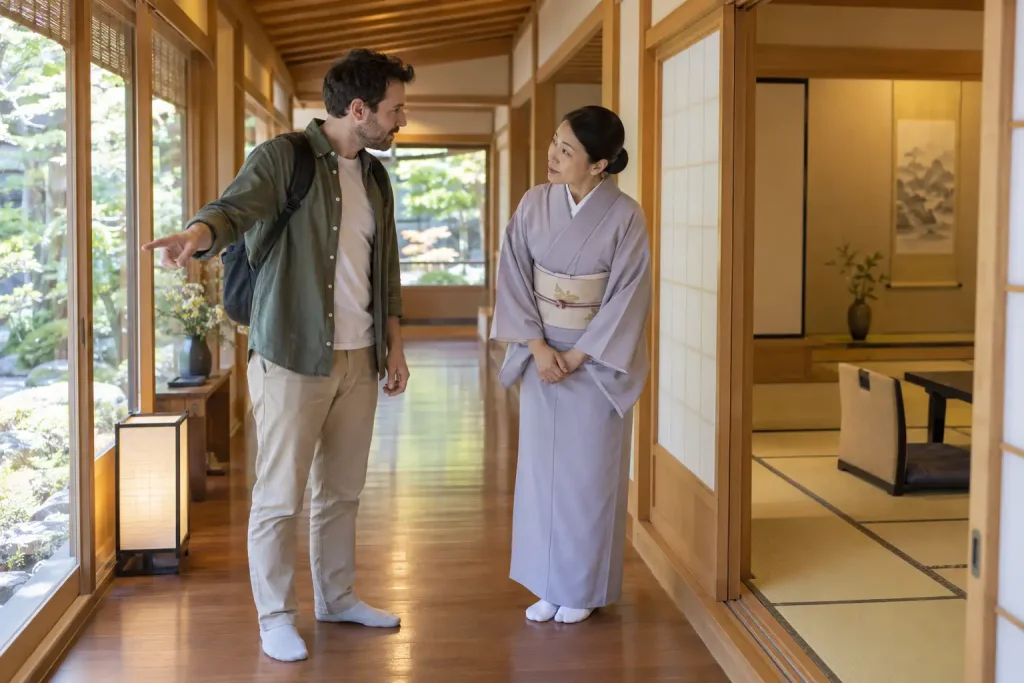
How do I ask the hotel to forward my suitcase?
The service is generally called 宅配便, takuhai-bin, literally “home-delivery service.” Ask:
荷物を次のホテルに送りたいです。
Nimotsu o tsugi no hoteru ni okuritai desu.
“I would like to send my luggage to my next hotel.”
宅配便を利用できますか。
Takuhai-bin o riyō dekimasu ka?
“Can I use a luggage-delivery service?”
The hotel will need the destination’s name, address, telephone number and the name attached to the next reservation. Show the booking page rather than trying to dictate a Japanese address. Confirm that the receiving property accepts forwarded luggage.
Do not promise yourself same-day arrival unless the carrier and hotel explicitly confirm it. Delivery time depends on origin, destination, acceptance cutoff, weather and the type of item. Keep medication, travel documents, electronics and the clothes you immediately need with you.
Useful follow-up questions include:
いつ届きますか。
Itsu todokimasu ka?
“When will it arrive?”
料金はいくらですか。
Ryōkin wa ikura desu ka?
“How much is the fee?”
このホテルで受け取れますか。
Kono hoteru de uketoremasu ka?
“Can it be received at this hotel?”
Prices change by carrier, size and route, so no universal yen or dollar figure belongs in the phrase itself. Ask the counter to show you the total before paying.
This is the question travelers do not know to ask: when is the front desk unattended?
Ask フロントは何時までですか, furonto wa nan-ji made desu ka, “Until what time is the front desk staffed?” This matters at small ryokan, family-run inns, hostels and properties using self-check-in.
A room key, entrance code or curfew may determine whether you can reenter late at night. Staff may say:
門限は十一時です。
Mongen wa jūichi-ji desu.
“The curfew is eleven.”
夜はこの暗証番号を使ってください。
Yoru wa kono anshō bangō o tsukatte kudasai.
“At night, please use this access code.”
Do not photograph or publish a door code where other people can see it. Save it privately and confirm whether the room key must be left at reception.
The other detail Americans often miss is volume. Hotel corridors, elevators and ryokan rooms with thin partitions reward a lower conversational level than a busy US lobby. The Register Americans Do Not Notice explains how delivery can sound considerate or aggressive even when the dictionary meaning is correct.
What do I say at checkout?
The shortest useful phrase is:
チェックアウトをお願いします。
Chekku auto o onegai shimasu.
“I would like to check out.”
Give the room key or card to the receptionist. If payment remains, staff may ask:
お支払いは現金ですか、カードですか。
O-shiharai wa genkin desu ka, kādo desu ka?
“Will you pay by cash or card?”
カードでお願いします。
Kādo de onegai shimasu.
“By card, please.”
To request a receipt, say:
領収書をお願いします。
Ryōshūsho o onegai shimasu.
“A receipt, please.”
If you need the receipt made out to a company, show the exact written company name. Japanese receipts may use 宛名, atena, “addressee,” and staff should not have to guess its spelling.
Before leaving, check for a stored passport, luggage, charging cable and items placed in a room safe. Then say ありがとうございました, arigatō gozaimashita, “thank you very much.” You do not need to bow deeply or produce ceremonial language.
Which phrases should I save before the trip?
Save the phrases tied to actions you may actually take. A small offline note is more useful at reception than a long vocabulary list you cannot scan quickly.
The practical set is:
- 予約しています。 Yoyaku shite imasu. — I have a reservation.
- もう一度お願いします。 Mō ichido onegai shimasu. — Please say that again.
- 書いていただけますか。 Kaite itadakemasu ka? — Could you write it down?
- 荷物を預かっていただけますか。 Nimotsu o azukatte itadakemasu ka? — Could you keep my luggage?
- エアコンが動きません。 Eakon ga ugokimasen. — The air conditioner is not working.
- 何時までですか。 Nan-ji made desu ka? — Until what time?
- チェックアウトをお願いします。 Chekku auto o onegai shimasu. — I would like to check out.
For greetings, transport, restaurants and emergencies, Essential Japanese Phrases for Travelers provides the broader travel sequence. The site’s phrasebook with 337 phrases in 25 situations gives each phrase its own page with pronunciation support, so there is no reason to reproduce the entire tool here.
The next thing to learn is how staff language changes with time of day: continue with Ohayou, Konnichiwa, Konbanwa: the Clock Decides.
Mini-FAQ
Does every foreign guest have to give the hotel a passport copy?
The national passport-copy guidance specifically concerns foreign guests who do not have an address in Japan. Guests residing in Japan fall outside that defined group, although the accommodation still maintains a guest register and may request information needed for it.
Can I refuse to let a hotel scan my passport?
If you are a visiting foreign guest without an address in Japan, the operator is expected to request the passport, record its number and retain a copy under the national lodging-registration protocol. If you reside in Japan or believe the request is being applied incorrectly, state that clearly and ask the property to explain its basis.
Is a ryokan harder than a hotel if I speak no Japanese?
Not necessarily. The sequence is simply different because staff may need to confirm meals, bathing hours and bedding arrangements. Send dietary restrictions before arrival, keep the booking confirmation accessible and save the few phrases connected to your actual stay.