Your decision is not simply whether to buy the highest number; it is whether you want intense Japanese marbling, a more balanced steak or American-raised beef with wagyu genetics. Getting what does A5 wagyu mean wrong can make you pay a premium for richness you do not enjoy, and the answer depends on grade, provenance and how the cut will be served.
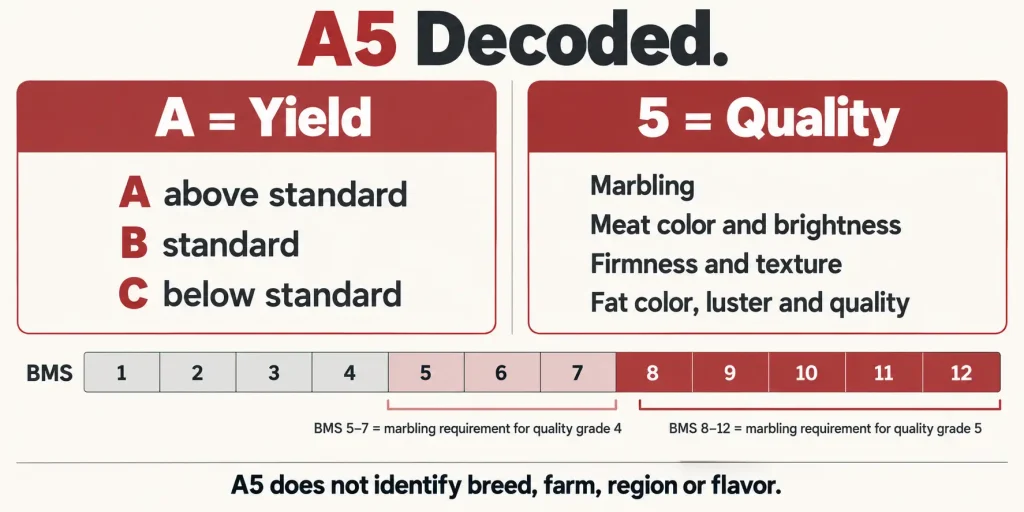
A5 is a Japanese carcass grade, not a breed, farm, region or flavor guarantee. The A measures how much usable meat the carcass is expected to yield, while the 5 is a quality grade determined from marbling, meat color and brightness, firmness and texture, and fat color, luster and quality.
What does A5 wagyu mean on a Japanese label?
The Japanese grade has two separate axes. The yield grade is written as A, B or C, while the meat-quality grade runs from 1 to 5. Joining the two produces grades such as A5, A4, B5 or B3.
A means an above-standard estimated yield of saleable meat from the carcass. B means standard yield, and C means below-standard yield. That letter matters to producers and processors, but it does not directly tell you whether your steak will taste better.
The number is the eating-quality side of the system, although “eating quality” still means measured carcass characteristics rather than a tasting panel. Four factors are assessed:
- Fat marbling
- Meat color and brightness
- Firmness and texture
- Fat color, luster and quality
The final quality grade follows the lowest result among those factors. A carcass does not receive quality grade 5 merely because its marbling reaches the required range if another assessed factor grades lower.
That correction matters because the usual explanation—“A means quality and 5 means marbling”—is wrong twice. For a broader introduction to menu terms and meal formats, begin with Japanese Food for Beginners: How to Read a Menu.
| Label element | What it measures | What it does not prove |
|---|---|---|
| A, B or C | Estimated carcass yield | Flavor, breed or farm quality |
| 1 to 5 | Lowest result across four quality factors | A particular region or brand |
| BMS | Amount and distribution of marbling | Tenderness, aroma or your personal preference |
| 和牛, wagyū | “Japanese cattle,” used for designated Japanese breeds in Japan | That US beef was raised in Japan |
| Brand name | Rules of a regional or producer program | A universal flavor shared by every carcass |
When should you choose Japanese A5?
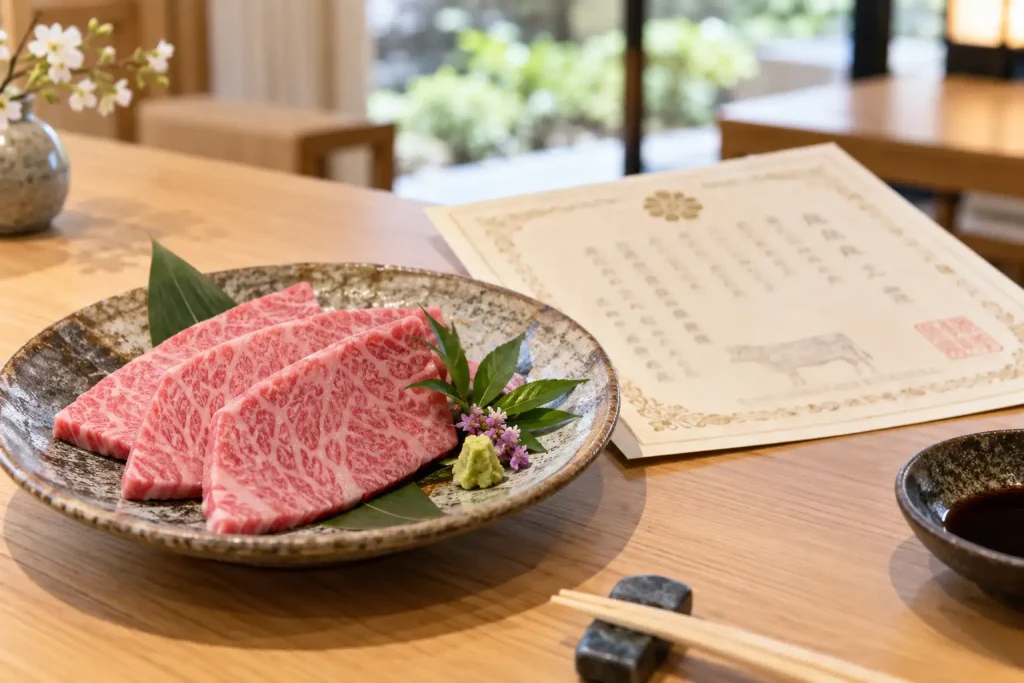
Choose Japanese A5 wagyu when you specifically want dense, fine marbling and plan to eat a small, carefully cooked portion. It suits a first tasting, teppanyaki, yakiniku or a comparison in which the beef itself is the main event.
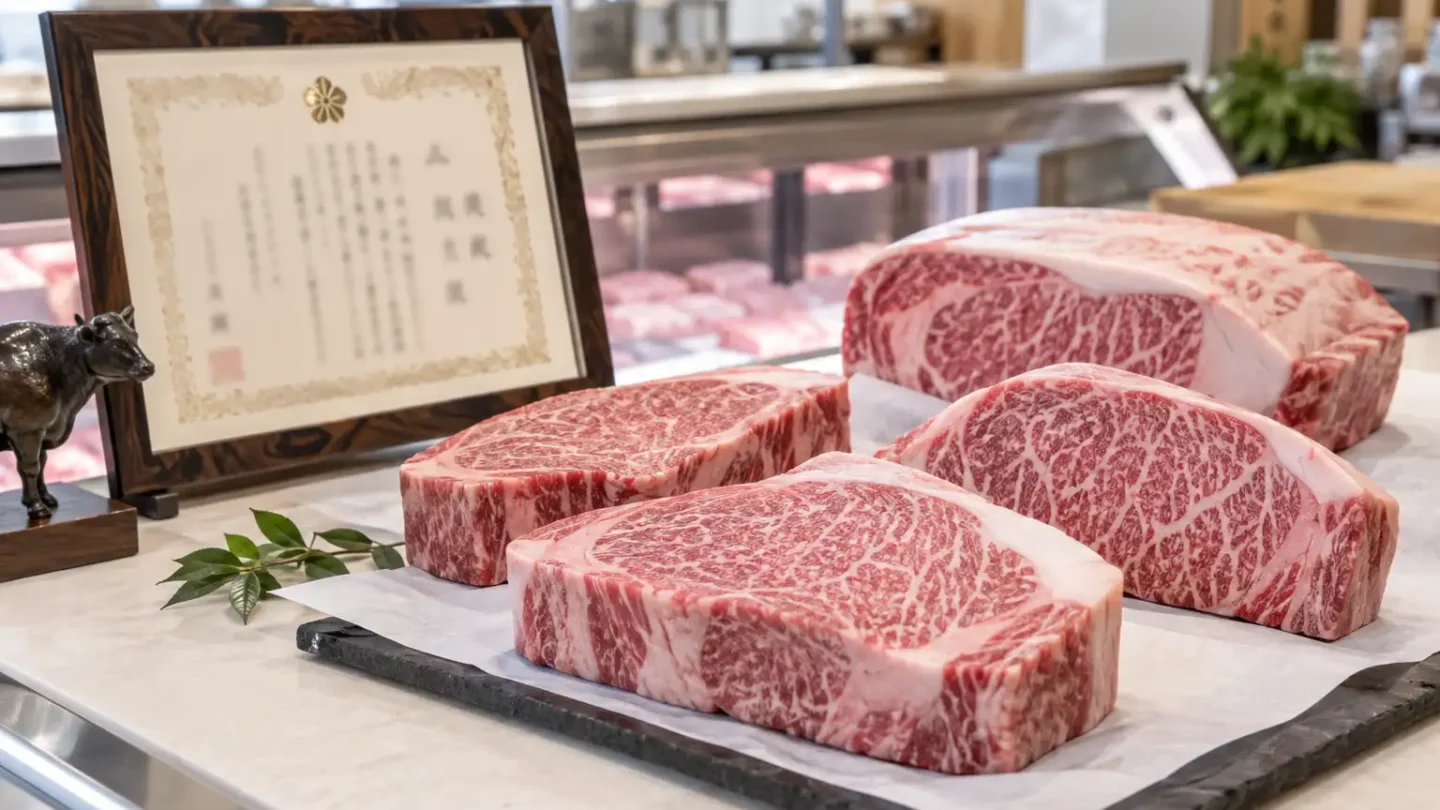
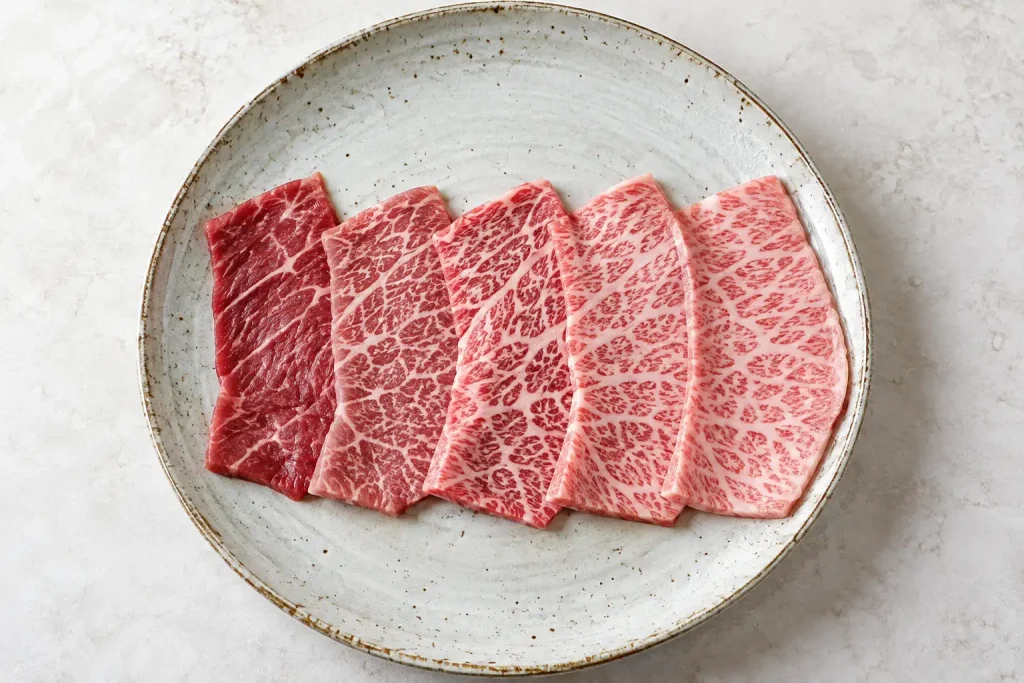
Quality grade 5 corresponds to Beef Marbling Standard scores 8 through 12, but marbling is not the only condition. The meat, texture and fat assessments must also support the final grade. An A5 BMS 8 carcass and an A5 BMS 12 carcass therefore share a grade while carrying visibly different amounts of marbling.
A5 does not tell you the prefecture, cattle lineage, feed program, age, cut or cooking quality. It also says nothing about whether you personally prefer a heavy concentration of intramuscular fat. A badly handled A5 cut can be less enjoyable than expertly cooked beef with a lower grade.
The cost is normally the highest of the options because imported Japanese beef combines limited supply, documentation, shipping and a premium grade. Before paying, ask for the country of origin, cut, grade and serving weight. A menu that says only “wagyu” has not answered those questions.
A5 identifies a carcass grade. It does not certify that every diner will prefer every cut from that carcass.
When is A4 the better choice?
Choose A4 wagyu if you want pronounced marbling but still want the meat and browned exterior to carry more of the experience. Quality grade 4 generally corresponds to BMS 5 through 7, subject to the other quality factors.
A4 can be easier to enjoy as a conventional steak-sized serving. A5 often works best in smaller slices because its richness accumulates quickly, while A4 can leave more room for chew, crust and beef flavor. That is a dining judgment, not an official grading claim.
The practical threshold is your desired portion and cooking style. If the meal is built around several small bites, A5 makes sense. If you expect one larger steak eaten from first bite to last, A4 may give you a better balance and can cost less.
A4 is not failed A5. The Japanese grading system describes measurable carcass characteristics; it does not rank every possible dining experience from worst to best. Choosing the lower number deliberately can be the more informed decision.
When should you buy American wagyu?
Choose American wagyu when you want more marbling than conventional US beef but prefer a familiar steak format and flavor profile. Many American wagyu programs use wagyu crossed with Angus or another breed, although registered fullblood and high-percentage wagyu cattle also exist in the United States.
This category does not automatically carry Japan’s A–C and 1–5 carcass grade. US beef can instead be evaluated under USDA grading or a producer’s proprietary marbling system. An American package labeled “A5” needs clarification because A5 belongs to the Japanese grading framework.
The term “American wagyu” is not precise enough to reveal genetic percentage. Ask whether the animal was:
- Fullblood wagyu with documented wagyu ancestry
- Purebred under the registry’s defined threshold
- A percentage or F1 cross
- Sold only under an unverified marketing description
The cost usually sits below imported Japanese A5 but above ordinary USDA-graded beef. What you receive can be excellent, but it is a different decision: American production, American grading or brand standards, and potentially crossbred genetics.
The brief’s claim that most US wagyu is crossbred is plausible and commonly repeated within the industry, but no current government census was found that measures the genetic composition of all beef marketed as wagyu in the United States. The safe buying assumption is not “all American wagyu is crossbred.” It is “the word American wagyu alone does not prove fullblood genetics.”
When is ordinary Japanese beef enough?
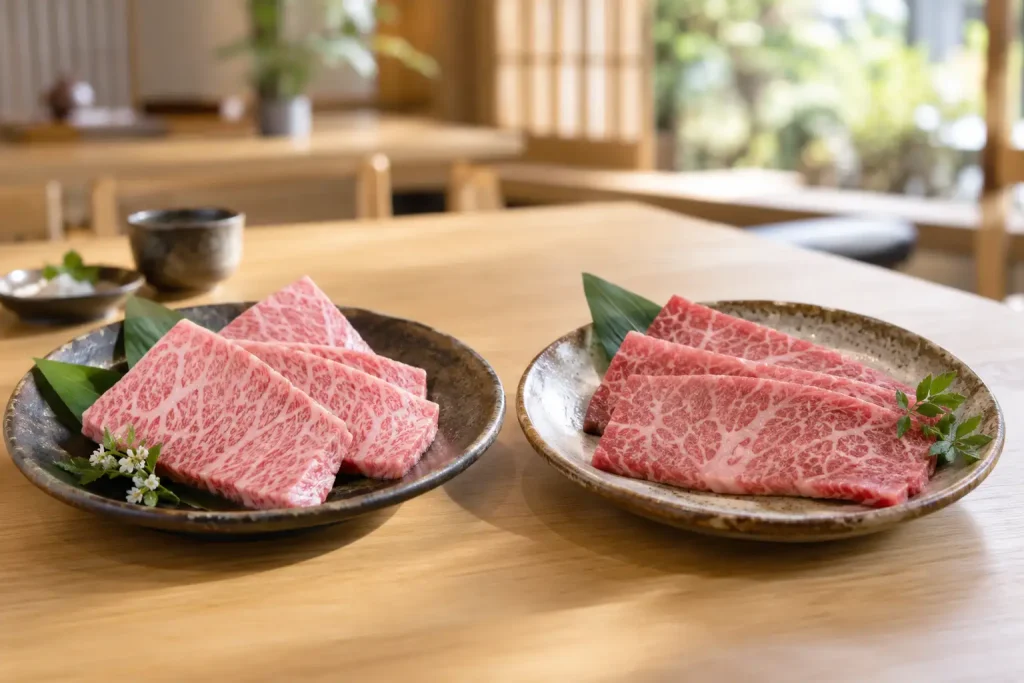
Choose ordinary Japanese beef or a lower formal grade when wagyu is only one component of the meal. Thin slices in curry, noodles, hot pot or strongly seasoned dishes do not always justify paying for extreme marbling.
This is the lowest-cost path among the options in this guide, but “lower cost” does not mean poor food. Cut, freshness, thickness and cooking method can matter more than a luxury carcass label. Japan has excellent beef that is neither A5 nor presented as a famous regional brand.
This choice also suits travelers who want to explore more meals rather than spend heavily on one plate. Shun: the Month Decides the Menu explains how seasonality changes the rest of the menu, while Regional Ramen Styles, and the Four Variables covers a completely different way to compare regional food.
| Option | Relative cost | Marbling expectation | Best suited to |
|---|---|---|---|
| Japanese A5 | Highest | Very high; BMS 8–12 | Small luxury tasting |
| Japanese A4 | High | High; BMS 5–7 | Rich but more balanced steak |
| American wagyu | Medium to high | Varies by genetics and producer | Familiar steak with added marbling |
| Other Japanese beef | Low to high | Wide range | Everyday dishes and budget control |
Which three factors actually decide the answer?
Provenance is the first factor. If you want Japanese A5, the beef must be Japanese, and the seller should be able to document origin and grade. “Wagyu-style,” “Kobe-style” and “American wagyu” are not substitutes for a Japanese certificate.
Marbling tolerance is the second factor. If you enjoy several very rich bites more than a large steak, A5 is a logical choice. If you want a full steak with a stronger lean-meat presence, the answer flips toward A4 or American wagyu.
Preparation is the third factor. Thin slices, teppanyaki cubes and short yakiniku cooking expose marbling without making the portion exhausting. Burgers, long braises and heavily sauced dishes reduce the value of paying for a narrowly specified Japanese carcass grade.
These variables matter more than the letter A. Moving from B5 to A5 changes yield classification while preserving quality grade 5. For the diner, origin, BMS, cut and cooking may be more revealing than the yield letter.
How does the BMS scale change the choice?
脂肪交雑, shibō kōzatsu, literally “fat intermingling,” is evaluated through the Beef Marbling Standard. The BMS scale runs from 1 to 12, with larger numbers representing more abundant marbling.
The quality-grade mapping is:
| Japanese quality grade | BMS range required for marbling |
|---|---|
| 5 | 8–12 |
| 4 | 5–7 |
| 3 | 3–4 |
| 2 | 2 |
| 1 | 1 |
This table does not mean BMS alone fixes the final quality grade. The other assessed characteristics still matter, and the lowest component result controls the final number.
The useful threshold is between BMS 7 and BMS 8: crossing it moves the marbling component from quality grade 4 into grade 5. Inside A5 itself, the difference between BMS 8 and 12 can still be visually substantial. Ask for the BMS when the seller uses “A5” as if it described one exact level of marbling.
What would three different diners choose?
Consider a first-time visitor who wants to understand the famous product but has several other meals planned. The best choice is a small Japanese A5 tasting with documented origin. The logic is simple: verified Japanese provenance + a small serving + curiosity about maximum marbling = A5.
Now consider a steak eater who wants a substantial main course. If the choice is A5 BMS 10 versus A4 BMS 6, the first option sits four BMS points higher and may feel far richer. A4 is the safer choice when portion size and browned meat flavor matter more than maximum fat dispersion.
The third diner is eating in the United States and sees “American wagyu” beside “Japanese A5.” The American option may offer a larger steak at a lower price, but the label does not establish Japanese origin or A5 grading. The decision becomes familiar steak experience versus documented Japanese tasting—not cheap and expensive versions of one identical product.
A vegetarian traveler should skip this decision entirely. The Only Reliably Vegan Meal in Japan explains 精進料理, shōjin ryōri, literally “devotion cuisine,” while the site’s phrasebook with 337 phrases, including ordering and allergies helps communicate dietary needs.
Which label details should you check before ordering?
Ask for country of origin first. If the answer is Japan, ask for the formal grade and, for an expensive purchase, supporting documentation. If the answer is the United States or Australia, do not assume that Japanese A5 terminology applies.
Then check:
- Country of origin
- Japanese carcass grade, if claimed
- BMS, if available
- Cut and serving weight
- Fullblood, purebred or crossbred status for non-Japanese wagyu
- Regional brand only when its certification can be identified
The phrase 和牛, wagyū, literally “Japanese cattle,” has a defined livestock context in Japan. In American marketing, “wagyu” can cover a much broader range of genetics and production systems. The same word on two menus may therefore describe different products.
If the server cannot answer technical questions, that does not prove fraud. It does mean you lack the information needed to justify a large premium. Order for the dish in front of you, not for a story the label has not documented.
What are the expensive mistakes?
The first mistake is treating A as the beef equivalent of an American school grade. A is yield, so it rewards how much usable meat the carcass produces. It is not a direct score for flavor.
The second mistake is saying the 5 “means marbling.” Grade 5 requires high marbling, but it also reflects color, brightness, firmness, texture and fat characteristics. The lowest assessment controls the final quality grade.
The third mistake is treating wagyu as a synonym for Japanese A5. Wagyu identifies cattle background, A5 identifies a Japanese carcass grade, and Kobe or another regional name applies a separate brand specification. Those labels answer different questions.
The fourth mistake is ordering too much. A5 is not simply a richer USDA Prime steak. Its dense marbling can make a small serving feel complete, so paying for a large portion may buy fatigue rather than pleasure.
The final mistake is assuming that the highest grade must match every dish. Rice changes sushi into sushi, as Sushi vs Sashimi: The Difference Is the Rice explains; in the same way, cut and preparation can change whether extreme beef marbling is useful.
How should you make the final choice?
If you want a small, documented Japanese luxury tasting, choose A5 and ask for origin, grade and BMS.
Otherwise, choose A4 or clearly identified American wagyu for a larger, more steak-like meal.
Mini-FAQ
Is A5 the highest Japanese beef grade?
A5 combines the highest yield category with quality grade 5. That makes it the top combined grade, but A describes yield rather than better flavor.
Does the 5 mean BMS 5?
No. Quality grade 5 requires a marbling result in the BMS 8–12 range, plus qualifying results for the other quality factors.
Is American wagyu fake?
No. It can come from documented fullblood, purebred or crossbred wagyu cattle raised in the United States. It is simply not the same claim as Japanese origin or a Japanese A5 carcass grade.