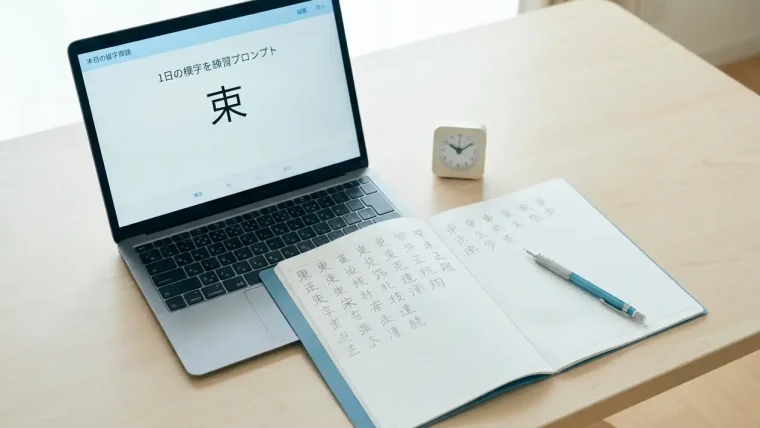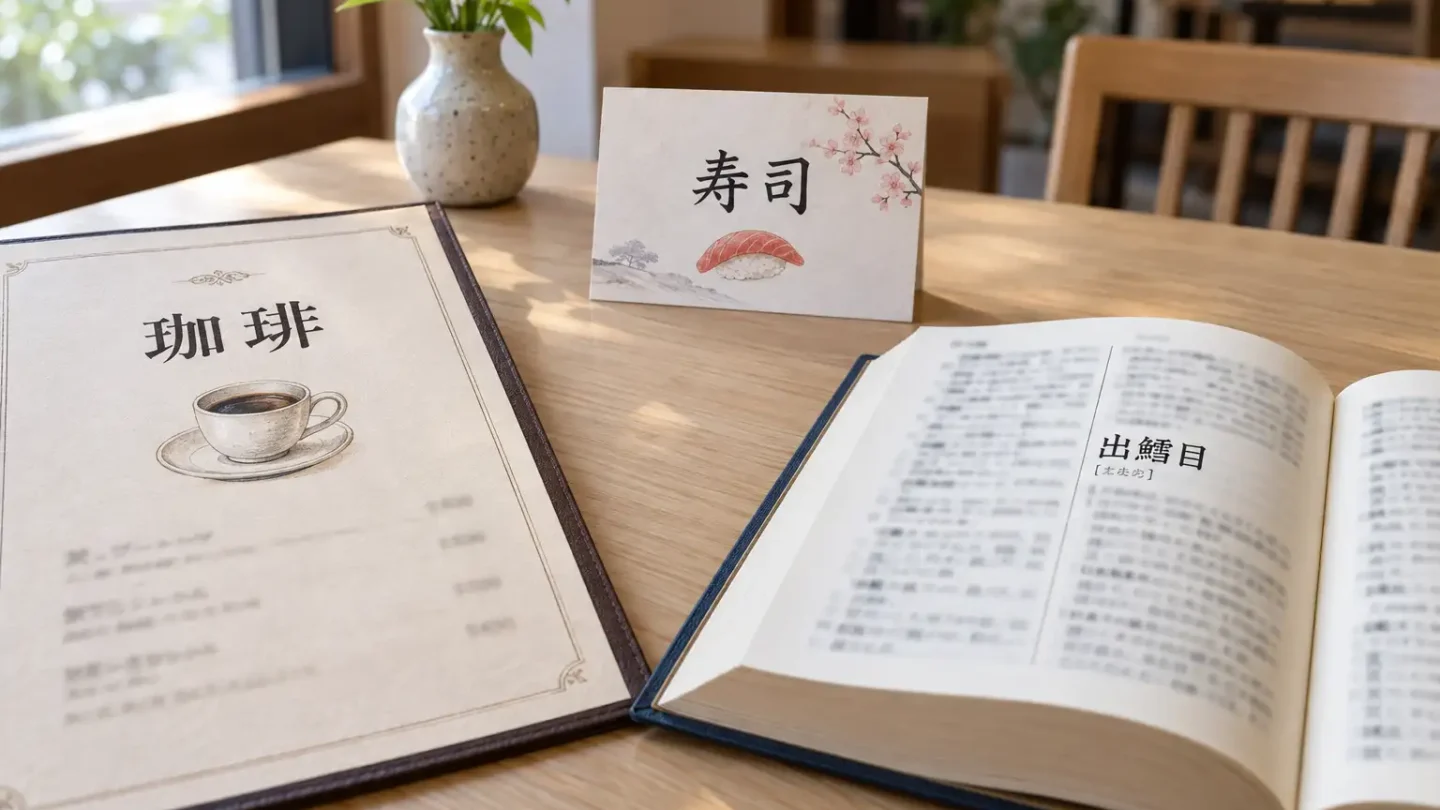
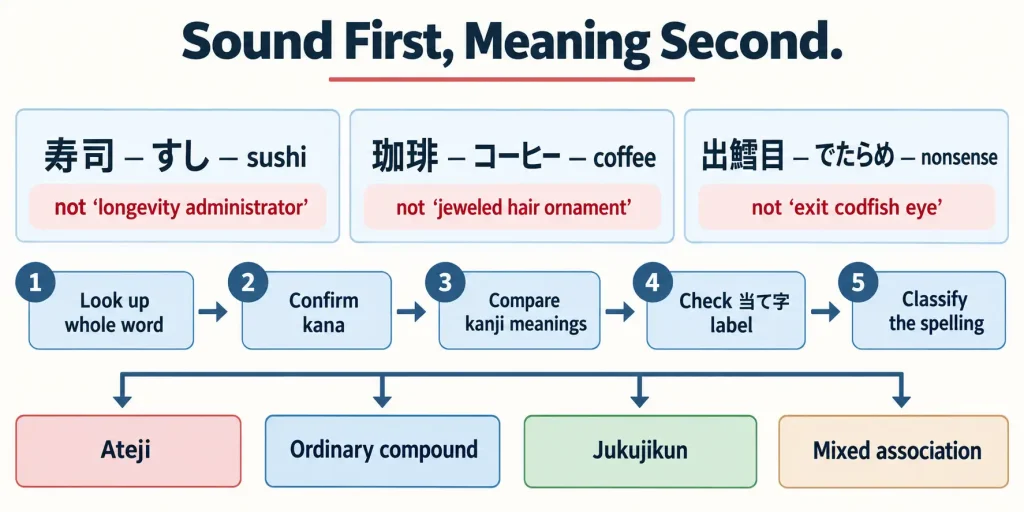
Why do the kanji in 寿司 not translate into “sushi”? Because ateji examples such as 寿司, 珈琲 and 出鱈目 use characters primarily to represent an existing word’s sound, so translating each character separately produces an explanation the word never had.
What does ateji mean?
当て字, ateji, literally “assigned characters,” describes kanji applied to a word in a way that does not follow their ordinary meanings or standard reading relationships. In the narrow sense used here, the characters provide an approximate sound while their dictionary meanings are secondary or irrelevant.
Japanese writing normally lets kanji carry both sound and meaning. Ateji deliberately loosens that connection. If you need the larger map of how hiragana, katakana and kanji divide the work, Hiragana, Katakana, Kanji: How Japanese Writing Works covers that foundation without duplicating it here.
Are ateji just kanji spelling out sounds?
Often, but not mechanically. A writer selects kanji whose available readings can approximate the word, yet the match may reflect an older pronunciation, historical spelling or conventional reading rather than modern sound-by-sound transcription.
This is why ateji are not a secret alphabet hidden inside kanji. You cannot reliably build or decode them by assigning one fixed sound to every character. The established word comes first; the spelling is attached to it.
A useful comparison is a rebus. If an English puzzle uses an image of an eye for the sound “I,” the picture’s literal meaning is not the intended message. Ateji can make kanji perform a similar job, although historical convention determines which spellings survive.
What are the clearest ateji examples in daily life?
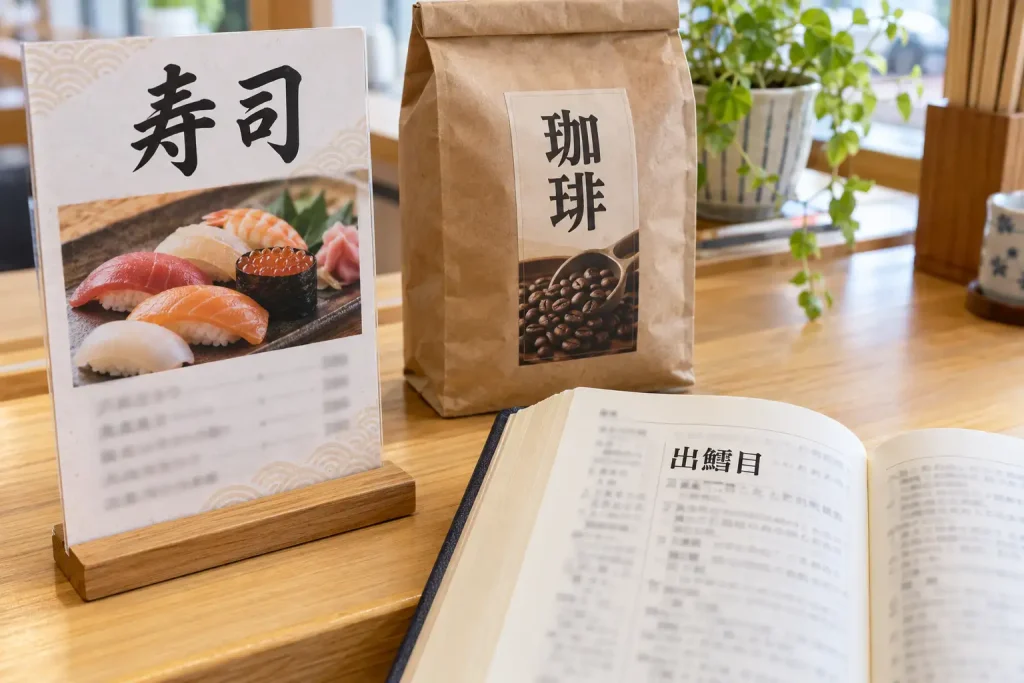
Start with the three words that expose the mechanism most cleanly. Their character-by-character meanings either fail to explain the word or actively tempt you into a false story.
| Written form | Reading | Actual meaning | What a literal kanji reading suggests |
|---|---|---|---|
| 寿司 | sushi | Sushi | Longevity + administrator |
| 珈琲 | kōhī | Coffee | Ornamental hairpiece + string of jewels |
| 出鱈目 | detarame | Nonsense; irresponsible or random | Exit + codfish + eye |
| 歌舞伎 | kabuki | Kabuki theater | Song + dance + skill or performer |
| 滅茶苦茶 | mechakucha | Chaotic; absurd; completely | Destroy + tea + suffering + tea |
寿司, sushi, has a spelling selected for the sounds su and shi, with auspicious characters that look suitable on a restaurant sign. The form does not define sushi as “long life administered,” and 司 is not identifying a restaurant manager. Japanese reference works describe 寿司 as a favorable or celebratory ateji that became established alongside older forms such as 鮨 and 鮓.
珈琲, kōhī, means “coffee” and represents a loanword derived through Dutch koffie. The characters 珈 and 琲 refer to jeweled ornaments rather than roasted beans or a drink. Their readings approximate the borrowed sound, while their elegant visual associations helped make the spelling memorable.
出鱈目, detarame, means “nonsense,” “reckless” or “without a sound basis.” 鱈 means codfish, but cod has nothing to do with the word’s current meaning. The tara sequence in the spoken word gave the spelling somewhere to attach.
When the literal kanji translation sounds like an elaborate riddle, first check whether the spelling is ateji.
Why is 寿司 written with “longevity” and “administrator”?
The word sushi existed before the spelling 寿司 became its familiar form. Dictionary histories connect the spoken word with 酸し, sushi, “sour,” referring to the acidic character of earlier fermented preparations. 寿司 appeared later as one of several written forms.
寿 can be read su in the compound, and 司 supplies shi. The characters are visually positive: 寿 is associated with longevity and celebration, making it attractive for food sold on auspicious occasions. That positive association may explain why the spelling worked socially, but it is not a compositional definition of the dish.
This distinction prevents two opposite mistakes. It would be wrong to say the characters were selected with absolutely no attention to their appearance or associations. It would also be wrong to reverse-engineer “longevity administrator” into the origin of sushi.
The uncomfortable lesson is that a polished character explanation can still be false. Kanji invite storytelling because each graph has meanings of its own. With sushi kanji, historical spelling evidence matters more than an ingenious modern interpretation.
Does 珈琲 literally describe coffee berries?
No reliable dictionary definition makes 珈琲 a normal compound meaning coffee berries. The characters belong to the semantic field of ornaments: 珈 refers to a jeweled hair ornament, while 琲 can refer to a string of beads or jewels.
The spelling has traditionally been attributed to the scholar Udagawa Yōan, but reference sources do not all express the attribution with equal certainty. The form is documented in the 1862 A Pocket Dictionary of the English and Japanese Language, and the Nihon Kokugo Daijiten notes that it became increasingly established around the end of the Meiji period.
A popular explanation says the red fruit on a coffee branch resembled an ornament. That is an appealing account of why these particular characters may have been preferred over other phonetic candidates. It does not change the underlying structure: 珈琲 represents the sound of a foreign word rather than translating its beverage meaning.
Today you will more often see コーヒー, kōhī, in katakana in ordinary writing. 珈琲 remains visible in café names, packaging and designs that want a traditional or literary appearance. The two spellings name the same drink; the kanji version does not indicate a different brewing method.

Is 出鱈目 really connected to codfish?
No. 出鱈目, detarame, “nonsense” or “haphazard,” is identified by the Nihon Kokugo Daijiten as ateji, and the fish character 鱈 was recruited for its tara sound.
The precise origin of the spoken word is less secure than the status of the spelling. Explanations connect it either with words coming out carelessly or with accepting whatever result appears, but the evidence does not justify presenting a single colorful story as settled fact. What can be stated safely is that a codfish’s eye is not the source of the modern meaning.
This is an unusually useful warning for learners. If you translate 出 as “come out,” 鱈 as “cod” and 目 as “eye,” you receive a vivid image with no lexical value. The oddity belongs to the spelling, not to the definition.
The same problem appears when automated tools segment a conventional ateji spelling into independent kanji. A dictionary that recognizes the complete entry 出鱈目 will give a useful result. A tool that explains only the three isolated characters may produce fluent-looking literal kanji translation that is entirely misleading.
Why not write all these words in kana?
Modern Japanese frequently does. コーヒー is the normal transparent spelling for a foreign loanword, while でたらめ removes the visual complexity of 出鱈目. Sushi can appear as すし, スシ, 鮨 or 寿司 depending on the publication, sign and desired tone.
Ateji persist because spelling does more than record pronunciation. Kanji can suggest tradition, formality, humor, refinement or deliberate visual excess. A café may choose 珈琲 because it looks older and more atmospheric than コーヒー, not because customers pronounce the drink differently.
| Form | Main function | What you should do |
|---|---|---|
| コーヒー | Transparent loanword spelling | Read directly through katakana |
| 珈琲 | Conventional, visually traditional spelling | Learn the whole word as kōhī |
| でたらめ | Plain phonetic spelling | Read directly through hiragana |
| 出鱈目 | Conventional ateji spelling | Look up the complete compound |
| すし | Neutral phonetic spelling | Read directly as sushi |
| 寿司 | Established kanji spelling | Recognize it as a complete word |
This is also why learning katakana remains necessary even if you enjoy unusual kanji. The site’s guide to romaji systems explains how Japanese sounds are represented in the Latin alphabet, but romaji does not replace learning the Japanese scripts themselves.
Is ateji the same as an unusual on or kun reading?
No. 音読み, on’yomi, literally “sound reading,” and 訓読み, kun’yomi, literally “explanatory reading,” are conventional reading relationships attached to a kanji. Ateji applies characters to a complete word outside the straightforward meaning-and-reading pattern you expected.
That boundary is not perfectly neat. Historical dictionaries and Japanese-language policy documents sometimes discuss ateji together with 熟字訓, jukujikun, literally “compound-character meaning reading.” Jukujikun generally assigns a native word to a whole kanji compound because the compound’s meaning matches, even though the word cannot be divided into ordinary readings for each character.
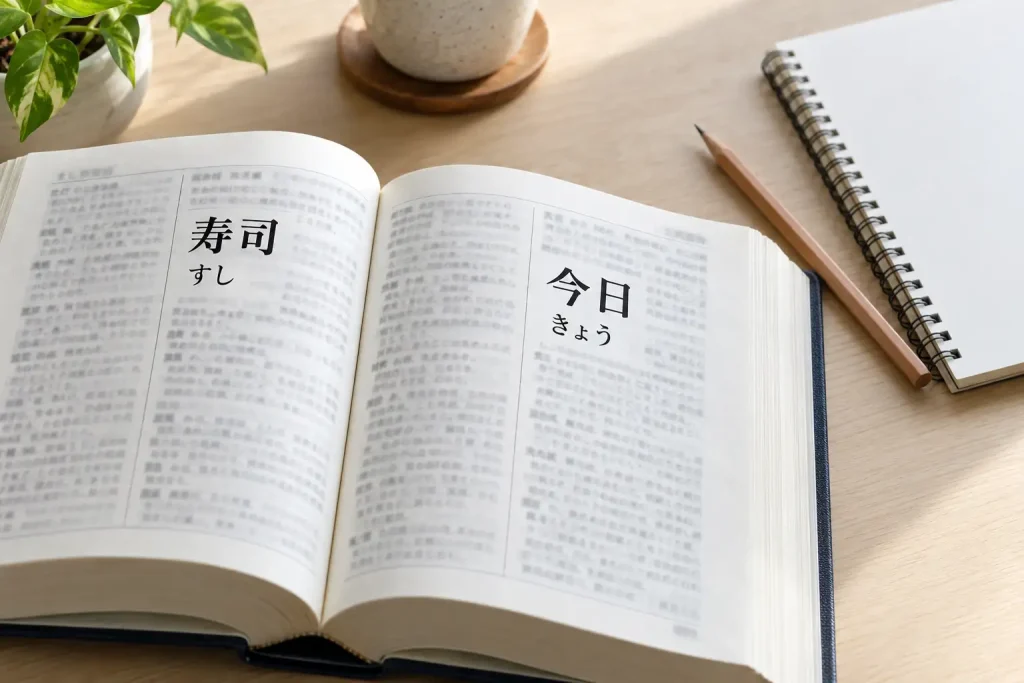
今日, kyō, “today,” illustrates the contrast. 今 means “now” and 日 means “day,” so the compound’s meaning supports the reading even though kyō cannot be obtained cleanly from the separate characters. 寿司 works differently: “longevity” plus “administrator” does not semantically compose “sushi.”
The government’s Jōyō Kanji documentation groups certain ateji and jukujikun together in an appendix because their readings are “difficult to list as readings of individual characters.” That administrative convenience does not make the linguistic mechanisms identical. Why the Same Kanji Sounds Different handles the ordinary reading system that you should learn before cataloging its exceptions.
How can I tell whether a spelling is ateji?
You usually cannot prove it from the surface form alone. Treat the spelling as suspicious when the accepted reading does not divide naturally across the characters, the individual meanings fail to build the word’s meaning, or a loanword has an elaborate kanji form alongside an ordinary katakana spelling.
Use a repeatable check:
- Look up the entire word before looking up separate characters.
- Confirm the standard reading and definition.
- Check whether the dictionary labels the spelling 当て字.
- Compare the form with its kana spelling.
- Read the word history only after confirming the modern entry.
- Treat an attractive character-by-character story as a hypothesis, not evidence.
This order matters. Starting with isolated kanji encourages you to invent a semantic connection and then search for material that confirms it. Starting with the lexical entry tells you how Japanese readers actually use the word.
If you cannot enter an unfamiliar graph, How to Find a Character You Cannot Read explains radical, component and handwriting searches. Those methods identify the characters; the full-word dictionary entry then tells you whether their relationship to the word is phonetic, semantic or mixed.
Here is the question beginners do not know to ask: can ateji carry meaning too?
Yes. “Used for sound” does not always mean “selected without any thought for meaning.” Some ateji spellings use characters that approximate the pronunciation while also creating a favorable, witty or descriptive association.
寿司 is a good example because 寿 contributes a celebratory tone even though the compound does not literally define sushi. 歌舞伎, kabuki, uses characters meaning “song,” “dance” and “skill or performer.” The spelling is ateji, yet those meanings happen to suit the theatrical form so well that the characters feel inevitable after the fact.
This mixed behavior is why rigid classroom slogans eventually fail. A spelling can be phonetic in structure and semantically suggestive in presentation. The decisive question is not whether the characters evoke something appropriate; it is whether their normal meanings and readings genuinely created the word.
Names add another complication because parents may select characters for pronunciation, meaning, family history and visual balance at the same time. Do not generate a name by translating an English meaning into random kanji. For foreign names, the site’s name converter with 898 checked names in katakana provides established phonetic forms without pretending that a decorative kanji spelling is standard.
Do I need to memorize every ateji spelling?
No. Prioritize forms you actually encounter, especially 寿司, common signs and words whose kanji spelling appears in the material you read. Recognition is more useful than practicing obscure forms you will probably type in kana.
Ateji should also not displace ordinary kanji study. The productive core of Japanese reading still depends on common characters, vocabulary and recurring reading patterns. The First Hundred Kanji and Why Those gives the next practical sequence.
When adding an ateji word to your notes, store four pieces together:
- The complete written form
- Its kana reading
- Its actual meaning
- A note that the spelling is phonetic or partly phonetic
Do not memorize a fake literal definition. Writing “寿司 = longevity administrator = sushi” trains the exact error you need to avoid. Write “寿司 — すし — sushi — conventional ateji spelling” and move on.
What should I learn after ateji?
Learn ordinary on and kun patterns, then practice looking up unfamiliar compounds as whole words before decomposing them. Ateji become manageable once they are exceptions inside a working reading system rather than puzzles you expect kanji meanings to solve.
The most useful next step is The First Hundred Kanji and Why Those: build the regular system first, and let unusual spellings remain vocabulary.