The first decision is whether to conduct check-in in Japanese, use only a few prepared replies or ask for English immediately. Getting it wrong rarely costs money, but it can turn a short identity check into a confusing discussion about passports, addresses and payment. The best choice depends on your Japanese level, whether you have an address in Japan and whether your booking contains extras such as breakfast.
For most visitors, the right approach is mixed-language check-in: begin with hotel check in Japanese phrases you can say confidently, then switch to English when a legal or financial detail becomes unclear. You do not earn a prize for pretending to understand a deposit condition. The purpose of the phrases is to make the transaction shorter and safer.
Choose how much Japanese you will use
There are three sensible approaches at a hotel desk. The fully Japanese option suits travelers who can understand unexpected follow-up questions. The mixed option suits most visitors, while an English-first check-in is reasonable at an international hotel or whenever the terms of payment are complicated.
| Approach | What it costs | What it gets you | Best suited to |
|---|---|---|---|
| Japanese-first | More concentration and a risk of missing details | A smooth exchange when your listening is strong | Travelers who understand numbers, dates and polite questions |
| Mixed Japanese and English | A few memorized lines plus occasional clarification | The quickest balance of courtesy and accuracy | Most first-time and intermediate visitors |
| English-first | Possible waiting time for an English-speaking employee | Lower risk of misunderstanding charges or policies | Beginners, complex bookings and payment disputes |
The deciding threshold is not whether you can introduce yourself. It is whether you can understand a reply that differs from the sentence you practiced. If you understand only the expected script, use Japanese for the greeting and reservation name, then ask for clarification as soon as the script changes.
The longer guide, What Front Desk Staff Ask, and How to Answer, covers requests beyond arrival, including luggage, meals and ryokan procedures. This page stays with the six exchanges between reaching the counter and receiving the key.
The passport scanner is usually doing a lawful job
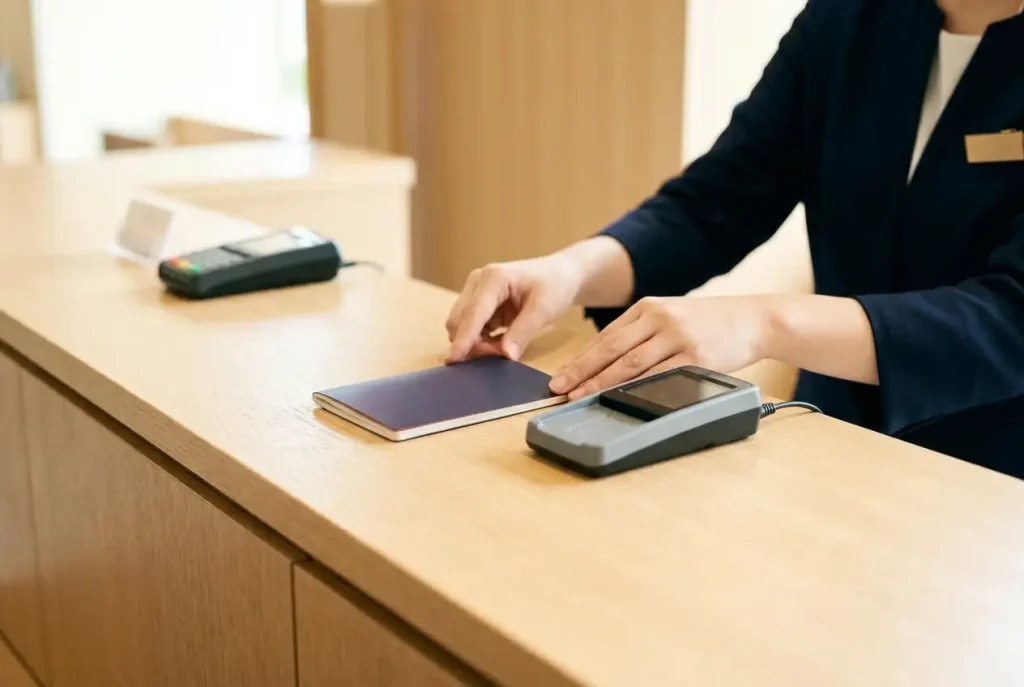
A short-term visitor with no address in Japan should expect the hotel to request a passport. Under the Japanese lodging-register rules, an accommodation records the guest’s name, address and occupation. For a foreign guest who does not have an address in Japan, the register must also contain nationality and passport number.
Official Ministry of Health, Labour and Welfare guidance instructs lodging operators to ask that guest to present the passport and to retain a copy with the guest register. A scanner or copier at a legitimate front desk is therefore part of a recognized compliance process. It is not automatically evidence of identity theft.
The important condition is 国内に住所を有しない, kokunai ni jūsho o yū shinai, “not having an address within Japan.” The trigger is not simply looking foreign or holding a non-Japanese passport. A foreign resident with a Japanese address is not in the same category as a tourist entering an overseas address.
There is also a distinction between scanning a passport in front of you and sending an image through an unexpected message before arrival. Verify advance requests through the hotel’s official website, booking account or published telephone number. A lawful need for information does not make every upload link trustworthy.
The rule is based on the absence of a Japanese address, not on foreign appearance alone.
Six hotel check in Japanese phrases in their real order
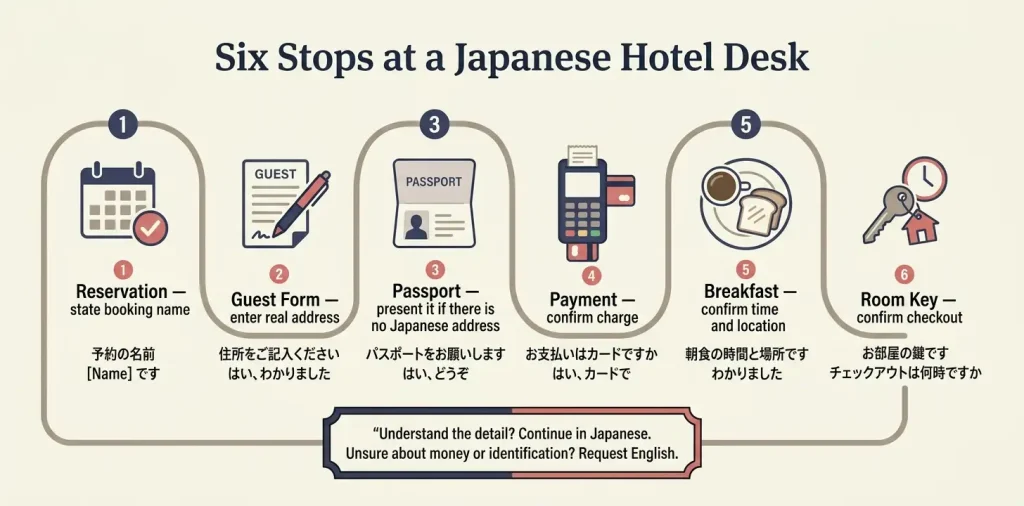
The following exchanges follow the usual path from reservation to room key. Exact wording varies because a business hotel, resort and family-run inn do not use identical systems. Listen for the key noun instead of expecting every employee to recite the same sentence.
| Stage | What the employee may say | Your shortest useful answer | Meaning |
|---|---|---|---|
| 1 | ご予約のお名前をお願いします。 | 予約しています。スミスです。 | “Your reservation name, please.” / “I have a reservation. I’m Smith.” |
| 2 | こちらにご記入ください。 | はい、わかりました。 | “Please fill this in.” / “Yes, understood.” |
| 3 | パスポートを拝見してもよろしいですか。 | はい、どうぞ。 | “May I see your passport?” / “Yes, here you are.” |
| 4 | お支払いはどうなさいますか。 | カードでお願いします。 | “How would you like to pay?” / “By card, please.” |
| 5 | 朝食は六時半からです。 | 場所はどこですか。 | “Breakfast is from 6:30.” / “Where is it?” |
| 6 | こちらがルームキーです。 | ありがとうございます。 | “Here is your room key.” / “Thank you.” |
The sequence contains six editorially defined stages rather than six requirements imposed by law. A prepaid hotel may omit the payment question, a room-only reservation may omit breakfast, and a self-check-in property may replace several spoken exchanges with a screen.
Exchange 1: Put the booking name first
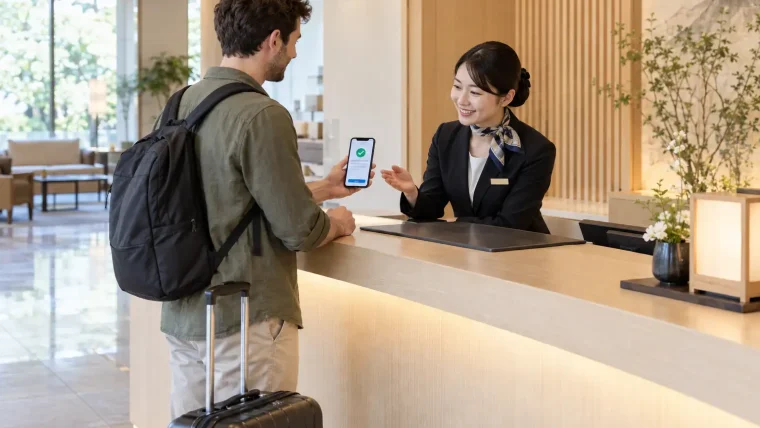
The employee needs to locate your reservation before discussing the room. Start with 予約しています, yoyaku shite imasu, “I have a reservation,” followed by the surname used in the booking.
Say:
予約しています。スミスです。
Yoyaku shite imasu. Sumisu desu.
“I have a reservation. I’m Smith.”
If the reservation is under another person’s name, say:
予約はジョン・スミスの名前です。
Yoyaku wa Jon Sumisu no namae desu.
“The reservation is under the name John Smith.”
Show the confirmation if spelling becomes a problem. Foreign names can be stored in a different order, divided incorrectly between form fields or written without a middle name. Pointing to the reservation number is faster than repeating the name more loudly.
A greeting is welcome but does not replace the reservation sentence. If you are uncertain whether to say good morning, afternoon or evening, Ohayou, Konnichiwa, Konbanwa: the Clock Decides explains where each greeting fits.
Exchange 2: Complete the guest form accurately
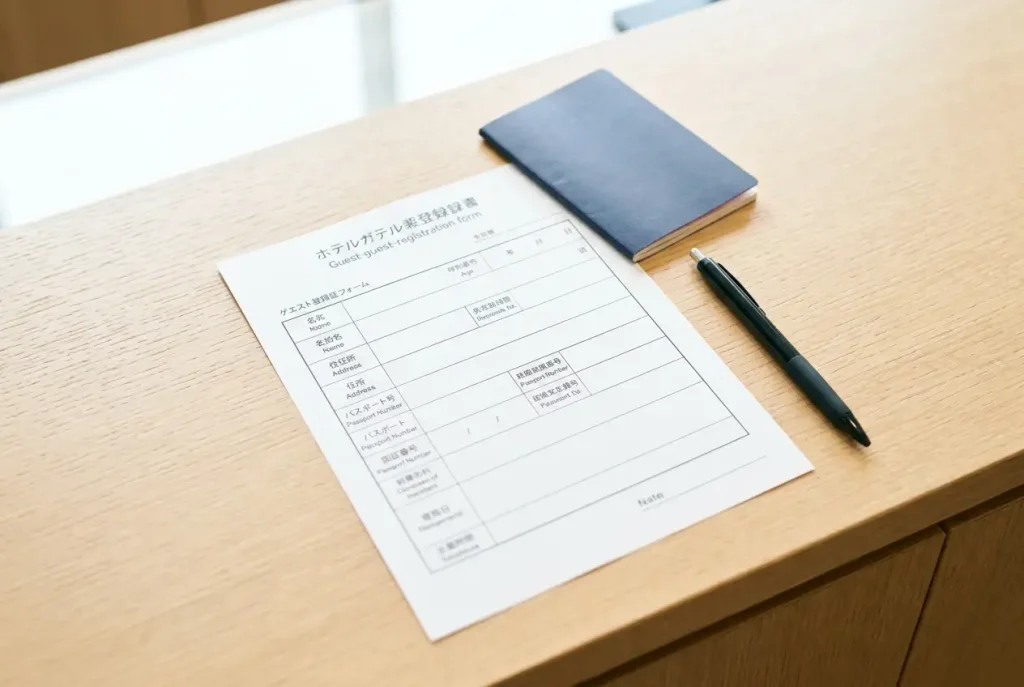
The next instruction is often こちらにご記入ください, kochira ni go-kinyū kudasai, “please fill this in.” The prefix ご, go, adds politeness to 記入, kinyū, “entry in a form.” You do not need to imitate that formality when replying.
Say:
はい、わかりました。
Hai, wakarimashita.
“Yes, understood.”
The form may request your name, address and occupation because lodging operators must maintain a guest register. If you are visiting from the United States and have no Japanese residence, use your actual overseas home address unless the form clearly requests a different address. Do not invent the hotel’s address to make the boxes easier to complete.
If you cannot read a label, point and ask:
ここは何を書きますか。
Koko wa nani o kakimasu ka.
“What should I write here?”
You need polite, functional Japanese rather than ceremonial language. Japanese Politeness Levels, and Which One to Use explains why ordinary desu/masu speech is sufficient when you are the guest.
Exchange 3: Hand over the passport without a debate
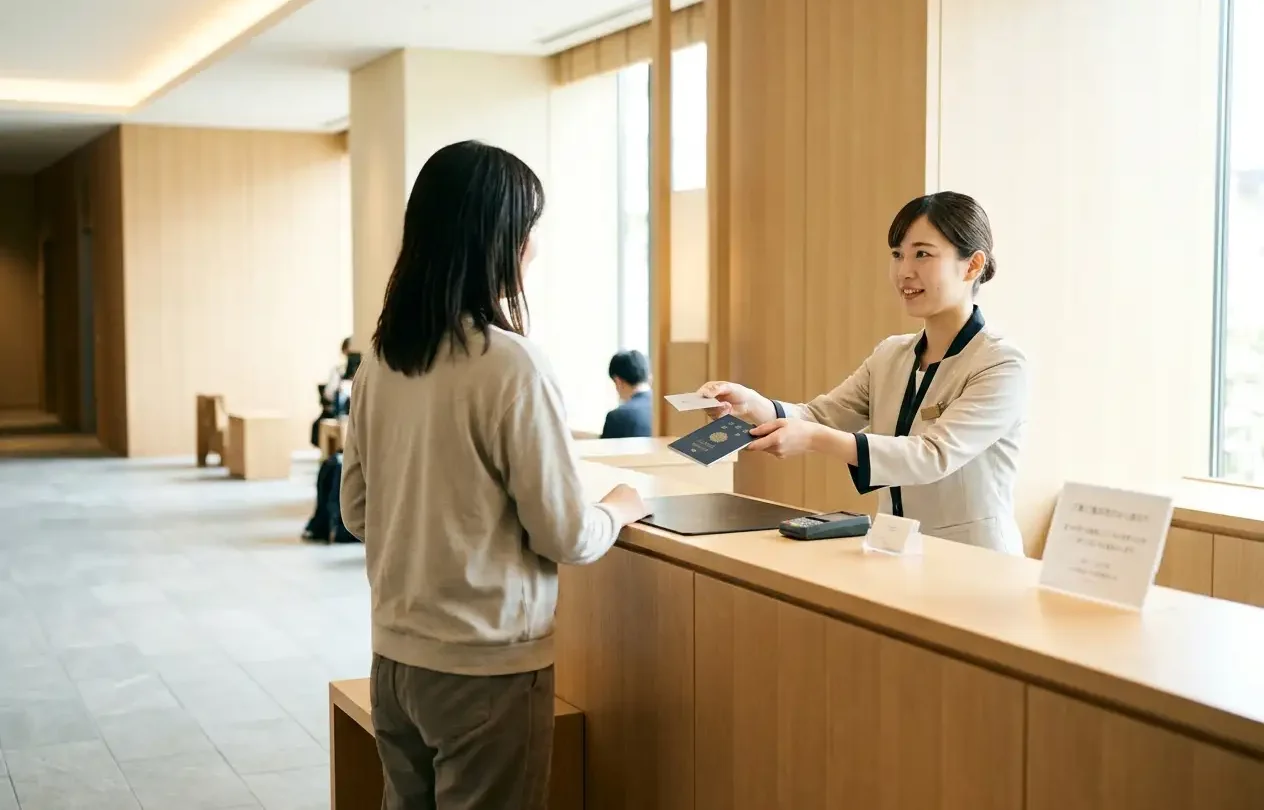
The employee may say パスポートを拝見してもよろしいですか, pasupōto o haiken shite mo yoroshii desu ka, literally “may I humbly look at your passport?” 拝見, haiken, is a humble verb used by the employee for their own action.
Your answer can be very short:
はい、どうぞ。
Hai, dōzo.
“Yes, here you are.”
The hotel may scan the identification page or photocopy it. For a foreign visitor with no address in Japan, official guidance calls for passport presentation and preservation of a copy. You should receive the physical passport back after the copy is made.
If you are a foreign resident with a Japanese address and the hotel asks to copy your passport solely because you are foreign, explain the distinction calmly:
日本に住所があります。
Nihon ni jūsho ga arimasu.
“I have an address in Japan.”
You can then ask why the copy is required under the property’s policy. Do not turn the lobby into a legal argument if a staff member needs to check with a supervisor, but do not assume that the tourist rule applies automatically to every non-Japanese resident.
Exchange 4: Confirm payment before tapping your card
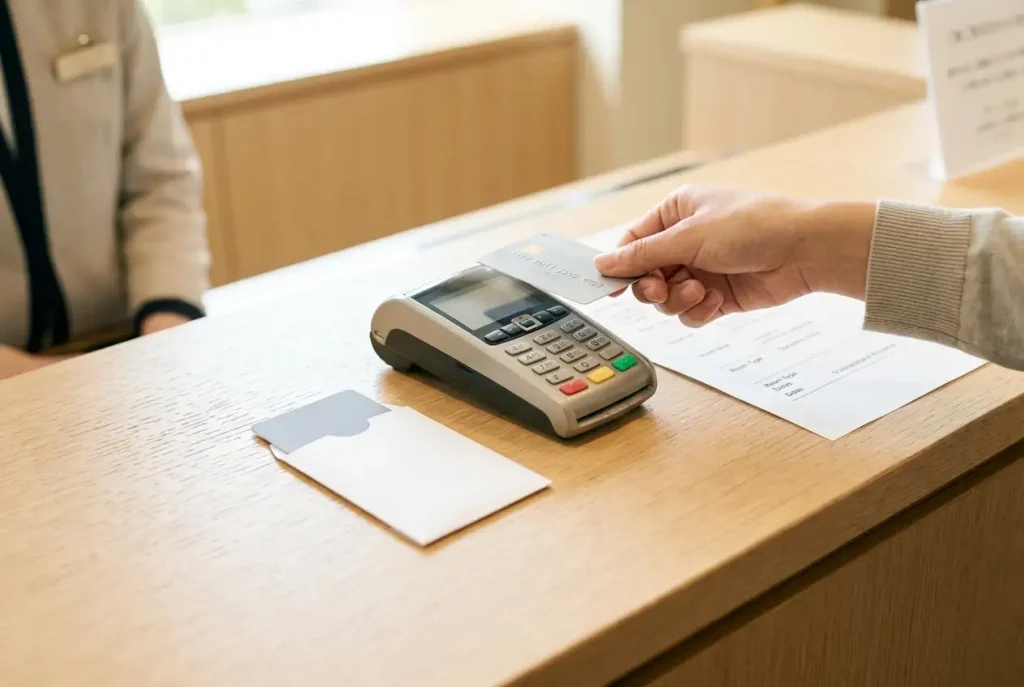
Payment may have been collected online, reserved on the card or left until arrival. Those are not the same arrangement. Listen for 支払い, shiharai, “payment,” and ask before authorizing a second charge.
For card payment, say:
カードでお願いします。
Kādo de onegai shimasu.
“By card, please.”
For cash, say:
現金でお願いします。
Genkin de onegai shimasu.
“Cash, please.”
If you believe the room has already been paid for, use:
もう支払いました。確認していただけますか。
Mō shiharaimashita. Kakunin shite itadakemasu ka.
“I have already paid. Could you check?”
This is where switching to English is sensible. Ask whether the amount is the room balance, a local accommodation tax, a security authorization or a charge for meals. Do not approve an amount merely because holding up the line feels impolite.
Exchange 5: Treat breakfast time as a deadline
The employee may explain breakfast in one sentence:
朝食は六時半から九時までです。
Chōshoku wa roku-ji han kara ku-ji made desu.
“Breakfast is from 6:30 to 9:00.”
The useful words are 朝食, chōshoku, “breakfast,” から, kara, “from,” and まで, made, “until.” Repeat the closing time if your morning schedule is tight. Some hotels stop admitting guests before food is physically removed, so ask rather than inferring a last-entry rule.
To ask for the location:
朝食会場はどこですか。
Chōshoku kaijō wa doko desu ka.
“Where is the breakfast venue?”
To confirm that breakfast is included:
朝食は料金に入っていますか。
Chōshoku wa ryōkin ni haitte imasu ka.
“Is breakfast included in the price?”
If you have an allergy, do not rely on a memorized ingredient name alone. The site’s phrasebook contains 337 phrases across 25 situations, including hotels, ordering and allergies, with each expression kept on its own reference page.
Exchange 6: Check the key, room and departure time
The final handover is usually こちらがルームキーです, kochira ga rūmu kī desu, “this is your room key.” The employee may add the room number, elevator location, Wi-Fi instructions and checkout time in one quick explanation.
Reply:
ありがとうございます。
Arigatō gozaimasu.
“Thank you.”
Before leaving the desk, confirm anything that could cost you effort the next morning:
チェックアウトは何時ですか。
Chekkuauto wa nan-ji desu ka.
“What time is checkout?”
If the room number is spoken but not shown clearly, ask the employee to point to it. Saying the number aloud can be risky because Japanese number readings change in time expressions and room numbers. A written key sleeve is more reliable than guessing what you heard.
For broader emergency and transport vocabulary, Essential Japanese Phrases for Travelers covers the reusable expressions rather than duplicating the hotel script here.
Which approach fits your trip?
A first-time visitor on a nine-day trip may stay in three hotels. That creates up to 18 core interactions if each property uses all six stages: 3 hotels × 6 stages = 18. Memorizing every possible staff sentence is unnecessary; learn the six short replies and keep the reservation confirmations accessible.
Someone spending the entire trip in one city usually completes the sequence once. Japanese-first check-in offers little practical advantage if that person cannot understand payment or breakfast details. The mixed approach remains safer: Japanese for the reservation, form and passport handover; English for conditions that affect money or timing.
A foreign resident staying for work faces a different decision. The reservation and payment phrases remain useful, but the passport-copy trigger may not apply because the guest has a Japanese address. The sentence Nihon ni jūsho ga arimasu can change the procedure more than any elaborate honorific phrase.
| Traveler profile | Japanese stages to attempt first | Stages to clarify if uncertain | Recommended approach |
|---|---|---|---|
| First visit, several hotels | 1–3 | 4–6 | Mixed |
| One hotel, no Japanese | 0–1 | 2–6 | English-first |
| Conversational Japanese | 1–6 | Any unexpected charge | Japanese-first |
| Foreign resident with a Japanese address | 1–2, then explain address | Passport-copy basis and payment | Mixed |
Defaults that make check-in harder
The first bad default is handing over a booking-app screen without stating the reservation name. Staff still need to locate the record, and a crowded confirmation page can slow that search. Say the name first, then show the number.
The second is answering hai to every sentence. はい, hai, can signal that you are listening, but staff may reasonably understand it as agreement. If you did not understand a charge, say:
すみません。英語でお願いします。
Sumimasen. Eigo de onegai shimasu.
“Excuse me. English, please.”
The third is refusing a passport scan because an online comment said hotels may never copy identification. That claim ignores the rule for foreign guests without a Japanese address. The opposite claim—that every foreign resident must surrender a passport copy—is also too broad.
Other avoidable mistakes include:
- Using a nickname that does not match the reservation.
- Assuming online card details prove that the stay was prepaid.
- Leaving before confirming whether breakfast is included.
- Memorizing formal phrases without learning yes, no, already paid and please check.
- Uploading a passport through an unverified link merely because the request mentions Japanese law.
The two-line rule for the front desk
If you understand the question and its financial or legal consequence, answer briefly in Japanese.
Otherwise, ask for English before agreeing, paying or uploading identification.
From reservation name to room key
Short FAQ
Must every foreign hotel guest in Japan provide a passport copy?
No. The official rule discussed here concerns foreign guests who do not have an address in Japan. Foreign residents with a Japanese address fall outside that specific passport-copy category.
Can a Japanese hotel scan a tourist’s passport?
Yes. Official guidance instructs lodging operators to request presentation of the passport and preserve a copy for a foreign guest without a Japanese address.
Should you upload a passport before arrival?
Only after verifying that the request comes from the actual accommodation and uses its official or trusted booking channel. You can ask whether verification can be completed at check-in.
Is it rude to request English?
No. A clear request is better than pretending to understand a charge, cancellation condition or identity-document request.