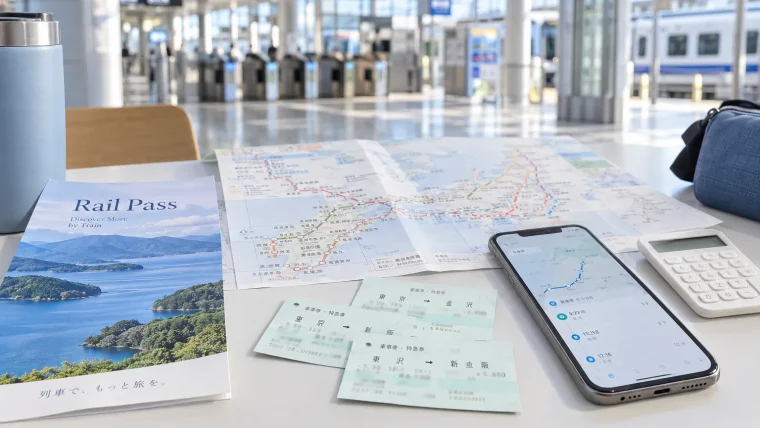
指定席 shiteiseki, literally “designated seat,” appears when you choose a reserved seat; 乗車券 jōshaken, “boarding ticket,” and 特急券 tokkyūken, “limited-express ticket,” appear when the fare is
The words you will meet first are 指定席 shiteiseki, “reserved seat,” on the booking screen; 乗車券 jōshaken, “boarding ticket,” in the fare breakdown; and 受取コード uketori kōdo, “pickup code,” if you collect an online purchase. You will also see スマートEX Sumāto Īekkusu, the SmartEX reservation service, and 指定席券売機 shiteiseki kenbaiki, the station’s reserved-seat ticket machine. Those terms matter because how to buy Shinkansen tickets is not merely a choice between an app and a counter. You must first identify the railway corridor, then choose a seat type, payment method and boarding method. For the Tokaido, Sanyo and Kyushu Shinkansen, SmartEX is the online option designed to be usable without a Japanese rail pass, but a foreign-issued card can still fail authentication.
Before paying: the terms that define the ticket
指定席 — shiteiseki — “designated seat”
指定席 shiteiseki, literally “designated seat,” appears when you choose a specific train, car and seat. You meet it on SmartEX, station machines and counter displays. The reservation belongs to that departure rather than every train traveling along the route. The common mistake is boarding a different service because the destination is the same. If your plans are fixed or you need a particular seat location, this is the option that confirms where you sit.
自由席 — jiyūseki — “unreserved seat”
自由席 jiyūseki, literally “free seat,” means unreserved seating, not a seat that costs nothing. You meet the term when selecting a fare or looking at platform signs for cars that accept unreserved passengers. A ticket permits you to use an eligible unreserved car, but it does not guarantee an empty seat. During selected peak periods, JR Central operates Nozomi services with all seats reserved, so the usual assumption about unreserved cars may not apply. The mistake is reading “free” as either complimentary travel or complete freedom to board any train.
乗車券 — jōshaken — “boarding ticket”
乗車券 jōshaken, literally “boarding ticket,” covers the basic railway fare for traveling between stations. You encounter it in a fare breakdown, sometimes beside a separate Shinkansen supplement. In English, “ticket” often suggests the entire purchase, but 乗車券 can mean only one component. A Shinkansen trip generally also requires a limited-express ticket or an integrated product containing both components. How Japan’s Rail Fares Are Actually Built explains that fare structure without repeating it here.
新幹線特急券 — Shinkansen tokkyūken — “Shinkansen limited-express ticket”
新幹線特急券 Shinkansen tokkyūken, literally “Shinkansen limited-express ticket,” is the supplement associated with using the high-speed service. You meet it on paper tickets and itemized purchase screens. The English phrase “limited express” can sound as if the train makes only a limited number of trips, but in Japanese railway language it identifies a service category and surcharge. Depending on how you buy, the basic fare and express component may appear separately or inside one product. The expensive mistake is assuming that possession of only the basic-fare ticket is enough for the Shinkansen gates.
| Term | Reading | Literal meaning | Where you meet it |
|---|---|---|---|
| 指定席 | shiteiseki | designated seat | Seat-selection screen |
| 自由席 | jiyūseki | unreserved seat | Fare menu and platform signs |
| 乗車券 | jōshaken | boarding ticket | Basic-fare breakdown |
| 新幹線特急券 | Shinkansen tokkyūken | Shinkansen limited-express ticket | Paper ticket or fare details |
| スマートEX | Sumāto Īekkusu | SmartEX, a service name | Online booking |
| エクスプレス予約 | Ekusupuresu Yoyaku | Express Reservation | Membership-based booking |
| 指定席券売機 | shiteiseki kenbaiki | reserved-seat ticket machine | JR station |
| みどりの窓口 | Midori no Madoguchi | green window | Staffed JR counter |
| 受取コード | uketori kōdo | pickup code | Collecting online tickets |
| 交通系ICカード | kōtsūkei IC kādo | transport-system IC card | Ticketless gate entry |
| QRチケット | QR chiketto | QR ticket | SmartEX boarding screen |
| 早特 | hayatoku | early-value fare | Advance online products |
Online booking: SmartEX and the foreign-card question
スマートEX — Sumāto Īekkusu — “SmartEX”
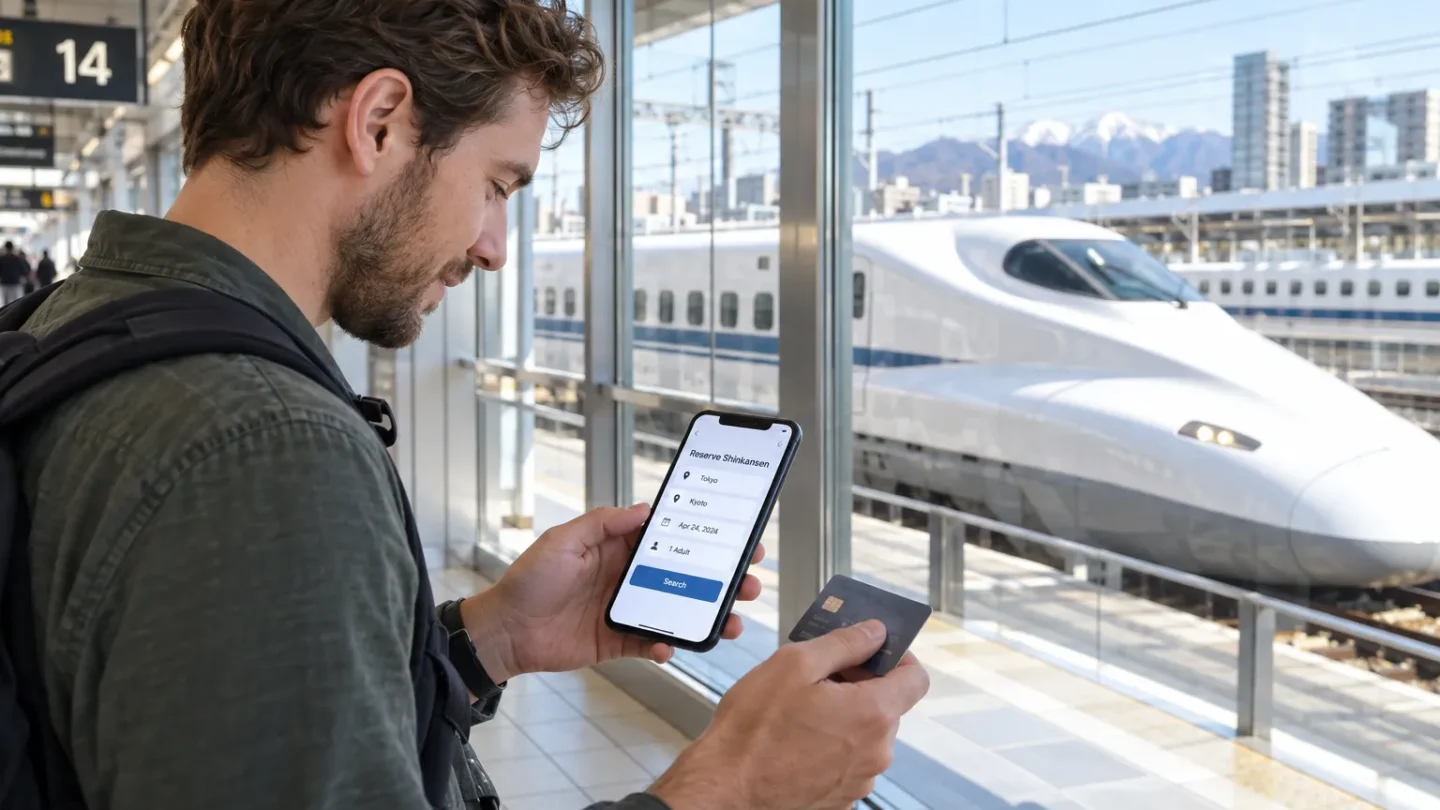
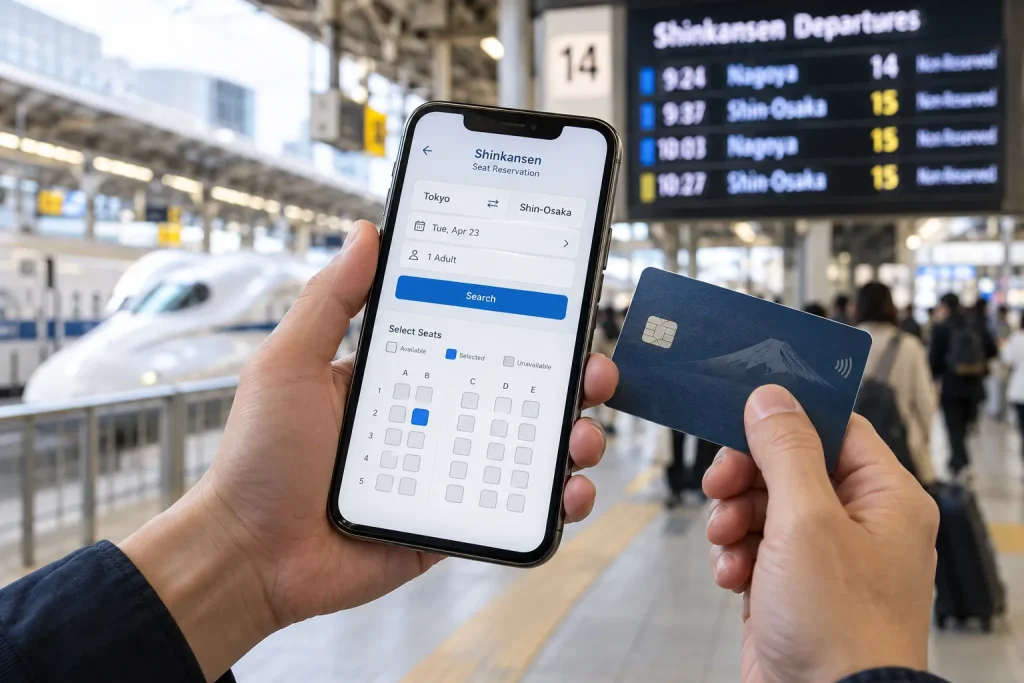
スマートEX Sumāto Īekkusu is a proper service name rather than a generic Japanese phrase. You meet it when booking the Tokaido, Sanyo or Kyushu Shinkansen online. Registration requires a supported credit card, and payment is taken when the reservation is completed. The international-facing service can be used by overseas visitors, but successful registration is not guaranteed for every foreign-issued card because issuer authentication and card-security settings still apply. The mistake is waiting until a popular travel date to discover that your only card will not register.
This is the practical protocol:
- Confirm that your journey is on the Tokaido, Sanyo or Kyushu Shinkansen.
- Try registering your card before the date on which you expect to book.
- Confirm that your card supports the authentication requested by the issuer.
- Keep a second card available rather than assuming another card from the same bank will behave differently.
- If registration fails, buy through a JR station machine or staffed counter after arriving in Japan.
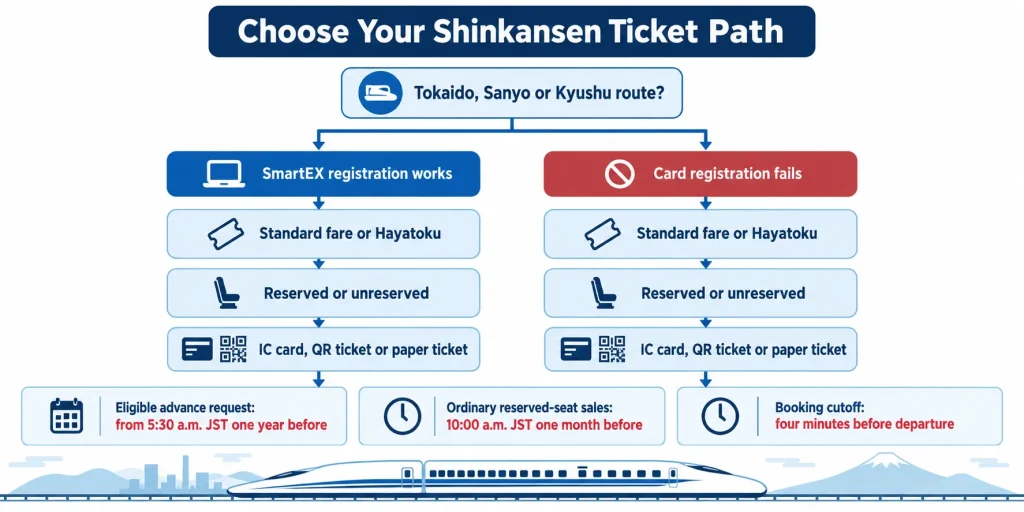
SmartEX now accepts reservation requests for certain products from 5:30 a.m. Japan Standard Time up to one year before travel. That directly contradicts the simplified claim that all seats open only one month ahead at 10:00 a.m. Before the one-month point, the train and seat may remain unconfirmed, and the number of seats offered through the advance-request system is limited. The ordinary JR reserved-seat sales point remains 10:00 a.m. Japan Standard Time one month before departure. SmartEX says train and seat details for eligible earlier requests are confirmed from the one-month stage, while changes to the confirmed reservation become available after 10:00 a.m.
“The number of seats available for reservation is limited.” — SmartEX reservation guidance
The difference matters on dates when many travelers want the same train. An early request is not identical to choosing a specific seat from the normal live seat map. SmartEX excludes early-discount products, S Work seats, wheelchair-accessible seats and oversized-baggage seats from its one-year advance system. If you need one of those categories, check the applicable product’s own sales window rather than assuming the one-year option applies. SmartEX reservations are convenient, but the product rules still decide what can be booked.
エクスプレス予約 — Ekusupuresu Yoyaku — “Express Reservation”
エクスプレス予約 Ekusupuresu Yoyaku, officially branded EX Reservation in English, is a separate membership service. You encounter it when comparing JR Central’s online products and noticing fares intended for members. “Reservation” sounds generic in English, but this is a specific paid membership system linked to eligible cards and enrollment arrangements. It is not simply the Japanese version of SmartEX that every overseas visitor should select. The common mistake is following an EX Reservation tutorial without checking whether you can qualify for and complete its membership process.
The brief’s claim that “SmartEX accepts a foreign card and EX Reservation does not” is directionally useful but too absolute. SmartEX is the practical online route for many foreign visitors, yet individual foreign-issued cards may be rejected. EX Reservation is built around its own qualifying membership and card relationships rather than ordinary visitor registration. For a traveler holding a standard U.S.-issued card and no eligible EX membership, start with SmartEX and keep the station as the fallback. Do not interpret either brand name as a promise that your payment will be approved.
早特 — hayatoku — “early value”
早特 hayatoku, literally “early value,” labels advance-purchase fares available under specified conditions. You meet products such as EX Hayatoku in the SmartEX fare list. The name implies an early-booking benefit, but it does not mean every ticket bought early receives a discount. Each product has its own eligible trains, routes, seat types, sales deadline and change conditions. The mistake is choosing a low price before checking whether the departure can be changed.
SmartEX is not automatically cheaper for every train. Its standard product and its Hayatoku products are separate fare choices. The advance products are the part of this buying system specifically designed to offer further discounts, but inventory can be limited. A station machine or counter gives you access to ordinary JR tickets, not every SmartEX-only advance offer. The cheapest visible fare is therefore not necessarily the most flexible one.
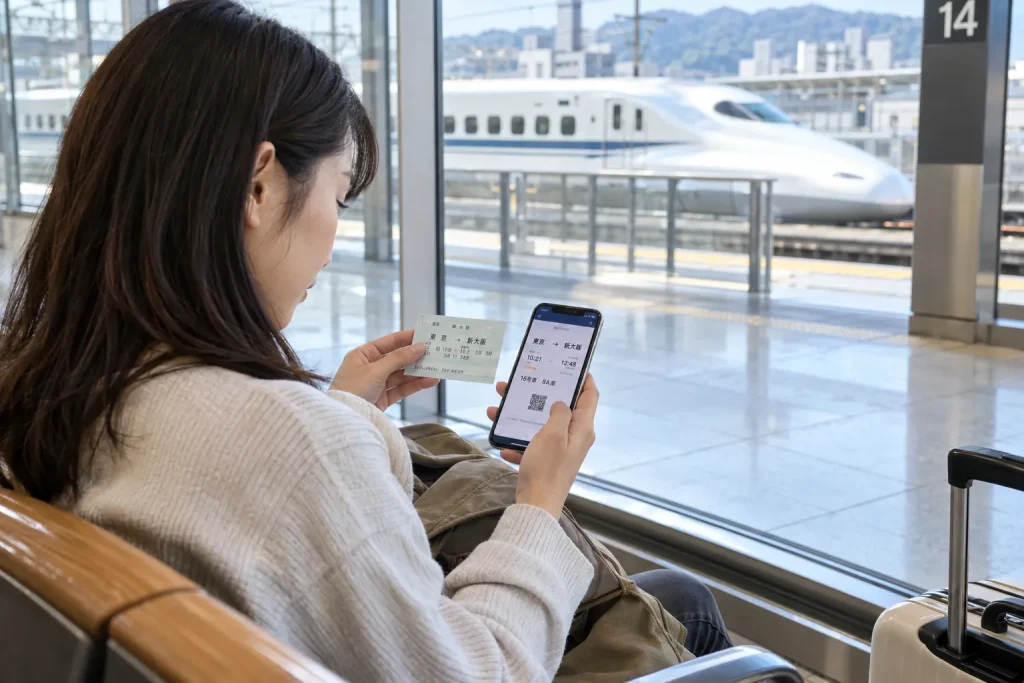
At the station: machine or staffed counter
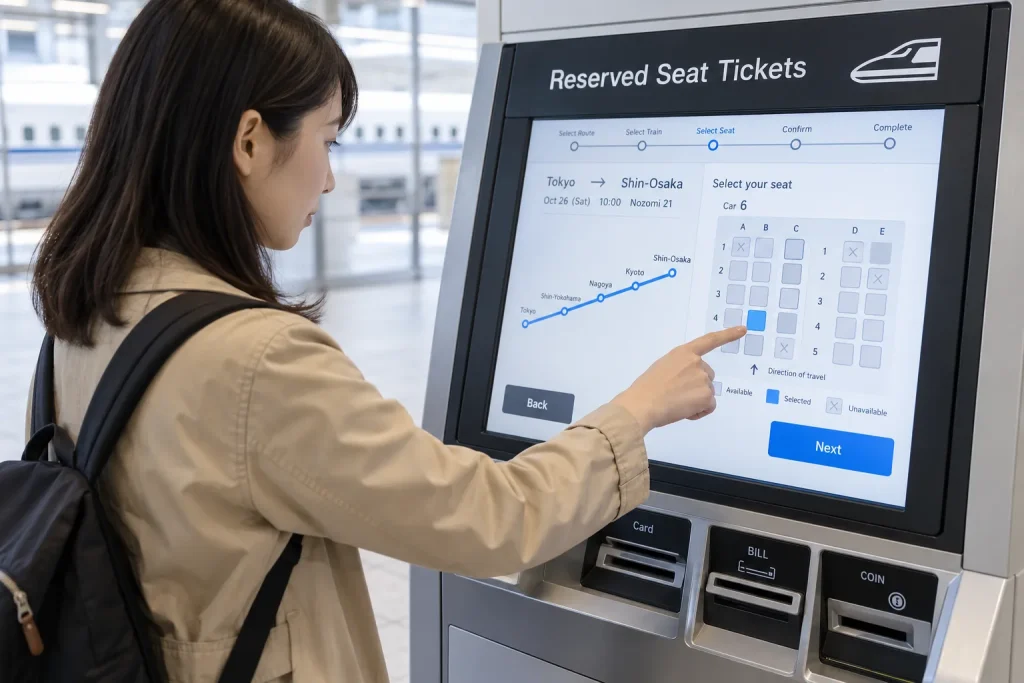
指定席券売機 — shiteiseki kenbaiki — “reserved-seat ticket vending machine”
指定席券売機 shiteiseki kenbaiki, literally “reserved-seat ticket vending machine,” is the machine used to search trains and purchase reserved tickets. You meet it in major JR stations, often with an English interface. It asks for the route, travel date, departure time, passenger count, train and seat preference. The word “machine” may suggest a limited cash-only kiosk, but many of these units accept supported payment cards and provide extensive reservation functions. The mistake is using an ordinary local-ticket machine that does not sell the Shinkansen product you need.
Before starting, know the names of your departure and arrival stations. Also decide whether you want reserved, unreserved or Green Car seating. If you carry baggage whose combined dimensions fall into JR Central’s oversized category, select the designated seat option rather than hoping to place it behind the last row. Those reservations have specific rules, and the one-year SmartEX request does not cover oversized-baggage seats. When uncertain, leave the machine and use the staffed counter instead of completing the wrong booking.
みどりの窓口 — Midori no Madoguchi — “green window”
みどりの窓口 Midori no Madoguchi, literally “green window,” is JR’s branded staffed ticket counter. You meet it at stations displaying the green sign. It is not an information booth in the American sense, although staff can clarify a journey while issuing tickets. The counter is useful for complex connections, multiple passengers, failed card payments or requests you cannot express through the machine. The mistake is joining the line without first writing down the exact route, date and preferred departure range.
The site’s Japanese phrasebook with shopping and travel language can help you recognize practical expressions without replacing the counter interaction with a long memorized script. Show the staff your origin, destination and date in writing. If you want a reserved seat, add your preferred time and whether window or aisle matters. If your itinerary includes several regional journeys, read The Break-Even Math on Kansai, JR East and Hokkaido before buying individual tickets. A regional pass can be useful, but only when its coverage and arithmetic match the trip.
| Buying method | Best fit | Main limitation | Discounted advance products |
|---|---|---|---|
| SmartEX | Tokaido, Sanyo and Kyushu routes | Card registration can fail | Selected Hayatoku products |
| Reserved-seat machine | Straightforward station purchase | Interface and machine functions vary | Not SmartEX-only fares |
| Staffed JR counter | Complex routes or questions | Possible lines and limited operating hours | Not SmartEX-only fares |
| Authorized travel seller | Prearranged purchase through an intermediary | Fees and conditions vary | Depends on the seller |
After an online purchase: collecting or linking the ticket
受取コード — uketori kōdo — “pickup code”
受取コード uketori kōdo, literally “pickup code,” is generated when you plan to collect SmartEX paper tickets. You meet it in your account before using an eligible pickup machine or counter. It is not the same as the booking reference displayed in every part of the service. You may also need the password specified by SmartEX during collection. The mistake is arriving at the machine with only a screenshot of the itinerary.
Collecting a ticket changes what you can do online. SmartEX conditions for changes and refunds depend partly on whether you have already collected the paper ticket or entered the gate. If you want to keep the digital flexibility, do not collect merely because seeing paper feels safer. If you do collect, store every issued piece rather than assuming the largest ticket is the only one required. Read the collection instructions again before leaving for the station.
交通系ICカード — kōtsūkei IC kādo — “transportation IC card”
交通系ICカード kōtsūkei IC kādo, literally “transportation integrated-circuit card,” includes cards such as Suica, PASMO and ICOCA. You meet the term when assigning a card to a SmartEX reservation for gate entry. “IC card” does not mean a credit card with a chip, despite the familiar initials. It is a transit card that acts as the identifier connected to the purchased Shinkansen booking. The common mistake is tapping an unlinked card and expecting the gate to locate the reservation automatically.
When multiple people travel together, the booking must be associated with the correct boarding method for each traveler. A single account can purchase seats for a group, but that does not turn one physical IC card into several passengers’ gate credentials. Check the current SmartEX instructions for assigning cards or issuing QR tickets. After tapping an assigned card, take the seat-information slip if the gate prints one. That slip records travel details but is not a second fare charged to the card.
QRチケット — QR chiketto — “QR ticket”
QRチケット QR chiketto, literally “QR ticket,” is a gate-entry option generated for an eligible SmartEX reservation. You meet it in the app or website when selecting the boarding method. The English loanword “ticket” suggests a transferable image, but forwarding a screenshot is not a reliable substitute for following the service’s issuance rules. Screen brightness, account status and reservation changes can affect what is available at the gate. The mistake is opening the code for the first time while standing at the scanner with a line behind you.
Load the valid code before approaching the gate, especially if your data connection is uncertain. Do not confuse a QR pickup code with a QR ticket for boarding. Both use square codes, but they perform different tasks. One helps retrieve paper tickets, while the other can be used to enter through a compatible gate. Shinkansen ticket booking becomes much easier once you identify which code you actually possess.
Boarding: read the train name as well as the destination
列車名 — resshamei — “train name”
列車名 resshamei, literally “train name,” appears as Nozomi, Hikari, Kodama, Mizuho, Sakura or another named service. You meet it on the reservation, departure board and platform display. Two trains can serve the same destination but have different stopping patterns and departure times. The name is therefore part of the booking, not decorative branding. The mistake is boarding the first Shinkansen shown for your destination without matching the train name and number.
Check these items before passing the platform barrier:
- Departure station and destination
- Departure time
- Train name and train number
- Car number
- Seat number
- Reserved or unreserved status
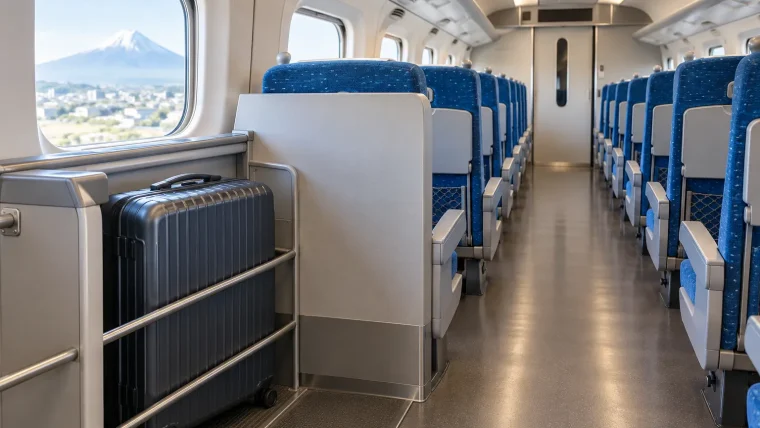
- Oversized-baggage seat designation, when applicable
Planning the train segment should follow the larger trip structure rather than precede it. Planning a First Trip to Japan: The Order That Works covers when to settle cities, nights and long-distance travel. If you are considering a nationwide pass, Is the Japan Rail Pass Worth It in 2026? handles that calculation separately. This article assumes you have already decided to buy an individual Shinkansen journey. It does not repeat the pass comparison.
The three terms worth memorizing
Memorize 指定席 shiteiseki, 乗車券 jōshaken and 受取コード uketori kōdo. The first tells you whether your seat is guaranteed, the second prevents you from misunderstanding the fare components, and the third gets an online booking out of the machine when you need paper. Keep SmartEX, EX Reservation, Hayatoku, the reserved-seat machine and the green counter at recognition level. You do not need to memorize every label if you can identify the route and follow the correct purchase path.
For a typical U.S. visitor on the Tokaido, Sanyo or Kyushu corridor, try SmartEX registration before the booking date. If the foreign-issued card registers, compare the standard and eligible advance fares, then choose your boarding method. If the card fails, stop retrying the same setup and plan to use a station machine or staffed counter. Ordinary reserved-seat sales still reach their important one-month point at 10:00 a.m. Japan time, but SmartEX now accepts limited requests for certain products up to one year ahead. That updated rule is why the old “wait until exactly one month before” protocol is no longer complete.
Frequently asked questions
Can a foreign credit card be used with SmartEX?
SmartEX is available to overseas travelers and accepts supported credit cards, but approval is not guaranteed for every foreign-issued card. The card issuer’s authentication system, security settings and transaction approval still matter. Test registration before the date when you need to reserve. Carry a second payment method because repeated attempts with the same rejected card may not solve the problem. A station machine or JR counter remains the practical fallback.
Do Shinkansen seats open exactly one month ahead?
Ordinary JR reserved-seat sales open at 10:00 a.m. Japan Standard Time one month before travel. SmartEX now also accepts limited reservation requests for certain products from 5:30 a.m. one year before the boarding date. For those early requests, the exact train and seat are not immediately confirmed. SmartEX processes confirmation around the one-month point, and changes to confirmed reservations become available after 10:00 a.m. The old one-month rule therefore remains important but no longer describes every SmartEX transaction.
Is SmartEX always cheaper than the ticket machine?
No. SmartEX offers a standard service as well as conditional Hayatoku products with further discounts. A discount depends on the route, train, product, booking deadline and remaining inventory. The lowest fare may also have less flexibility than the ordinary ticket you could purchase at the station. Compare the conditions rather than assuming that an app purchase is automatically cheaper. Prices should be checked directly for the intended journey because JR can revise fares and products.
Can I use SmartEX on every Shinkansen line?
No. SmartEX covers the Tokaido, Sanyo and Kyushu Shinkansen corridors. It is not the universal booking system for every Shinkansen operating in Japan. Routes operated through other JR regions can use different reservation platforms and ticket channels. Confirm the line before creating an account or following app instructions. The destination city alone may not reveal which system you need.
Do I need a physical ticket after buying through SmartEX?
Not necessarily. Depending on the reservation and setup, you may board using an assigned transportation IC card, an eligible QR ticket or collected paper tickets. Each method has its own preparation steps. A chipped credit card is not a transportation IC card. Choose and verify the boarding method before reaching the gate. If collecting paper tickets, bring the required pickup code and credentials.
What happens if my SmartEX card is rejected?
Check whether the card supports the authentication requested by its issuer and whether international online transactions are enabled. Do not assume that every rejection originates with JR. Trying a second card from another issuer may produce a different result, but it is not guaranteed. If online registration remains unavailable, use a reserved-seat machine or staffed JR counter in Japan. For a high-demand departure, leave enough flexibility to select another train.