On May 23, 1875, Japan lifted the national ban on cremation imposed less than two years earlier, allowing a funeral practice involving chopsticks to continue and eventually become nearly universal. That history explains the sharp reaction to two mistakes covered by chopstick etiquette japan guides: standing chopsticks upright in rice and passing food directly from one pair of chopsticks to another. Both resemble actions associated with handling cremated remains. Four other commonly listed mistakes are ordinary breaches of table manners, not funeral imitations. If you remember that distinction, you can avoid the gestures that genuinely disturb people without treating every awkward movement as a ceremonial offense.
Before cremation became the modern norm
Cremation had existed in Japan for centuries before the Meiji government attempted to prohibit it. Buddhist clergy and communities practiced it long before the nineteenth century, but burial customs varied by period, region, religious affiliation, and social position. After cremation, surviving bone fragments could be collected and placed in an urn rather than reduced completely to powder. This collection is called 収骨, shūkotsu, literally “gathering the bones,” or 骨上げ, kotsuage, literally “lifting the bones.” It is this part of the funeral, rather than cremation itself, that gives two dining gestures their emotional weight.
During 骨上げ, kotsuage, relatives use special chopsticks to move pieces of bone into the funerary urn. Depending on local and crematorium practice, two people may lift the same fragment together, or a fragment may be transferred between chopsticks. These actions deliberately separate the handling of remains from normal eating behavior. At the dining table, copying either visual pattern can bring the funeral rite abruptly into an everyday meal. The response is therefore stronger than it would be to dropping food or holding chopsticks clumsily.
The problem is not that chopsticks possess a mysterious meaning. The problem is that two familiar dining gestures reproduce movements reserved for handling human remains.
Ordering, Paying and the Rules Nobody States covers the larger restaurant sequence, including entering, ordering, eating, and settling the bill. The practical point here is narrower: you do not need perfect technique, but you should know what your chopsticks communicate when they are no longer moving food toward your own plate. A server is unlikely to lecture you about an accidental mistake. A Japanese companion may quietly correct the position or move the dish instead. Deliberately repeating the gesture after being warned is a different matter because it turns discomfort into disregard.
The change in 1875—and the limit of that date
The Meiji government prohibited cremation on July 18, 1873, during a wider effort to reorganize religious and public life. The measure created practical problems, particularly in urban areas where land for burials was limited. It was repealed on May 23, 1875, after arguments about sanitation, space, and the treatment of family remains. Cremation subsequently expanded, and bone collection remained part of the process. The repeal did not invent the chopstick taboos, but it preserved the funerary setting that continues to make them understandable.
There is no verified national decree dated 1875—or any later year—that created a legally binding list of dining prohibitions. Japanese chopstick rules are social conventions, taught through households, schools, etiquette guides, restaurants, and observation. That means the before-and-after story must be stated carefully. Cremation policy changed on identifiable dates, while table behavior evolved without one nationwide starting day. No scheduled law will suddenly make standing chopsticks in rice acceptable at a restaurant.
| Period | Funeral practice and policy | Meaning for table behavior |
|---|---|---|
| Before July 18, 1873 | Cremation and the collection of surviving bones were established practices in parts of Japan | Funeral associations involving chopsticks already had cultural context |
| July 18, 1873–May 23, 1875 | The national government prohibited cremation | The interruption was governmental policy, not the invention of new dining manners |
| From May 23, 1875 | The prohibition was lifted and cremation expanded again | Bone collection continued to reinforce the distinction between funeral and dining gestures |
| Today | Families still collect cremated remains with chopsticks under local procedures | Upright chopsticks and tip-to-tip transfer retain their funeral association |
Chopstick etiquette Japan visitors should prioritize
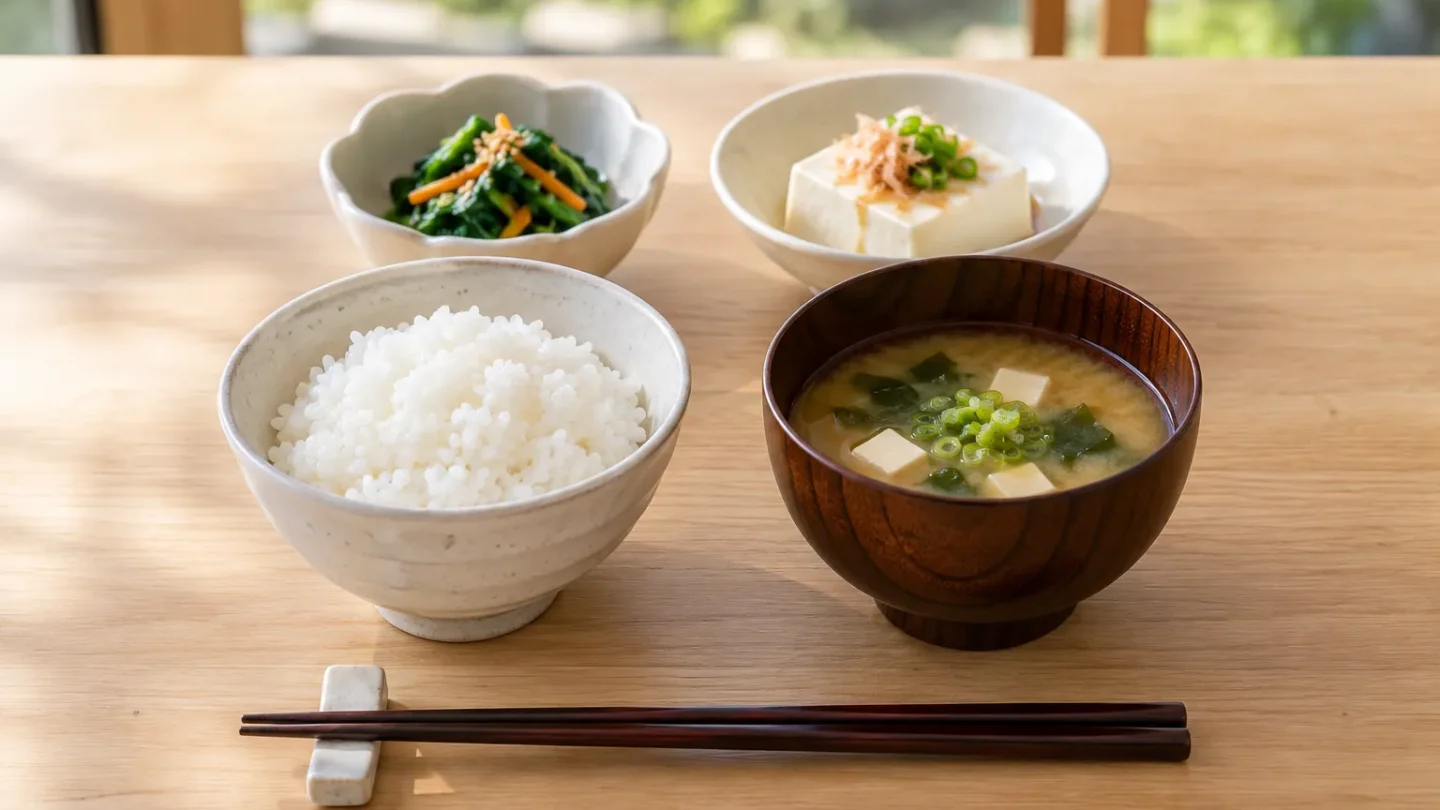
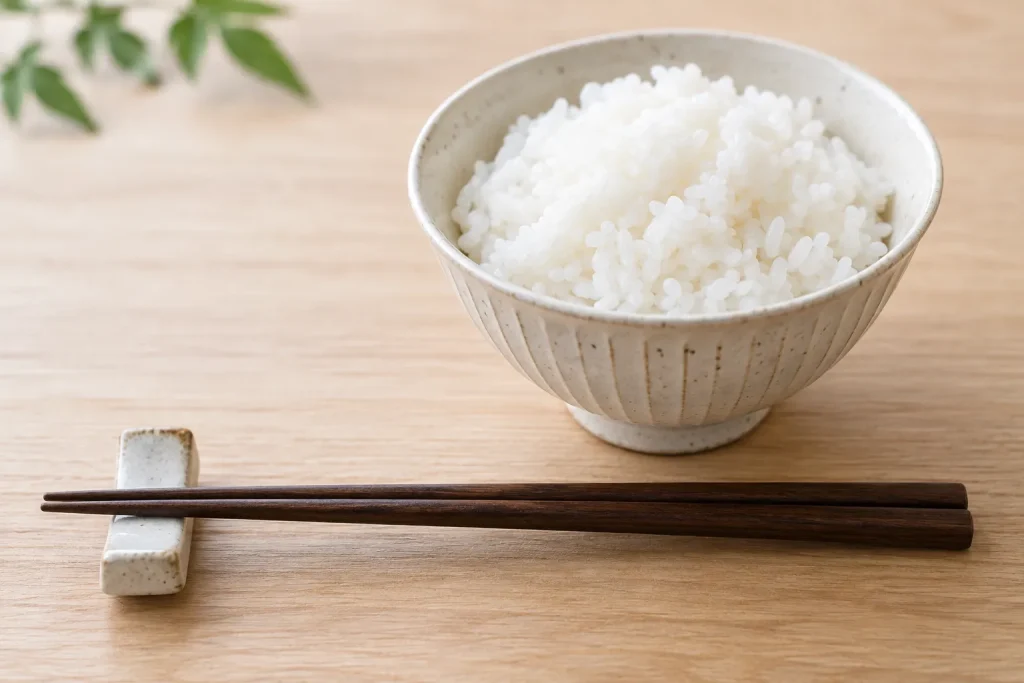
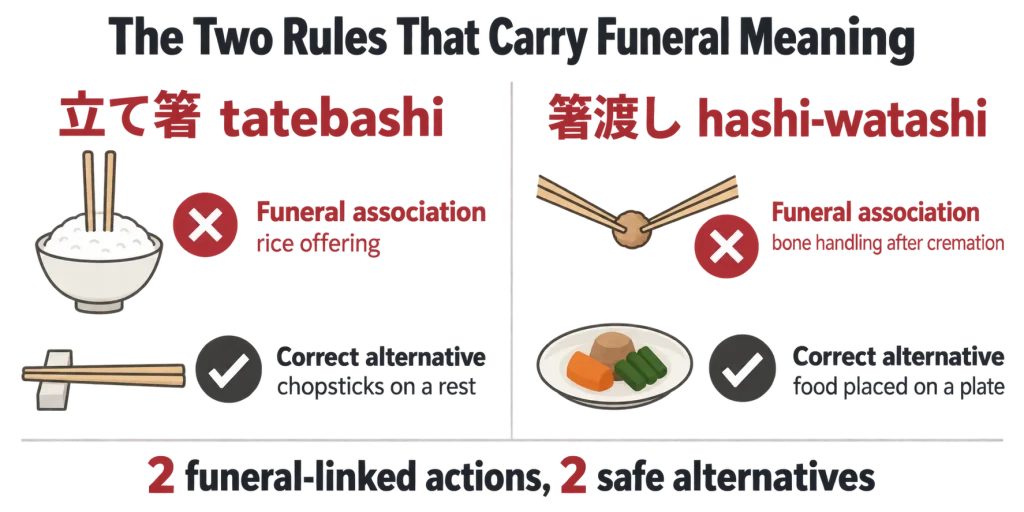
The first serious taboo is 立て箸, tatebashi, literally “standing chopsticks.” It means planting chopsticks vertically in a bowl of rice and leaving them there. A bowl of rice with upright chopsticks resembles a rice offering made for the deceased, so it introduces a direct mortuary image at the table. Lay the chopsticks across a rest or use the holder supplied by the restaurant instead. If no rest is available, follow the table setting rather than creating an upright position.
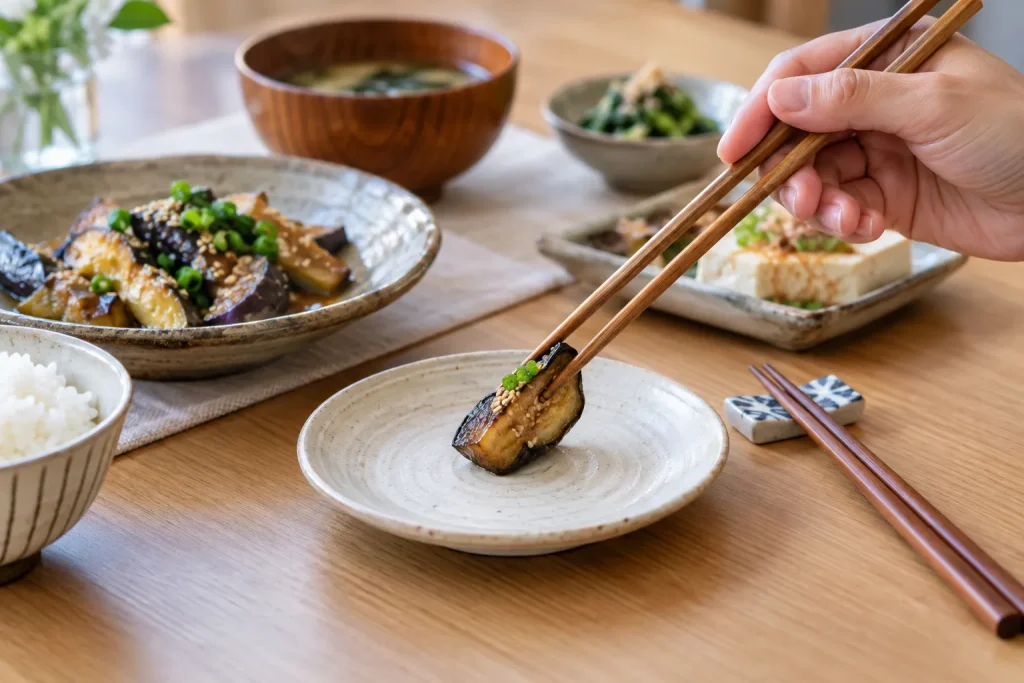
The second is 箸渡し, hashi-watashi, literally “chopstick passing.” It means transferring food directly from the tips of your chopsticks to another person’s chopsticks. This resembles the transfer or shared handling of bone fragments during 骨上げ. Place the food on the other person’s plate or on a small communal plate instead. This is the one moment when an American instinct to “hand it over carefully” produces precisely the wrong solution.
These two behaviors belong at the top of any Japanese table manners list because their significance is not merely tidiness. You may see inconsistent English names such as “chopstick-to-chopstick passing,” “bridging chopsticks,” or “funeral passing.” The Japanese term 箸渡し identifies the action more clearly. It should not be confused with placing chopsticks across a bowl, which is a different behavior. The defining feature is food moving directly between two pairs of chopsticks.
What the six rules actually mean
Only the first two actions in the following list reproduce recognizable funeral practices. The remaining four are grouped with 嫌い箸, kiraibashi, literally “disliked chopsticks,” a broad label for undesirable ways of using chopsticks. Different etiquette lists include different numbers of named behaviors, so there is no single official catalog that every restaurant enforces. The practical hierarchy matters more than memorizing dozens of labels. Avoid the funeral-linked gestures first, then use the utensils without pointing, playing, searching, or moving dishes.
- 立て箸, tatebashi — “standing chopsticks.” Do not leave chopsticks upright in rice because the arrangement evokes an offering for the deceased.
- 箸渡し, hashi-watashi — “chopstick passing.” Do not pass food from chopsticks to chopsticks because the movement resembles the handling of cremated bones.
- 刺し箸, sashibashi — “stabbing chopsticks.” Do not spear food unnecessarily as though using a fork. This is poor table form, but it is not itself a funeral rite.
- 迷い箸, mayoibashi — “hesitating chopsticks.” Do not hover over several communal dishes while deciding what to take. Choose first and then move toward that dish.
- 寄せ箸, yosebashi — “drawing-near chopsticks.” Do not hook a plate or bowl with your chopsticks and drag it toward you. Move it carefully with your hand when appropriate.
- ねぶり箸, neburibashi — “licking chopsticks.” Do not lick or suck the ends after eating. The objection is ordinary cleanliness and appearance, not a reference to death.
The working title needs one qualification: six actions may be inappropriate, but only two read specifically as a funeral.
| Action | Funeral connection | Likely reaction | Better choice |
|---|---|---|---|
| Standing chopsticks in rice | Direct visual association | Strong discomfort or immediate correction | Put them on the rest |
| Passing food tip to tip | Copies bone-handling movement | Strong discomfort or refusal | Set the food on a plate |
| Spearing food | None established | Seen as rough or childish | Grip it from the sides |
| Hovering over dishes | None established | Seen as indecisive or inconsiderate | Decide before reaching |
| Pulling a dish with chopsticks | None established | Seen as careless | Reposition it by hand |
| Licking the tips | None established | Seen as unpleasant | Put the chopsticks down |
What you should do in a restaurant today
Most restaurant situations require three habits, not a performance of formal etiquette. Keep the eating ends away from the table, put the chopsticks down when you are not using them, and transfer shared food to a plate rather than another person’s chopsticks. If a 箸置き, hashioki, literally “chopstick rest,” is provided, place the narrow ends on it. Disposable chopsticks may arrive in a paper sleeve that some diners fold into a temporary rest, but you are not required to produce origami at lunch. Leaving the chopsticks neatly beside the dish is better than improvising a gesture you do not understand.
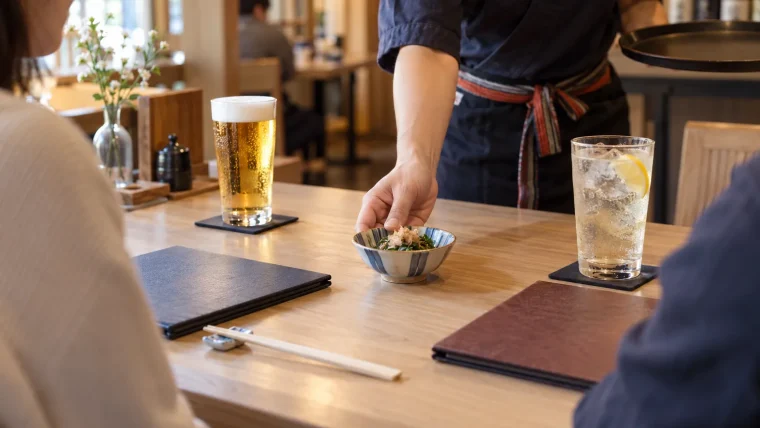
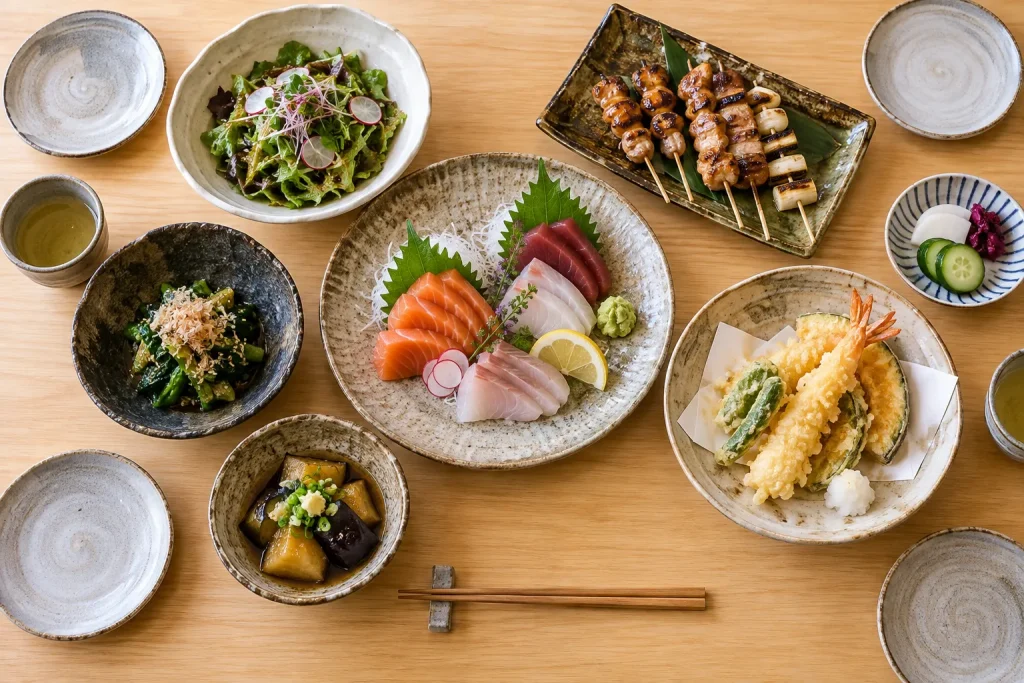
At an izakaya, you will often share several dishes, making direct transfers tempting. Use communal utensils when the restaurant supplies them. If none are present, ask your companions how they prefer to serve the food or place a portion on an available plate. The Small Dish You Never Ordered and Must Pay For explains the separate issue of お通し, otōshi, the appetizer that can arrive automatically with a seating charge. Chopstick manners do not determine whether that charge appears on the bill.
Ramen shops are simpler because you generally eat from your own bowl. Paying Before You Sit Down explains the ticket-machine process instead of repeating it here. You may alternate between chopsticks and the soup spoon, and you can place your chopsticks on the supplied rest or across the designated holder. Avoid leaving them planted in noodles or rice. A lack of polished technique attracts far less attention than a deliberate funeral-linked gesture.
What has not changed at the table
Using chopsticks with your left hand is not a funeral taboo. Some older diners were taught to use the right hand, but left-handed use is now common and is not equivalent to any of the six named mistakes. Crossing the sticks briefly while learning is also not a symbolic offense. Holding them unusually high or low may look awkward, but it does not carry the same meaning as 立て箸 or 箸渡し. Correct the grip for control, not because you fear causing ceremonial insult.
Holding a rice bowl close to your mouth can be normal in Japan, unlike in some other chopstick-using cultures. However, lifting every plate, oversized bowl, or serving dish is not automatically appropriate. Watch what local diners do with the same type of vessel. Japanese Food for Beginners: How to Read a Menu covers dish categories and menu reading, while Sushi vs Sashimi: The Difference Is the Rice handles a distinction that utensils alone cannot reveal. Neither subject requires another universal list of chopstick prohibitions.
Food allergies have not become a matter that can be solved through gestures. If cross-contact, broth ingredients, or cooking alcohol matters medically, say so before ordering and confirm what the restaurant can provide. The site’s phrasebook with ordering and allergy language contains 337 phrases organized by situation. Use it to communicate a restriction rather than pointing at food with chopsticks. Etiquette should never replace a clear safety question.
What is—and is not—scheduled to change
No government timetable currently sets a future date for revising these table conventions. They are not traffic laws or restaurant licensing rules, and no central authority issues a binding national chopstick code. Practices can soften between generations and differ among homes, formal meals, casual restaurants, and regions. Hygiene expectations may also encourage shared serving chopsticks even where family members once used their own. None of this removes the funeral association attached to upright chopsticks or tip-to-tip transfer.
The rules also apply to visual jokes and photographs. Staging upright chopsticks in a rice bowl for social media may upset a companion even if nobody intends to eat that way. Turning the bowl into a prop does not erase the resemblance. By contrast, a child dropping food, crossing the sticks, or struggling with noodles is likely to be treated as a learner. Intent and repetition affect the reaction, but the safest approach is still to correct the position immediately.
Where chopsticks should rest
A chopstick rest solves most uncertain moments. Place the tips on the rest with the chopsticks parallel to each other and generally horizontal in front of you. If a tray or dish has a clearly intended resting position, follow that setup. Do not insert the tips into food to keep the chopsticks from rolling. Do not point them toward another diner while talking.
When you finish, return reusable chopsticks to the rest or the position established by the restaurant. Disposable chopsticks can be placed neatly beside the dish or partly back in their paper sleeve if that is practical. There is no need to rub good disposable chopsticks together; doing so can suggest that you expect splinters or poor quality. If the sticks are genuinely damaged, ask for another pair. The useful standard is controlled, clean handling rather than elaborate ceremony.
Short FAQ
Can I pass food to someone using my chopsticks?
Do not transfer it directly into the other person’s chopsticks. Place it on their individual plate or on a small intermediate plate. The tip-to-tip action is 箸渡し, hashi-watashi, and it resembles the handling of bones after cremation. Using serving chopsticks is appropriate when they are provided. For shared food, follow the arrangement already on the table.
Is it acceptable to leave chopsticks across a bowl?
It is better to use the chopstick rest or place them in the position indicated by the table setting. Laying them horizontally is not the same action as planting them vertically in rice, so it does not reproduce the funeral offering associated with 立て箸. However, placing chopsticks across a bowl can signal that you have stopped eating and may be considered inelegant in a formal setting. In a casual restaurant, the response is usually mild. Never balance them where they can fall into another dish.
Will restaurant staff be offended if I hold chopsticks incorrectly?
An imperfect grip is normally treated as a practical issue, especially when you are visibly learning. Staff and companions care more about what you do with the chopsticks than whether your fingers match a diagram exactly. Avoid pointing, playing, spearing, upright placement, and direct chopstick-to-chopstick transfer. Ask for a fork if the food is becoming difficult to control. Courtesy matters more than pretending to have mastered the utensil.