A Japanese name written in kanji is doing two things at once: it sounds like something, and it means something. Writers exploit both, and translation can usually only carry one.
There is also a second difficulty, which surprises people: a written Japanese name often has several correct readings, and Japanese people genuinely do not know which one you use until you tell them.
Family name first
Start with the order, because it has changed recently in English-language releases.
Japanese puts the family name first: 田中健二 is Tanaka Kenji, where Tanaka is the surname. English publishing spent decades reversing this to Kenji Tanaka, and much of it has now stopped — the Japanese government formally asked media to use Japanese order for Japanese names in 2019, and official subtitles increasingly comply.
The practical result is that the same character can appear in two orders across two releases, which is confusing and not your fault.
The kanji are doing work
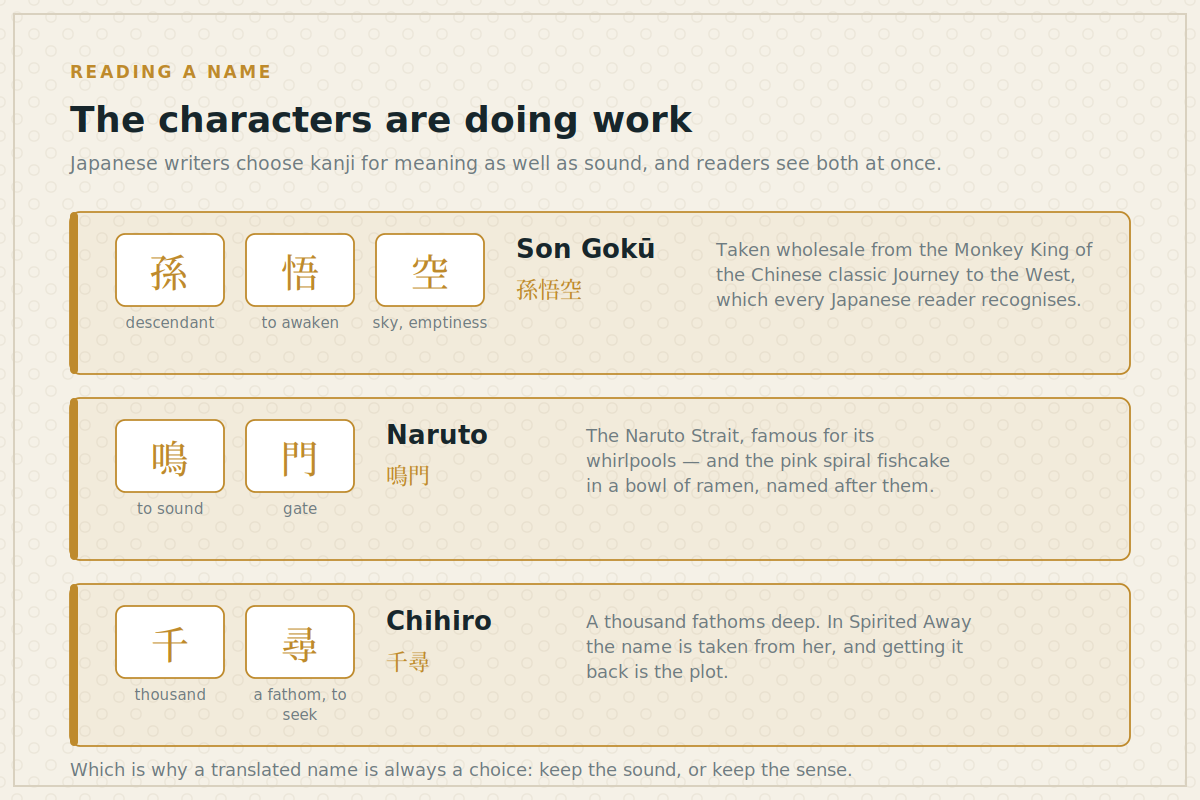
Some examples where the naming is not decorative.
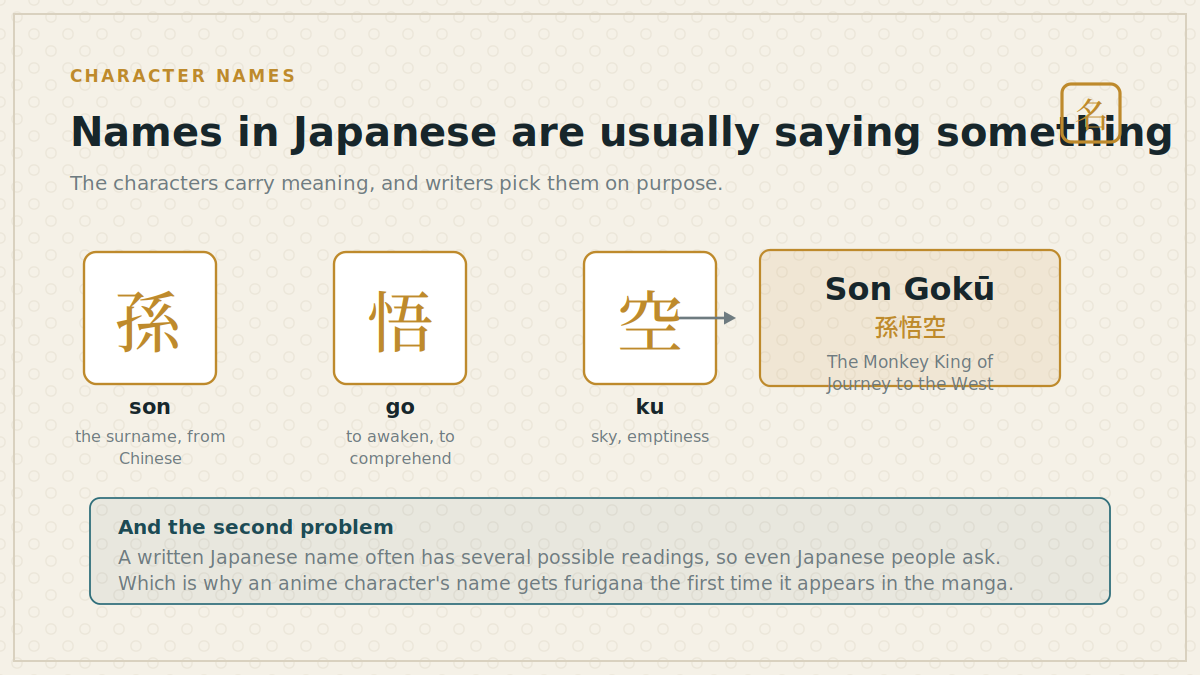
孫悟空 Son Gokū is not an invented name at all. It is the Japanese reading of Sun Wukong, the Monkey King from the sixteenth-century Chinese novel Journey to the West, which every Japanese reader recognises instantly. A boy with a tail, a magic staff and a flying cloud is not a coincidence — it is a retelling, announced in the name.
鳴門 Naruto is the Naruto Strait, famous for its whirlpools. It is also the name of the pink-spiralled fishcake that sits in a bowl of ramen, named after the same whirlpools. The spiral turns up on the character’s clothing and in the village’s symbol.
千尋 Chihiro is “a thousand fathoms.” In Spirited Away the character’s name is taken from her and reduced to 千 — just “thousand” — and getting it back is the entire plot. The film is built on the idea that a name is a possession, which is a Japanese folk-belief and not a screenwriting invention.
None of this reaches a viewer who only hears the sound.
The reading problem
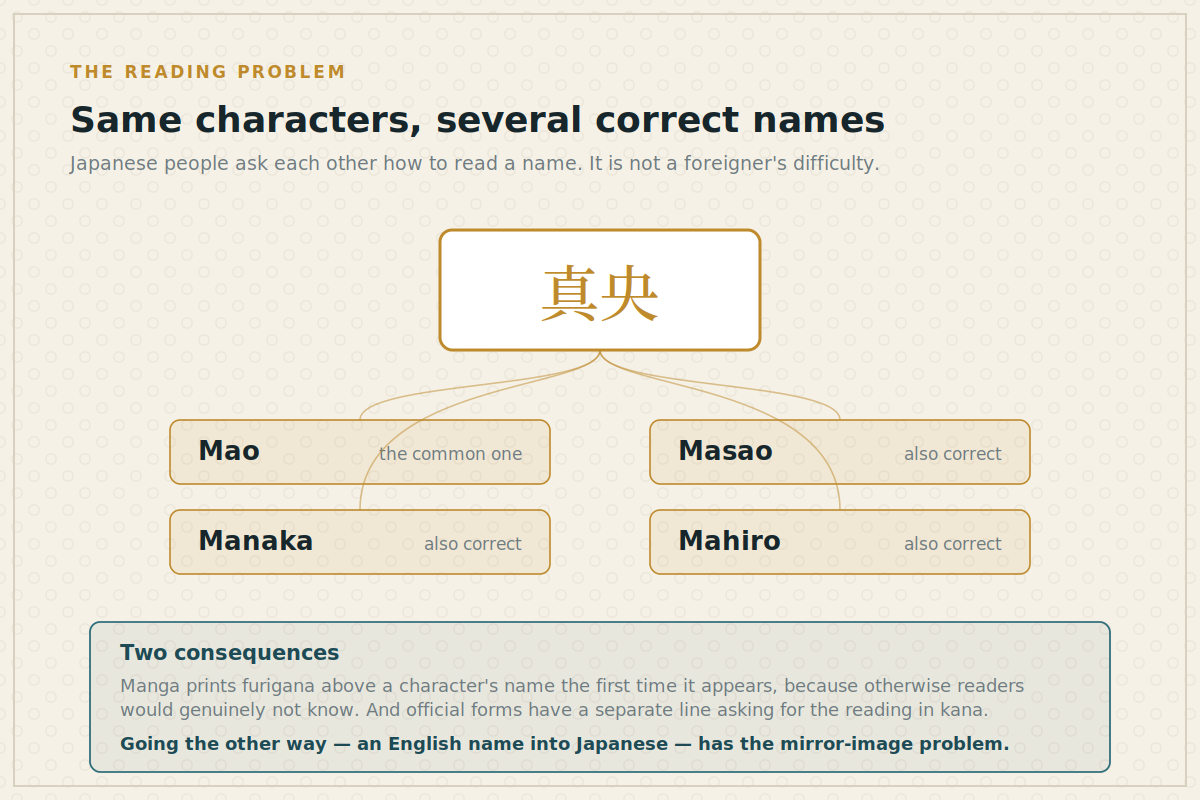
Japanese kanji have multiple readings, and names use a special extra set called 名乗り nanori that appear in names and almost nowhere else. The result is that a written name is frequently ambiguous.
Two consequences follow, and both are visible in anime and manga.
Manga prints furigana — small kana above the kanji — the first time a character’s name appears, because otherwise readers would guess. This is not a courtesy for children; it is necessary.
Official forms have a separate line asking for the reading in kana, usually marked ふりがな. Japanese bureaucracy has an entire field dedicated to the fact that nobody can reliably read a name from its characters. That field, and the rest of the anatomy of a Japanese form, is covered in reading dates on Japanese documents.
Katakana names, and what they signal
Not every anime name is in kanji, and the script itself carries information.
| Written in | Typically signals |
|---|---|
| Kanji | An ordinary Japanese name, with meaning available |
| Katakana | Foreign, fantasy, robotic, or a stage name |
| Hiragana | Soft, young, gentle — often a girl’s given name |
| Roman letters | Deliberately foreign or stylised, common in titles |
So a character named in katakana in a Japanese-set story is marked as an outsider before they say anything. And a fantasy series where every name is katakana is telling you the setting is not Japan, in a way an English reader has no equivalent for — English cannot make a name look foreign without spelling it differently.
Names with jokes in them
Japanese naming supports puns to a degree English does not, because the same sound can be written many ways and the same characters read many ways.
- Numbers as sounds. Digits can be read as syllables, so a name can be hidden in a number or a number in a name. This is the same wordplay that makes 4 and 9 unlucky, described in our article on Japanese numbers and superstition.
- Contradictory characters. A gentle character written with violent kanji, or the reverse, is a joke that lands on sight.
- Family names as themes. Whole casts named after flowers, months, chess pieces or planets, which reads as a wink in Japanese and as a coincidence in English.
Translators face a real choice here, and there is no correct answer. Keep the sound and lose the joke, or rename the character and lose the original. Most modern releases keep the sound, which is the more honest of the two failures.
Keep the sound or keep the sense. A translated name is always one of those, and never both.The choice every translator makes
Going the other way
The mirror-image problem is what happens to a Western name entering Japanese, and anime does it constantly — foreign characters, international settings, and the Japanese dub of anything.
English is not written phonetically, so there is no mechanical way to derive the Japanese spelling. Michael can reasonably be マイケル or ミカエル or ミヒャエル depending on which language you think it came from, and all three appear in Japanese media.
Japanese also has no consonant clusters and no standalone consonants except n, so every cluster gains a vowel: Christmas becomes クリスマス, five syllables where English has two. Names get longer, and where a name ends in a consonant it gains a vowel too.
We measured how far rules alone get you on this, using a purpose-built engine on real American names: about 77% exact matches, with the failures concentrated on the most common names of all. The reasoning and the misses are in our article on katakana name rules and their exceptions, and if you just want your own name done properly, the name converter guide covers it.
Reading a name aloud
Four practical notes for anyone talking about anime out loud.
- Every vowel is pronounced. Kaneki is ka-ne-ki, three even beats, not “kuh-NECK-ee.”
- Long vowels are long. Gokū holds the final u. Tōkyō has two long vowels, which is why “toe-key-oh” is closer than “tok-yo.”
- No stress accent. Japanese uses pitch rather than stress, so putting an English stress pattern on a name is the main thing that makes it sound foreign.
- Doubled consonants are held. The pause in Sakki is real and meaningful — it distinguishes words.
Why any of this matters
Because a name in Japanese fiction is rarely arbitrary, and knowing that changes what you notice. A character introduced with an unusual reading, a cast sharing a naming theme, a villain written in katakana, a name taken away and returned — these are authorial decisions made in a channel English does not have.
The same is true of how characters address each other, which is the most visible version of the problem: Japanese honorifics in anime. And the writing systems themselves, and why a language needs three of them, are explained in how Japanese writing works.