Deciding whether to read the light novel, its manga version, or simply watch the anime can cost more than expected if you choose the wrong route. An English paperback may cost several times the Japanese edition, while an adaptation may omit the narration that explains the story. The right choice depends on three things: your Japanese reading ability, how close you want to remain to the original text, and how much time and money you will spend on a long series.
So what is a light novel in practical terms? It is not merely a novel that happens to be short, nor is it manga with extra words. ライトノベル, raito noberu, literally “light novel,” is a publishing category built around compact books, recognizable imprints, recurring illustrations, fast-moving series, and a pipeline that can lead from a newcomer contest or web platform to print, manga, anime, and translation.
The claim that light novels supply most anime adaptations in every season is harder to defend. No primary industry dataset found for this article provides a verified season-by-season majority. Manga, games, original projects, and other novels remain major sources. Light novels feed a highly visible part of the television schedule—especially fantasy, school comedy, romance, and 異世界, isekai, literally “different world”—but “half the season” should be treated as a headline, not a measured rule.
Buy the Japanese bunko when you want the actual object
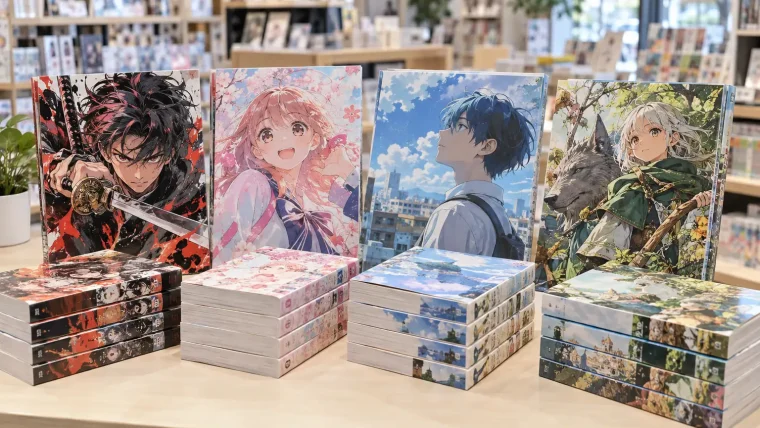
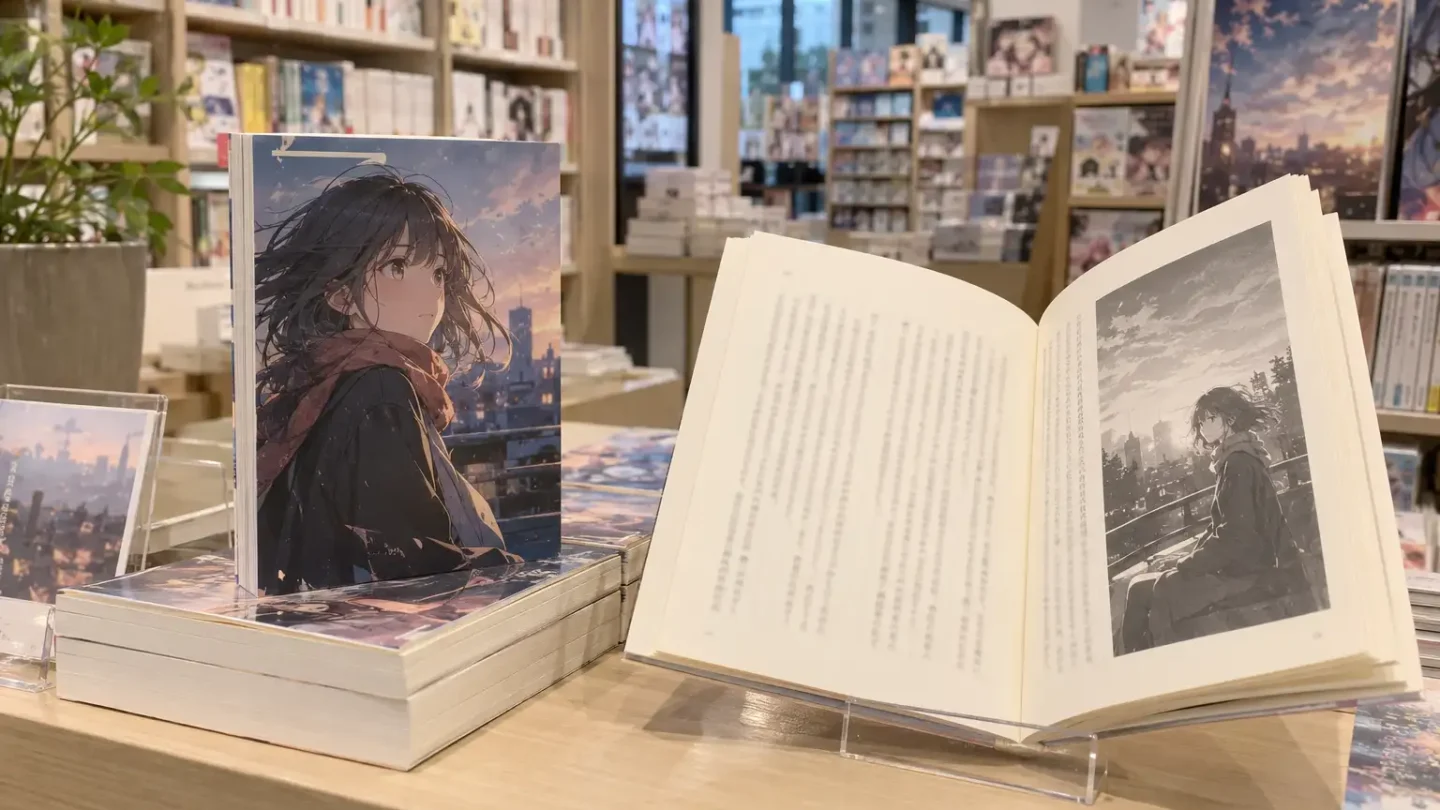
The Japanese edition is the clearest way to see the format as its domestic publishers designed it. 文庫, bunko, literally “library” but used for a compact paperback format, is small enough to carry on a train and cheap enough to support serialized buying. The cover illustration announces the cast and genre, while monochrome images inside mark selected scenes. Most pages are prose.
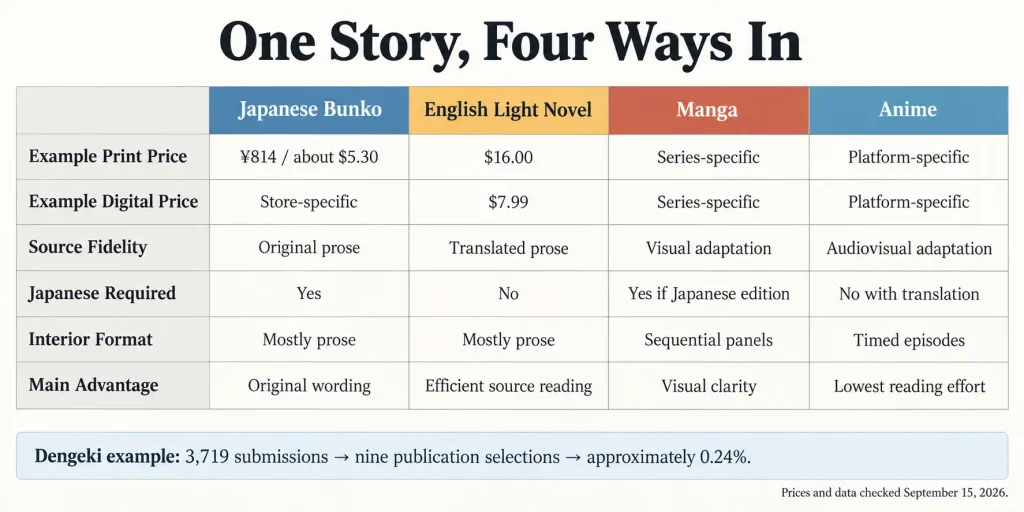
A representative example shows the economics. KADOKAWA lists the first Re:Zero volume under MF Bunko J as a bunko-format book with 288 pages and a price of ¥814. At the Federal Reserve reference rate of ¥153.71 to $1 on September 11, 2026, that was about $5.30. The price and conversion were checked on September 15, 2026 and should be refreshed before publication.
What you get is the original wording, the Japanese typography, the illustrations in their intended positions, and the imprint’s complete packaging. You also get every difficulty the translation normally removes: uncommon kanji, invented terminology, compressed dialogue, and readings that may be supplied only when the editor thinks they are necessary.
This option suits you if you already read continuous Japanese prose. The threshold is not whether you can identify speech bubbles in manga. It is whether you can finish several pages of narration without stopping for every sentence. If you cannot, the lower cover price buys you a much higher time cost.
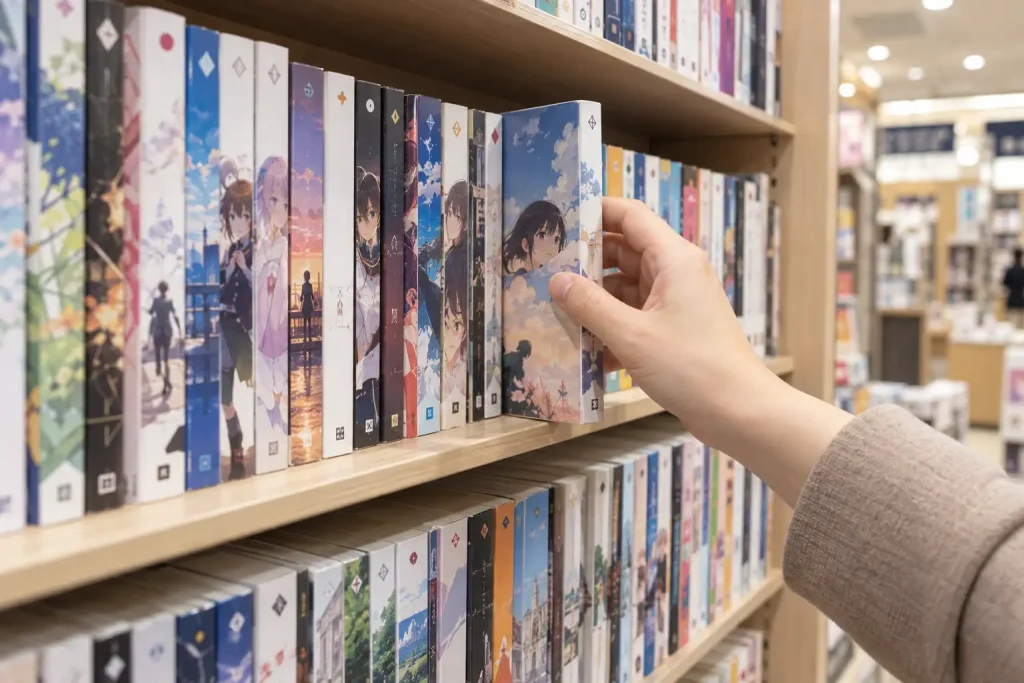
The format also reveals how the publishing company organizes the market. 電撃文庫, Dengeki Bunko, literally “Dengeki paperback library,” and MF文庫J, MF Bunko J, are imprints rather than genres. An imprint selects, edits, illustrates, packages, and markets books to a particular readership. KADOKAWA’s catalog places Dengeki Bunko and MF Bunko J alongside several other light-novel labels instead of treating every title as part of one undifferentiated shelf.
The mechanics differ from manga publication. From Weekly Magazine to the Volume You Buy follows manga from serialization to collected book; light novels usually reach the reader as prose volumes controlled by a book imprint.
Choose the English edition when reading speed matters
An official English edition gets you the prose, narration, and internal viewpoint without requiring literary Japanese. It is the most direct choice for an American reader who wants the source story rather than a visual retelling. It is also physically different from the Japanese bunko.
Yen Press lists its English paperback of Re:Zero’s first volume at $16.00 and its digital edition at $7.99, with 248 pages and a trim size of 5.5 by 8.25 inches. The publisher’s details were checked on September 15, 2026. The Japanese book is listed by KADOKAWA at ¥814, about $5.30 at the cited exchange rate, so the official English paperback costs roughly three times as much as that Japanese retail example before shipping or discounts.
The extra cost buys professional translation, English editing, licensing, production, and distribution. It does not buy a line-for-line mechanical transfer. Japanese prose may use withheld subjects, unusual first-person pronouns, honorifics, or speech patterns that cannot occupy the same space in English.
Anime Speech Styles, and What Subtitles Cannot Carry explains how pronouns, register, and role language lose information on screen. The same linguistic problem exists in translated prose, although a novel gives the translator more space than a subtitle. Japanese Honorifics in Anime: -san, -kun, -chan and the Rest covers forms of address instead of repeating that system here.
The English edition suits you when plot detail and reading momentum matter more than owning the Japanese artifact. It is also the sensible entry point if you want to compare a book with its adaptation. You can see which explanations, scenes, and viewpoints the anime compressed without trying to solve the language at the same time.
The expensive paperback is often the cheapest option measured in hours rather than dollars.
Pick the manga adaptation when you need a visual bridge
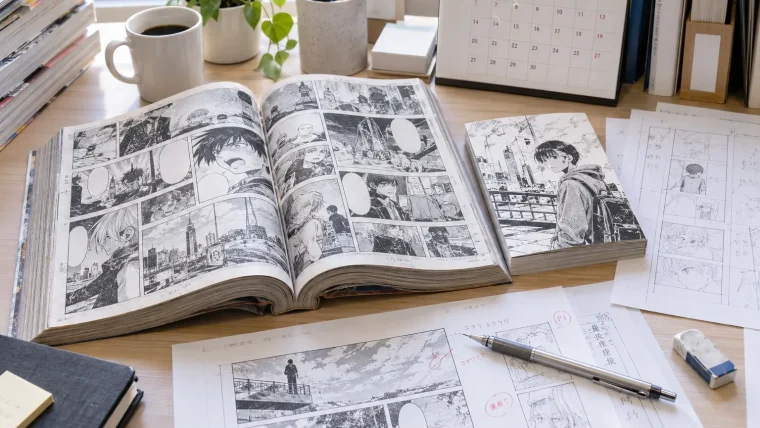
A manga adaptation turns prose into panels, speech balloons, character acting, and page composition. It is not usually the manuscript from which the light novel was written. It is another adaptation of the prose source, often developed after the novel has demonstrated commercial potential.
What it costs varies by license and edition, so no universal figure is useful. More importantly, buying the manga does not guarantee that you are buying the same amount of story as one novel. The manga artist must convert narration into visible action, and its collected volumes may cover the source at a different rate. You need to compare volume descriptions for the specific series.
What you gain is speed and visual orientation. Costumes, locations, combat, and unfamiliar names become easier to track. What you lose can include internal monologue, world-building explanations, unreliable narration, and small decisions that make a character’s behavior logical.
The manga route suits you when dense Japanese prose is above your present level or when you want to sample the premise before committing to the novels. It can also work as a reading aid: finish a scene in manga, then read the corresponding prose while the characters and setting are already clear.
Do not confuse its production rhythm with the novelist’s. Nineteen Pages, Every Week, With Assistants explains the labor behind a weekly manga chapter; a light-novel writer works inside a book-production cycle with a prose editor and a separately credited illustrator.
Watch the anime when the story is more important than completeness
Anime costs you the least reading effort. Depending on the licensed platform and your existing subscriptions, it may also have the lowest immediate cash cost. Because streaming prices, regional catalogs, and advertising plans change, this article does not assign a universal dollar figure.
What you get is movement, voice acting, music, editing, and a shared release schedule. What you do not automatically get is the whole book. A television production must fit episodes and production resources, so description and interior thought are easy places to cut. Rearranged scenes do not necessarily mean the staff misunderstood the novel; they may be rebuilding prose for a timed visual medium.
This route suits you if you want to discover whether the premise holds your attention. It is less suitable when your real question is why a character made a choice that the adaptation barely explained. In that case, the source novel is not bonus merchandise. It is where the missing reasoning may still exist.
The audience labels sometimes attached to anime do not identify the source format. Four Words That Name a Magazine’s Readers explains why shōnen, shōjo, seinen, and josei classify manga magazine audiences rather than universal story genres. A light novel has an imprint and intended market of its own.
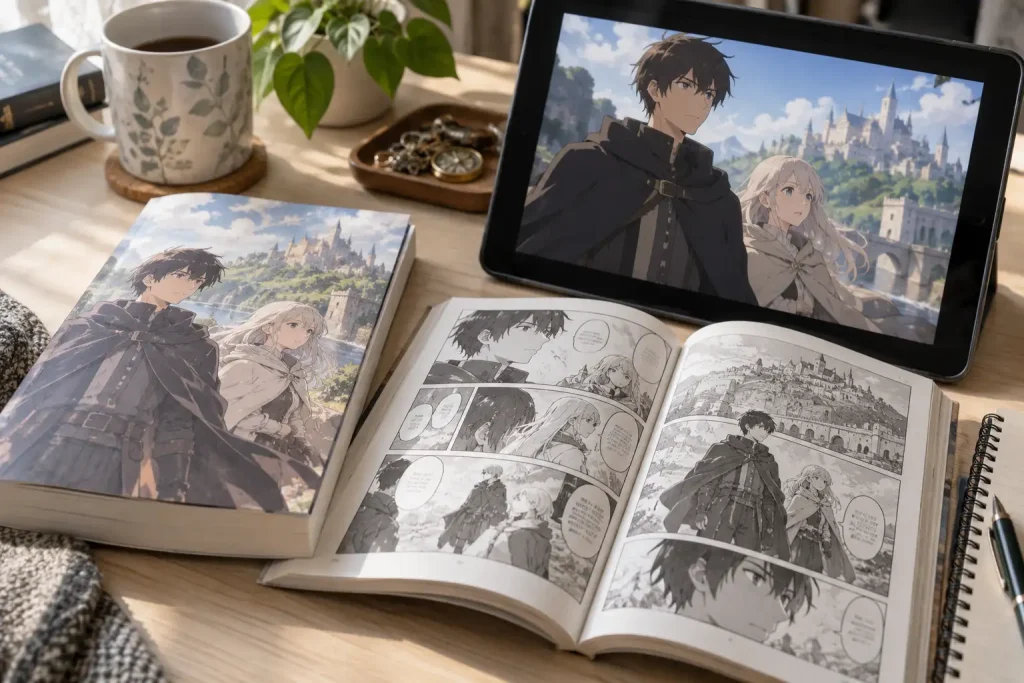
What is a light novel when you compare the formats?
The fastest test is to look inside. If the pages are overwhelmingly prose, with occasional full-page or partial-page illustrations, you have a novel. If sequential panels carry the action, you have manga. If the book is a large-format prose title sold under a “new literature” label, it may share themes with light novels without using the bunko package.
| Deciding factor | Japanese light novel | English light novel | Manga adaptation | Anime adaptation |
|---|---|---|---|---|
| Closest to the original prose | Yes | Yes, through translation | No, visual adaptation | No, audiovisual adaptation |
| Japanese ability required | High for comfortable reading | None | Moderate if bought in Japanese | None with English subtitles or dub |
| Internal narration retained | Full source text | Usually retained in translation | Often compressed | Often compressed |
| Illustrations | Selected scenes | Usually retained | Sequential art throughout | Continuous animation |
| Representative cost | ¥814, about $5.30 | $16.00 print or $7.99 digital | Series-specific | Platform-specific |
| Best for | Advanced readers and collectors | Source-first English readers | Visual readers and learners | Fast discovery |
The crucial threshold is prose tolerance. If you can read dialogue but repeatedly lose the subject during narration, Japanese manga may be manageable while a Japanese novel remains exhausting. If you can follow several prose pages with occasional dictionary checks, the original bunko becomes realistic.
Your second threshold is source fidelity. If knowing every explanation matters, choose a light novel in a language you can read efficiently. If you mainly want the cast, premise, and major turns, the manga or anime may be enough.
Your third threshold is series commitment. A low per-volume price stops being low when the series is long. Before buying a stack, check the publisher’s volume list, translation availability, and whether the story is complete.
The imprint matters more than the cover style
Readers often define Japanese light novels by anime-style covers, short paragraphs, or long titles. Those are clues, not the industrial definition. The more reliable signal is who published the book and under which imprint.
A label such as Dengeki Bunko is an editorial machine. It commissions covers and interior art, positions books for a known audience, schedules releases, manages series branding, and controls the rights from which other projects can grow. MF Bunko J performs a similar function within its own list and identity.
This explains why the illustrator’s name appears prominently even though the book is prose. The artwork is not random decoration added by a bookstore. Character designs help the series move between print, promotion, manga, merchandise, and animation. The book is already being packaged as reusable intellectual property.
“Winning works debut from Dengeki Bunko, Dengeki no Shin Bungei, Media Works Bunko, and other labels.” — translated from the official Dengeki Novel Prize site
The quote matters because it describes the contest as a route into specific publishing lines. An aspiring author is not merely trying to win money. The real prize is entry into an editorial and production system.
Contests are a front door, not the only door
Publisher-run newcomer prizes remain a visible way into the business. The official Dengeki Novel Prize site describes its competition as a route for winners to debut through KADOKAWA imprints. As checked on September 15, 2026, the current competition page gave an April 10, 2027 submission deadline.
The previous Dengeki competition received 3,719 works and selected nine for publication, according to KADOKAWA’s April 3, 2026 announcement. That produces a blunt piece of arithmetic: 9 ÷ 3,719 × 100 = approximately 0.24 percent. It is not a universal acceptance rate, because prizes, publication decisions, and submission pools change. It does show why “enter a contest and become a novelist” is not a practical plan by itself.
MF Bunko J also runs its own newcomer award. Its official FAQ states that a writer may enter no more than three works in the same round and warns that submitting four or more makes the entries noncompliant. That is not a literary preference. It is an industrial gate with formal submission rules.
There are three common entry routes worth separating:
- Submit directly to a publisher’s newcomer contest.
- Build an audience on a Japanese web-fiction platform and attract editorial interest.
- Approach publication through another writing or media career.
A contest offers a defined reading process and a direct imprint connection. A web platform offers public feedback and visible audience data but forces the writer to compete for attention before an editor becomes involved. Neither route guarantees an anime; publication itself is only an early gate.
The adaptation pipeline is selective, not automatic
The simplified pipeline looks neat: manuscript, light novel, manga, anime, English edition. Real projects do not always travel in that order. A web novel can precede the commercial book. A manga may appear before an anime announcement. Translation may arrive after the adaptation creates overseas demand, or it may never arrive.
| Stage | Main gatekeeper | What must be proved | What can stop the project |
|---|---|---|---|
| Submission or web publication | Contest judges, editors, or readers | A workable story and market fit | Rejection or weak readership |
| Imprint publication | Publisher and editorial team | Sales potential as a book series | Low sales or cancellation |
| Manga version | Publisher and rights partners | Visual and promotional value | Limited staff, budget, or audience |
| Anime development | Rights holders and production committee | Value across broadcasting, streaming, books, and licensing | Financing, scheduling, or strategic risk |
| English edition | Overseas licensee | Sustainable translated demand | Licensing cost or weak sales forecast |
An anime adaptation is therefore not the natural final chapter of every successful novel. It is another investment decision. The publisher may benefit from renewed book sales, but broadcasters, streaming platforms, animation companies, music companies, and merchandise partners have different reasons to participate.
This is also why visible anime hits distort the reader’s impression of the whole market. You see the books that crossed the adaptation gate. You do not see the many series that remained print-only, ended early, or were never licensed in English.
Light novels are a major source of anime because their imprints produce adaptable story packages—not because most light novels become anime.
Does the format really feed half the anime season?
No verified primary source located for this article supports the claim that light novels provide half—or most—of every seasonal anime lineup. The available industry material confirms that they are an established source category and that large publishers operate dedicated adaptation pipelines. It does not establish a stable season-wide majority.
The distinction matters. Light novel adaptations can dominate a viewer’s personal queue because fantasy and romantic-comedy titles are highly visible. That is different from dominating the total output, which also includes manga adaptations, games, multimedia franchises, children’s properties, original anime, and conventional novels.
A defensible article should therefore say that light novels feed a substantial and recognizable share of modern anime, not that they reliably supply most titles. To publish a percentage, the editor would need a dated seasonal dataset with rules for sequels, continuing shows, short-form animation, web series, and mixed-source projects.
The uncomfortable part is that “half the anime season” is an excellent headline and an unsupported statistic. Keep the industrial argument. Drop the number unless a reproducible count is added before publication.
Three readers, three different answers
Consider a first-time source reader who wants three Re:Zero volumes in English. Using Yen Press’s checked list prices, the arithmetic is 3 × $16.00 = $48.00 for paperbacks or 3 × $7.99 = $23.97 digitally. The digital novels are the sensible choice if the goal is to read light novels rather than collect them.
Now consider a Japanese learner buying the same three Japanese volumes at the first volume’s representative ¥814 price. The arithmetic is 3 × ¥814 = ¥2,442, about $15.89 at the September 11, 2026 Federal Reserve rate. That saves about $32.11 against three English paperbacks, but only if the reader can handle the prose. If each page becomes a translation exercise, the financial saving buys weeks of extra work.
Finally, consider an anime viewer who wants to know what was omitted. Buying every available adaptation format is the expensive default. Start with the first English digital novel at $7.99 and compare it with the opening anime arc. If the added narration changes the experience, continue with the novels. If it does not, stop after one book instead of purchasing an entire shelf.
For unfamiliar Japanese character names, use the name converter with 898 checked katakana names only for transliterating your own name or another non-Japanese name. It does not decode fictional kanji names, and reproducing the tool as a homemade table would make the answer worse.
The defaults that waste money and time
The first mistake is buying the manga because its cover resembles the novel and then expecting the original prose. Check the format and credits. “Story by,” “art by,” “manga,” and “light novel” identify different products even when the English title is identical.
The second mistake is buying a long run before testing the translation. Start with a sample or one volume. Translation style, narration, and localization choices matter more over a long series than they do in a bookstore preview.
The third mistake is importing Japanese volumes because they look inexpensive. Shipping can erase the price advantage, and a low-priced unreadable book is not a bargain. Buy the Japanese edition when you want the object or can read it—not because the yen price looks small.
The fourth mistake is assuming the anime proves the novels are complete. An adaptation can appear while the source continues, pauses, or ends without translating every volume. Check the Japanese publisher and English licensee separately.
The fifth mistake is treating “light novel” as a genre. It does not mean fantasy, reincarnation, comedy, or young-adult fiction. Those may be common on particular lists, but the useful category is the publication system: prose volume, imprint, editor, illustrator, recurring series, and rights pipeline.
The two-line rule is simple:
If you want the source story and read English faster, buy the official English light novel—digital first if cost matters.
Otherwise, use the manga or anime as a trial, and buy Japanese bunko only when your prose ability or collecting goal justifies it.
FAQ
Are light novels mostly pictures?
No. They are prose books with selected illustrations. Manga uses sequential panels to carry the story, while the text carries a light novel.
Are light novels shorter than regular novels?
Some are compact, but length alone does not define the category. The imprint, format, illustrations, editorial positioning, and series model are more reliable identifiers. KADOKAWA’s first Re:Zero volume, for example, is listed at 288 pages.
Is a light novel the same as a young-adult novel?
No. The categories come from different publishing industries and do not map neatly onto each other. Some light novels target teenage readers, but the label describes a Japanese publishing segment rather than an American age category.
What is the difference between a light novel and manga?
A light novel tells the story primarily through prose and uses occasional illustrations. Manga tells it through sequential drawings, panel order, dialogue balloons, and visual pacing. A manga bearing the same title may be an adaptation of the novel.
Why do light novels have long titles?
A descriptive title can communicate the premise quickly in a crowded market, especially when a work begins online. However, long titles are a tendency rather than a formal requirement, and many successful series have short names.
Do light novels become manga before anime?
Often, but not always. Adaptation order depends on the property and its rights holders. A web version may precede print, while manga, anime, translation, audio, and games can enter the pipeline in different sequences.
Do most light novels receive anime adaptations?
No. Anime viewers encounter the selected titles that made it through financing and rights decisions. Many published series never receive animation, and some end before obtaining an English license.
Do most seasonal anime come from light novels?
The research for this draft did not find a primary, reproducible source proving a majority across seasons. Light novels are a major source, but manga, games, original projects, and other media also supply substantial portions of each lineup.
Is the Japanese edition cheaper than the English edition?
In the checked Re:Zero example, yes. KADOKAWA listed the Japanese first volume at ¥814, about $5.30 at the cited exchange rate, while Yen Press listed the English paperback at $16.00 and the digital edition at $7.99. Shipping, discounts, and exchange rates can change the comparison.
Where should a new reader start?
Choose a series whose anime or manga already interests you, then buy one digital English volume. This limits the initial cost and shows whether you enjoy prose-driven versions of familiar stories.