The sub-versus-dub argument usually runs on the assumption that dubs are a compromise and subtitles are the real thing. That is not quite right, and the reason is technical rather than aesthetic.
An English dub is not a translation of a Japanese script. It is a rewrite constrained by the shape of a mouth that was already drawn.
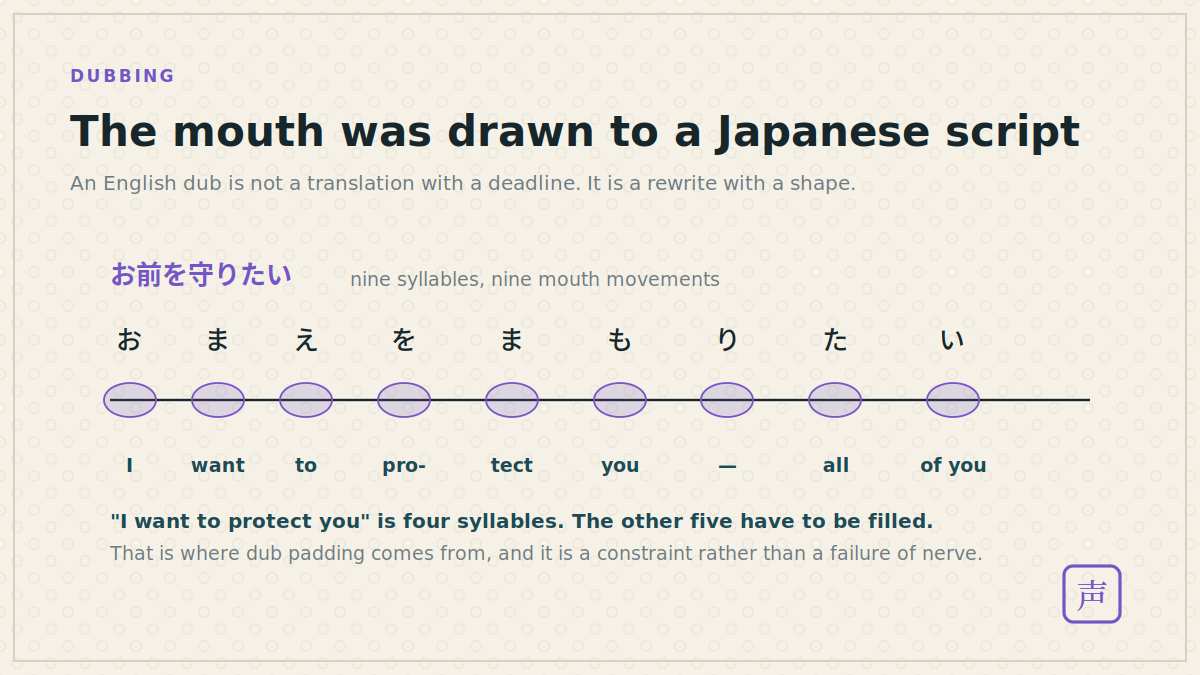
The lip flap problem
Animation is drawn to a recorded Japanese performance. The mouth movements — “flaps,” in the trade — match Japanese syllable timing, and they are on the film before any English speaker sees it.
So an English line has to do three things at once: mean roughly what the Japanese meant, sound like natural English, and open and close a mouth the same number of times in the same places.
Japanese and English differ enormously in syllable count for the same idea. Omae o mamoritai is nine syllables. “I want to protect you” is six, and “I’ll protect you” is four. The dub writer has five empty flaps to fill, and the options are to add words, lengthen words, or leave the mouth moving silently — which looks broken.
This is the source of what viewers call dub padding: the extra clause, the repeated name, the “…and I always will.” It is a constraint, not a failure of nerve.
What each format loses
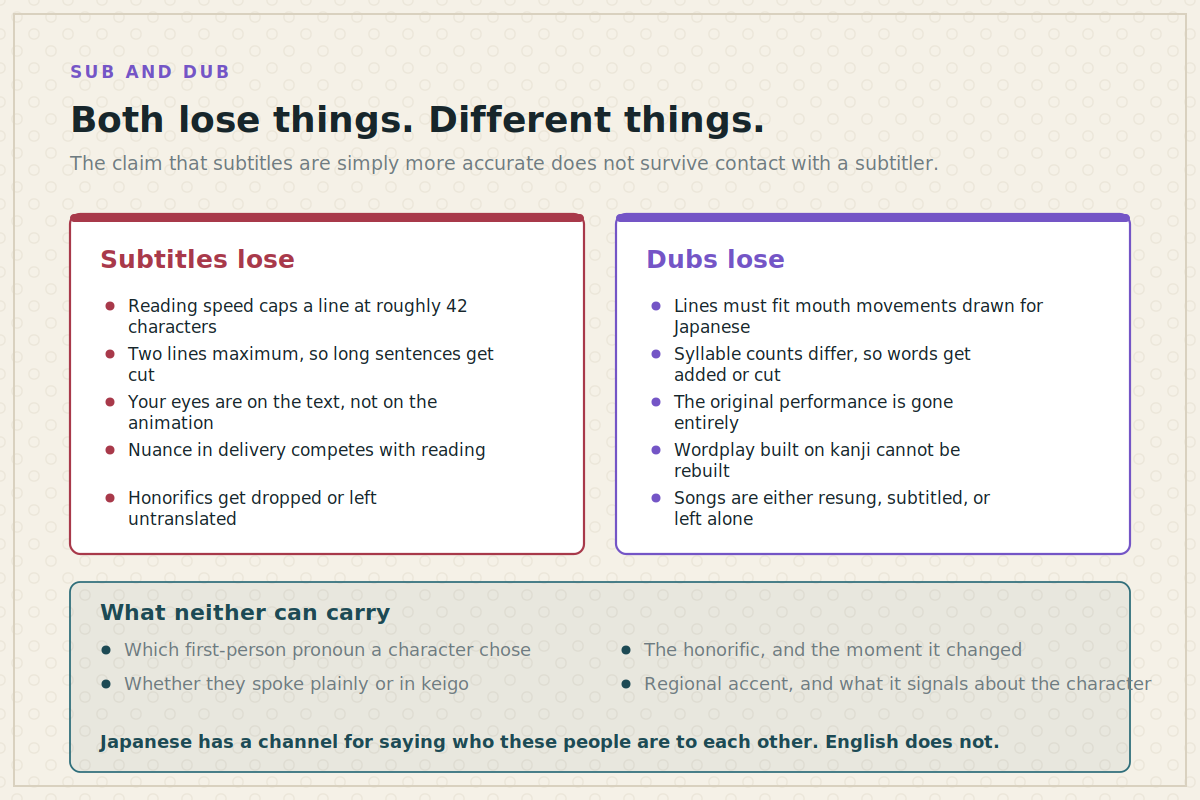
Subtitles have their own constraints, and they are tighter than most viewers assume. A line has to be readable in the time it is on screen, which caps it at roughly forty characters per line and two lines. Long Japanese speeches get compressed, not translated in full.
And there is a cost nobody counts: while you are reading, you are not watching. Anime is a visual medium with a great deal of information in the frame, and subtitles take your eyes off it several times a minute.
Dubs lose the original performance entirely, which is a real loss — Japanese voice acting is a distinct profession with its own training, its own star system, and performers whose casting is itself news. They also cannot rebuild wordplay that lives in kanji, and they have to decide what to do about songs.
What neither of them can carry
This is the more interesting category, and it is the same list in both directions.
- Which first-person pronoun a character chose, and whether they changed it.
- Whether they spoke plainly, politely or in full keigo.
- The honorific attached to a name, and the episode where it was dropped.
- Regional accent, and everything it signals about where a character is from and what kind of person that makes them.
These all belong to one channel: the grammatical machinery Japanese uses to state the relationship between the speaker and everyone else. English does not have that machinery. It can approximate — a stiffer register, a “sir,” a chosen nickname — but it cannot encode it in the same place, and it cannot break it on cue the way Japanese can.
Those systems are set out in our article on speech styles and our article on honorifics.
Localisation has changed a great deal
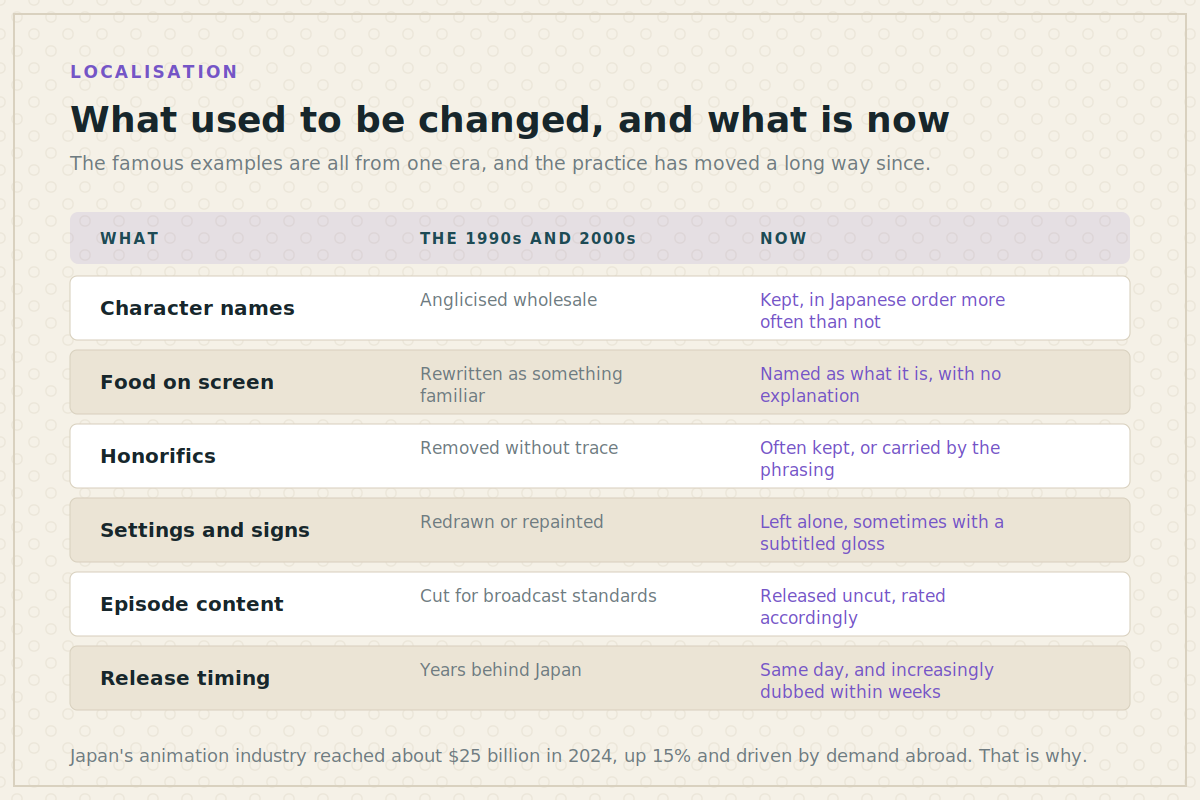
Almost every story people tell about dubs ruining anime dates from the same period — roughly the mid-1990s to the mid-2000s, when anime was being sold to American children’s television and had to fit its standards.
Names were anglicised wholesale. Food was renamed to something recognisable. Settings were repainted. Episodes were cut, merged, or skipped. Music was replaced.
Almost none of this happens now. The audience changed, the distribution changed, and the economics changed with them: Japan’s animation industry reached about $25 billion in 2024, up roughly 15% on the year and driven largely by demand outside Japan. When overseas viewers are the growth, there is no incentive to pretend a show is not Japanese.
Current practice keeps names, keeps honorifics more often than not, leaves signage alone or glosses it, releases uncut, and dubs within weeks rather than years.
Every famous story about a dub mangling a show comes from the era when anime was being sold to children’s television. That era ended, and the stories outlived it.Why the reputation lags the practice
The voice acting difference
Worth understanding, because it explains a lot of the feel that people attribute to translation.
Seiyū in Japan is a career with its own schools, agencies and celebrity. Performers release music, host radio shows and appear at events as themselves. The performance style that comes out of that tradition is broader and more stylised than mainstream English-language acting, which is a convention rather than a fault.
English dub actors work from a different tradition, and when they match the Japanese delivery exactly it can sound artificial in English, while playing it naturalistically can feel underpowered against the animation. Neither choice is neutral, and studios differ on which they take.
There is also a scheduling difference. Japanese recording is often done with the full cast together, reading to picture. English dubs are more commonly recorded one actor at a time, which makes overlapping dialogue and genuine reactions harder to build.
What to actually watch
A defensible position, rather than a tribal one.
| Watch subbed when | Watch dubbed when |
|---|---|
| The performance is the point — a famous cast, a vocal showcase | The animation is the point and you want to look at it |
| You are learning Japanese and want the input | You are doing anything else at the same time |
| The show leans on wordplay and register | The show is dense with on-screen action or text |
| It is a simulcast and the dub is months away | Reading subtitles tires you, which is not a character flaw |
The one genuinely bad option is deciding in advance that one of them is for serious people. Both are translations, both drop things, and a good dub is a considerable piece of craft.
Where the interesting losses actually are
If you want to notice what is missing rather than argue about formats, three habits help.
Listen for pronouns. Ore, boku and watashi are easy to hear and immediately tell you something the English is not saying.
Listen for the honorific. A dropped -san is audible even if you speak no Japanese, and it is usually the most important thing in the scene.
Read the manga for the wordplay. Print can carry a translation note or a furigana gloss that a subtitle cannot, which is why jokes built on kanji generally survive on the page and die on screen. How manga handles that, and how to read a page in the first place, is in our article on manga reading order.