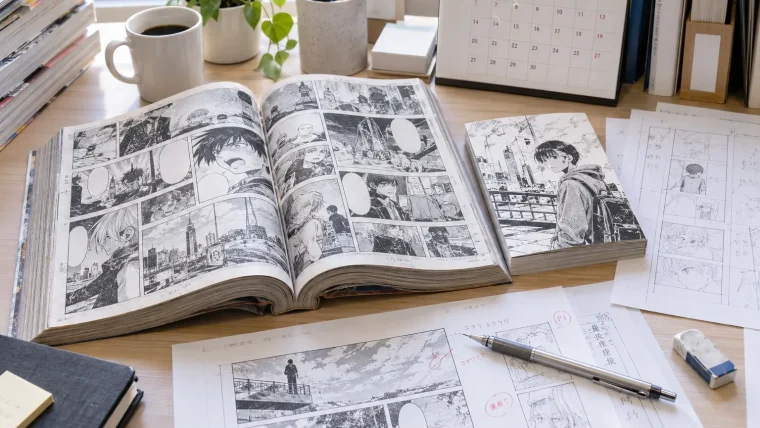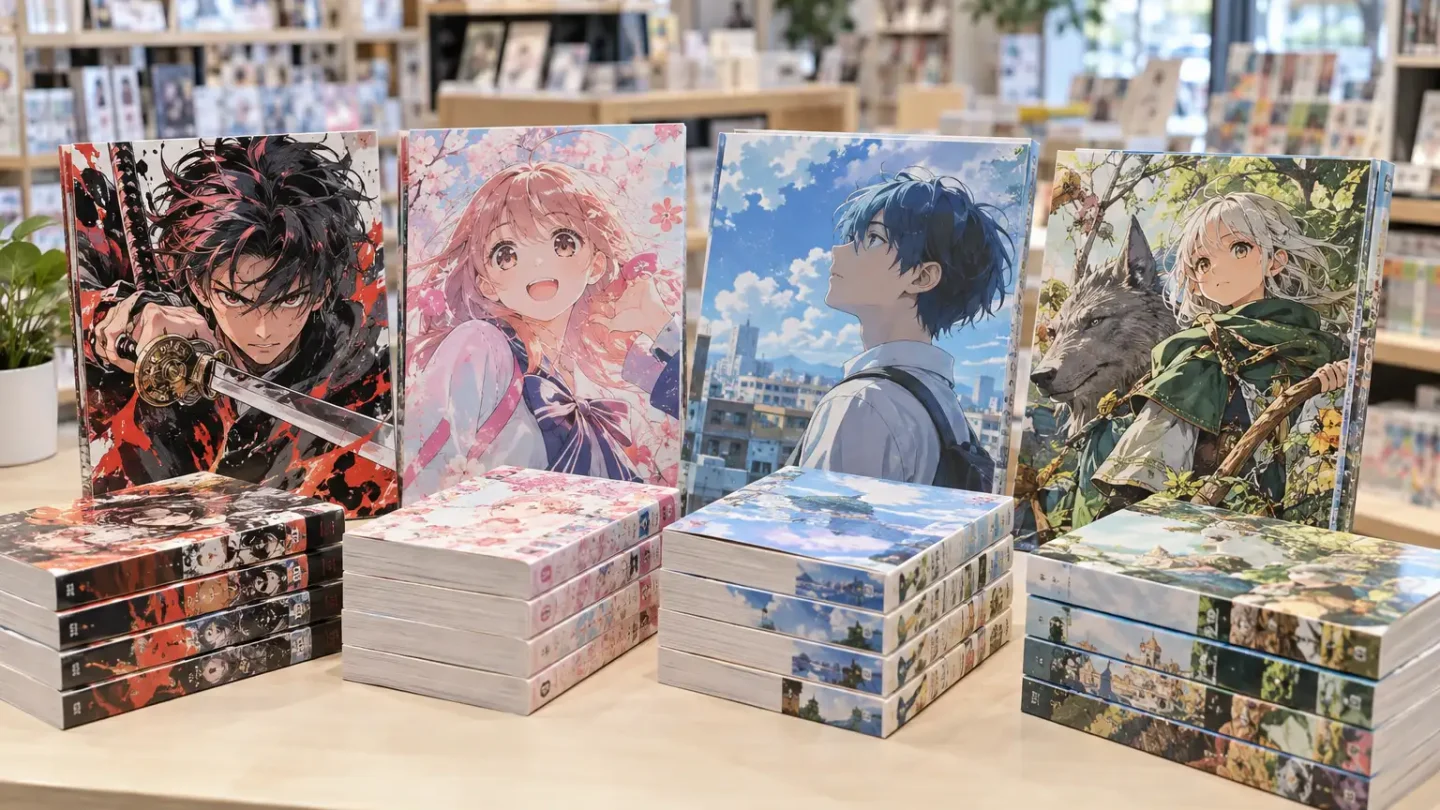
The label moved online, but its meaning did not
In 2014, Shueisha launched the Shonen Jump+ manga app, moving the word shōnen from a familiar print masthead onto a digital platform. The delivery system changed, but the label still did not become a genre. In the common shonen vs seinen vs shojo comparison, each word identifies the readership toward which a publication or editorial line is marketed. It does not promise action, romance, comedy, horror or any other kind of story. That is why the useful question is not “What genre is this manga?” but “Where was this manga published?”
The four terms are 少年 shōnen, literally “boy” or “youth”; 少女 shōjo, literally “girl”; 青年 seinen, literally “young man”; and 女性 josei, literally “woman.” American bookstores and streaming services often display them beside genre tags, which makes them look equivalent to fantasy, horror or romance. Japanese publishers use them more like market and magazine categories. A series inherits much of its demographic identity from its publishing home, even when readers outside that target group become its largest international audience. From Weekly Magazine to the Volume You Buy explains the larger system of serialization, collected volumes and editorial ownership.
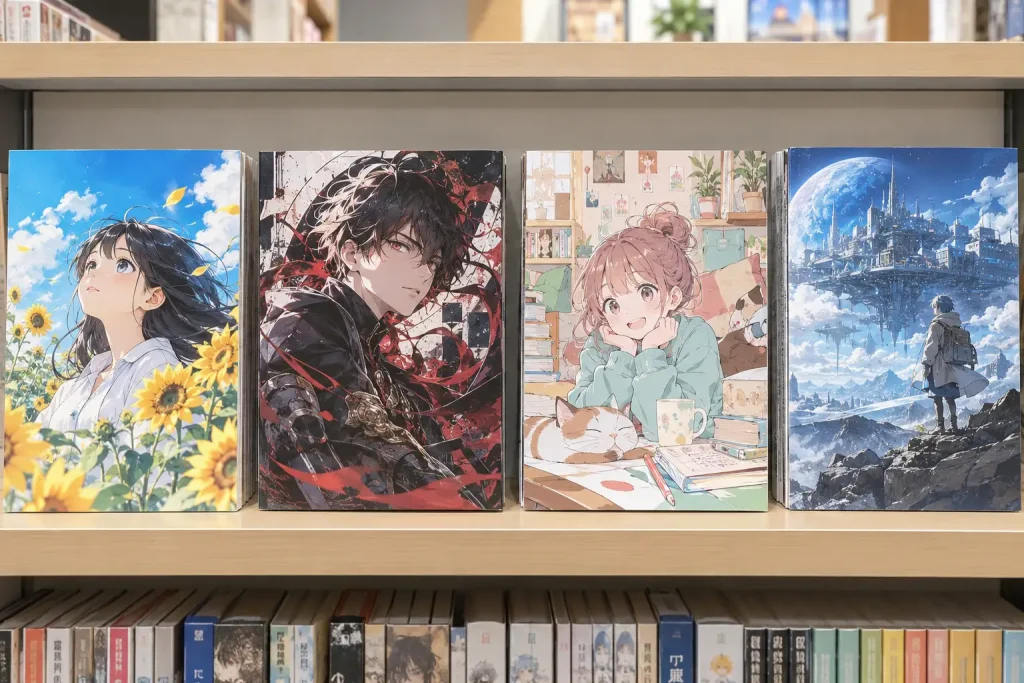
Before apps, the magazine shelf made the system visible
For most of modern commercial manga history, the physical magazine gave the classification an obvious context. A reader bought a weekly, monthly or semimonthly anthology assembled for a defined market, and several serialized works appeared inside it. The magazine’s editorial policy shaped page counts, pacing, advertising, cover design and the kinds of pitches editors were willing to develop. A collected volume could later sit alone on an American shelf, but its original Japanese magazine remained part of its publishing identity. The demographic label therefore described the container before it described anything about the work inside.
The basic editorial map looked like this:
| Japanese term | Literal reading | Publishing category | What it does not guarantee |
|---|---|---|---|
| 少年 shōnen | Boy or youth | Publications marketed mainly toward boys and young male readers | Fighting, adventure or a male protagonist |
| 少女 shōjo | Girl | Publications marketed mainly toward girls and young female readers | Romance, softness or a school setting |
| 青年 seinen | Young man | Publications marketed mainly toward adult men | Violence, realism or sexual content |
| 女性 josei | Woman | Publications marketed mainly toward adult women | Romance, domestic drama or realism |
The categories were never airtight descriptions of actual readers. Girls read boys’ magazines, adults read youth magazines, and successful series routinely traveled far beyond the audience named on the masthead. Editors were targeting a market, not inspecting the identity of everyone who bought an issue. This is the part that disappears when English-language databases reduce manga demographics to four colored filters. A filter can be useful for browsing, but it cannot tell you what happens in the story.
Two series that break the shortcut immediately
Fruits Basket makes the distinction unusually clear. The official anime site identifies Natsuki Takaya’s manga as a shōjo work serialized in Hakusensha’s Hana to Yume from 1998 through 2006. Its family trauma, supernatural curse, comedy and romance do not independently make it shōjo. Publication in a magazine that Hakusensha categorizes among its shōjo manga magazines does. Calling it shojo manga describes its editorial home and intended market, not a single genre.
Berserk supplies the opposite test. Its official adaptation site says serialization began in 1989 and identifies the publisher and Young Animal, while Hakusensha places Young Animal under 青年まんが誌 seinen mangashi, literally “young-men’s manga magazines.” The series contains dark fantasy, war, horror and graphic violence, but none of those elements defines seinen as a category. A gentle workplace comedy published in the same demographic market could also be seinen manga. The label follows the publishing line; the content still needs its own description.
“Shōnen” does not mean battles, and “shōjo” does not mean romance. Those are common contents, not definitions.
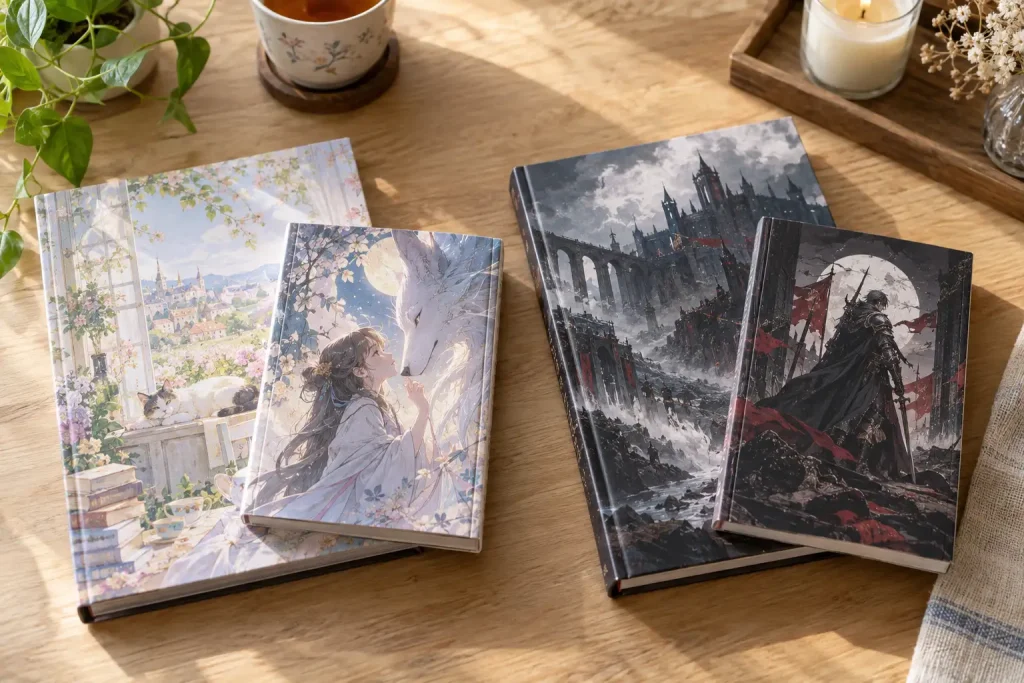
What changed when the magazine became an app
Shonen Jump+ reached its tenth anniversary in 2024, according to Shueisha, after launching in 2014 as a manga-magazine app. The platform shows why the old shelf model now needs an extra step. Digital publications can carry original serials, one-shots and works with tones that would have seemed far apart in a single printed issue. You may encounter the work through an app, an international service or an anime adaptation without ever seeing a magazine cover. The demographic word survives as part of the editorial brand, but the physical container is less visible.
This change affects discovery more than definition. A digital platform can reach readers of many ages and genders while retaining “Shonen” in its name and institutional lineage. The word is therefore evidence about the publisher’s editorial channel, not a reliable description of every person using the app. Shueisha’s own anniversary account described Jump+ as a manga-magazine app carrying original serials and one-shots, rather than as an action-only catalog. Digital distribution widened the doorway without turning shonen manga into a content genre.
How to classify a manga without guessing from the plot
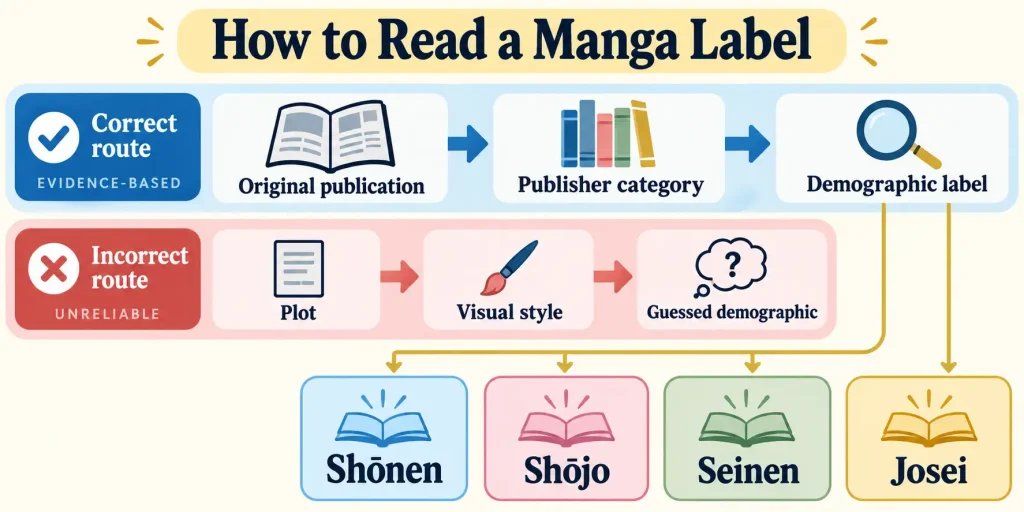
Start with the Japanese publisher rather than the anime’s visual style. Find the original serialization venue, then check how that publisher categorizes the magazine, app or imprint. If the work moved between publications, record the move instead of forcing its full history into one timeless label. If it began as a web manga without a clearly stated demographic line, do not invent one from the protagonist’s age. English retailers and fan databases are secondary clues, not final authorities.
A reliable check follows this order:
- Find the original Japanese title and creator.
- Identify the first publication venue.
- Check the publisher’s own category for that venue.
- Look for later transfers, relaunches or digital editions.
- Describe the story with separate genre terms.
This method prevents familiar but weak deductions. A tournament arc does not prove shōnen, an adult protagonist does not prove seinen, and a central love story does not prove shōjo or josei. The magazine may support a probable classification, but a plot summary does not work in reverse. The production pressures behind frequent serialization are covered in Nineteen Pages, Every Week, With Assistants. The route from serialization to the book in your hands remains From Weekly Magazine to the Volume You Buy.
What the four labels can and cannot tell you
Used carefully, the labels provide real information. They can point you toward the editorial department, neighboring series, advertising context and initial sales strategy surrounding a work. They may also help explain recurring conventions within a particular publication, because editors develop a recognizable house style. None of that makes the label a synopsis. You still need genre, tone, age rating and content information before deciding whether a series suits you.
| Question | Can the demographic label answer it? | What to check instead |
|---|---|---|
| Which market did the publication target? | Usually, if the publisher states the category | Publisher and magazine pages |
| Does the story contain romance? | No | Official synopsis and genre description |
| Is the content suitable for children? | No | Age rating and content guidance |
| Is the protagonist male or female? | No | Synopsis or the work itself |
| Will every reader match the target demographic? | No | Actual readership data, if published |
| Did the classification change after a transfer? | Possibly | Serialization history and new venue |
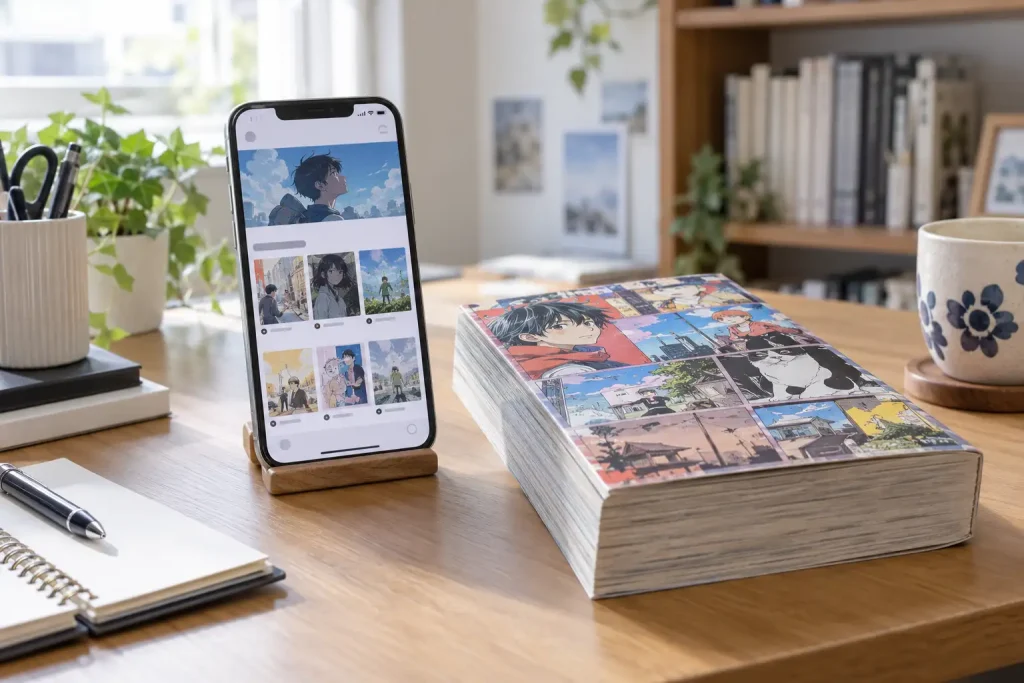
The uncomfortable part is that even “demographic” can sound more precise than the evidence allows. Publishers do not apply one government-controlled taxonomy, and English licensors sometimes market the same work without foregrounding its Japanese category. Josei is especially likely to disappear under broader English labels such as romance, drama or simply manga. Josei manga still identifies an adult-women’s publishing market when the Japanese venue supports that reading. It does not mean “more mature shōjo” as a universal rule.
Anime adaptations do not rewrite the manga’s publishing history
An anime may be broadcast to a broader audience, licensed under different age ratings and promoted through different channels from its source manga. Those changes do not retroactively move the manga into another Japanese magazine category. You should describe the anime by its actual content and distribution rather than automatically treating a manga demographic as an anime genre. “A shōnen anime” is convenient international shorthand, but it often compresses “an anime adapted from manga serialized in a shōnen publication.” The longer version is less catchy and more accurate.
Demographic labels also tell you little about how characters speak. Anime Speech Styles, and What Subtitles Cannot Carry explains pronouns, register and dialect without pretending those signals belong to one magazine market. Names create another separate problem because kanji meaning and pronunciation do not map neatly into English. When you need to render a personal name rather than classify a series, use the Japanese name converter instead of treating manga terminology as a language tool. Keep publication category, story genre and translation mechanics in separate boxes.
What has not changed, and what may change next
No verified industry-wide rule has replaced these four categories. Publishers still openly describe magazines as shōjo or seinen publications, and Shueisha continues to operate products carrying “Shonen Jump” in their names. What has changed is the route by which readers meet the work: apps, publisher websites, international simulpublication and streaming adaptations can hide the original magazine context. That makes the old vocabulary easier to misuse, not obsolete. Manga magazine labels remain useful only when they are connected to a documented publication venue.
There is also no verified date on which Japanese publishers are scheduled to abandon the categories. Individual magazines can close, merge, change frequency or move series online, so any title-level classification can still require an update. Before relying on a label, check the publisher’s current magazine list and the work’s serialization history. For an ongoing title, confirm that it has not transferred to another platform or editorial department. This article should be rechecked in October 2027, with special attention to publisher category pages and digital-platform branding.
FAQ
Is shōnen a genre?
No. 少年 shōnen, literally “boy” or “youth,” identifies a publishing market associated with boys and young male readers. Action and adventure are common in prominent shōnen magazines, but those patterns do not define the word. A shōnen publication can run comedy, romance, sports, mystery or horror. Check the original magazine before applying the label.
What is the difference between shōnen and seinen?
The intended magazine market is the central difference. Shōnen publications are marketed mainly toward boys and younger male readers, while seinen publications target adult men. The boundary does not create a dependable scale of violence, complexity or quality. Some shōnen works address severe subjects, and some seinen works are quiet comedies. Publisher classification is stronger evidence than tone.
Can a horror manga be shōjo?
Yes. Shōjo identifies the target market of the publication, not an obligation to tell romantic stories. A horror series published in a shōjo manga magazine remains shōjo even if romance is absent. The same principle allows comedy, fantasy, mystery and historical drama to appear under the label. Genre and demographic should be listed separately.
Why is Fruits Basket considered shōjo?
Fruits Basket ran in Hakusensha’s Hana to Yume from 1998 through 2006, according to the official anime site. Hakusensha classifies Hana to Yume among its shōjo manga magazines. That publishing record supplies the classification. Its romantic and emotional elements may fit popular expectations, but they are not the defining evidence. Another story in the same market could have very different content.
Why is Berserk considered seinen?
Berserk is associated with Hakusensha’s Young Animal, which the publisher lists among its seinen manga magazines. Its dark fantasy and violent material do not create the category by themselves. Those elements describe genre and content. The publication venue supplies the demographic context. If you recommend it, use content guidance rather than assuming “seinen” communicates everything a reader needs to know.
Can a manga’s demographic label change?
It can become complicated if a series transfers between publications or restarts under another editorial line. The earlier installments do not lose their original publication history. A database may choose one label for simplicity, while a careful description records both venues. Digital-first works can also lack an obvious traditional category. When the publisher does not state one, leave the demographic unclassified instead of guessing.