Japanese characters in anime are constantly telling you who they are, and most of it is happening in words that all translate to the same English.
A character says ore. Another says watashi. A third says boku. The subtitle says “I” every time, because there is nothing else it can say.
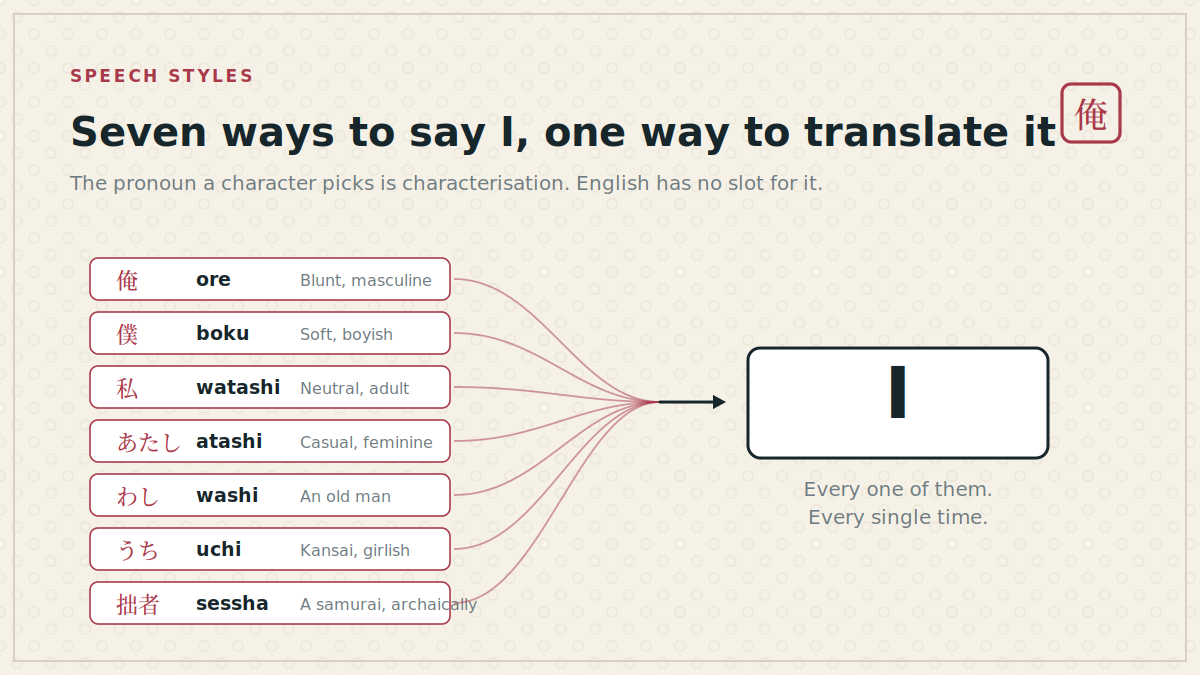
The pronoun is a costume
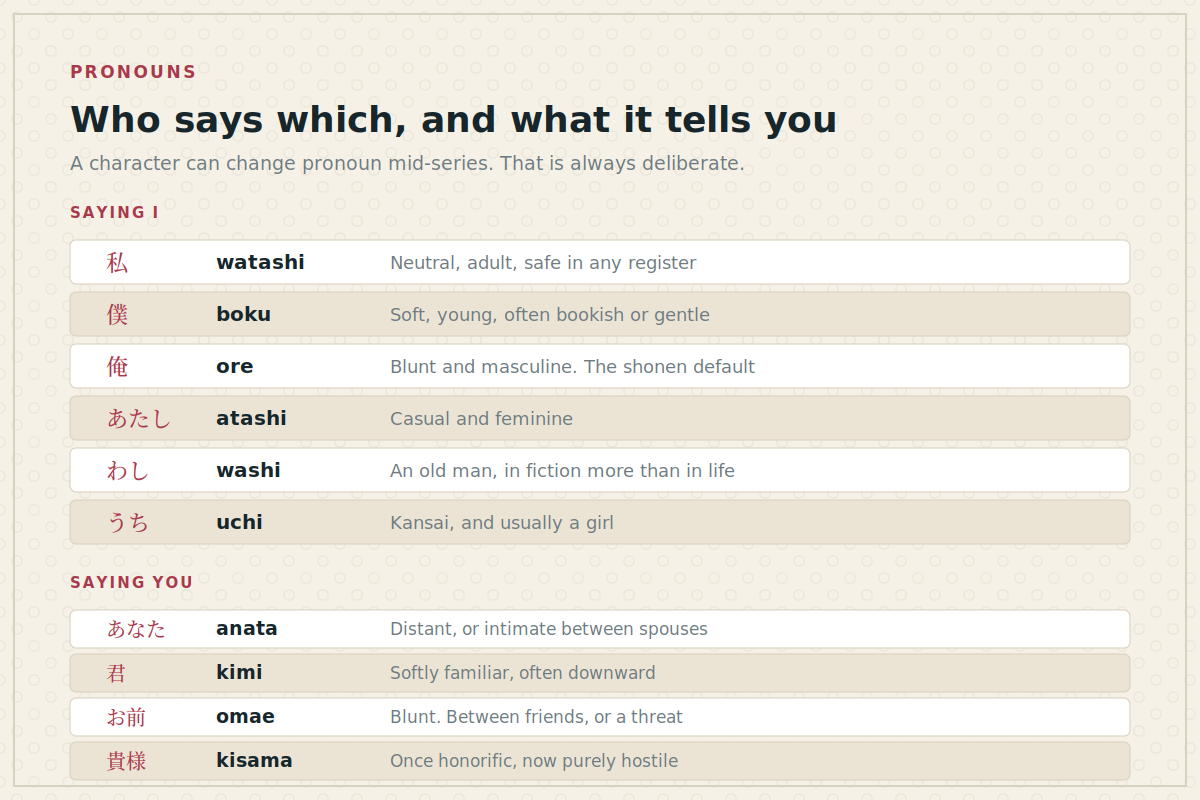
English has one first-person pronoun and no choice to make. Japanese has a dozen in common use, and the choice is public and permanent enough that it functions as part of a character’s design.
俺 ore is blunt and masculine. It is the shonen protagonist’s default, and a character who uses it in a formal setting is being deliberately rude.
僕 boku is softer — young, often gentle, sometimes bookish. A male character switching from boku to ore partway through a series is a growing-up scene, and it needs no dialogue to explain it.
私 watashi is neutral and adult, and the only one that is safe in every register. あたし atashi is its casual, feminine version. わし washi marks an old man, more in fiction than in life. うち uchi is Kansai, and usually a girl.
Then there are the costume pieces: 拙者 sessha for a samurai, 我輩 wagahai for someone pompous, and a range of archaic forms used entirely to signal a character type.
Role language
That last group has a name in Japanese linguistics: 役割語 yakuwarigo, “role language,” a term coined by the linguist Satoshi Kinsui.
It describes speech patterns that no real person uses but that every Japanese reader instantly attributes to a character type. The old man who says washi and ends sentences with ja. The country bumpkin. The aristocratic young lady who says watakushi and desu wa. The Chinese character in older manga who ends sentences with aru.
These are conventions of fiction, not of speech, and Japanese readers process them the way English readers process a nineteenth-century butler saying “very good, sir.” They are also almost entirely untranslatable, because English fiction has different conventions and reaching for the nearest one — a Cockney accent, a Southern drawl — imports connotations nobody asked for.
The second person is worse
English “you” covers a range that Japanese splits into a graded scale from intimate to openly hostile.
| Japanese | Reading | What it does |
|---|---|---|
| あなた | anata | Formally neutral, but distancing between people who know each other. Also what a wife calls her husband |
| 君 | kimi | Familiar, slightly downward, common in song lyrics |
| お前 | omae | Blunt. Warm between close male friends, aggressive to anyone else |
| てめえ | temee | Hostile. A fight is starting |
| 貴様 | kisama | Written with the characters for “honourable one” and now purely contemptuous |
That last row is a small history lesson. 貴様 was genuinely respectful several centuries ago and drifted all the way to insult, which is a common fate for second-person pronouns in Japanese — the polite one wears out and becomes the rude one. It is also why the most natural Japanese sentence often has no second-person pronoun at all: naming the person you are speaking to is a decision, and the safest choice is to use their name instead.
Verb endings, and the mismatch
Alongside the pronoun sits the verb form: plain, polite (-masu), or full honorific keigo. The system is set out in our article on politeness levels.
For anime the interesting cases are the mismatches. A character who speaks in flawless keigo to someone they are about to kill. A character who addresses their superior in plain form because they no longer care. A character whose polite register cracks for one line under stress and then reassembles.
Each of those is a whole scene of characterisation delivered in a verb ending, and none of them survive into English, which has no equivalent grammatical layer to break.
Dialect as shorthand
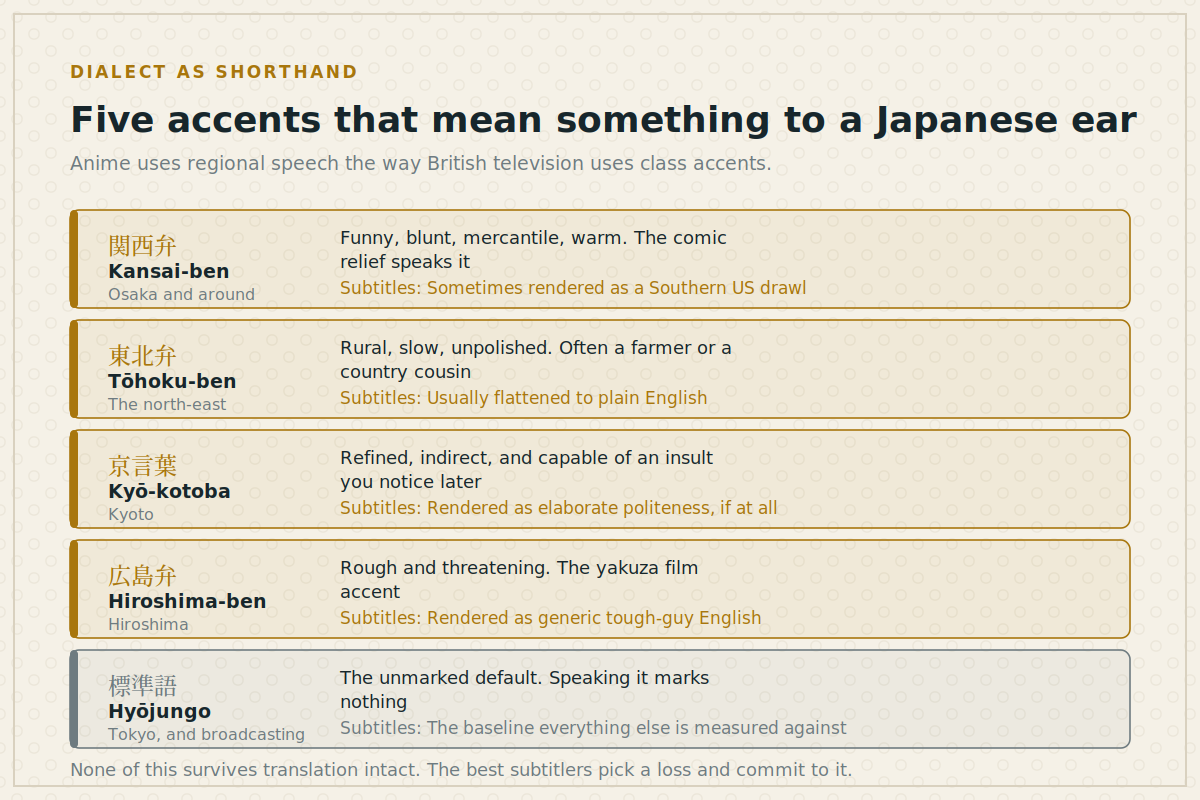
Kansai-ben, from the Osaka region, is the big one. It reads as funny, direct, warm and commercially minded, and Japanese comedy has been dominated by Osaka performers for long enough that the association is automatic. The comic-relief character speaks it.
Tōhoku-ben from the north-east reads rural. Hiroshima-ben carries the yakuza film. Kyoto speech is refined and famously capable of an insult you only recognise on the walk home.
Subtitlers have three options and none of them are good: flatten it and lose the signal, substitute an English regional accent and import a different set of assumptions, or write a note. The best subtitlers pick a loss deliberately rather than pretending there is not one.
English has one word for I and one for you. Japanese has a dozen of each, and the choice is the character. That is the gap the subtitle cannot close.The structural problem
What a subtitler is actually working with
It is worth knowing the constraints, because “the subtitles left something out” is usually a space problem rather than a competence problem.
- Reading speed. A line has to be readable in the time it is on screen, which caps it at roughly 42 characters per line in most house styles.
- Two lines maximum. Anything longer takes over the picture.
- The picture is the point. Every extra word is a word the viewer reads instead of watching the animation.
- Timing to the cut. Subtitles are not supposed to span a shot change, which chops long speeches at inconvenient places.
So a subtitler translating a line that carries a pronoun choice, a verb register and an honorific has to decide which one to spend characters on. Usually the answer is none of them, because the literal content of the sentence has to go in first.
Sentence-final particles
One more layer, and the one that survives translation least visibly.
Japanese sentences frequently end in a short particle that carries attitude: ね ne seeking agreement, よ yo asserting, な na musing, ぜ ze and ぞ zo masculine and emphatic, わ wa traditionally feminine, かしら kashira a feminine “I wonder.”
These do in one syllable what English does with tag questions, intonation and word order — “isn’t it,” “you know,” “I suppose.” They are not omitted from subtitles so much as dissolved into whatever English phrasing seemed closest, which usually works and occasionally flattens a character who was built on them.
What you can actually do about it
Three things, roughly in order of effort.
Listen for the pronoun. You can learn to catch ore, boku and watashi in about a week of watching, and it will immediately tell you things the subtitle is not saying.
Notice the endings. -masu and -desu are easy to hear. A character who stops using them, or starts, has changed something.
Accept the loss. The alternative to a lossy translation is no translation. Subtitles that try to carry everything become footnotes, and footnotes are not television.
The most visible piece of this system — the honorific attached to a name — has its own article: Japanese honorifics in anime. And the constraint that shapes dubs, which is a different problem entirely, is in what gets lost in the dub.