If you watch subtitled anime for long enough, you notice a pattern: a character says a name, the subtitle shows a name, and something has clearly happened that the subtitle is not showing you. The other characters react. You do not know why.
What happened is almost always an honorific — and honorifics are the most information-dense thing in Japanese dialogue that English has no way to carry.
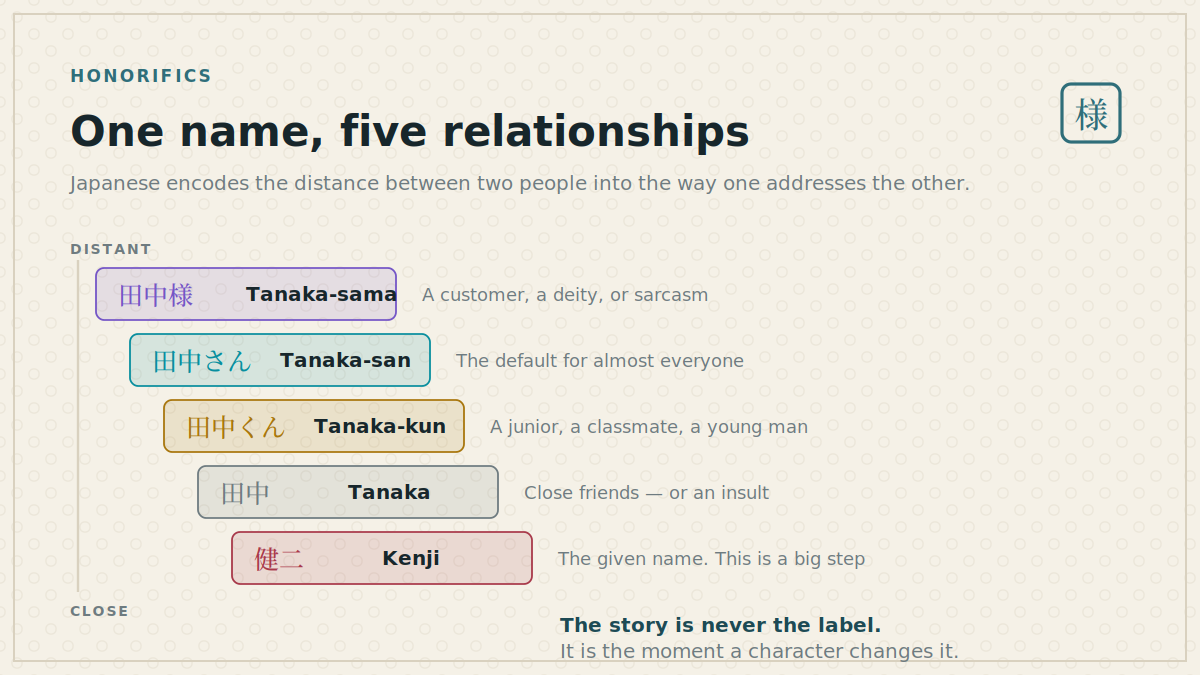
What they actually are
A Japanese honorific is a suffix attached to a name that states the relationship between speaker and subject. It is not politeness decoration. It is closer to grammar — you cannot address someone in Japanese without making a choice about it, including the choice to use nothing at all.
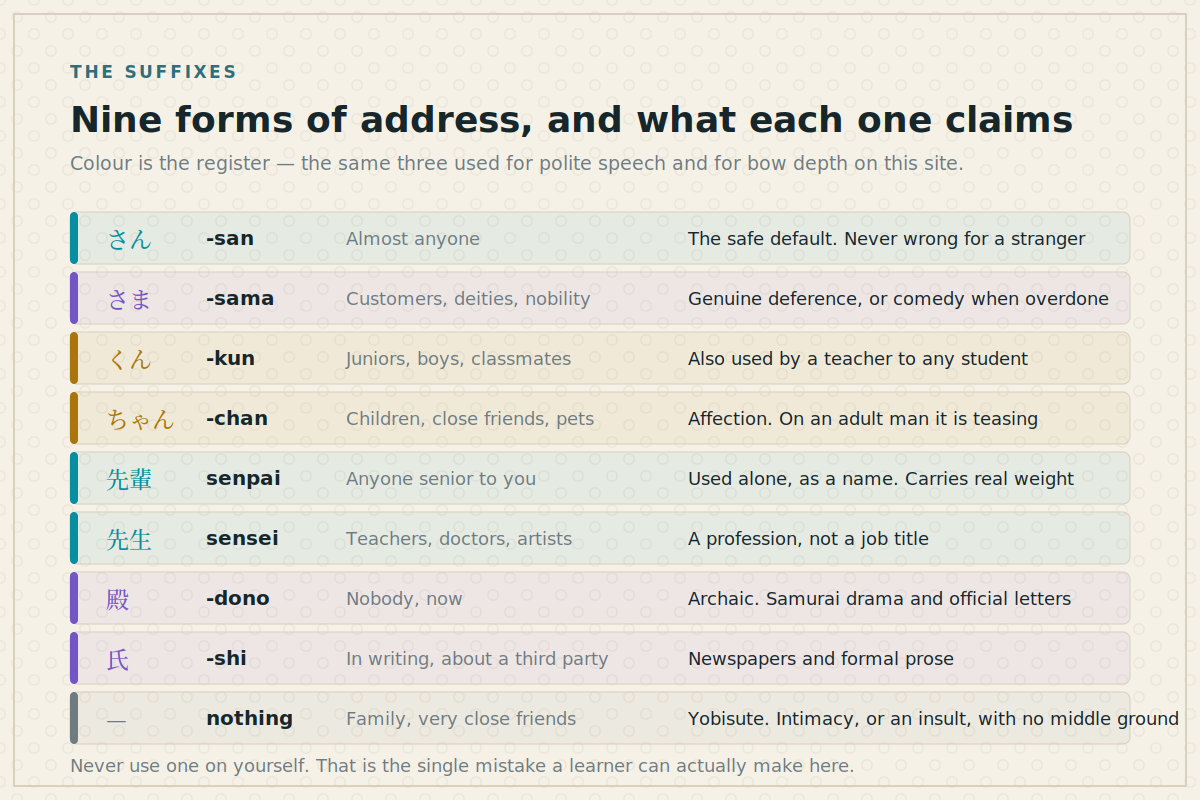
さん -san is the default and covers almost everyone: colleagues, strangers, shopkeepers, people older or younger than you. If you are ever unsure, this is the answer.
さま -sama is genuine deference — customers (お客様), deities (神様), nobility. In anime it is also comedy, attached by a character who is laying it on far too thick, or by a servant who never stops.
くん -kun goes downward or laterally: a junior at work, a male classmate, a young man. Note that a teacher may use it for students of any gender, which surprises people who learn it as “the boy one.”
ちゃん -chan is affection. Children, close friends, pets, and — pointedly — adult men, where it becomes teasing or diminishing.
先輩 senpai and 先生 sensei are not suffixes but terms of address that replace the name entirely. Senpai is anyone senior to you in the same institution, and it carries real social weight; sensei covers teachers, doctors, lawyers, novelists and manga artists, because it marks a profession rather than a job.
The one that matters most is nothing
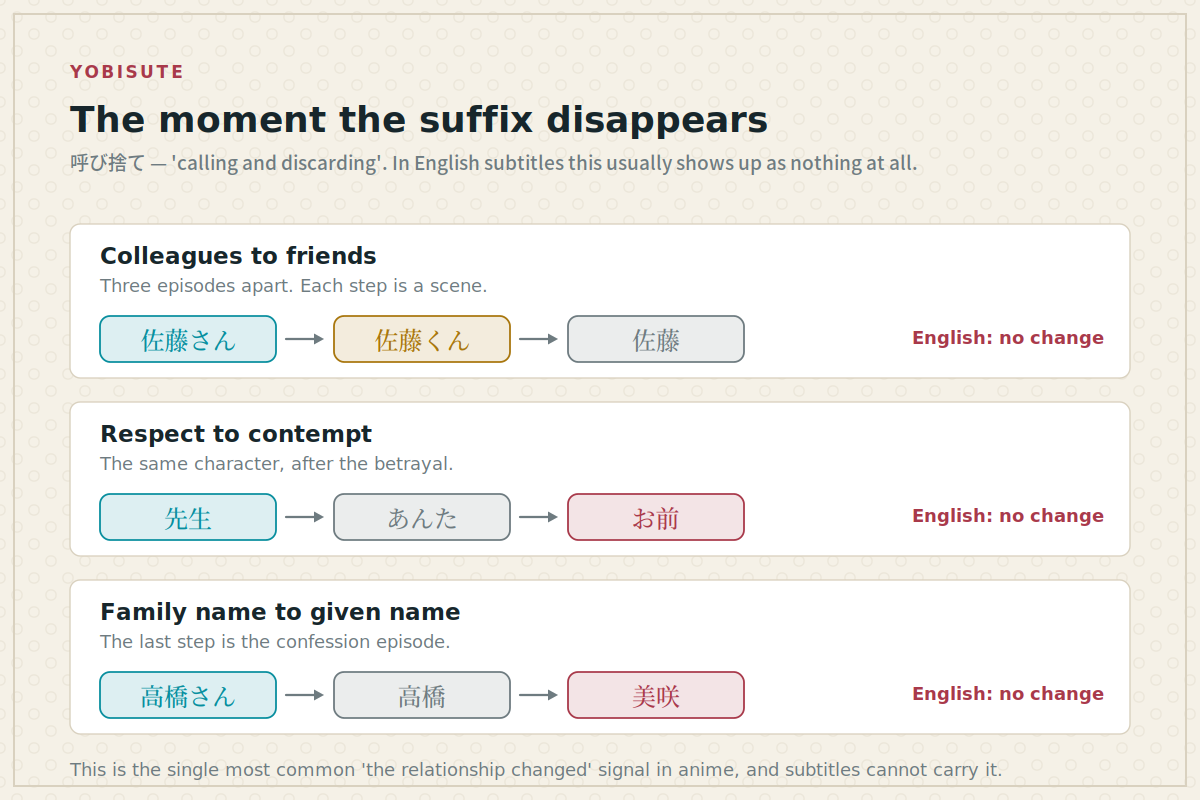
呼び捨て yobisute — literally “calling and discarding” — is addressing someone by bare name with no suffix at all.
It means one of two things and nothing in between. Either you are close enough that the formality has been dropped, or you are being deliberately insulting. Which one it is depends entirely on the relationship, and both readings are available in the same word.
This is the single most common way anime signals that a relationship has changed. A character who has said “Sato-san” for twenty episodes says “Sato” and the room goes quiet. In the subtitle, both are “Sato.”
The same logic runs one step further with names themselves. In Japanese, using someone’s given name at all is intimate; family names are the default even between people who have known each other for years. So the shift from “Takahashi-san” to “Takahashi” to “Misaki” is a three-stage arc, usually spread across a season — and in English all three are just names.
How subtitles handle it
Three approaches, all imperfect.
| Approach | What it does | The cost |
|---|---|---|
| Keep them | “Sato-san” appears as written | Assumes the viewer knows what -san does |
| Drop them | “Sato” throughout | Every relationship change becomes invisible |
| Translate around them | “Mr Sato”, or a shift in register elsewhere in the line | Approximate, and unavailable for -chan or -senpai |
Official subtitles have moved toward keeping them over the last decade, partly because the audience for subtitled anime is now large enough to have learned what they mean. Fan translations kept them from the start, sometimes with translation notes on screen — a practice widely mocked and, on this one point, defensible.
The subtitle can show you what a character said. It cannot show you what they called someone, and in Japanese that is often the more important half.Why this channel is lossy
Kinship terms are used the same way
A related habit that confuses viewers: Japanese uses family words as forms of address, including for people who are not family.
- onii-chan / onii-san — older brother, and also any young man slightly older than the speaker.
- onee-san — older sister, and also a young woman, including a waitress or a shop assistant.
- oji-san and oba-san — uncle and aunt, and also any middle-aged man or woman. Used to a stranger, this can sting.
- obaa-san and ojii-san — grandmother and grandfather, and any elderly person.
So a child calling a stranger “onii-san” is not confused about their family tree. And the difference between oba-san (aunt, or middle-aged woman) and obaa-san (grandmother, or old woman) is one long vowel, which is why getting the vowel length wrong is a joke that turns up constantly.
What this means if you are learning
Four practical rules, and one of them is the only one you can actually get wrong.
- Use -san on everyone until told otherwise. It is never rude.
- Attach it to the family name where you know it. Attaching it to a given name is not wrong and is what foreigners default to, but it reads as slightly familiar.
- Do not drop it on your own initiative. Wait to be invited, or for the other person to drop yours.
- Never use an honorific about yourself. Not -san, not -sensei, and definitely not -chan. This is the mistake anime can lead you into, because you hear characters do it for comic effect.
That last one is worth spelling out because anime is genuinely misleading here. Characters who refer to themselves in the third person with an honorific are being written as childish or self-important, on purpose.
The same system, in three places
Honorifics are one of three ways Japanese encodes the same information, and they line up.
The verb endings do it grammatically — plain form for equals and intimates, -masu for polite distance, full keigo for real deference. That system is set out in our article on politeness levels.
The body does it physically, in the depth of a bow — fifteen, thirty and forty-five degrees, mapping onto the same three registers. That is in our article on bowing.
And the name does it lexically, which is this page. A character who bows deeply, speaks in keigo and says -sama is saying the same thing three times. When one of the three slips out of alignment — polite words with a dropped honorific, say — that mismatch is itself the point, and it is the sort of thing a good subtitler will try to smuggle into the phrasing.
Where to go next
Honorifics are the most visible part of a wider problem. Japanese also encodes character through pronoun choice, verb register and regional accent, none of which English has slots for — that is in our article on speech styles and subtitles.
Names themselves carry meaning through their kanji, and often have several possible readings, which is a whole separate difficulty: character names in Japanese.
And if you want to know why a dub sounds the way it does — which is a constraint problem rather than a translation problem — that is what gets lost in the dub.