You will meet ネーム, nēmu, literally “name,” in interviews about planning a chapter; アシスタント, ashisutanto, “assistant,” in studio accounts; and 休載, kyūsai, “publication break,” in magazine notices when a series disappears for a week. Together, those words explain the manga artist schedule more honestly than the familiar image of one creator quietly drawing alone.
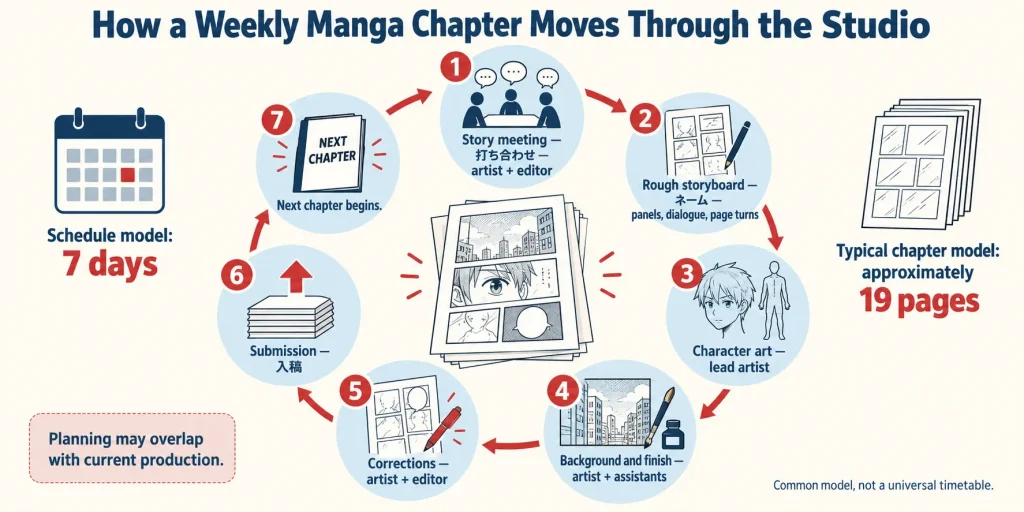
A conventional weekly chapter is often described as roughly nineteen pages delivered on a seven-day cycle, but that is a working model, not an industry-wide rule. Opening chapters, color pages, digital series, monthly magazines, planned breaks, and individual contracts can all change the count. What matters is the loop: the next chapter starts demanding decisions before the current one feels finished.
週刊連載, shūkan rensai: the deadline that comes back every week
週刊連載, shūkan rensai, literally “weekly serialization,” is the term you meet when a manga runs in successive issues of a weekly magazine. The common mistake is thinking “weekly” describes only how often readers receive a chapter. For the production team, it describes how quickly the entire editorial and drawing cycle resets.
A chapter must pass through story discussion, rough page construction, editorial review, final drawing, assistant work, lettering or data preparation, and delivery. These stages can overlap. While assistants finish backgrounds or tones for one chapter, the artist may already be discussing the next plot with an editor.
The nineteen-page figure is strongly associated with standard installments in major weekly boys’ manga magazines, but publishers do not promise that every chapter will contain exactly that number. A safer description is “roughly nineteen pages in a typical weekly installment.” The publication schedule, rather than a universal page rule, creates the pressure.
The larger route from serialization to collected book is covered in From Weekly Magazine to the Volume You Buy. That guide follows publication formats; here, the concern is what the recurring deadline does to the people producing the pages.
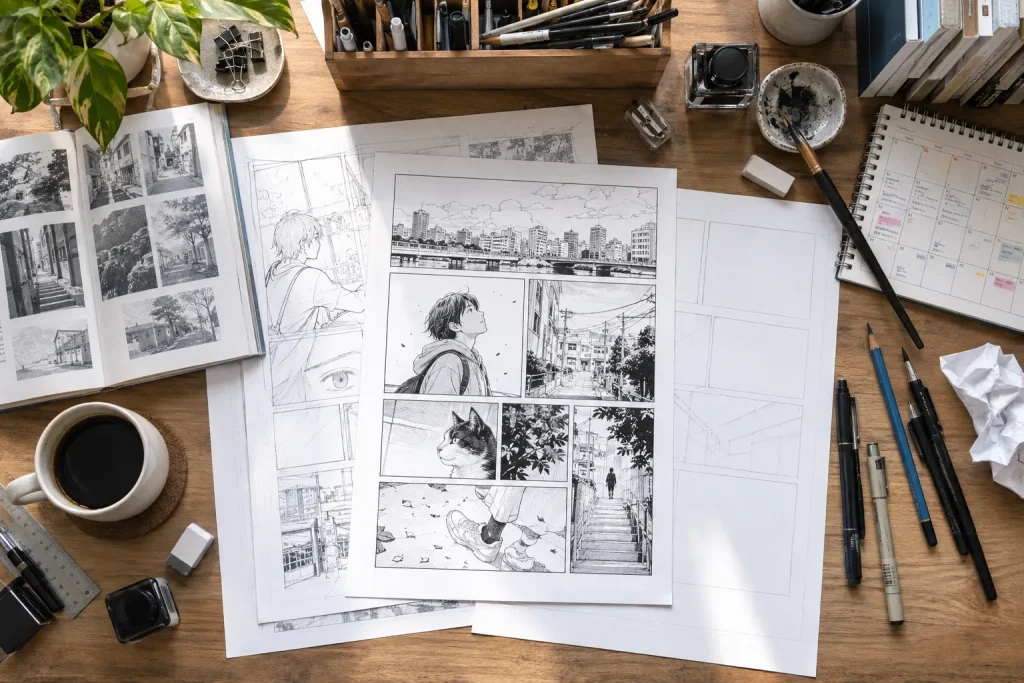
打ち合わせ, uchiawase: the meeting before the drawing
打ち合わせ, uchiawase, literally “bringing things together,” is the editorial meeting in which the creator and editor discuss the story. You encounter it before the finished page exists, sometimes before the chapter has settled into a complete sequence.
The editor may question motivation, pacing, clarity, page turns, dialogue, or whether a promised plot point has landed. The artist can reject suggestions, propose another solution, or rebuild the chapter. The exchange may happen in person, by phone, or through digital messages and shared files.
Calling the editor a proofreader badly understates the job. Calling the editor an automatic co-author overstates it. Editors can become intensive story partners, but the degree of involvement varies by creator, series, publisher, and stage of production.
The uncomfortable point is that a rejected idea does not stop the deadline. If the story conference reveals a structural problem, the artist must solve it inside the same production window. Weekly manga production contains revision time, but it rarely receives an extra week merely because the first version failed.
ネーム, nēmu: the English word that does not mean a name
ネーム, nēmu, literally borrowed from English “name,” means a rough manga storyboard in publishing practice. This is the first loanword that does not mean what an English-speaking reader expects.
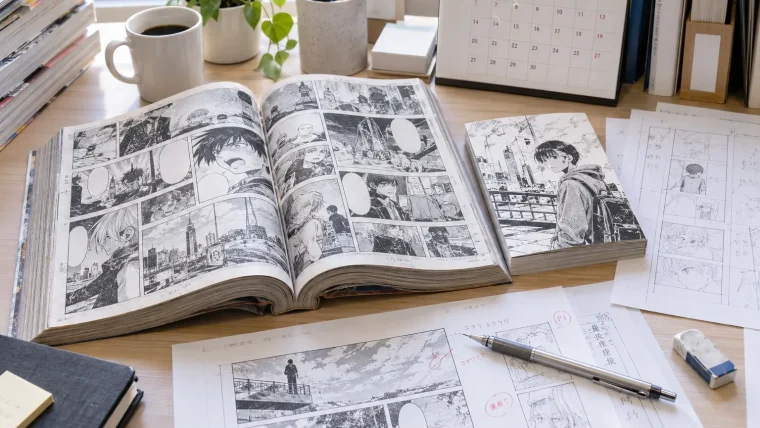
The name sets page order, panel size, dialogue, character positions, visual rhythm, and page turns. It can look loose or unfinished because its purpose is not to impress a reader. It tests whether the chapter works before expensive final drawing begins.
Editors commonly review the name and request changes. A creator may redraw individual pages or rebuild a sequence before receiving approval to proceed. The mistake is imagining that the script is complete first and illustration merely follows; in many manga workflows, storytelling is worked out spatially on the page.
A nineteen-page chapter therefore means more than producing nineteen polished illustrations. It also means deciding how much story fits into those pages and where every reveal, reaction, silence, and turn belongs.
原稿, genkō: the pages the publisher is waiting for
原稿, genkō, literally “original manuscript,” is the finished or production-ready work delivered for publication. You meet the word near the end of the cycle, especially in discussions of deadlines and submission.
In traditional production, genkō refers to physical manuscript pages. Digital workflows now allow creators and assistants to exchange layered files, apply screentone electronically, and submit data remotely. The term survives because the editorial function is the same: this is the material that becomes the printed or digital chapter.
The mistake is assuming that “finished” means untouched after delivery. Editors and production staff may still identify missing elements, unclear lettering, technical problems, or corrections. Collected editions can also contain later revisions.
A simplified weekly cycle looks like this:
| Stage | Approximate place in the cycle | Main participants | Output |
|---|---|---|---|
| Story discussion | Early cycle | Artist and editor | Chapter direction |
| Name creation | Early to middle cycle | Artist, with editorial feedback | Rough storyboard |
| Final character drawing | Middle cycle | Lead artist | Main figures and expressions |
| Background and finish work | Middle to late cycle | Artist and assistants | Completed page art |
| Corrections and delivery | Deadline end | Studio and editor | Publication-ready manuscript |
| Next chapter planning | Often overlaps | Artist and editor | Beginning of the next cycle |
This is a composite model drawn from creator and editor accounts, not a mandatory timetable. Some artists plan farther ahead, some perform more of the finishing work themselves, and some digital series use different cadences.
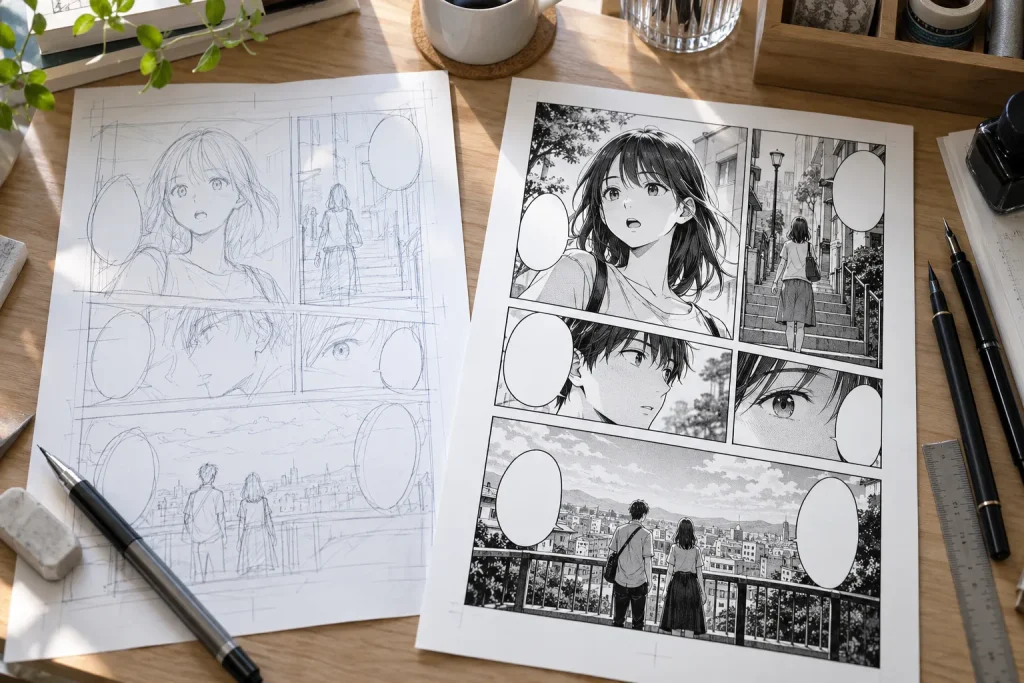
アシスタント, ashisutanto: the staff behind the credited name
アシスタント, ashisutanto, literally “assistant,” refers to a person who helps produce the art under the lead creator’s direction. You meet assistants after the layout and primary character work have established what the page needs.
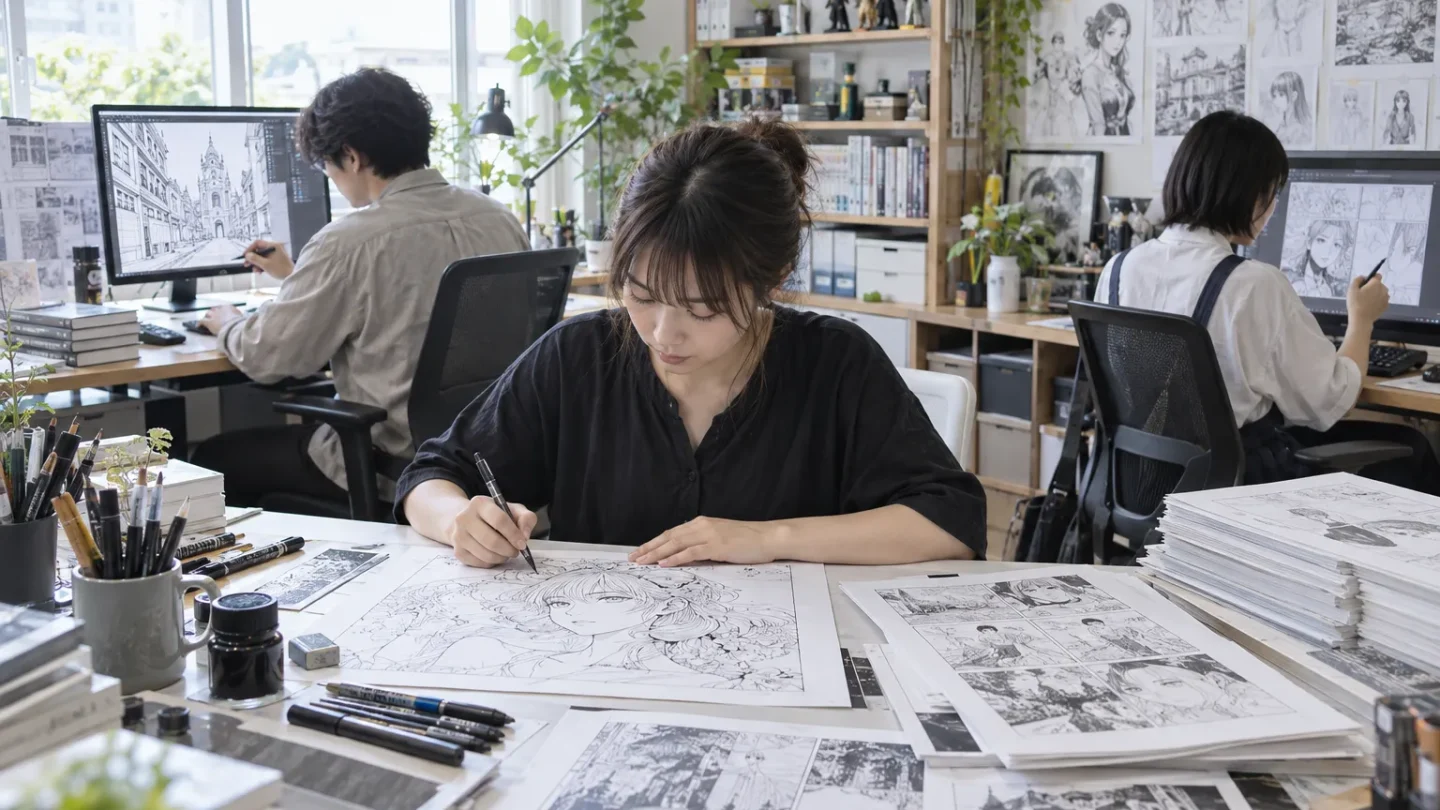
Depending on the studio, assistants may draw buildings, interiors, landscape, crowds, vehicles, effects, ruled borders, blacks, or digital finishing. Experienced assistants can specialize in difficult perspective work or recurring environments. Others are aspiring manga creators learning a professional workflow.
The common mistake is assuming assistants secretly draw everything. Another is assuming they perform only trivial cleanup. The division is negotiated inside each studio, but the lead artist generally remains responsible for the story, page composition, principal characters, final choices, and consistency of the work.
Assistants do not create spare time so much as make the deadline physically possible. Work can happen simultaneously: while the creator inks characters on a later page, an assistant completes the background on an earlier one. Without that parallel production, the same chapter may require more hours than the calendar contains.
ペン入れ, pen-ire: “putting in the pen” means inking
ペン入れ, pen-ire, literally “putting in the pen,” is the process of turning rough pencil work into final line art. You meet it after the name has been approved and page layouts have become working drawings.
This is the second term whose literal English shape can mislead. Nothing is being inserted into the manuscript. Lines are being committed, clarified, and prepared for reproduction.
Digital tools have blurred the physical distinction between pencil and ink, but creators still use the vocabulary of the analog process. A stylus may perform the work once done with a dip pen, while software layers make corrections easier. Easier correction does not necessarily reduce the workload; it can also increase the amount of detail considered possible before deadline.
The lead artist commonly concentrates on faces, bodies, acting, and other identity-defining lines. That is not a universal division, but it helps explain how readers can recognize one author’s hand even when a studio team completes the page.
ベタ and トーン: black areas and the “tone” that is not mood
ベタ, beta, meaning a solid black fill in manga production, appears during finishing. トーン, tōn, borrowed from “tone,” usually means screentone rather than emotional atmosphere.
Traditional screentone is an adhesive sheet carrying dots, gradients, textures, or patterns. Artists cut and apply it to produce gray values and effects that black-and-white printing can reproduce. Digital manga software performs similar work with selectable patterns and masks.
Assistants often help with both solid blacks and tone, although the allocation differs by studio. A mistake at this stage can flatten a figure, obscure a line, or make the page reproduce poorly. “Finishing” sounds secondary, but it controls whether the artwork remains legible at magazine size.
Modern digital tools remove cutting and scraping from the process, yet they do not remove decisions. Someone still chooses the density, shape, placement, and visual priority of each area. Manga assistant work is production drawing, not merely office support.
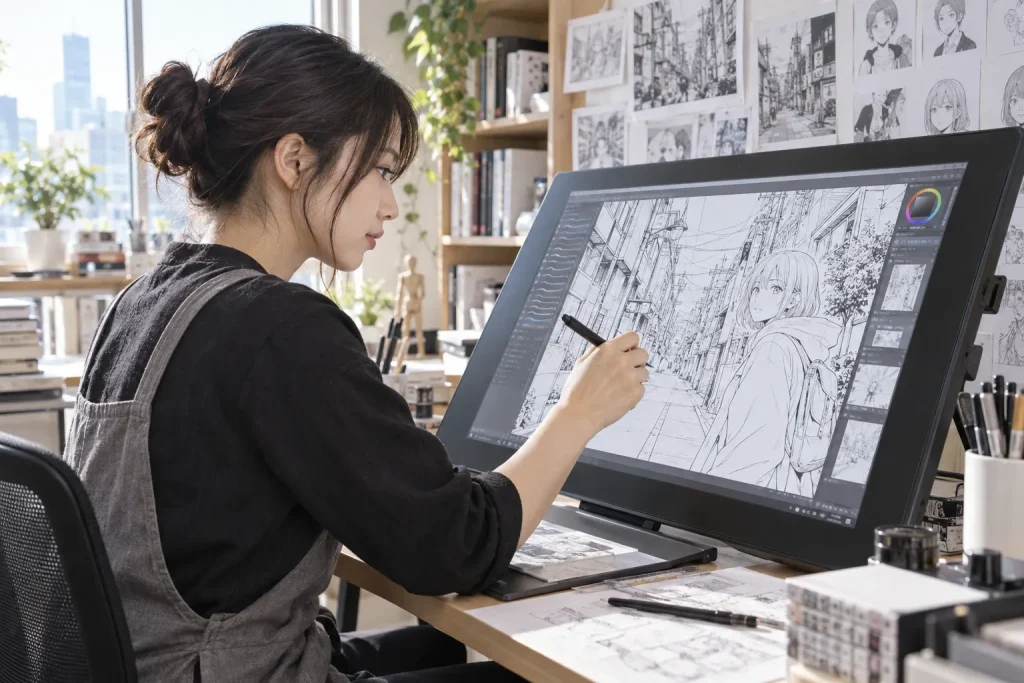
背景, haikei: the world behind the characters
背景, haikei, literally “background scenery,” is the environment around the principal figures. You meet it wherever a chapter needs a street, classroom, apartment, train, store, forest, or city skyline to remain spatially convincing.
Backgrounds are frequently assigned to assistants because they can be developed alongside character art. However, “the assistant draws the backgrounds” is only a shorthand. The lead creator’s name, layout, references, instructions, corrections, and established visual system determine what the scene must communicate.
Perspective-heavy settings require time and technical skill. Photography, location research, three-dimensional reference models, reusable digital assets, and previous drawings can accelerate the process. They do not make the environment automatic.
Readers tend to notice backgrounds only when they fail. Inside the studio, they are part of continuity: a door must stay in the correct wall, a desk must face the same direction, and a chase must move through a location the reader can understand.
集中線 and 効果線: the lines that make still images move
集中線, shūchūsen, literally “concentration lines,” direct the eye toward a focal point. 効果線, kōkasen, literally “effect lines,” is a broader term for drawn marks that communicate movement, force, shock, atmosphere, or emphasis.
You meet these lines during the finishing of action, comedy, and dramatic reaction panels. Assistants may help execute them, especially when the effect is technically regular or labor-intensive. The creator still decides what must move, where the reader should look, and how strong the effect should feel.
The mistake is treating speed lines as a decorative anime cliché. On a black-and-white page, they replace information that live-action film can obtain from physical motion and a camera. Their angle, spacing, and density affect reading speed.
This is also where manga vocabulary and anime vocabulary begin to diverge. What Anime Teaches and What It Quietly Skips explains the limits of treating stylized media speech as a complete language lesson. For speech itself, Anime Speech Styles, and What Subtitles Cannot Carry covers character voice without repeating the production terms here.
入稿, nyūkō: delivery is part of production
入稿, nyūkō, literally “putting in the manuscript,” is submission to the publisher or production system. You meet it at the deadline, when the completed pages leave the studio.
Digital delivery makes the transfer faster, but a faster transfer does not lengthen the week. Files still need correct dimensions, resolution, page order, lettering, and technical preparation. Late corrections can compress the time available for everyone downstream.
The creator’s deadline is not the reader’s publication day. Editorial checking, lettering, printing, distribution, and digital release happen after the manuscript leaves the studio. From Weekly Magazine to the Volume You Buy follows those later stages.
This is why a public release calendar can conceal how little margin the studio has. When one chapter is submitted, discussion of the next may already be underway. The finish line curves back into the starting line.
休載, kyūsai: the break that the schedule makes predictable
休載, kyūsai, literally “publication rest,” means that a serialized work does not appear in an issue in which readers might otherwise expect it. You meet the word in magazine contents pages, publisher notices, author comments, and release announcements.
A break may be planned around production, research, holidays, magazine scheduling, or collected-volume work. It may also be attributed to the creator’s health. Publishers do not always disclose a diagnosis, and the absence of detail should not be filled with rumor.
A manga hiatus for health reasons is not surprising in a system built around recurring deadlines, but “normal” needs careful definition. Health-related breaks appear regularly across the industry; that does not prove they are harmless, inevitable, or experienced by every creator. No comprehensive publisher dataset was found that would allow a reliable percentage of weekly artists taking medical hiatuses.
The mechanism is easier to establish than the frequency. A weekly creator must make story decisions, produce principal art, supervise assistants, answer editorial feedback, correct pages, and begin the next installment inside an overlapping cycle. When illness, pain, exhaustion, or treatment interrupts that chain, postponing publication may be the only responsible option.
A hiatus is therefore not evidence that an artist has stopped caring about the series. It is evidence that serialized manga is labor performed by bodies with limits. The surprise should not be that breaks occur, but that readers were taught to view uninterrupted production as the neutral state.
FAQ
Does every weekly manga chapter have nineteen pages?
No. Roughly nineteen pages is a useful model for many standard weekly installments, not a universal requirement. Debuts, finales, color features, special chapters, digital publications, and individual editorial plans may use different lengths.
Does a mangaka draw every line personally?
Not necessarily. The lead artist may draw the main characters and decisive elements while assistants handle assigned backgrounds, tones, blacks, effects, or technical finishing. The division differs from studio to studio.
Does the editor write the manga’s plot?
The artist remains the credited creator unless the work formally has a separate writer. An editor may nevertheless shape the plot through conferences, questions, proposed changes, reader-response analysis, and repeated review of the name. Describing that as collaboration is fair; calling every editor a co-writer is too categorical.
Are manga assistants credited?
Sometimes, but not consistently in the way Western readers may expect from film or television credits. Assistants can be thanked in collected volumes, author comments, interviews, or studio materials. Their contribution may remain largely invisible on the publication page.
Why do manga series go on sudden hiatus?
Publishers cite several reasons, including creator health, research, production conditions, and scheduling decisions. A short notice may deliberately omit private medical information. It is inaccurate to assume that every unexplained break reflects poor planning.
Is digital manga production less demanding?
Digital tools can accelerate corrections, asset reuse, tone application, and file delivery. They do not remove plotting, drawing, supervision, or the deadline, and they may encourage more elaborate artwork. The effect depends on the artist’s process.
Why is a storyboard called a “name”?
ネーム, nēmu, is established Japanese manga-industry vocabulary for a rough storyboard containing panels, dialogue, and page flow. Its origin is associated with the text and dialogue elements once called “name,” but in current use it refers to much more than a character’s name.
Do character names follow the same production process?
Character naming belongs to story development rather than page finishing. Japanese Honorifics in Anime explains how suffixes express relationships, while the site’s name converter with 898 checked katakana names handles foreign-name spellings without duplicating that tool here.
Remember three terms: nēmu, the chapter’s storyboard; ashisutanto, the production team around the artist; and kyūsai, the break that interrupts serialization. The rest—genkō, pen-ire, tōn, haikei, shūchūsen, and nyūkō—only need to look familiar when you meet them in an interview or creator note.
Glossary table
| Term | Reading | Literal meaning | Where you meet it |
|---|---|---|---|
| 週刊連載 | shūkan rensai | Weekly serialization | Magazine schedules and series announcements |
| 打ち合わせ | uchiawase | Bringing things together | Artist-editor story meetings |
| ネーム | nēmu | Name | Rough storyboard review |
| 原稿 | genkō | Original manuscript | Finished-page production |
| アシスタント | ashisutanto | Assistant | Studio production |
| ペン入れ | pen-ire | Putting in the pen | Final line drawing |
| ベタ | beta | Solid fill | Black-area finishing |
| トーン | tōn | Tone | Screentone application |
| 背景 | haikei | Background scenery | Environment drawing |
| 集中線 | shūchūsen | Concentration lines | Action and emphasis |
| 効果線 | kōkasen | Effect lines | Motion and atmosphere |
| 入稿 | nyūkō | Putting in the manuscript | Publisher delivery |
| 休載 | kyūsai | Publication rest | Hiatus notices |