800 successful reviews follow every weekly batch of 100 new items in the simplified model below. That number—not the subscription fee—is what decides the wanikani vs anki question for most learners. WaniKani supplies the content, order and fixed review path; Anki supplies a configurable engine. Neither automatically turns recognition into handwriting, free recall or fluent reading.
Spaced repetition is good at returning an item shortly before you are likely to forget it. It is much less good at noticing that you can recognize 漢字, kanji, “Chinese characters,” on a screen but cannot write them, select them in an original sentence or understand them inside unfamiliar prose. The uncomfortable part is simple: if you introduce 100 new characters a week, reviews can consume the time you thought you had reserved for Japanese.
Where the 800-review figure comes from
WaniKani’s official spaced-repetition system has nine stages. A new item starts at Apprentice 1 and needs eight successful reviews to reach Burned, assuming that you make no mistakes. The published waits are four hours, eight hours, one day, two days, one week, two weeks, one month and four months.
That produces the minimum:
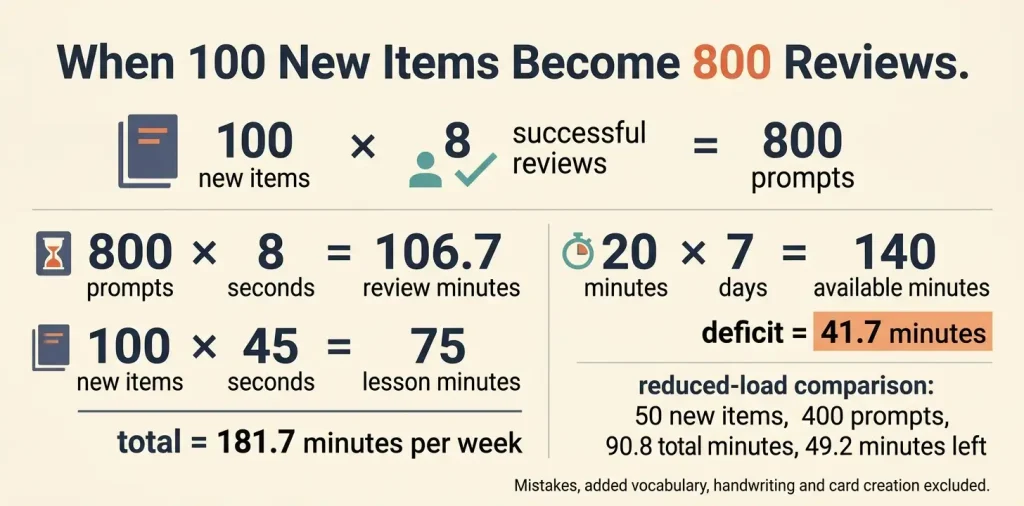
100 new items × 8 successful reviews = 800 review prompts.
The word “minimum” matters. An incorrect answer moves an item backward, creating extra reviews. WaniKani also teaches radicals and vocabulary alongside characters, so 100 new kanji do not mean only 100 new WaniKani items.
Anki does not impose the same fixed ladder. Its scheduler uses your review history and settings to choose intervals. The current desktop software supports FSRS, which can target a desired retention level; asking for higher retention normally produces shorter intervals and more reviews.
Before choosing a tool, choose the material. The First Hundred Kanji and Why Those provides a bounded starting set instead of asking you to import thousands of cards simply because a shared deck makes that possible.
What the software actually costs
WaniKani charges for a prepared course. Its official September 2026 prices were $9 monthly, $89 annually or $299 for lifetime access, with tax or VAT potentially added at checkout. Its public description says the course contains more than 2,000 kanji and more than 6,000 vocabulary words.
Anki’s desktop program is free, as are AnkiWeb synchronization and the contributor-developed AnkiDroid application for Android. The official AnkiMobile iOS application was listed at $24.99 as a one-time purchase in the United States. The important hidden cost is deck construction and maintenance: Anki provides the machinery, not a complete kanji curriculum.
| Option | Up-front cost checked September 17, 2026 | Cost after 12 months | What is included |
|---|---|---|---|
| WaniKani monthly | $9 | $108 before tax | Fixed lessons, mnemonics, radicals, kanji, vocabulary and reviews |
| WaniKani annual | $89 | $89 before tax | Same course with annual billing |
| WaniKani lifetime | $299 | $299 before tax | Continuing access without another subscription payment |
| Anki desktop | $0 | $0 | Scheduler, card editor, statistics, add-ons and sync support |
| AnkiDroid | $0 | $0 | Android review and card-management application |
| AnkiMobile | $24.99 | $24.99 | Official iOS application |
| Total for free desktop/Android Anki route | $0 | $0 | Software only; content preparation remains yours |
The annual WaniKani plan saves $19 against paying for 12 separate monthly periods: $108 − $89 = $19. The lifetime plan reaches the same nominal outlay as 40 months of monthly payments once the forty-first month begins: $9 × 40 = $360, so it actually passes the $299 price during month 34 because $9 × 34 = $306. Against consecutive annual plans, $299 is more than three years at $89 but less than four: $267 after three years and $356 after four.
Those comparisons exclude sales, taxes and unused months. Lifetime access is not automatically good value if you stop after the free levels or abandon daily reviews in the second month.
WaniKani vs Anki when time is the real price
A useful calculation needs your own response speed. The example below uses eight seconds per review and 45 seconds to learn each new item. These are explicit planning assumptions, not averages published by either company.
Once a weekly pipeline has matured, 100 new items entering the system and 100 old items eventually leaving it create approximately 800 successful review events per week under an eight-review model. In practice, those events are unevenly distributed because several early reviews arrive close together while later intervals extend across months.
| Weekly component | Calculation | Time in the worked model |
|---|---|---|
| New-item study | 100 × 45 seconds | 75 minutes |
| Successful reviews | 800 × 8 seconds | 106.7 minutes |
| Mistake allowance | Not included | 0 minutes |
| Handwriting | Not included | 0 minutes |
| Reading Japanese text | Not included | 0 minutes |
| Total SRS workload | 75 + 106.7 | 181.7 minutes |
| Daily average across seven days | 181.7 ÷ 7 | About 26 minutes |
Now compare that with a 20-minute daily study budget. Seven sessions provide 140 minutes a week. The modeled SRS workload requires 181.7 minutes, leaving a deficit of 41.7 minutes before handwriting, grammar, listening or reading begins.
If you double the response time from eight to 16 seconds, the review portion doubles from 106.7 to 213.3 minutes. If accuracy drops and the queue produces another 20 percent of review attempts, 800 becomes 960 prompts. At eight seconds each, that is 128 minutes of reviews rather than 106.7.
The arithmetic is reusable:
weekly review minutes = new items × successful reviews per item × seconds per prompt ÷ 60.
For your own numbers, replace 100, eight and eight seconds. Anki can reduce the scheduled count by changing retention targets or suspending cards. WaniKani offers less control over content order but removes the decisions involved in building the course.
Recognition is not production
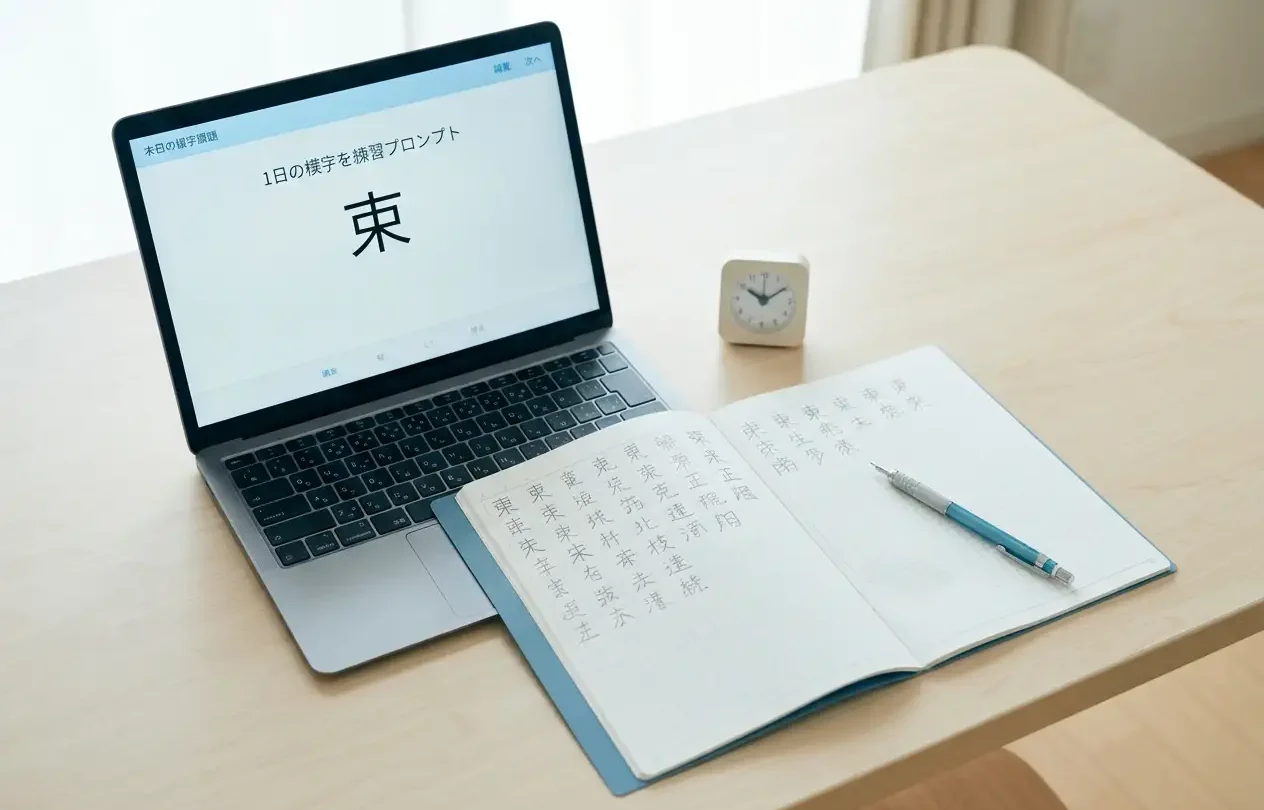
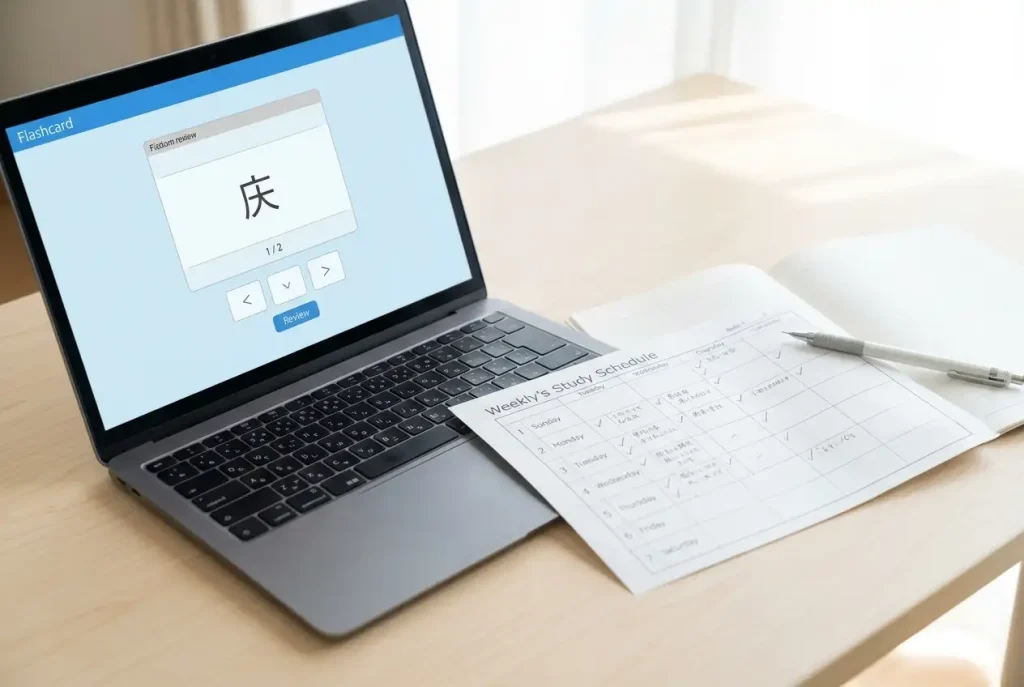
Most digital kanji flashcards display a character and ask for a meaning or reading. That is cued retrieval: the character is already in front of you. It is useful, but it is not the same task as starting with an idea or spoken word and producing the correct written form.
Recognition asks, “What does 駅 mean?” Production asks, “How do I write the character for station?” Reading in context adds another question: “Which reading and meaning fit this sentence?” Handwriting adds stroke sequence, proportion and motor memory.
WaniKani directly tests typed meanings and readings. It does not make handwriting part of the core review. Anki can test either direction, but only if the cards are designed that way. A downloaded recognition-only deck remains recognition-only regardless of how advanced the scheduling algorithm is.
That is the limit behind kanji recognition. You can become fast at supplying an English gloss while still hesitating over a real compound. Why the Same Kanji Sounds Different covers 音読み, on’yomi, “sound reading,” and 訓読み, kun’yomi, “meaning reading,” because a single flashcard answer cannot explain every reading choice.
A scheduler decides when to ask the question. It does not decide whether you practiced the right question.

WaniKani buys a curriculum
WaniKani suits you when choosing and editing cards would become another form of procrastination. Its order is fixed around proprietary radical labels, mnemonics, kanji and associated vocabulary. Correctly advancing the required components unlocks later material.
That structure reduces setup decisions. You do not need to choose a deck, define note fields, install a Japanese font or decide which reading belongs on the answer side. The course also prevents you from importing an enormous collection and pretending that possession is progress.
The trade-off is control. You cannot freely reorder the full curriculum around your textbook, job vocabulary or the characters appearing in a novel. Some mnemonic vocabulary may arrive before it becomes useful in your own reading.
WaniKani’s radical names are memory labels, not a complete course in dictionary indexing. When the problem is identifying an unfamiliar shape rather than remembering a scheduled item, How to Find a Character You Cannot Read explains component, handwriting and camera-based lookup.
Anki buys flexibility—and work
Anki suits you when you already know what belongs in the deck. You can create recognition cards, production cards, sentence cards, audio prompts or cards copied from material you are reading. You can also delete a bad card instead of repeatedly failing a badly framed question.
That freedom makes an Anki kanji deck only as reliable as its source. Shared decks may contain unnatural glosses, missing context, duplicated cards or an ordering system that does not match your course. Even an accurate deck may test the wrong skill for your goal.
Card creation adds time that subscription comparisons usually hide. If you spend one minute researching and building each of 100 new cards, that is 100 minutes before a single scheduled review. Copying a premade deck reduces setup time but also removes the act of deciding what the card should teach.
Anki becomes strongest when it follows contact with real Japanese. Add a sentence you actually read, keep enough context to identify the meaning and avoid putting several independent facts on one card. The broader relationship among hiragana, katakana and kanji belongs in Hiragana, Katakana, Kanji: How Japanese Writing Works, not inside an overloaded flashcard.

The variables that move the queue
Four variables change the workload more than the brand name does.
First, new-item rate moves the queue almost linearly. In the eight-review model, 50 new items create 400 successful review prompts over their lifetime; 100 create 800; 150 create 1,200. Halving lessons is the quickest response when reviews begin consuming the entire session.
Second, errors do more than add one correction. In WaniKani, an incorrect response can lower the SRS stage, with larger penalties at later stages. That schedules additional appearances before the item can advance again.
Third, card direction changes the skill being practiced. Character-to-meaning cards emphasize recognition. Meaning-to-character prompts, typing from audio and actual kanji writing practice demand more production, but each answer also takes longer.
Fourth, vocabulary multiplies the item count. Learning one character without words can create shallow knowledge, yet adding several vocabulary cards for every character means that “100 kanji a week” may generate several hundred new items. WaniKani’s published course scale—more than 2,000 kanji and more than 6,000 vocabulary words—shows why character count alone understates its workload.
Japanese names reveal another limit. A character’s common vocabulary reading may not predict how it is read in a person’s name. If your immediate goal is katakana rather than kanji name readings, the name converter contains 898 checked names in katakana and avoids turning the flashcard deck into a name database.
A slower plan leaves room for Japanese
Reduce the input to 50 new items a week and keep every other assumption unchanged. New-item study falls from 75 to 37.5 minutes. Successful reviews fall from 106.7 to 53.3 minutes. The modeled total becomes 90.8 minutes a week, or about 13 minutes a day.
With a 20-minute daily budget, that leaves approximately 49.2 minutes a week for reading, handwriting or grammar:
140 available minutes − 90.8 SRS minutes = 49.2 minutes.
That is still a tight plan, especially when mistakes and card creation are added. But it no longer guarantees that the scheduler receives every available minute. The reduced pace may produce more usable Japanese because you can meet the characters outside the review interface.
A practical weekly allocation is:
- Stop adding new items when due reviews exceed the time reserved for SRS.
- Clear existing reviews without rushing the answers.
- Read material containing known characters.
- Write a small sample from memory.
- Resume new lessons only when the queue fits again.
This is not an argument against spaced repetition for kanji. It is an argument for giving SRS one job: maintaining retrievable associations while reading and writing develop the rest of the skill.
Which tool earns its place?
Choose WaniKani if you want a prepared route, human-written mnemonics and a fixed dependency order. The subscription pays for editorial decisions as much as software. It is easier to begin and harder to customize.
Choose Anki if you want to follow a textbook, mine sentences or test production deliberately. The software can cost nothing on desktop or Android, but your time becomes the editorial budget. Flexibility is valuable only if you use it to build better prompts.
Neither choice solves the review-volume problem. An SRS is a queue: items enter now and create obligations later. A clean dashboard after an enthusiastic lesson session does not mean the work disappeared; it means the reviews have been scheduled for your future self.
The single figure to remember is 800 minimum successful reviews per 100 new items in the eight-review model. Recheck tool prices, scheduler documentation and product limits after September 17, 2027.