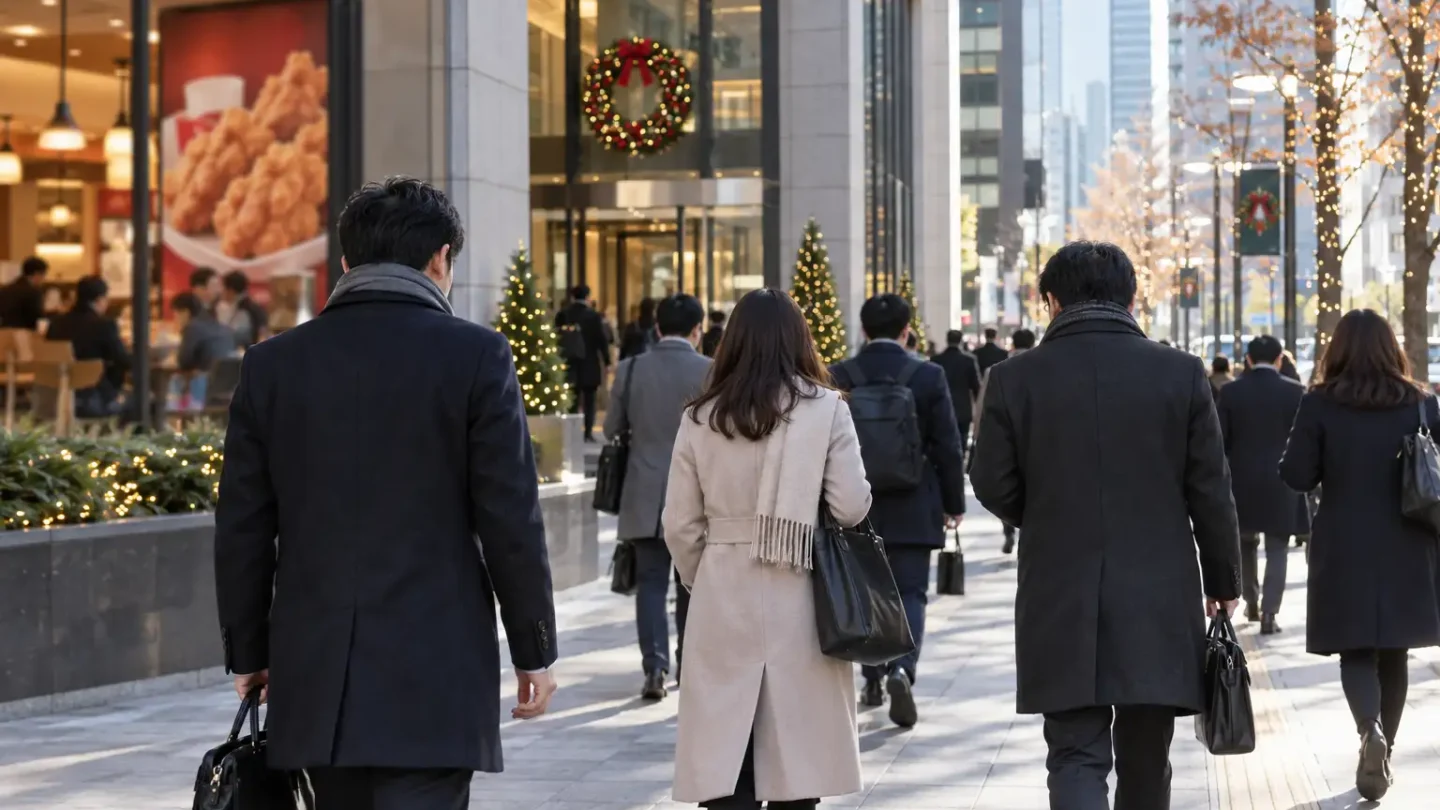
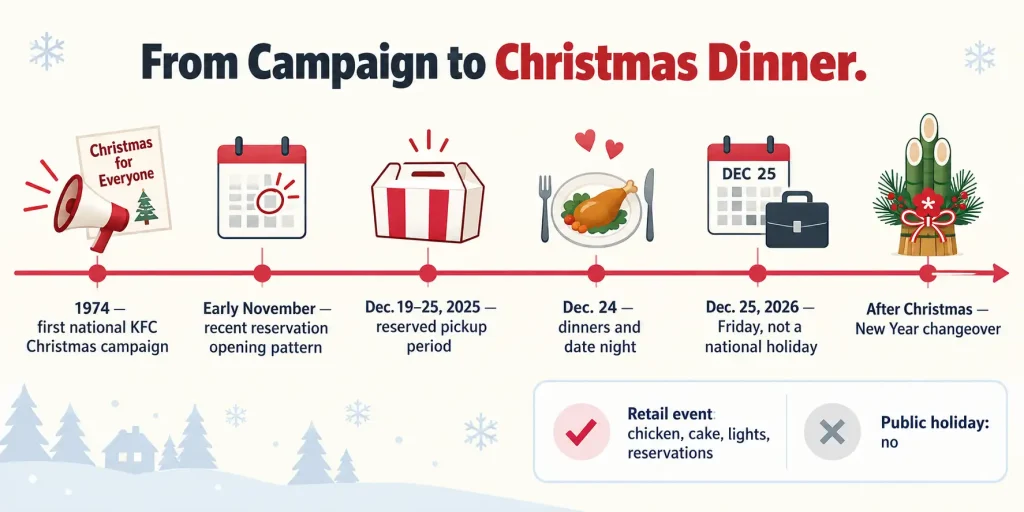
The mechanism behind Christmas in Japan is commercial rather than governmental: stores, restaurants and couples create a short seasonal event around December 24, while the national calendar treats December 25 as an ordinary day. That is how a country can have illuminated shopping streets, strawberry cakes and fried-chicken reservations without giving most employees Christmas Day off. The surprise is not merely that people eat KFC. It is that a meal promoted nationally in 1974 became organized like a limited holiday product, with pickup slots and quantities that can be allocated weeks before Christmas.
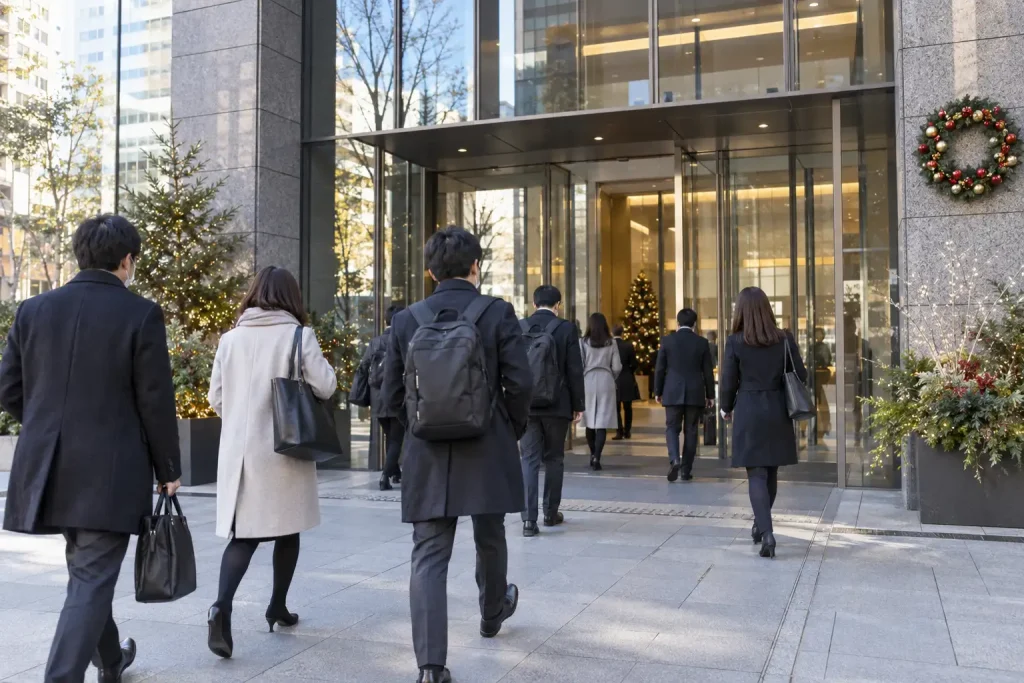
Japan recognizes Christianity and has churches, Christmas services and Christian families, but the modern mass-market celebration does not depend on Christmas being a national holiday. If December 25 falls on a weekday, offices, schools, trains and government services generally follow their normal schedules unless an individual organization chooses otherwise. In 2026, December 25 falls on a Friday and does not appear on the Cabinet Office list of national holidays.
This makes the celebration run on retail time. Decorations appear in shopping districts, restaurants advertise seasonal menus, bakeries collect cake orders and KFC opens reservations well before the meal is eaten. For the larger annual calendar around it, What Happens in Japan, Month by Month explains how public holidays, festivals and travel peaks fit together.
How Christmas in Japan works without a holiday
There are two calendars operating at once. The legal calendar determines whether employees and students receive a public holiday. The retail calendar creates a recognizable Christmas season through food, lights, gifts and limited products. Christmas has a strong place in the second calendar but no automatic place in the first.
That difference is easy to miss if you come from the United States, where Christmas Day is a federal holiday and family schedules tend to revolve around it. In Japan, the most visible social activity often happens on the evening of December 24. Couples book dinners, families serve chicken and cake, and businesses prepare to replace Christmas displays with New Year decorations almost immediately afterward.
The result is a compact celebration rather than a long shutdown. You can enjoy the lights and special menus, then find commuters returning to ordinary routines the next morning. Railways do not switch to a universal Christmas timetable, shops do not all close, and hotels do not assume that every guest will spend December 25 with family.
| Part of the system | What it does | What visitors often get wrong |
|---|---|---|
| National calendar | Determines public holidays | December 25 is not automatically a day off |
| Retail calendar | Creates seasonal products and displays | Commercial visibility does not make Christmas an official holiday |
| Christmas Eve | Concentrates dinners and dates | December 24 can feel more socially important than Christmas Day |
| Food preorders | Allocate limited meals and pickup periods | Popular sets may not be practical as a walk-in purchase |
| New Year transition | Replaces Christmas displays quickly | Christmas is not the main winter family holiday |
KFC turned chicken into the expected meal
Japan’s first large KFC Christmas campaign ran in December 1974. The company’s corporate history records it as the beginning of the national campaign, while KFC’s own museum says there are multiple accounts of exactly how the idea originated. That qualification matters because the familiar story about a foreign customer searching for turkey is often repeated as settled history, although KFC itself describes the origin as having several versions.
What is firmly documented is the campaign and its long continuation. The phrase クリスマスはケンタッキー, Kurisumasu wa Kentakkī, literally “Christmas is Kentucky,” offered a convenient answer to a practical question: what should a household serve for a Western-looking celebration in a country without a widespread domestic turkey tradition?
The company did not invent eating chicken, and no rule says Japanese families must order from KFC. Its achievement was making KFC Christmas in Japan recognizable and repeatable. Fried chicken was easy to share, visibly different from an ordinary home dinner and available through a national restaurant chain. Advertising supplied the ritual before most households had inherited one.
KFC did not replace an old Japanese Christmas dinner. Its campaign helped define what a modern Japanese Christmas dinner could be.
The outsider’s mistake is to imagine that customers spontaneously formed lines on December 25 and created the custom from the bottom up. Walk-in demand is visible, but the system is deliberately built around advance sales. The company announces a Christmas menu, opens reservations, assigns pickup periods and warns that orders may close when planned quantities are reached.
The reservation is part of the tradition
The claim that you should reserve weeks ahead is supported by KFC Japan’s recent sales schedules. For Christmas 2025, online reservations opened on November 4, while reserved products could be collected from December 19 through December 25. KFC also stated that reservations would end when planned quantities were reached and advised customers to order early.
That was not an isolated arrangement. In 2024, reservations opened on November 1 for pickups from December 20 through December 25. The company warned that some limited products could stop accepting orders once their allocated supply was gone. These schedules place the purchasing decision roughly seven weeks before the final pickup date, even though not every customer orders on opening day.
For a visitor, the uncomfortable part is simple: seeing a KFC restaurant does not guarantee that you can walk in at the busiest time and buy the advertised Christmas chicken in Japan. A store may still offer regular items or whatever remains available, but the special set, preferred pickup window or exact quantity you want may already be unavailable. Treat the meal like a restaurant reservation, not like an emergency fast-food stop.
A sensible order of action is:
- Check KFC Japan’s official Christmas page when the current campaign is announced.
- Select a participating store and confirm whether it accepts online reservations.
- Choose the product and an available pickup period.
- Save the confirmation in a form you can access without relying on public Wi-Fi.
- Arrive within the assigned period rather than joining a general walk-in line.
Cake completes the manufactured ritual
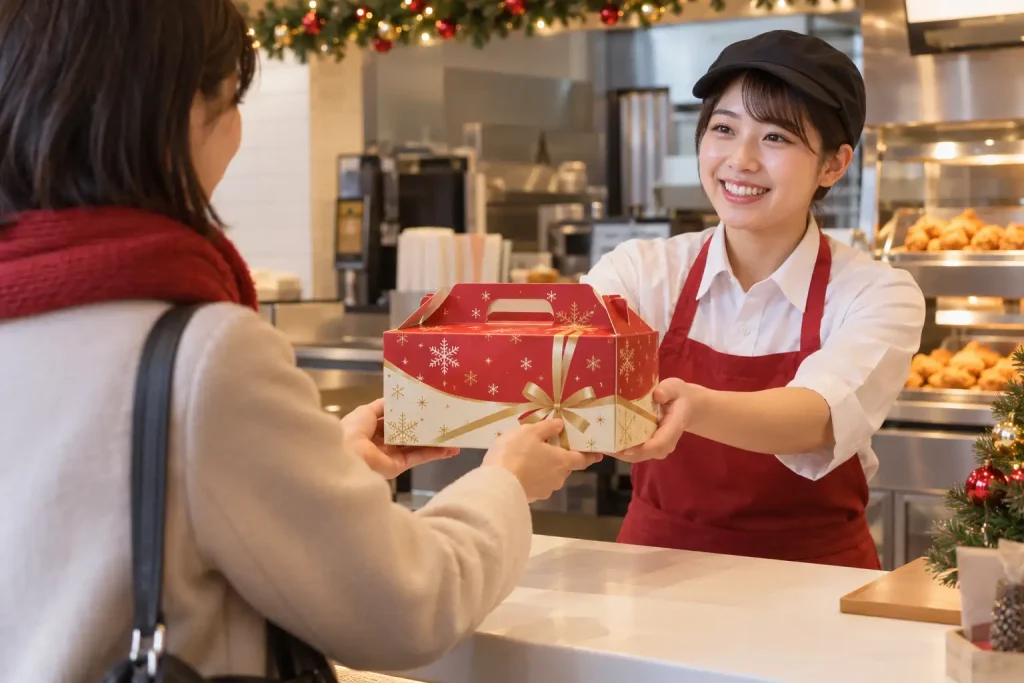
The other standard item is クリスマスケーキ, Kurisumasu kēki, literally “Christmas cake.” The familiar version is a light sponge cake decorated with whipped cream and strawberries, although contemporary catalogs also include chocolate cakes, cheesecakes and character-themed designs. Bakeries, department stores, hotels and convenience stores all participate in the preorder economy.
Cake reinforces the same mechanism as chicken: a limited seasonal product turns an unofficial occasion into something you can plan and repeat. You reserve it, collect it near December 24 or 25 and bring it to a household gathering. The custom therefore feels organized even though no public authority organizes it.
Not every Japanese household buys the same cake, and plenty buy none. The important point is the shared commercial script. Chicken provides the savory centerpiece, while cake marks the meal as a celebration. Together they give families a recognizable Christmas format without requiring a religious service or a legal holiday.
| Item or activity | Usual planning point | Practical implication |
|---|---|---|
| KFC Christmas menu | Reservations have recently opened in early November | Prime products and pickup periods may be allocated in advance |
| Christmas cake | Bakeries and retailers publish seasonal preorder catalogs | The exact design may be limited by store and pickup date |
| Christmas Eve dinner | Restaurants sell seasonal courses and reservation slots | Popular urban venues may require advance booking |
| Illuminations | Dates vary by installation and location | Some displays continue after December 25, while others end promptly |
| December 25 work | Controlled by the employer or institution, not a Christmas holiday law | Confirm your own workplace, school or tour schedule |
Christmas Eve belongs to couples as well as families
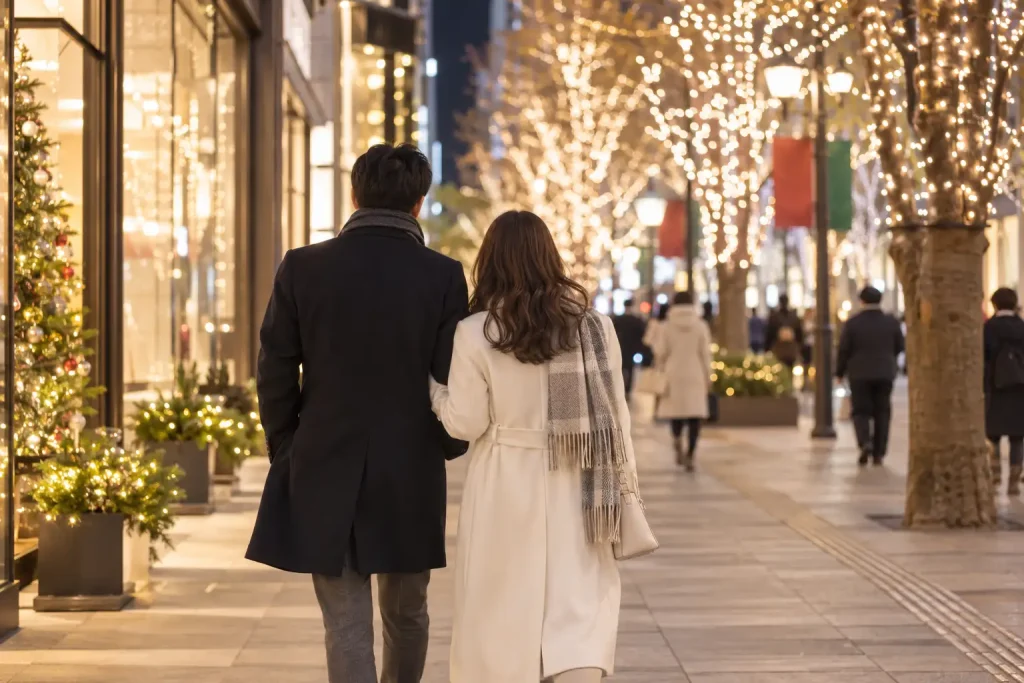
Commercial culture has also framed December 24 as a romantic evening. Restaurants, hotels and illuminated districts market it as a date night, sometimes closer in social function to Valentine’s Day in the United States than to an American family Christmas morning. Families still celebrate, but couples are unusually prominent in advertising and city-center dining.
This helps explain why December 25 can feel like the aftermath rather than the climax. A couple may have exchanged gifts and eaten a special dinner the night before, then return to work on Christmas morning. A household may schedule chicken and cake for whichever evening fits everyone’s jobs and school commitments.
You do not need to imitate the date-night script to participate. Visiting an illumination, ordering cake or sharing chicken with friends is equally ordinary. Japanese Etiquette for Visitors: What Actually Matters covers the behavior that affects people around you; there is no separate code of etiquette requiring tourists to celebrate Christmas in a particular way.
December 25 leads directly into New Year
The speed of the changeover makes sense once you recognize which holiday carries more cultural weight. After Christmas, retailers remove trees, Santa figures and red-and-green displays so they can prepare for 正月, Shōgatsu, literally “the first month,” meaning the New Year period. Kadomatsu decorations, New Year foods and homecoming preparations take over.
New Year is the season associated with family reunions, shrine or temple visits, traditional foods and widespread business closures. Christmas competes for retail space immediately before that larger domestic occasion. It therefore has a sharp endpoint even when winter illuminations remain in place.
Japan’s other annual observances do not follow the same pattern. Coming of Age Day, for example, is an official public holiday centered on civic ceremonies, which The Ages Japan Marks With a Ceremony explains separately. Seasonal festivals also have local institutions, religious contexts and regional schedules; Japanese Festivals by Season covers that system rather than treating every decorated event as the same kind of holiday.
The contrast is useful: Christmas is culturally visible but institutionally light, while New Year is both culturally and operationally consequential. If you are planning transportation, meals or sightseeing, Christmas Day is often easier than the days around New Year.
Where the simple rule breaks down
December 25 being an ordinary workday does not mean everyone works. Christian schools, churches, international companies and individual employers may arrange services, vacations or special schedules. Some employees use paid leave, and school calendars can overlap with winter vacation. The absence of a national holiday removes the automatic rule; it does not prohibit anyone from taking the day off.
Nor does every household order fried chicken. People cook at home, buy roast chicken from supermarkets, choose another restaurant or ignore Christmas entirely. KFC is the most recognizable version of the custom, not a census of what every resident eats.
There are regional and personal variations in illuminations, restaurant demand and how long decorations remain. If your trip is motivated by autumn color rather than Christmas displays, Where the Leaves Turn, and Exactly When gives the separate timing logic for 紅葉, kōyō or momiji, literally “autumn-colored leaves.”
Historical dates can also appear in two forms. Japan may describe 1974 as 昭和49年, Shōwa yonjūkyū-nen, literally “the forty-ninth year of Shōwa.” The site’s era converter covering every year from 1868 to 2050 and all five eras handles those conversions without reproducing the entire system here.
What the system changes for a December visitor
First, do not schedule Christmas Day as if the country will close. Trains, urban attractions and commercial districts generally operate according to their published weekday or seasonal schedules, although you must still check each venue. December 25, 2026 is a Friday, so an ordinary Friday schedule is the starting assumption rather than a nationwide holiday timetable.
Second, book the culturally famous meal before you arrive if eating it matters to you. The brand’s recent campaigns have opened ordering in early November, and the company explicitly states that reservations can end when planned quantities are reached. KFC Christmas reservations are not merely a suggestion for impatient customers; they are part of how the chain controls a concentrated pickup rush.
Third, place your romantic dinner on December 24 if you want the atmosphere advertised in Japan. Place it on another evening if you want easier availability. The lights will often still be visible, but the strongest restaurant demand follows the social script rather than the legal calendar.
Fourth, prepare more carefully for New Year than for Christmas. The closures and reduced hours likely to affect a traveler cluster around the end of December and the beginning of January, not around Christmas Day itself.
Frequently asked questions
Is Christmas Day a public holiday in Japan?
No. December 25 is not included in Japan’s statutory list of national holidays. Offices, schools and businesses may make their own scheduling decisions, but there is no nationwide Christmas Day entitlement comparable to the US federal holiday.
Do people in Japan really eat KFC for Christmas?
Many customers do, and KFC runs a substantial annual Christmas campaign, but the habit is not universal. Other families buy supermarket chicken, cook at home, eat at restaurants or do not celebrate.
When did the KFC Christmas campaign begin?
KFC Japan’s corporate history records its first Christmas campaign in December 1974. The company says several versions exist concerning the precise inspiration behind it, so the famous foreign-customer origin story should not be presented as an independently established fact.
How early should you reserve KFC for Christmas?
The exact 2026 schedule had not been announced at the September 16, 2026 research cutoff. In 2025, online reservations opened on November 4 for pickup from December 19 through December 25. In 2024, ordering opened on November 1 for pickup from December 20 through December 25. Checking the official campaign page in early November is the practical rule.
Can you buy KFC without a reservation on December 24 or 25?
Possibly, but you should not depend on obtaining the special set or your preferred quantity and time. Participating stores, inventory and walk-in menus can differ. KFC warns that reservations for planned quantities may close early.
What is a Japanese Christmas cake?
The classic version is a sponge cake decorated with whipped cream and strawberries. Retailers now sell many alternatives, including chocolate and character-themed cakes, and popular designs are commonly offered through advance-order catalogs.
Is Christmas Eve more important than Christmas Day?
For commercial dining and romantic outings, December 24 often receives more attention. December 25 remains visible as Christmas Day, but it does not produce a nationwide work stoppage and can feel like the transition toward New Year preparations.
Do shops close on Christmas Day?
There is no general Christmas closure rule. Check the official schedule for each attraction, restaurant or store. Closures around New Year are more likely to disrupt a trip.
The rule to carry with you is simple: treat December 25 as a normal working day, but treat the famous chicken dinner as a reservation.