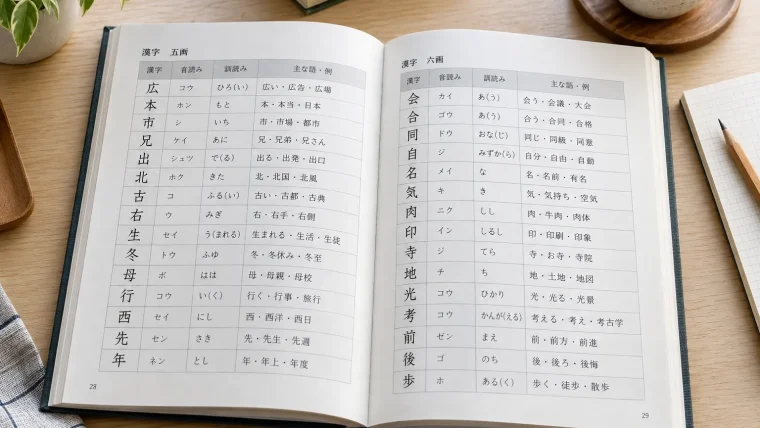
音読み, on’yomi, “sound reading,” and 訓読み, kun’yomi, “explanatory reading,” are regularly presented as two interchangeable pronunciations of the same character. They are not interchangeable, and choosing between them is not random. The working rule for on and kun readings is simple: a kanji joined directly to another kanji will usually take an on-reading, while a kanji followed by hiragana okurigana will usually take a kun-reading. This shortcut predicts many ordinary words, but it cannot generate every pronunciation. Mixed compounds, whole-word readings, personal names, and historical sound changes all break it.
Two adjacent kanji suggest on’yomi. A kanji followed by a grammatical hiragana ending suggests kun’yomi. The word “suggest” is what keeps the rule accurate.
Five ways to compare the two reading systems
A useful comparison needs consistent axes rather than disconnected definitions. The five axes used here are historical source, visual clue, common word structure, relationship to meaning, and predictable failure points. Historical source explains why the readings coexist, while the visual clue gives you something usable when you meet an unfamiliar word. Word structure and meaning reveal what each reading normally does. The final axis matters most in practice because it tells you when to stop applying the shortcut.
Stroke count, radicals, handwriting style, and proficiency-test level are not included. Those features can help you recognize or memorize a character, but they do not directly determine its pronunciation inside a particular word. If you are still deciding which characters deserve priority, The First Hundred Kanji and Why Those covers study order and selection. The broader division of labor among kanji, hiragana, and katakana is explained in Three Scripts Doing Three Different Jobs. Here, the narrower question is what reading to test after you see the written structure.
| Axis | On’yomi | Kun’yomi |
|---|---|---|
| Historical source | Pronunciation adapted from Chinese | Native Japanese word matched to the character’s meaning |
| Strongest visual clue | Two or more adjacent kanji | Kanji followed by grammatical hiragana |
| Common structure | Compound nouns | Verbs, adjectives, and standalone native nouns |
| Relationship to meaning | Builds compact compound vocabulary | Connects a native word with a character |
| Main failure points | Multiple on-readings, mixed compounds, sound changes | Kun-kun compounds, jukujikun, names |
How on and kun readings developed
Kanji reached Japan together with written Chinese, but the Japanese language already had its own vocabulary. One solution was to approximate the Chinese pronunciation of a character. That produced 音読み/おんよみ, on’yomi, literally “sound reading.” Another solution was to associate the character’s meaning with an existing Japanese word. That produced 訓読み/くんよみ, kun’yomi, literally “explanatory reading.”
This history did not happen once under controlled conditions. Chinese pronunciations entered Japan through different regions and at different periods, and Japanese sound patterns changed them further. A character can therefore possess several accepted on-readings. The modern Mandarin pronunciation is not a dependable shortcut to the Japanese reading. What survives in Japanese is a collection of historically adapted readings embedded in established vocabulary.
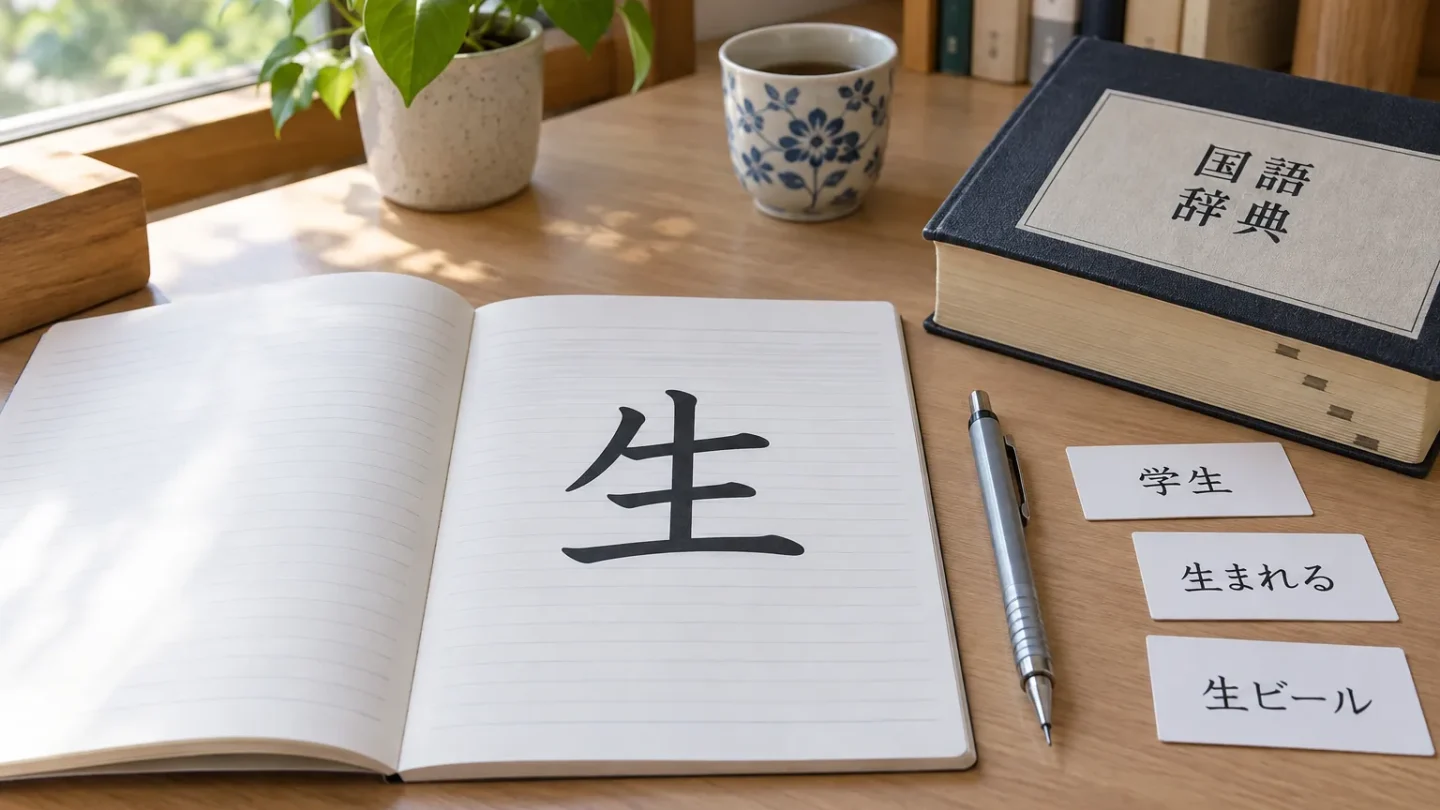
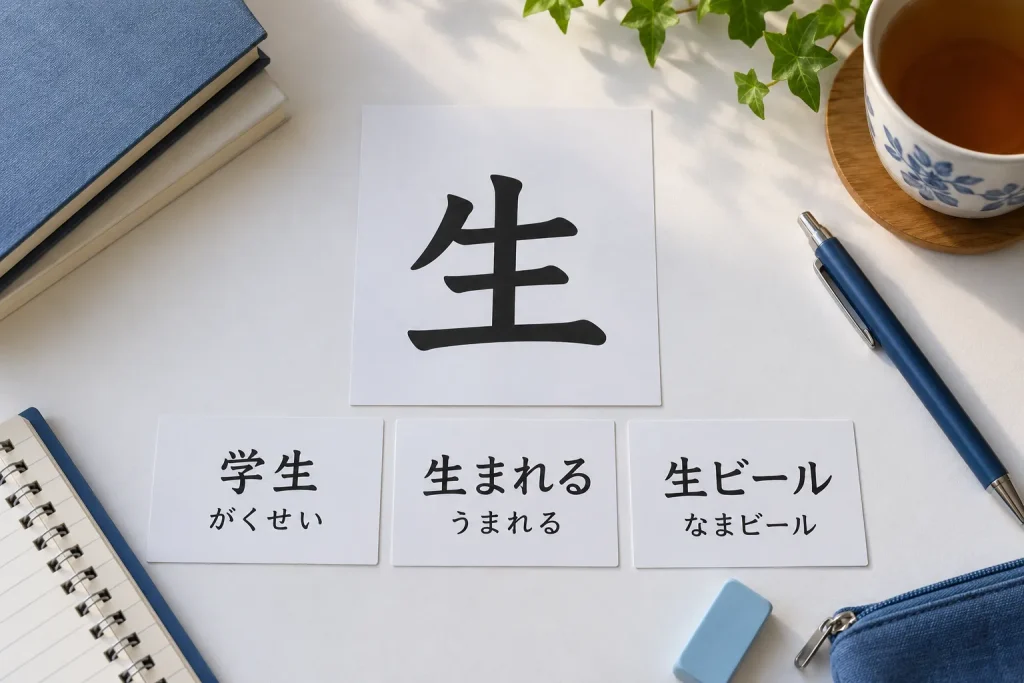
The result is easier to understand if you stop treating a kanji as a letter. A letter normally represents a sound, but a kanji can carry meaning while participating in several words with different pronunciations. 生, for example, appears in 学生/がくせい, gakusei, “student,” 生まれる/うまれる, umareru, “to be born,” and 生ビール/なまビール, nama bīru, “draft beer.” The character remains recognizable while its reading changes with the complete word. That is inconvenient for learners, but it is not linguistic chaos.
On’yomi inside kanji compounds
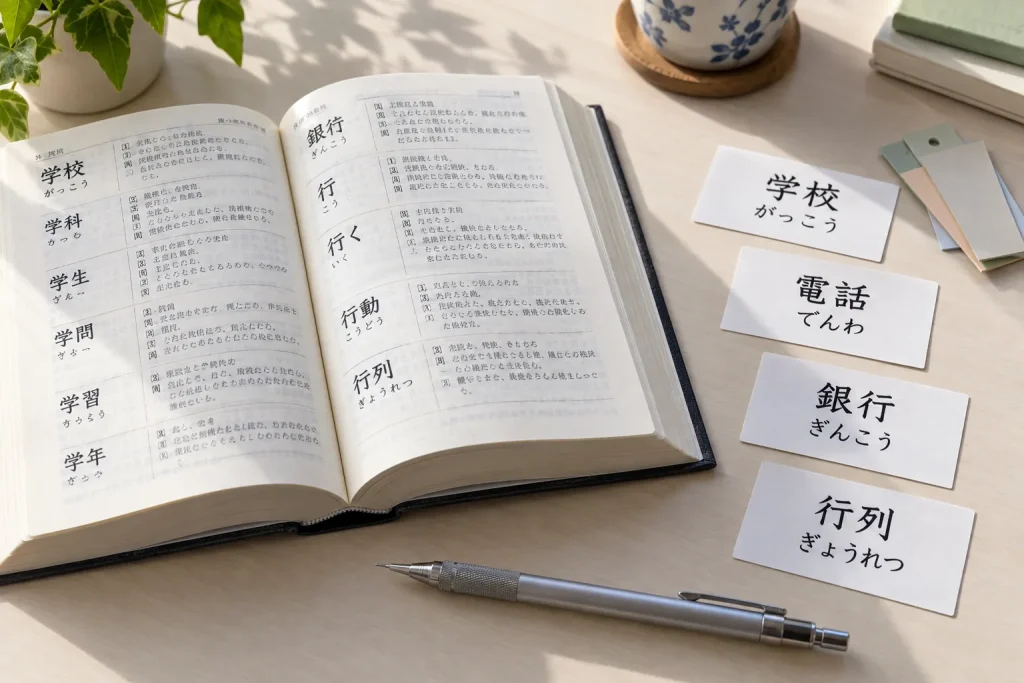
On’yomi is the first reading to test when two or more kanji appear together without kana between them. 学校/がっこう, gakkō, “school,” combines 学, normally represented here by gaku, with 校, read kō. 電話/でんわ, denwa, “telephone,” combines den and wa. 文化/ぶんか, bunka, “culture,” combines bun and ka. These are standard examples of why kanji compounds are associated with on-readings.
On-readings are common in words for institutions, academic subjects, administration, technology, and abstract concepts. That is a tendency rather than a semantic law. Everyday words such as 時間/じかん, jikan, “time,” 写真/しゃしん, shashin, “photograph,” and 電気/でんき, denki, “electricity,” also use on-readings. You cannot identify the reading merely by deciding whether a word feels formal. The written structure gives the better first clue.
The first difficulty is that a character may offer more than one on-reading. 行 is read kō in 銀行/ぎんこう, ginkō, “bank,” but gyō in 行列/ぎょうれつ, gyōretsu, “line or procession.” Both readings are established, so the compound heuristic cannot choose between them by itself. You must know or verify the complete word. A dictionary entry is evidence; a plausible reconstruction is only a guess.
The second difficulty is sound change. 学校 is conventionally analyzed from gaku and kō, but the spoken result is gakkō, not gaku-kō. The consonants combine and produce a small っ in the kana spelling. Similar changes can involve voicing or contraction. Selecting the correct reading family is therefore only the beginning of the pronunciation.
Kun’yomi and the clue supplied by okurigana
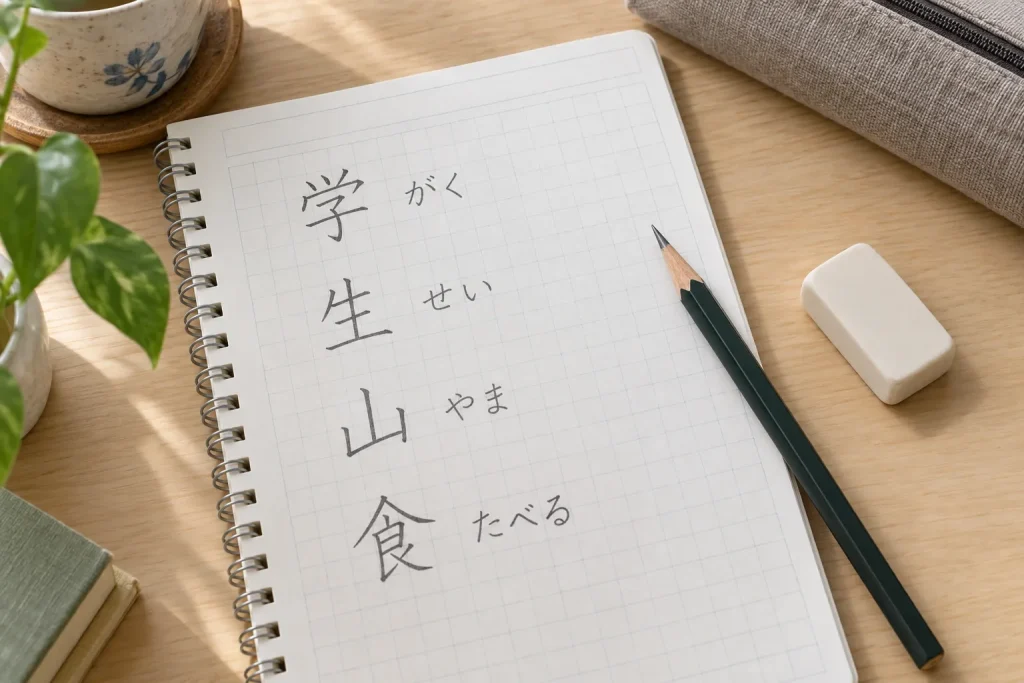
Kun’yomi connects an existing Japanese word with a character of corresponding meaning. 山/やま, yama, “mountain,” and 水/みず, mizu, “water,” are straightforward standalone examples. The principle becomes especially visible in verbs and adjectives. The kanji carries the lexical core, while the following hiragana carries information such as tense, negation, or inflection. Those following kana are called 送り仮名/おくりがな, okurigana, literally “accompanying kana.”
In 食べる/たべる, taberu, “to eat,” 食 represents the beginning of the native reading and べる completes the verb. In 高い/たかい, takai, “high” or “expensive,” 高 carries taka while い supplies the adjective ending. 読む/よむ, yomu, “to read,” becomes 読んだ/よんだ, yonda, “read” in the past tense. The kana changes with the grammar while the written root remains recognizable. This makes okurigana the strongest everyday signal for trying kun’yomi first.
Kun-readings often feel closer to basic concrete vocabulary, but they are not restricted to objects that can be seen or touched. 思う/おもう, omou, “to think,” and 考える/かんがえる, kangaeru, “to consider,” also use kun-readings. The historical source of the Japanese word matters more than whether its modern meaning is concrete or abstract. Meaning can help you remember the form. It does not independently prove which reading is present.
The larger relationship between kanji and kana is covered in Hiragana, Katakana, Kanji: How Japanese Writing Works. That guide explains what each script contributes to a Japanese sentence. In this article, kana is being used as evidence about the reading of a neighboring kanji. The distinction is small but important: identifying a script and predicting a word’s pronunciation are separate tasks.
Where the distinction stops mattering
Once you know that 学校 is pronounced gakkō, classifying both elements as on-readings does not change how you speak or understand the word. Native speakers ordinarily retrieve a familiar word as a complete lexical item. They do not pause to calculate an on-kun formula whenever they see it. The labels are useful when they help you predict, compare dictionary entries, or connect related vocabulary. When they provide no additional help, you can learn the word without repeatedly analyzing it.
The distinction also becomes less tidy inside mixed compounds. 重箱読み/じゅうばこよみ, jūbako-yomi, literally “tiered-box reading,” describes an on-reading followed by a kun-reading. In 重箱/じゅうばこ, jūbako, “tiered box,” 重 contributes on jū, while 箱 contributes kun hako, voiced to bako. 湯桶読み/ゆとうよみ, yutō-yomi, literally “hot-water-bucket reading,” describes the reverse order. 湯桶/ゆとう, yutō, “hot-water bucket,” combines kun yu with on tō.
These combinations are not mistakes. They are established readings of established words, and their labels describe them after the fact. Knowing the label “jūbako reading” rarely allows you to predict an unfamiliar mixed compound. It simply explains why an already verified pronunciation contains both systems. Vocabulary remains the final unit you need to learn.
| Written pattern | First reading to test | Worked example | Result |
|---|---|---|---|
| Kanji + kanji | On + on | 学校 | がっこう, gakkō |
| Kanji + okurigana | Kun-reading | 食べる | たべる, taberu |
| On + kun compound | Mixed reading | 重箱 | じゅうばこ, jūbako |
| Kun + on compound | Mixed reading | 湯桶 | ゆとう, yutō |
| Whole-word reading | Verify the whole word | 今日 | きょう, kyō |
| Personal or place name | Verify from a reliable source | Reading depends on the name | Cannot be safely generated |
The exceptions that break the shortcut
The uncomfortable part is that the heuristic cannot tell you how every written word sounds. It works often enough to reduce uncertainty, but its exceptions are common enough to appear in ordinary reading. These are not obscure curiosities reserved for literature. Words such as 今日, 大人, 手紙, and 入口 occur in basic everyday Japanese. A learner who treats the shortcut as an absolute rule will misread familiar vocabulary.
The main kanji reading exceptions belong to recognizable groups:
- Kun-kun compounds place native readings together even though the word contains adjacent kanji. 入口/いりぐち, iriguchi, “entrance,” combines iri and kuchi, with kuchi voiced to guchi. 手紙/てがみ, tegami, “letter,” combines te and kami, with kami voiced to gami.
- Mixed compounds use on plus kun or kun plus on. 重箱 and 湯桶 provide the traditional names for the two directions.
- Standalone kanji can take an on-reading. 本/ほん, hon, “book,” and 駅/えき, eki, “station,” show why “one kanji means kun’yomi” is not dependable.
- Words with okurigana can contain an on-derived base. 信じる/しんじる, shinjiru, “to believe,” and 感じる/かんじる, kanjiru, “to feel,” include following kana but do not follow the ordinary kun-reading prediction.
- 熟字訓/じゅくじくん, jukujikun, “compound-character native reading,” assigns one established reading to the compound as a whole. The sound cannot be divided safely among its individual characters.
- Personal names and place names can use specialized readings, historical conventions, or pronunciations that ordinary vocabulary rules do not predict.
- Sound changes can alter the surface form after readings combine. These include consonant doubling, voicing, and contraction.
Jukujikun is the category that most clearly defeats character-by-character calculation. 今日/きょう, kyō, “today,” cannot be produced by selecting an ordinary reading for 今 and then another for 日. 大人/おとな, otona, “adult,” behaves in the same way, as does 明日/あした, ashita, “tomorrow.” The Japanese government’s 常用漢字表/じょうようかんじひょう, Jōyō Kanji-hyō, “List of Kanji for Common Use,” records established whole-word readings in its appended table. Their official inclusion does not make them predictable; it confirms that they must be learned as complete words.
The trap hidden inside a correct rule
The practical mistake is believing that the compound-versus-okurigana shortcut generates pronunciations. It does not. It tells you which reading family is worth testing first. If the character has several on-readings, if the compound mixes systems, or if the word uses jukujikun, the shortcut runs out of information. Continuing to calculate after that point produces confident errors.
生 provides a useful worked example. In 学生/がくせい, gakusei, “student,” the all-kanji structure correctly points toward on’yomi, and 生 is read sei. In 生まれる/うまれる, umareru, “to be born,” the following kana correctly suggests a kun-reading beginning with u. In 生ビール/なまビール, nama bīru, “draft beer,” 生 is read nama before a katakana loanword. The same visible character participates in three established words, and the entire word determines the result.
A dependable procedure for how to read kanji has three stages:
- Inspect the word boundary: all kanji, kanji plus okurigana, or a mixture of scripts.
- Use the visual pattern to select the most likely reading family.
- Verify the complete word in a dictionary and learn its written form, kana, and meaning together.
This procedure is slower than pretending there is a universal formula, but it prevents false vocabulary from entering your memory. A card for 学校 should contain 学校, がっこう, gakkō, and “school.” Adding “on-on compound” can help organize the word, but the classification is supporting information. The complete vocabulary item is what you will actually read and use.
Names require even more restraint. Japanese personal names can share a written form while using different pronunciations, and place names preserve readings that are difficult to derive from modern vocabulary. Foreign names are usually handled through katakana instead of receiving improvised kanji. The site’s name converter with 898 checked names in katakana covers that separate task. It should not be used to predict Japanese kanji names.
What to try in the three common situations
When you see an unfamiliar all-kanji common noun, test on’yomi first. When a verb or adjective contains a kanji followed by a grammatical hiragana ending, test kun’yomi first. When you encounter a personal name, place name, mixed-script expression, or compound that produces no recognizable word, stop predicting and verify it. These choices make Japanese kanji readings manageable without pretending that every exception can be removed. The heuristic is a first hypothesis, not a final answer.
Romaji can record the pronunciation you find, but it cannot determine which reading the kanji requires. Romaji Explained: Three Systems and Which One to Use covers the different conventions for writing Japanese sounds with the Latin alphabet. For kanji study, keep the original spelling, kana pronunciation, and English meaning together. Use on’yomi and kun’yomi to explain patterns after you have verified the word. Choose the compound rule for all-kanji vocabulary, the okurigana rule for inflected forms, and a dictionary whenever the pattern breaks.
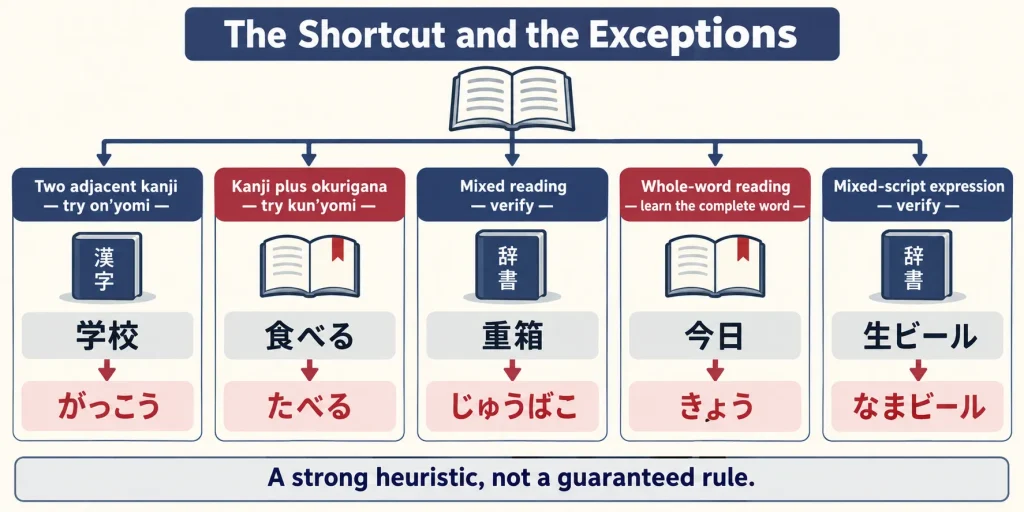
| What you see | First choice | Example | Warning |
|---|---|---|---|
| Two adjacent kanji | Try on’yomi | 学校 → がっこう | Could be kun-kun, mixed, or jukujikun |
| Kanji plus inflecting hiragana | Try kun’yomi | 食べる → たべる | Some on-derived verbs also take kana |
| One standalone kanji | Verify the word | 本 → ほん | A single character is not automatically kun |
| A personal or place name | Verify the official reading | Name-dependent | Ordinary vocabulary rules may fail |
| An unexpected result | Learn the whole word | 今日 → きょう | Do not force one reading onto each character |