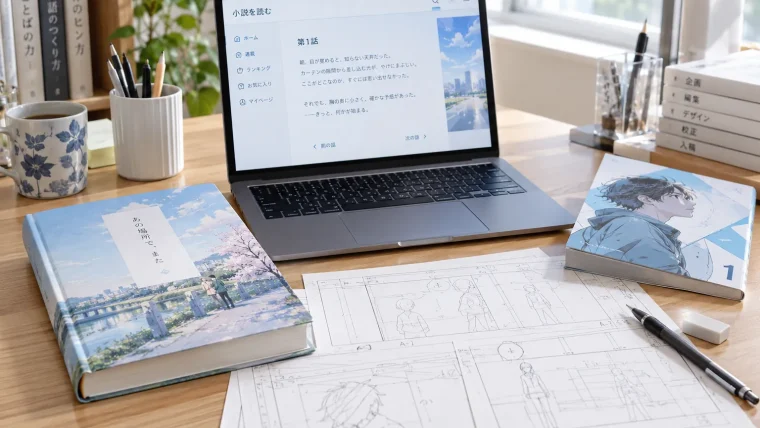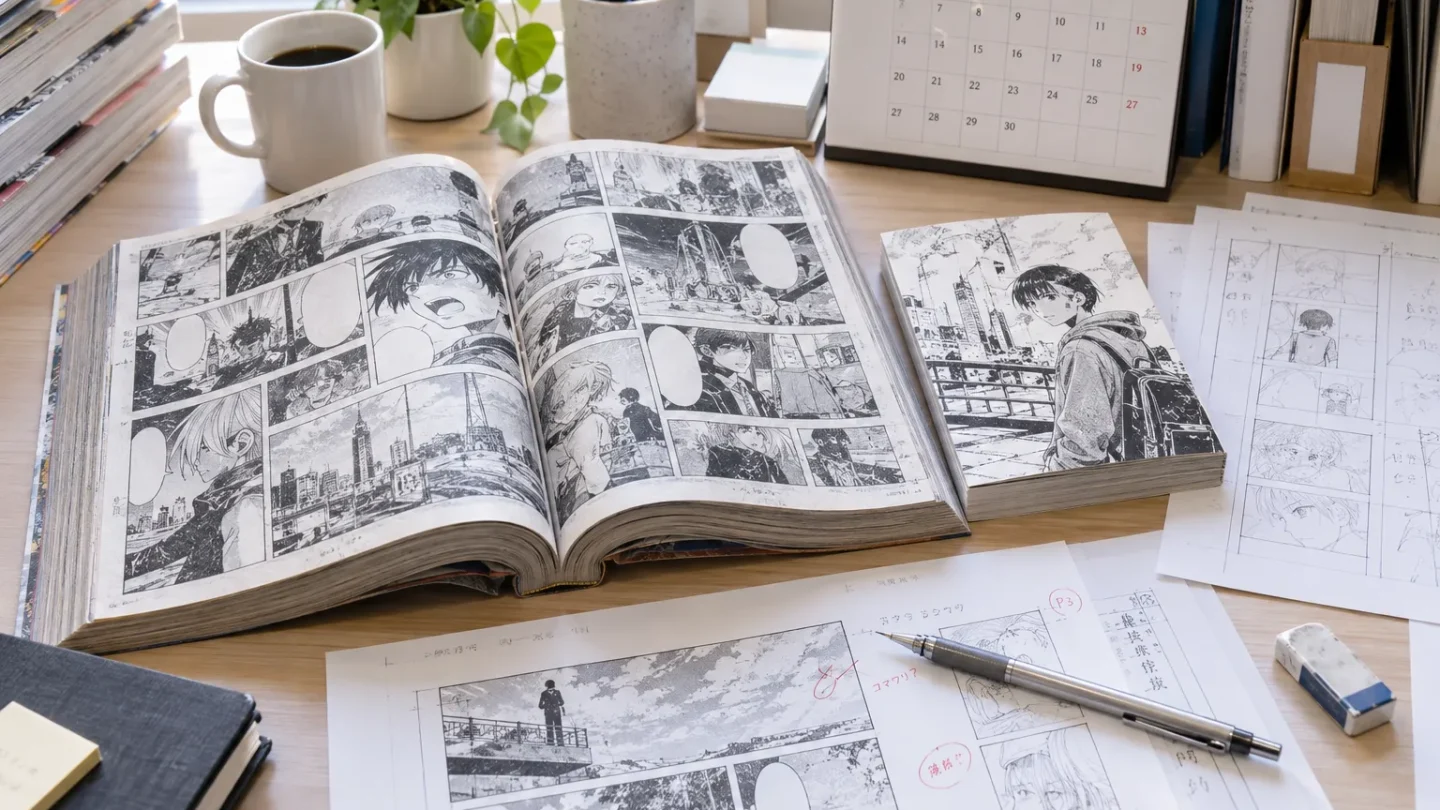
Why does Japan print thick manga magazines on cheap paper when readers eventually buy the same stories in books? The short answer is that the magazine introduces and tests serialized work, while collected editions, digital sales, licensing, and successful adaptations provide more opportunities to earn from it—although publishers do not publicly prove that every magazine issue loses money.
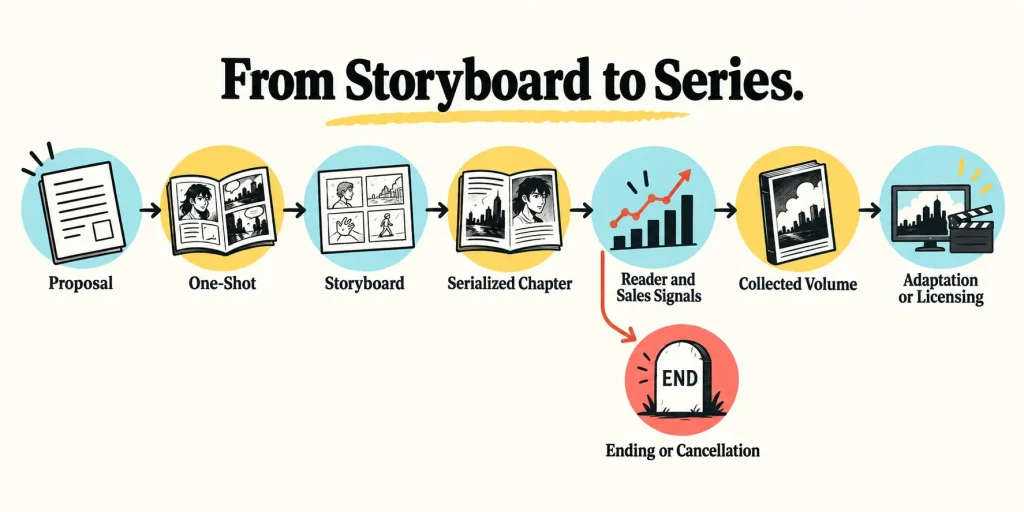
If you want to understand how manga is published, stop picturing an artist handing a finished book to a printer. Commercial manga is usually developed in stages, and each stage answers a different question. Can an editor shape the proposal? Will magazine or app readers return for another chapter? Can the chapters support a collected edition, and can the title continue beyond that?
How manga is published in Japan in the first place
A creator may approach a publisher through a competition, direct submission, editorial meeting, online platform, or work as an assistant who develops an original proposal. The first publishable result is often a 読切 yomikiri, literally “read-through,” meaning a self-contained one-shot. A one-shot lets the editor inspect pacing, character clarity, paneling, and reader response without committing to a long series. It can lead to serialization, but publication does not guarantee another assignment. Digital platforms have added more entry routes without removing the editor’s role.
The process varies by publisher and magazine, so there is no single national application form. A weekly boys’ anthology, a monthly women’s magazine, a web platform, and a specialist literary publication may recruit and edit work differently. Even within one publisher, separate editorial departments serve different audiences. The familiar Jump model is influential, but it is not the whole Japanese industry. Treat it as a worked example, not a universal constitution.
What does a manga editor actually do?
The editor is the continuing link between the creator and the publishing company. Editors discuss the premise, examine storyboards, question confusing scenes, watch deadlines, coordinate production, and present the series inside the company. They may also relay reader response and help prepare collected editions. The creator still produces the manga, but commercial publication is rarely a solitary transaction. Editorial influence can be substantial even when readers never see it.
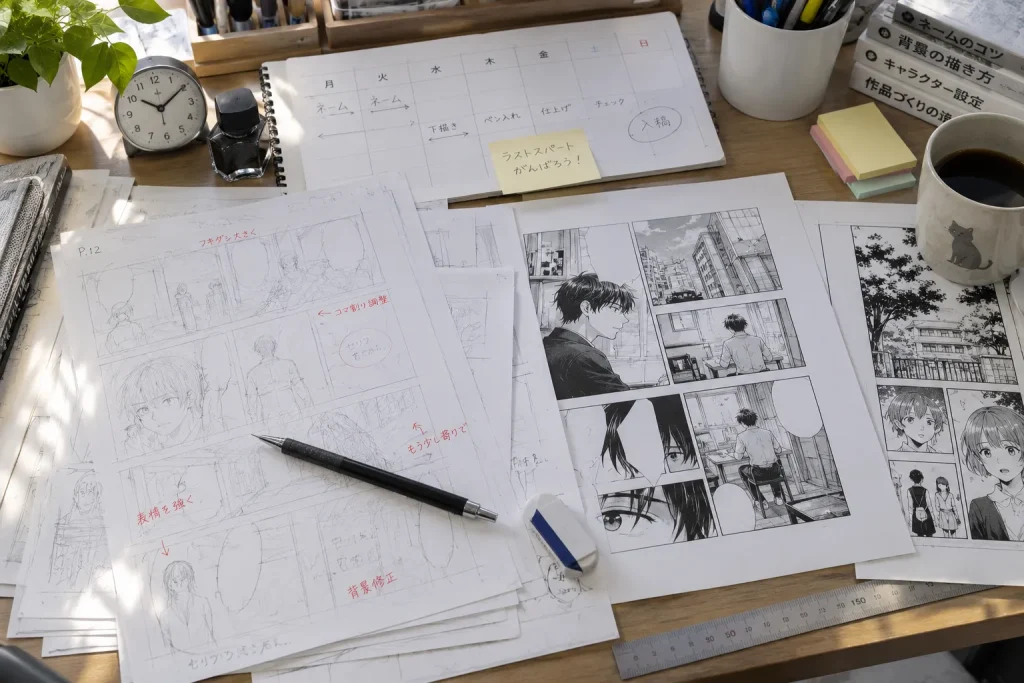
Before final art, many creators submit a ネーム nēmu, literally “name,” although here the English loanword does not mean a title or personal name. It means a rough storyboard showing panels, dialogue, action, and page turns. This is one of the moments when editing can still change the chapter without requiring finished pages to be rebuilt. The term is therefore different from what an English speaker expects. If a fictional character’s name is the issue instead, the site’s name converter covering 898 checked names in katakana serves that separate task.
Why are manga chapters published in magazines first?
A 漫画雑誌 manga zasshi, “manga magazine,” bundles chapters from many series into one recurring purchase. The reader pays for an assortment rather than gambling the full price of a book on an unknown creator. For the publisher, the anthology repeatedly exposes established readers to new work. That makes the magazine a discovery system, a deadline system, and a recognizable retail package. In that sense, manga serialization turns the anthology into a shop window.
The shop-window metaphor should not be converted into an unsupported accounting claim. Publishers generally do not release a profit-and-loss statement for each magazine title, so it is not possible to verify that every thick anthology is deliberately sold at a loss. Paper, printing, distribution, returns, editorial salaries, marketing, and advertising all affect the calculation. A ¥320 issue of Weekly Shonen Jump—about $2.08 using ¥154 to $1—clearly offers a great deal of printed material for its cover price. Low price, however, is not itself proof of a loss.
What can be shown is the larger direction of the market. Japan’s Research Institute for Publications reported an estimated comic market of ¥704.3 billion for 2024, or about $4.57 billion at the same illustrative exchange rate. Electronic comics represented ¥512.2 billion, approximately $3.33 billion, while paper collected books contributed ¥107.4 billion and printed comic magazines ¥84.7 billion. Digital comics therefore accounted for 72.7% of the measured market. The modern economic center is no longer adequately described as print volumes alone.
The magazine is where a series competes for attention; the reusable property is the series itself.
What is the difference between a chapter and a tankobon?
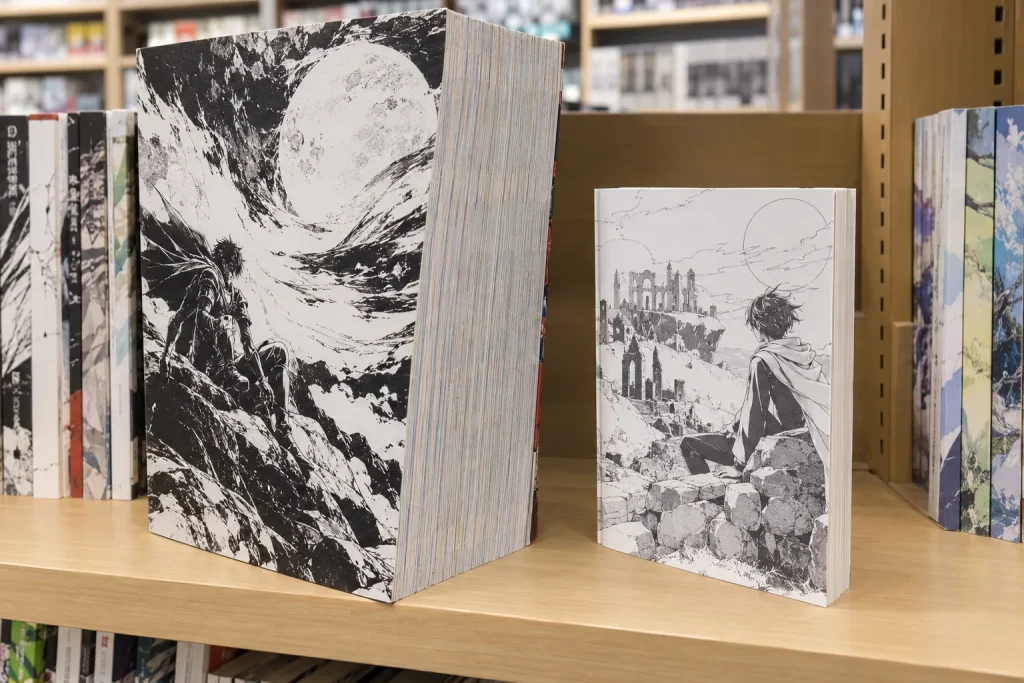
A 話 wa, “episode,” or chapter is one installment of the continuing work. A 単行本 tankōbon, literally “independent book,” collects a sequence of those chapters into a volume sold under a publishing imprint. The book may contain revised artwork, corrected dialogue, bonus pages, author comments, or material that did not appear in the serialization. It is easier to keep on a shelf and sell over time than a dated anthology issue. This is why tankobon volumes remain central even though digital editions now dominate the measured market.
A regular 2026 issue of Weekly Shonen Jump was listed at ¥320 ($2.08) on the official site when checked on September 12, 2026. A standard Jump Comics volume was commonly listed at ¥572 ($3.71), although format, imprint, and title can change the price. Comparing cover prices alone does not reveal the publisher’s margin because the two products have different page counts, paper, print runs, return risks, and production costs. It does show that the reader is asked to buy discovery cheaply and then pay again for a permanent edition. Popularity can turn the same underlying pages into several commercial products.
| Stage | What the reader receives | Main publishing function | Typical checked example |
|---|---|---|---|
| One-shot | One complete story | Tests a creator or premise | Price varies by venue |
| Magazine chapter | One installment among many | Discovery and repeat attention | Jump issue: ¥320 |
| Digital chapter | Individual or bundled access | Fast distribution and measurable use | Platform model varies |
| Collected volume | Several chapters in one book | Long-tail sale and series ownership | Jump Comics volume: about ¥572 |
| Licensed adaptation | Anime, merchandise, games, or overseas editions | Extends the property | No standard price |
How does a weekly chapter reach the printed issue?
The exact calendar is private and varies, but the workflow moves through repeatable production states. The creator and editor agree on the chapter direction, the creator prepares a rough storyboard, the editor responds, and the approved pages move toward finished art. Lettering, proofreading, page assembly, printing, and distribution follow on deadlines that cannot wait for artistic inspiration. Weekly publication compresses these decisions into an unusually tight rhythm. Monthly and digital schedules provide different amounts of time but still require delivery.
The simplified sequence looks like this:
- A chapter idea is discussed with the editor.
- The creator submits the rough nēmu storyboard.
- Story, dialogue, and page turns are revised.
- Final pages and required production materials are delivered.
- The publisher letters, checks, and assembles the issue.
- The chapter appears in print, digitally, or through both channels.
- Later chapters are prepared for a collected edition.
This sequence explains why visible publication dates are only the end of the reader-facing process. Several chapters may be at different stages simultaneously. The artist may be finishing current pages while discussing a future turn with the editor and correcting an earlier chapter for book publication. A missed deadline can affect more than one product. Serialization is therefore both storytelling and production management.
Do reader surveys really decide which manga survives?
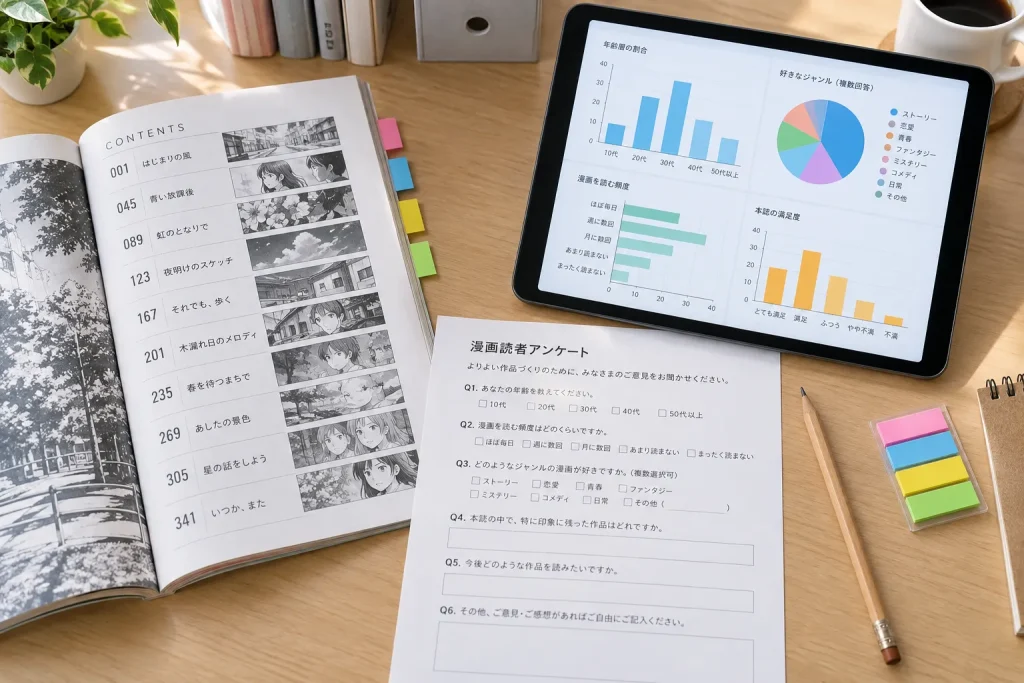
Many magazines ask readers to return questionnaires or submit digital reactions. In the Jump example, readers can indicate which works they liked, while editors also observe collected-volume sales, digital reading, audience response, growth, production reliability, and the magazine’s overall lineup. Manga reader surveys matter because they provide rapid comparative feedback. They do not operate as a public election in which the lowest series is automatically removed. Publishers do not release a complete formula that converts every response into a cancellation order.
The myth sounds believable because weekly anthologies replace weaker series and visibly promote successful ones. Fans then compare issue order, color pages, covers, and survey discussions, treating them as a live scoreboard. Those observations can identify editorial momentum, but they cannot reveal unpublished meetings or commercial forecasts. A newer series may receive protection while it develops, and an established series may move for production or editorial reasons. Different magazines also use feedback differently.
The uncomfortable fact is that buying a volume may matter more commercially than praising a chapter online. A reader can enjoy a series every week without producing enough collected-edition demand to sustain it. Conversely, a smaller but committed buying audience may support a title that rarely dominates general conversation. Surveys measure attention; purchases measure another kind of commitment. Neither number should be treated as the only one editors see.
Does chapter order reveal the cancellation list?
This is the question readers do not know to ask yet. The 掲載順 keisai-jun, “publication order,” is the sequence in which chapters appear inside an issue, and fans often interpret a late position as evidence that a series is failing. Front positions, color pages, and covers certainly give a title more visibility. Persistent movement toward the back may be concerning. It still is not an official cancellation notice.
The issue order has to serve the whole magazine. Editors balance genres, pacing, new launches, established hits, color production, absences, special events, and the reading experience of that particular issue. A comedic chapter may be placed between intense stories even if its survey performance has not changed. A new title may receive front placement as part of its launch. A manuscript or color-page deadline can also affect presentation.
| Signal readers watch | What it can reasonably indicate | What it cannot prove alone |
|---|---|---|
| Front placement | Strong promotion or editorial priority | Guaranteed long-term survival |
| Cover appearance | Marketing emphasis for that issue | Exact sales or survey rank |
| Color pages | Promotion, anniversary, or special treatment | That the creator receives reader-selected status |
| Repeated back placement | Possible weakness or reduced priority | A confirmed cancellation date |
| Volume announcement | Chapters are being collected | That serialization will continue indefinitely |
| Anime announcement | Major licensing investment | That the magazine run cannot end |
The table is useful precisely because it refuses fake precision. Fans may correctly sense that a series is in trouble while being wrong about why, when, or what will replace it. Editorial departments manage a portfolio, not a bracket tournament. The visible order is evidence of presentation, while cancellation remains a business decision. Conflating the two turns informed observation into false certainty.
Why would a promising series still be canceled?
A series occupies scarce pages, editing time, marketing space, and future publishing capacity. If it does not build an audience quickly enough, the publisher may decide that another launch has better potential. Weak survey response can contribute, as can disappointing volume sales, unclear positioning, limited growth, production problems, or a lineup that needs changing. Sometimes the creator and publisher bring the story to a shortened ending rather than stopping without resolution. Public explanations are not always detailed.
That makes manga cancellation more complicated than “readers voted no.” The magazine needs a mixture of reliable hits, developing titles, and experiments. Keeping every series indefinitely would prevent new creators from entering the schedule. Canceling quickly, however, can deny a slow-starting story the time it needs to find its shape. The system’s efficiency and its brutality come from the same limited space.
A canceled serialization is not necessarily erased. Existing chapters may still appear in collected form, a creator may publish another work, or the concept may return through a different platform. Digital services have expanded the range of viable lengths and release rhythms. They have not eliminated audience thresholds or publisher risk. Moving online changes the shelf; it does not remove the economics.
Where does the money come from after serialization?
A successful title can earn through paper volumes, digital volumes, individual digital chapters, subscription services, foreign licenses, anime rights, merchandise, games, advertising collaborations, and events. Not every series receives all of those routes, and the contractual division of revenue is not uniform. The manga magazine is therefore best understood as one part of a rights and audience system. It can introduce the work and preserve a weekly habit while other formats monetize access for longer. The valuable asset is the title’s continuing readership and intellectual property.
The 2024 market figures show why “the tankobon makes back the magazine loss” is too neat for the 2020s. Electronic comics at ¥512.2 billion were more than six times the ¥84.7 billion estimated for printed comic magazines. Paper collected books at ¥107.4 billion still exceeded printed magazine sales, but they were far smaller than electronic comics. The series may earn repeatedly without the reader buying a paper volume. Print remains culturally visible while revenue has shifted toward screens.
This shift also changes discovery. Shonen Jump+ advertises free access to original serializations and sells access to other material through points and subscriptions. The app listed more than 32 million downloads in its official store description when checked in September 2026. A free chapter can now act as the shop window previously supplied mainly by an inexpensive anthology. The economic logic survives even when the paper disappears.
Does every manga follow the magazine-to-volume route?
No. Some works begin on publisher websites or apps, some are adapted from novels, and others appear through creator-controlled platforms before a company edition exists. How Web Novels Took Over the Season explains one important route from online fiction to manga and anime. Digital platforms can publish at different intervals, measure reading behavior directly, and support formats that do not resemble a weekly print chapter. The collected volume may arrive later, but it is no longer always the second step.
Target readership also changes the route. 少年漫画 shōnen manga, “boys’ comics,” 少女漫画 shōjo manga, “girls’ comics,” 青年漫画 seinen manga, “young-men’s comics,” and 女性漫画 josei manga, “women’s comics,” are publishing-market categories rather than biological rules about who may read them. Weekly, monthly, and digital venues build different expectations about pacing and length. The American bookstore shelf often removes this original magazine context. Two similar-looking paperbacks may therefore come from very different production systems.
When does manga become anime?
An anime adaptation is a licensing and production decision, not the automatic graduation ceremony for a successful manga. Producers consider audience size, financing, broadcaster or platform needs, merchandise potential, available studios, schedules, and whether the material can support an adaptation. A continuing manga provides recognition and promotional momentum, but publication alone promises nothing. Some popular manga wait years or never receive animation. Some anime originate from novels, games, or original projects instead.
Adaptation can also send readers back to existing volumes, increasing the value of a backlist. That feedback loop is one reason the publishing sequence matters beyond the original magazine. Anime viewers encounter voices and performances that were absent from the printed page. Japanese Honorifics in Anime: -san, -kun, -chan and the Rest explains relationship markers, while Anime Speech Styles, and What Subtitles Cannot Carry covers character language. Those articles handle linguistic details rather than repeating the publishing economics here.
A viewer trying to study through dialogue also needs a separate warning. What Anime Teaches and What It Quietly Skips explains why stylized character speech can help listening without serving as a complete speaking model. That is the next layer after production: how the adapted work changes when it reaches another medium. The original manga remains a visual text organized by panels and page turns. Voice, timing, music, and motion create a different product.
What should I learn next?
Start with the physical object: chapter, anthology, collected volume, and digital edition. Then learn how Japanese page direction and book formats affect the act of reading through Manga Reading Order: Direction, Formats and Where to Start. After that, follow the work into adaptation and compare what print cannot carry with what subtitles cannot preserve. The publishing chain becomes easier to understand when each stage is treated as a different product. The weekly magazine is the beginning of the commercial test, not the final form.
FAQ
Does every manga begin as a one-shot?
No. A one-shot is a common test and entry route, but manga may also begin through competitions, direct proposals, adaptations, web publication, or other editorial arrangements. Publishers and magazines use different development systems. A successful one-shot does not guarantee serialization. It provides evidence that the creator can complete and communicate a story.
Are manga magazines really sold at a loss?
Public evidence does not support that claim for every magazine. A low cover price and large page count suggest that the anthology prioritizes reach and repeat purchasing, but they do not reveal title-level profitability. Advertising, circulation, returns, production costs, and digital subscriptions affect the calculation. Publishers generally do not publish a separate profit statement for each issue. The safer description is that magazines function as discovery and serialization platforms.
Do reader polls cancel manga?
Reader feedback can influence editorial decisions, particularly at publications known for frequent audience surveys. It is not the only input, and no verified public formula makes the lowest survey result an automatic cancellation. Volume sales, digital performance, growth, production reliability, and lineup needs may also matter. The editor and publisher make the final decision. Fans should treat polls as a signal rather than a mechanical vote.
Is a manga at the back of the magazine about to end?
Not necessarily. Repeated back placement can suggest weak editorial momentum, but issue order also reflects pacing, promotion, color pages, new launches, and production conditions. A single position proves very little. Several issues may reveal a pattern without identifying its cause. Only an official announcement confirms the ending.
Is the tankobon still where manga makes most of its money?
Collected editions remain important, but “tankobon” should not be understood as paper only. Electronic comics accounted for 72.7% of Japan’s measured comic market in 2024. Paper collected books still exceeded printed comic magazines in estimated sales, but digital comics were much larger than both. Licensing and adaptation can create additional income that market-format totals do not fully explain. The economic center now spans books, screens, and rights.