Two Tokyo Airports, Two Very Different Rides
You are through customs, your phone has service, and Tokyo expects you to make one immediate decision: train, monorail, or bus. At Haneda, that choice can cost ¥330–¥520, about $2.15–$3.38, and put you at a major city station in roughly 13–15 minutes. At Narita, the comparable ride takes about an hour and costs ¥1,500, about $9.75, by bus or ¥3,140, about $20.41, on the Narita Express.
That is the useful narita vs haneda comparison. Haneda gets you to Shinagawa or Hamamatsuchō quickly; Narita is much farther out and charges accordingly. The airfare shown on the booking screen is therefore not the final comparison.
Dollar equivalents throughout this article use ¥153.81 to $1, the Bank of Japan’s central spot rate at 5 p.m. JST on September 8, 2026. Your card issuer’s rate and fees may produce a different total.
Narita vs Haneda in one honest table
The headline comparison needs one qualification. Haneda’s famous 15-minute figure gets you to Shinagawa on Keikyu or Hamamatsuchō on the Tokyo Monorail—not all the way to Tokyo Station, Shinjuku, or your hotel. Narita’s bus and Narita Express figures below refer to Tokyo Station, so they are not perfectly identical journeys.
Even with that caveat, the gap is substantial. Haneda places you inside Tokyo’s urban rail system quickly, while Narita begins with a longer airport transfer.
| Airport and route | Destination | Adult fare | Approx. USD | Fastest stated time | Reservation |
|---|---|---|---|---|---|
| Haneda Terminal 3, Keikyu | Shinagawa | ¥330 | $2.15 | 11–14 minutes | Not required |
| Haneda Terminal 3, Tokyo Monorail | Hamamatsuchō | ¥520 | $3.38 | 13 minutes | Not required |
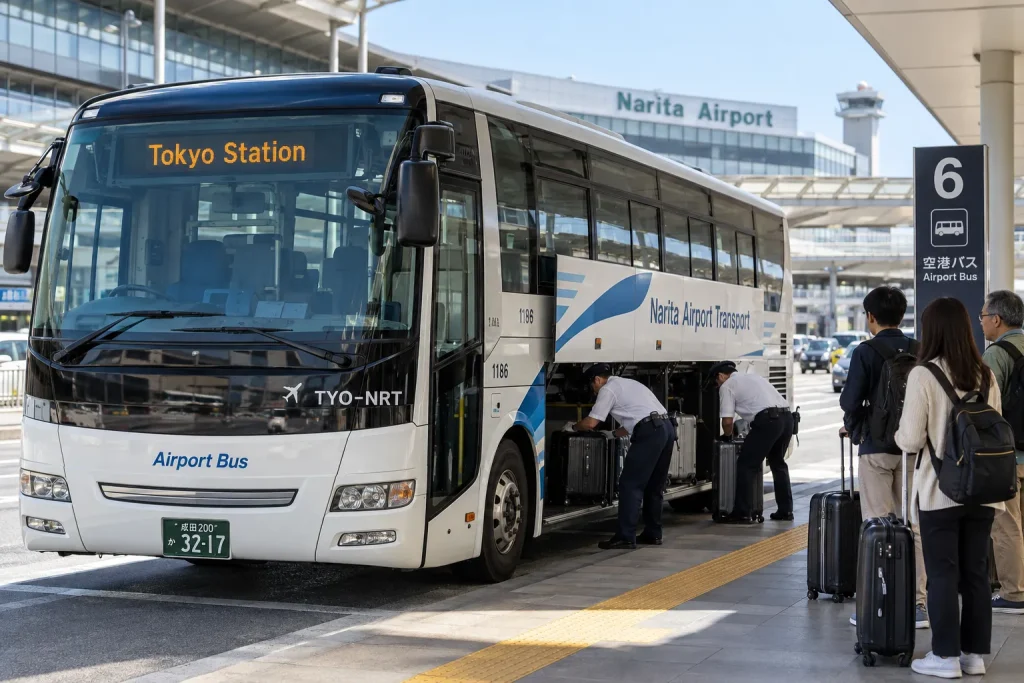
| Narita, TYO-NRT bus | Tokyo Station | ¥1,500 | $9.75 | 65 minutes | Not required from the airport |
| Narita, N’EX ordinary reserved seat | Tokyo Station | ¥3,140 | $20.41 | 53 minutes | Required |
JR East lists a standard Narita–Tokyo round trip at ¥6,280, making the current one-way ordinary-car fare ¥3,140. The often-quoted ¥3,070 price is outdated as of this check. Foreign visitors making the return journey within 14 days can instead buy the N’EX TOKYO Round Trip Ticket for ¥5,200, about $33.81.
“The fastest train from Narita Airport Station to Tōkyō Station takes just 53 minutes!” — JR East
The low-cost TYO-NRT bus is also no longer ¥1,300. Its current regular adult fare is ¥1,500, while designated late-night and early-morning services cost ¥3,000, about $19.50.
For the larger flight-booking sequence, read Flights, Airports and the First Two Hours. It covers the US departure side and explains why the airport decision belongs inside the airfare comparison, not after it.
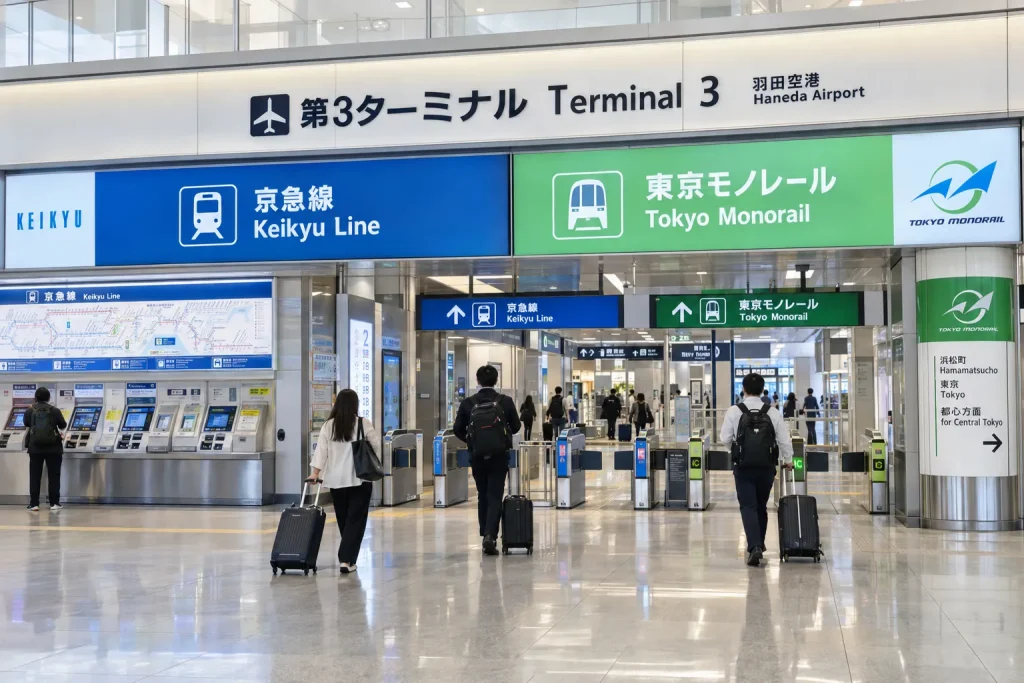
Follow this sequence after landing
The Tokyo airport transfer is manageable when you decide the route before reaching the ticket machine. This is the order I use after an international arrival.
- Check the airport code before leaving baggage claim.
Look at your boarding pass or arrival screen for HND or NRT. HND means Haneda; NRT means Narita. What happens next depends more on that code than on the word “Tokyo” printed beside it. - Identify your first useful station.
Do not type only “Tokyo” into a route planner. Use your hotel’s nearest station. Shinagawa favors Keikyu from Haneda, Hamamatsuchō favors the monorail, Tokyo Station favors the TYO-NRT bus or N’EX, and Ueno may make a Keisei service more useful than either Narita option compared here. - Compare the whole journey, not the airport leg.
A ¥330 ride to Shinagawa is excellent if your hotel is nearby. It is only the first fare if you still need another train. Your route screen should show the airport terminal, transfer stations, final station, fare, and expected arrival time. - Choose for your luggage, not your pride.
A local train is cheap, but you may stand with your suitcase during commuter hours. The N’EX has reserved seating and luggage areas. The bus keeps large bags underneath, although road traffic can make its arrival time less predictable. - Buy the correct ticket.
At Haneda, use an IC card or buy a regular rail ticket. At Narita, buy an assigned seat before boarding the N’EX. For the TYO-NRT bus, follow the terminal signs to the low-cost bus counter or stop; the last departing bus may require payment on board by cash or a transportation IC card. - Check the destination displayed on the vehicle.
Haneda’s Keikyu trains continue onto different lines, and not every departure follows the same pattern. At Narita, confirm Tokyo Station rather than assuming every airport bus serves the same stop. Platform displays use English as well as Japanese. - Keep the ticket accessible.
You may need it at the exit gate, and an N’EX conductor can check the reserved-seat information. Do not bury it in the suitcase you have just placed in the luggage area. - Recalculate if you miss the last convenient service.
Published timetables change, and neither airport’s rail system should be treated as a 24-hour service. If you land late, check the operator’s live timetable before joining a ticket line. A hotel near the airport may be cheaper than an unplanned taxi.
The site’s phrasebook with 337 phrases sorted by situation is useful if you need to ask whether a train stops at your station. You will rarely need it at an airport machine, but it earns its place when a disruption sends you to a staffed counter.
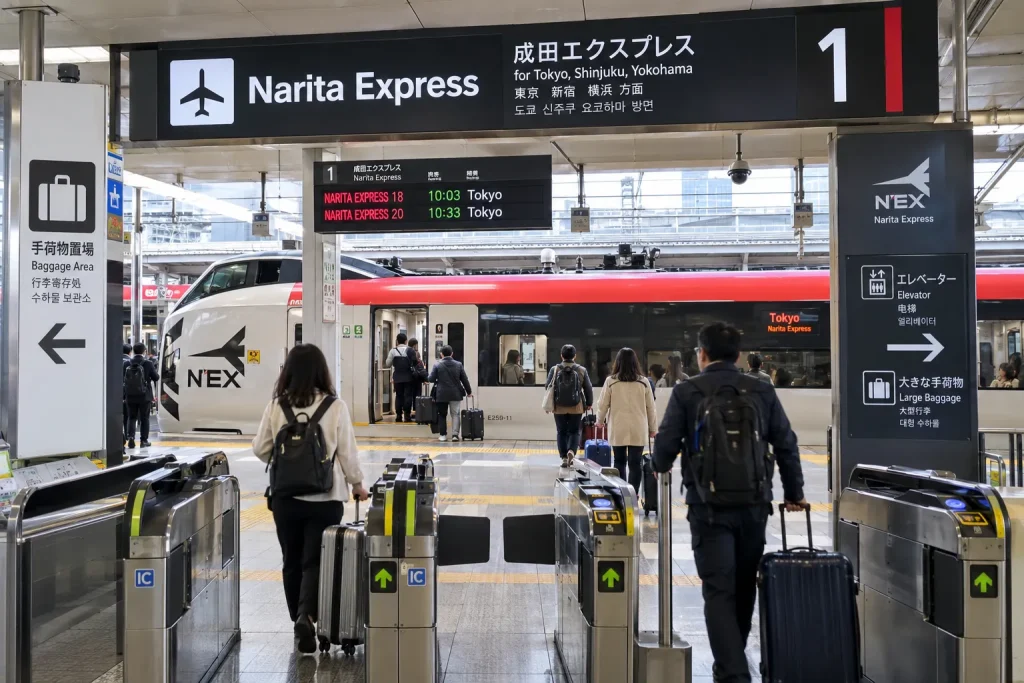
Where first-time arrivals lose time
The first stall happens at the word “Tokyo.” Tokyo Station is one station; central Tokyo is a large collection of districts and transport hubs. The cheapest Haneda Airport to Tokyo route may be a poor choice if it leaves you on the wrong side of the city.
The second stall is treating the N’EX as the automatic Narita train. It is comfortable and direct, but ¥3,140, about $20.41, is more than twice the ¥1,500, about $9.75, TYO-NRT bus fare. Pay the difference when the reserved seat, predictable rail journey, or onward JR connection solves a real problem.
The third stall is buying a nationwide rail pass to cover one airport ride. A pass may include the N’EX, but that does not make the pass economical. Is the Japan Rail Pass Worth It in 2026? shows how to total the long-distance journeys first rather than using airport transport to justify an expensive pass.
The fourth stall is trusting a fare quoted by an old article. The Narita Express price has moved to ¥3,140 for Narita–Tokyo, and the official tourist round-trip ticket now costs ¥5,200. The TYO-NRT bus is ¥1,500 rather than the ¥1,300 figure still repeated in older comparisons.
“Fast, affordable, and convenient.” — Airport Bus TYO-NRT
When the cheaper flight stops being cheaper
The transfer gap does not erase every Narita airfare discount. It erases small discounts, especially when you use the N’EX in both directions. The correct calculation is airfare plus the round-trip ground transfer for each traveler.
| Round-trip airport transfer | Total per adult | Approx. USD | Extra over Haneda monorail |
|---|---|---|---|
| Haneda monorail both ways | ¥1,040 | $6.76 | — |
| Narita TYO-NRT bus both ways | ¥3,000 | $19.50 | ¥1,960 / $12.74 |
| Narita N’EX tourist round trip | ¥5,200 | $33.81 | ¥4,160 / $27.05 |
| Narita N’EX standard fares both ways | ¥6,280 | $40.83 | ¥5,240 / $34.07 |
A Narita flight that saves $10 per passenger is not cheaper once you add a round-trip bus instead of the Haneda monorail. A $25 airfare saving survives the bus comparison but is effectively consumed by the N’EX tourist ticket. A $40 saving still leaves Narita ahead on cash, although you also accept a longer transfer.
For two adults, the airport-transfer difference doubles. Choosing standard N’EX tickets instead of the Haneda monorail adds ¥10,480, about $68.13, to the trip. Add the value of roughly two extra hours of combined airport travel on arrival and departure, and a modest Narita fare discount can become a bad trade.
The uncomfortable part is simple: a flight is not cheap merely because the airline portion costs less.
This calculation should happen before payment. Planning a First Trip to Japan: The Order That Works explains which decisions to lock in first and which purchases can wait.
The route changes with your hotel and arrival
There is no universal best Tokyo airport because the final address matters. Haneda is normally the easier choice for southern and central Tokyo, but a Narita flight can still win when its schedule, nonstop routing, or airfare advantage is large enough.
For Shinagawa, Keikyu from Haneda is the obvious baseline: ¥330, about $2.15, and as little as 11 minutes on the fastest listed service. For Hamamatsuchō, the Tokyo Monorail costs ¥520, about $3.38, and takes as little as 13 minutes from Terminal 3.
For Tokyo Station, the Narita bus is the budget reference at ¥1,500, about $9.75, with a fastest stated time of 65 minutes. The N’EX costs more but avoids road traffic and provides an assigned seat. For Shinjuku or Shibuya, compare the direct N’EX with the complete Haneda route, including the transfer and second fare.
Season changes crowding rather than the basic procedure. During major Japanese travel periods, reserved trains and airport buses can become busier. Bad weather can disrupt either road or rail services, so use the live operator information rather than a screenshot saved months earlier.
Late arrival changes the decision most sharply. Train and bus departures thin out at night, immigration can take an unpredictable amount of time, and a scheduled landing time is not a station-entry time. Check the dated timetable for your actual terminal shortly before departure from the United States.
What nobody at the station cares about
Nobody minds if you stand in front of the route map for a minute. Nobody expects a newly arrived visitor to understand every through-service train. Move away from the gate while checking your phone, keep the walking lane open, and take the time you need.
Nobody cares whether you use a paper ticket or an IC card. Both are ordinary. A paper ticket is not a tourist mistake, and buying one from an English-language machine will not slow anyone down if you step aside before organizing your wallet.
Nobody is offended when you ask whether a train goes to Shinagawa or Tokyo. Show the station name on your phone if pronunciation fails. The useful Japanese word is すみません, sumimasen, literally “excuse me,” but English and a visible destination are normally enough at an international airport.
Nobody expects you to choose the absolute fastest route. A seated bus that leaves you beside your hotel may be better than a train that saves several minutes and adds a difficult transfer. The only costly mistake is deciding without checking the full route.
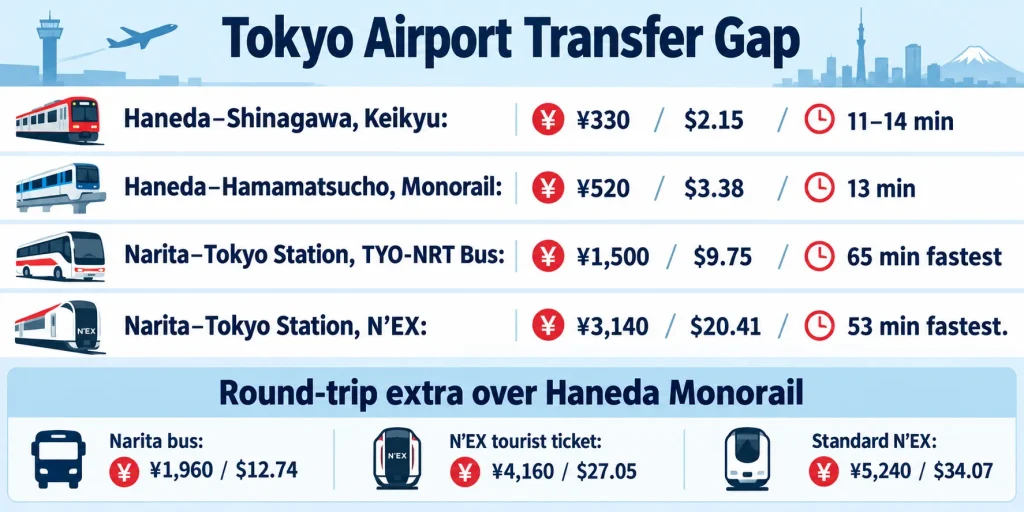
Tokyo airport transfer at a glance
The central comparison is not Haneda good, Narita bad. It is short urban connection versus long regional transfer. Narita can still be the right airport, but its airfare needs to beat the transfer penalty.
FAQ
Is Haneda always better than Narita?
No. Haneda usually offers the cheaper and shorter transfer into Tokyo, but Narita may have a better nonstop flight, arrival time, or airfare. Compare the complete cost from your US airport to your hotel.
How much cheaper must a Narita flight be?
Against a round-trip Haneda monorail journey, Narita adds about $12.74 per adult by TYO-NRT bus, $27.05 with the N’EX tourist round-trip ticket, or $34.07 using two standard N’EX fares. The airfare saving should exceed that amount before Narita wins on cash alone.
Is the Narita bus still ¥1,300?
No. The official TYO-NRT regular adult fare checked on September 9, 2026, is ¥1,500, about $9.75. Late-night and early-morning services are ¥3,000, about $19.50.
Is the Narita Express still ¥3,070?
No. JR East’s current fare table shows ¥6,280 for an ordinary-car round trip between Narita and Tokyo, or ¥3,140 each way. Eligible foreign visitors can buy the ¥5,200 N’EX TOKYO Round Trip Ticket for travel completed within 14 days.
Do I need to reserve airport trains?
Keikyu and Tokyo Monorail services from Haneda do not require reservations. N’EX seats are reserved. The TYO-NRT bus generally works without an advance reservation from Narita, although boarding procedures vary by stop and departure.
What is the shortest possible version?
- Check HND or NRT.
- Enter your hotel station.
- Compare total fare.
- Choose for luggage.
- Confirm the destination.