Is the Western year rejected on Japanese forms? Sometimes—but there is no nationwide rule requiring every agency to use an era year, and the field in front of you matters more than the institution’s reputation.
For readers searching wareki official documents Japan, the useful distinction is not “official versus unofficial.” It is required format, accepted alternative, or customary display.
What is wareki?
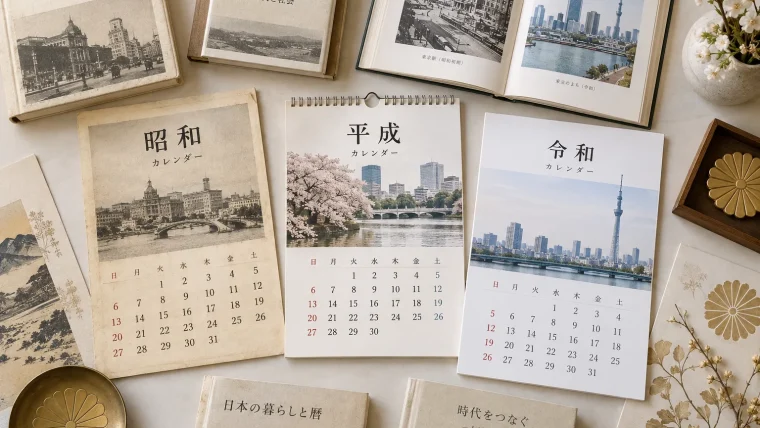
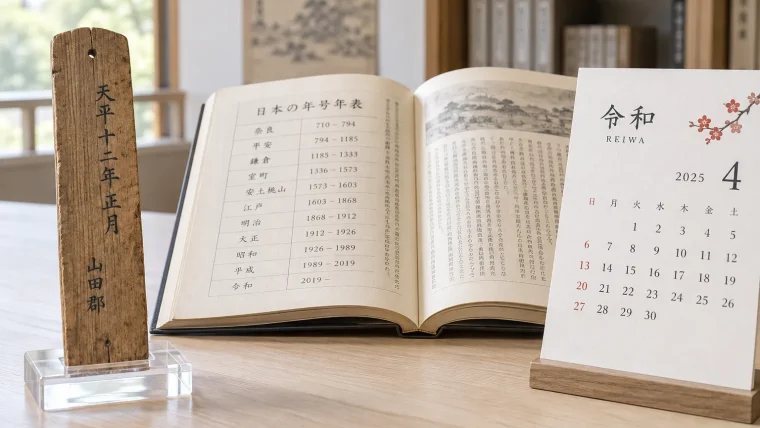
和暦, wareki, literally “Japanese calendar,” numbers a year within an imperial era. The present era is 令和, Reiwa, literally “beautiful harmony,” which began on May 1, 2019, under Cabinet Order No. 143 of 2019.
Why does Japan use era years and Western years at the same time?
Both systems are part of ordinary administration. Laws, notices, certificates, and forms frequently carry Japanese era years, while passports, residence cards, international systems, and many digital services use the Gregorian calendar.
This is not a contest between tradition and modernity. It is an interoperability problem: a date must match the field, database, and identity document being used.
Which wareki official documents in Japan still require era years?
No honest answer is simply “government documents.” Checked against agency materials on September 13, 2026, the landscape looks like this:
| Institution or document | What the published material shows | Practical classification |
|---|---|---|
| Family register, 戸籍, koseki, “family register” | Ministry of Justice examples record dates in era notation | Era format is part of the record and certificate design |
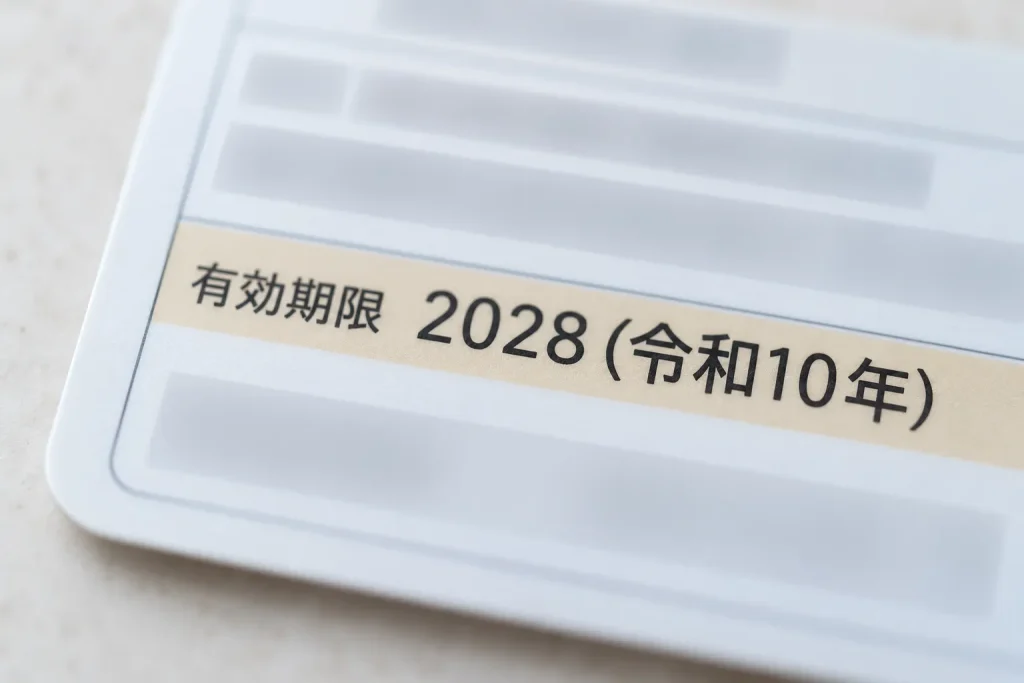
| Driver’s license | Expiration has shown Gregorian year followed by era year since May 1, 2019; older cards may show future Heisei dates | Mixed display, not era-only |
| National tax forms | Current forms and instructions are issued by tax year and may print era-based date fields | Form-specific; follow that year’s NTA form |
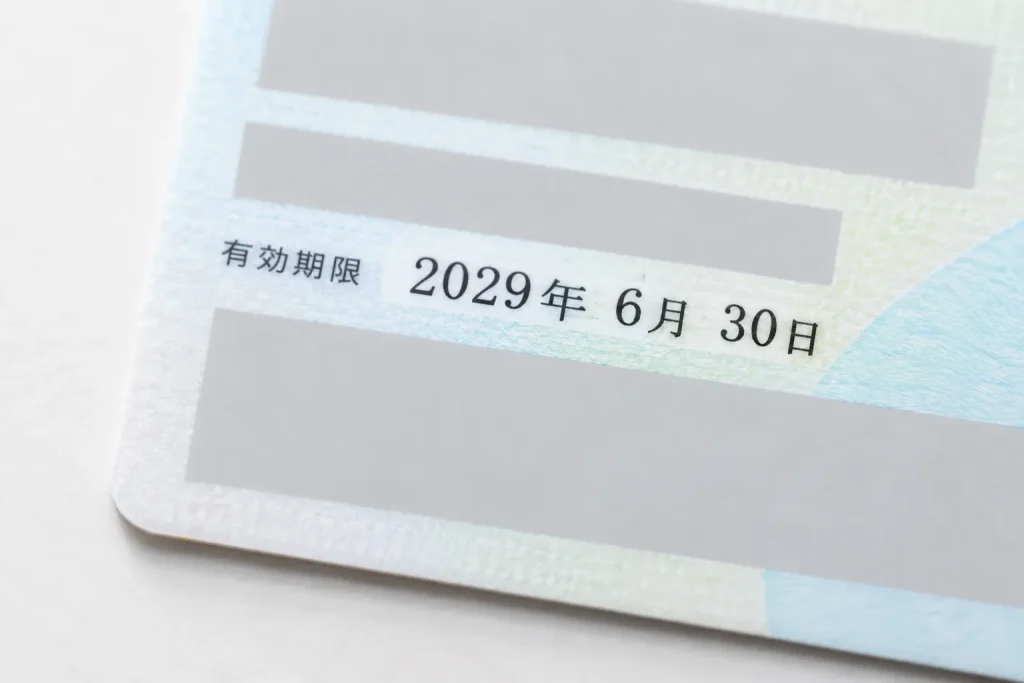
| Residence card, 在留カード, zairyu kādo, “residence card” | Immigration Services Agency samples display dates in Western years | Gregorian display |
| Pension and municipal forms | Formats vary by procedure and may offer an era selector | Form-specific, not a universal legal rule |
| Banks, clinics, employers | Era boxes may remain in private paperwork or software | Practice, not proof of a government mandate |
That middle column is the uncomfortable answer. Japanese official documents do not share one date standard, and a clerk’s preference does not create a law.
For the calendar system itself, Japanese Era Years: Meiji to Reiwa, Explained covers the eras without repeating this institution map. For a lookup rather than an explanation, Showa, Heisei and Reiwa Year Tables gives the paired years.
Does my Japanese driver’s license have to use an era year?
Not exclusively. The National Police Agency changed the expiration field on licenses issued from May 1, 2019, so the Gregorian year appears first and the era year follows in parentheses.
“The expiration date shows the era year in parentheses after the Western year.”
Other fields retained era notation because the agency said card space made a complete dual display difficult. A license reading 平成36年, Heisei sanjūroku-nen, “Heisei year 36,” did not become invalid merely because Heisei ended: police guidance equates that notional year with 2024. The card’s stated expiration remained controlling.
Do Japanese tax forms require wareki?
The National Tax Agency publishes forms for a particular filing year, often identified by a Reiwa year, and individual date fields may be designed around era notation. That does not support the broader claim that every tax date must always be converted.
Use the current form and its instructions from the NTA. If a tax field, electronic submission, or deadline is unclear, confirm it with the tax office named by the agency; this article cannot determine which entry a particular filing accepts. Rules and interfaces change, and this section was checked September 13, 2026.
What about residence cards and immigration forms?
This is where the “all Japanese government paperwork uses wareki” claim fails cleanly. Immigration Services Agency materials show residence-card dates in Gregorian form, so copying the date as printed is safer than converting it from memory.
An application form can still have its own instructions. For immigration procedures, use the current Immigration Services Agency page or contact the Foreign Residents Information Center identified by the agency rather than assuming that a municipal or tax-office convention applies.
How do I fill in a Japanese era date without guessing?
First read the labels. 西暦, seireki, literally “Western calendar,” asks for a Gregorian year; 元号, gengō, “era name,” or a row of era names asks you to select an era. 年, 月, and 日 mean year, month, and day.
Then reproduce the date openly:
| Source date | Conversion | Entry |
|---|---|---|
| April 15, 1990 | 1990 − 1988 = 2 | 平成2年4月15日 |
| April 30, 2019 | Last day of Heisei | 平成31年4月30日 |
| May 1, 2019 | First day of Reiwa | 令和元年5月1日 |
| October 21, 2026 | 2026 − 2018 = 8 | 令和8年10月21日 |
The arithmetic is a check, not the authority. A transition-year date must be compared with the actual accession boundary; The Four Japanese Years That Belong to Two Eras handles those dates, while the Japanese era converter covers every year from 1868 through 2050 across five eras.
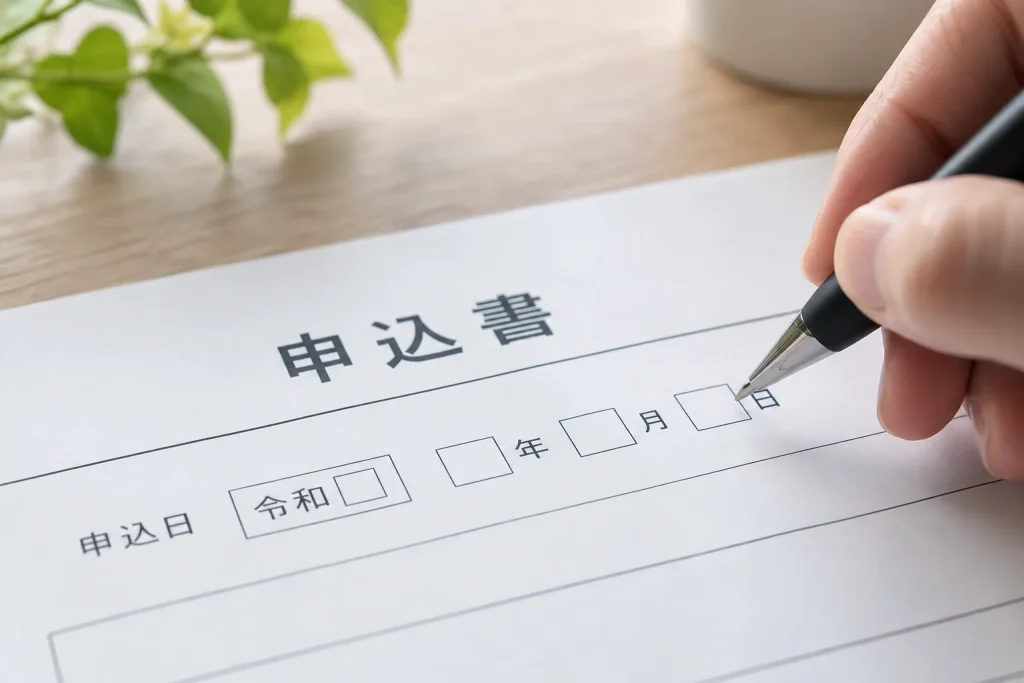
If the box is too short for four digits, stop before squeezing in 2026. The layout may be expecting 8 after 令和, but the form’s legend or instructions decide.
Can I write the Western year if the form prints an era box?
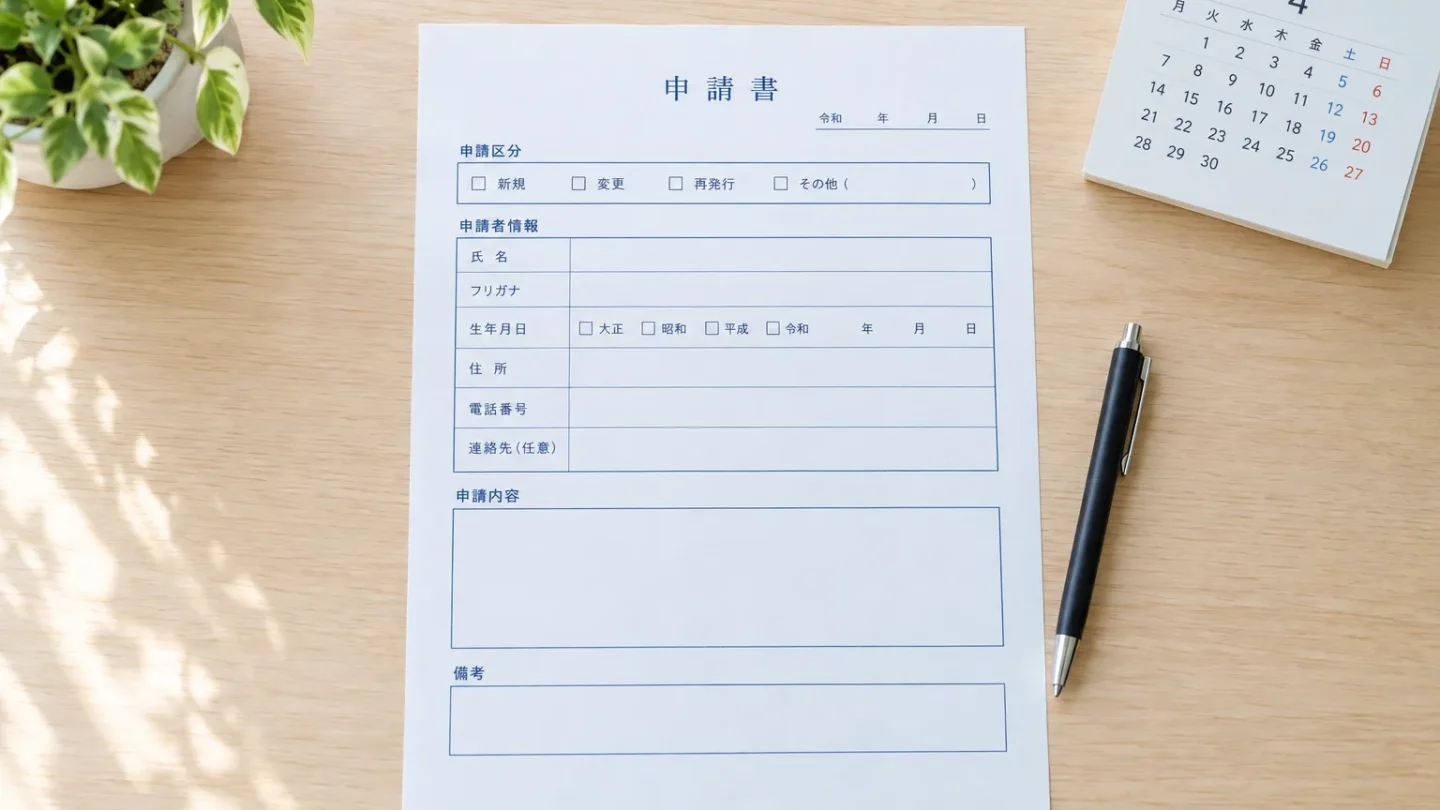
Do not treat a blank paper field as permission to redesign it. If 令和 is preprinted, a Western year may be rejected because it creates an ambiguous or impossible date; “2026” after 令和 would read as Reiwa 2026.
If the form offers 西暦・和暦, circle or select the system you use. If it gives no choice, ask the receiving office which format it accepts. A useful sentence is Seireki de kaite mo ii desu ka?—“May I write it in the Western calendar?”
The site’s phrasebook contains 337 phrases for everyday situations; use it as a language aid, not as a substitute for an agency’s procedural instructions.
What if the website rejects a correct date? — the question you did not know to ask
A mathematically correct wareki date conversion can still fail. Legacy software may require a two-digit era year, an era code selected elsewhere, full-width numerals, or a date inside the system’s permitted range.
That is a data-entry constraint, not evidence that your birthday changed. Compare the screen with the relevant identity document, keep the error wording, and contact the agency operating the service. Do not invent an era year merely to pass validation.
Culture pages sometimes make era names feel universal because they remain visible in nostalgia and public memory. Japanese Teenagers Are Nostalgic for 1998 explains that cultural afterlife; Why Japan Renames Its Emperors After Death separates an emperor’s personal name, era name, and posthumous name.
How can I tell whether wareki is law, habit, or software?
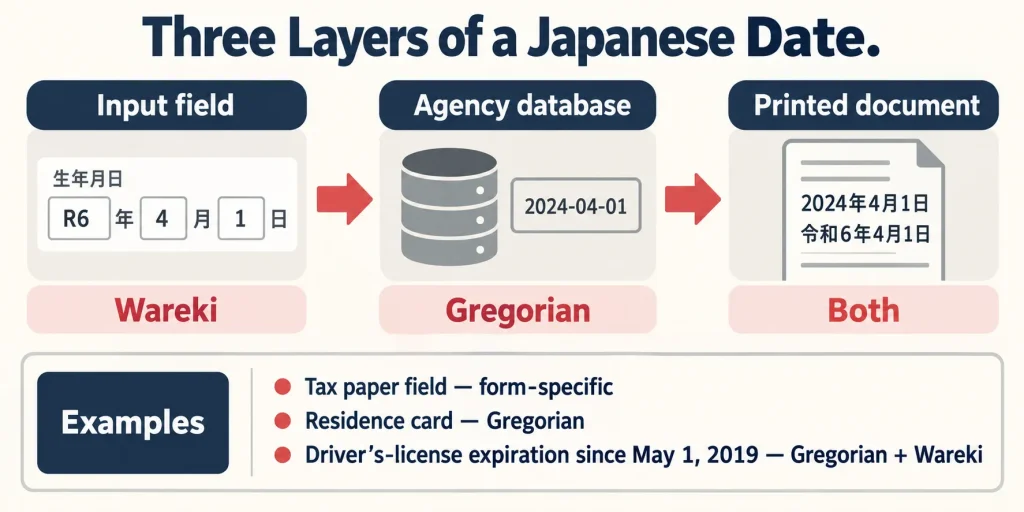
Ask three different questions: Does a statute or agency instruction prescribe the format? Does this edition of the form print an era field? Does the receiving system accept another format? Only the first is a legal claim; the other two describe implementation.
| Signal you see | What it establishes | What it does not establish |
|---|---|---|
| Era name preprinted beside a box | This form expects an era-year number | Every form at that institution does |
| Certificate displays wareki | The issuing record uses wareki | Your separate application must use it |
| Clerk asks for Reiwa | The office wants that entry now | A national statute bans Gregorian dates |
| Website accepts four-digit year | That interface accepts Gregorian input | The resulting certificate prints Gregorian dates |
This distinction is the center of Japanese government forms: display, input, and underlying record may use different formats. When the consequence affects tax or immigration status, rely on the responsible agency’s current form, instructions, and contact channel.
A document’s heading can also mislead you. An agency may identify a form as the “Reiwa 8 edition” because it was issued for 2026, while allowing Gregorian dates inside some of its fields. Conversely, an online service may accept a four-digit Western year and later produce a certificate that displays the same date in wareki. The calendar used in the title, the calendar accepted during data entry, and the calendar printed on the final document are therefore separate questions. You should check each stage instead of treating the first era name you see as the rule for the entire procedure.
Foreign residents should pay particular attention when several documents are submitted together. A passport or residence card may show a birth date in Gregorian form, while an accompanying municipal form provides boxes for an era name and era year. That difference does not necessarily mean that the records conflict; it may reflect two interfaces representing the same date. Enter the format requested by each document and keep the underlying year, month, and day consistent across the application. If an agency’s instructions do not explain how to convert or transcribe the date, confirm the entry with that agency before submitting paperwork that affects tax, immigration, licensing, or benefits.
What should I learn next?
Memorize 元号, gengō, “era name,” 西暦, seireki, “Western calendar,” and the current-era label 令和. Then learn how to read a date on a Japanese document, which covers the order of year, month, and day rather than repeating this institutional guide.
The rule worth carrying to the counter is simple: read the field, copy the source document, and verify uncertainty with the agency that receives the form.