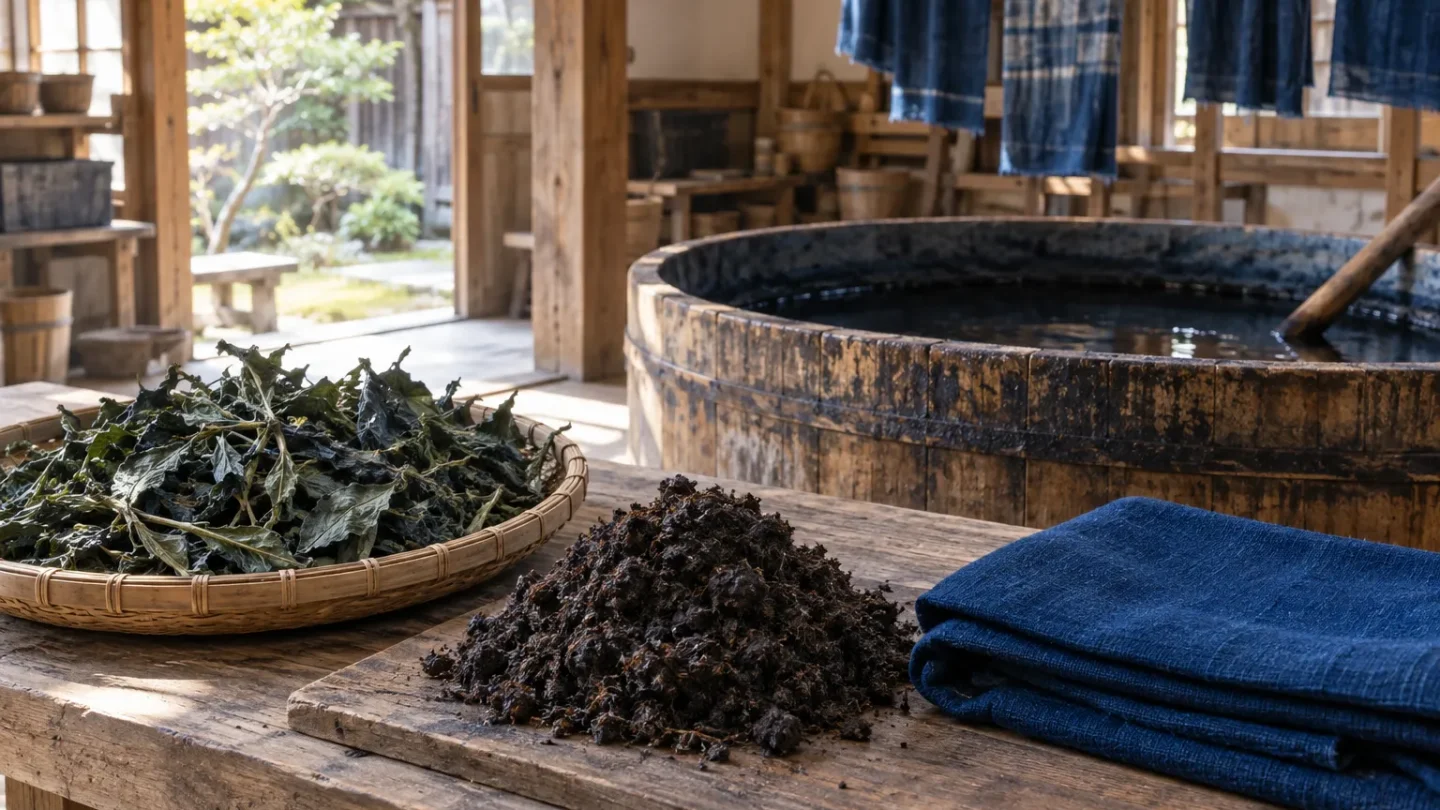
“Japanese indigo is simply plant dye” is the claim repeated most often, and it is misleading. Japanese indigo dyeing requires months of microbial work because its pigment does not dissolve in water on its own. Leaves first become 藍蒅/すくも, sukumo, fermented indigo-leaf compost, which is reduced in an alkaline vat. Cloth then leaves the liquid and meets oxygen. The color appears quickly; its preparation does not.
Is Japanese indigo dyeing just cloth dipped in blue liquid?
MOSTLY FALSE — the aizome process begins long before the dipping vat.
藍染め/あいぞめ, aizome, “indigo dyeing,” names a practice, not one recipe. Tokushima’s chain begins with 蓼藍/たであい, tadeai, Japanese indigo, or Persicaria tinctoria. Growers dry the harvest and separate its leaves. Composting turns them into sukumo, not a ready-made blue bath. That distinction matters when retailers use “natural indigo” and “Japanese blue” loosely.
The distinction between a recognized craft and a craft-style product is covered in The Law, the Mark, and the Price Difference. This article follows the material instead. A Japanese-made blue object need not use Tokushima sukumo. A natural-indigo object need not follow one protected specification. Only the maker’s process description identifies the chain.
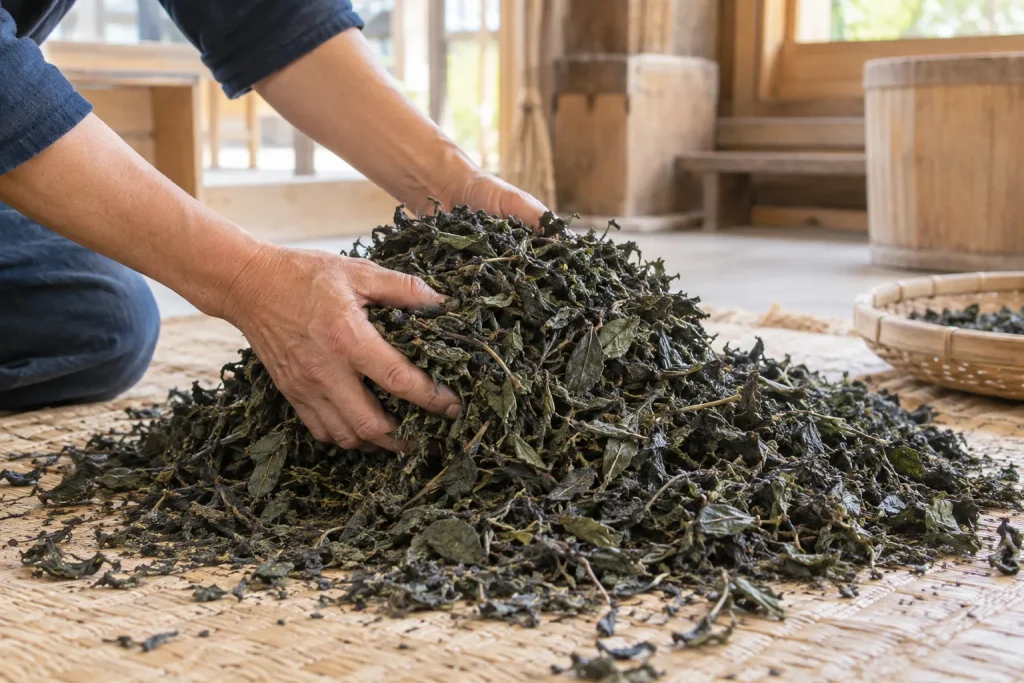
Does making sukumo really take about one hundred days?
MOSTLY TRUE — sukumo production takes roughly one hundred days.
Tokushima Prefecture describes Awa indigo as becoming ready after about one hundred days. Dried leaves are piled indoors, moistened and repeatedly turned so heat and microorganisms can transform them. This is controlled composting rather than storage: moisture, temperature, airflow and the condition of the leaves have to be judged throughout the batch. Japan’s national tourism organization describes the resulting material as resting for approximately three months, while Tokushima’s account summarizes the working cycle as about one hundred days. Those descriptions differ in emphasis, but both place the preparation on the scale of months rather than days.
“It takes 100 days to be ready as Awa indigo.” — Tokushima Prefecture
The specialist who makes this material is 藍師/あいし, aishi, literally “indigo master.” The title particularly concerns producing indigo and sukumo, not every dyer. Crop and composting calendars make the work seasonal. A failed batch cannot be replaced immediately. The hundred-day cycle is a production bottleneck, not romantic branding.
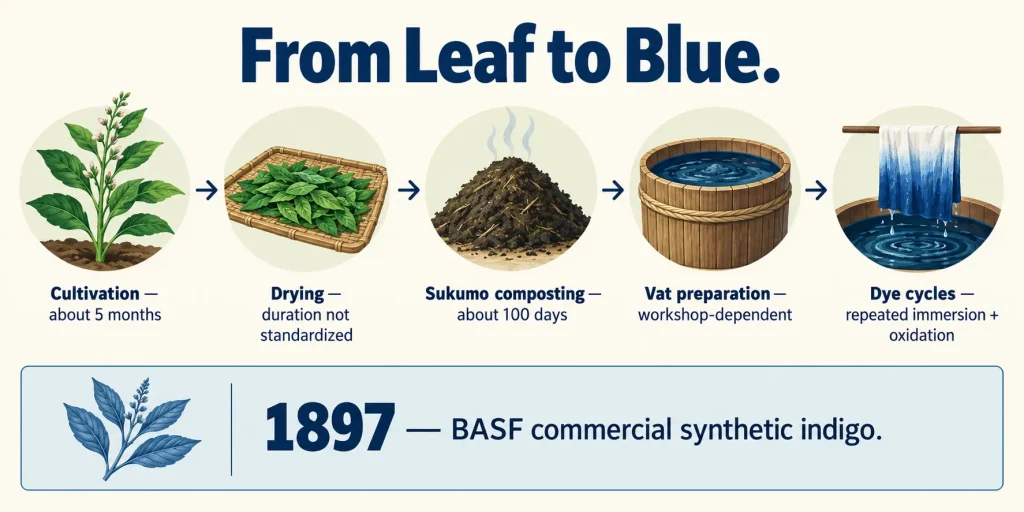
| Stage | Material entering | What happens | Published time |
|---|---|---|---|
| Cultivation | Seed and growing plant | Japanese indigo produces leaf biomass | About five months, JNTO |
| Drying and separation | Harvested plant | Leaves are dried and separated from stems | No universal duration verified |
| Sukumo making | Dried leaves | Leaves are watered, piled and turned during composting | About one hundred days, Tokushima Prefecture |
| Vat preparation | Sukumo and alkaline ingredients | Insoluble pigment is reduced into a soluble form | Varies by workshop |
| Dyeing | Prepared cloth | Repeated immersion and oxidation build color | Depends on fiber and target shade |
Is the indigo vat literally alive?
MOSTLY TRUE — an indigo fermentation vat is biologically active.
“Alive” is workshop shorthand, not mysticism. In 藍建て/あいだて, aidate, literally “building the indigo vat,” microorganisms operate in warm, alkaline, low-oxygen conditions and reduce indigo into a soluble form that can enter the fiber. The dyer manages an environment rather than merely mixing pigment with water. Temperature, alkalinity, smell, surface behavior and dyeing strength provide evidence about the vat’s condition. Different lineages use different ingredients and schedules, so there is no responsible universal feeding timetable.
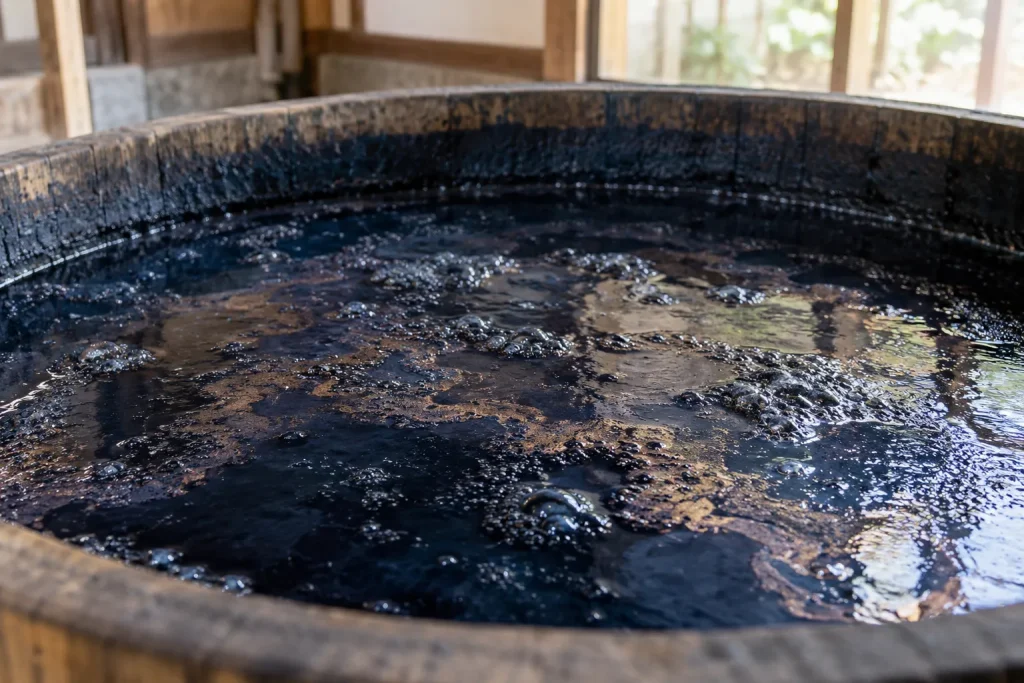
Do dyers really have to feed the vat?
TRUE WITH LIMITS — vat maintenance is continuous, but there is no single feeding recipe.
A working vat consumes available nutrients and changes as it is used. A dyer may add alkaline material, carbohydrate-bearing ingredients or other workshop-specific inputs while monitoring temperature and pH, but published recipes disagree because the microbiology, water, vessel and sukumo differ. Calling this “feeding” accurately captures continuing care; treating it as a fixed ritual does not. The Japanese term 灰汁/あく, aku, literally “ash lye,” refers to alkaline liquid traditionally leached from wood ash and used in many sukumo vats. Some contemporary natural-indigo methods use different reducing systems, so aizome does not guarantee the exact contents of the vat.
A pale sample may emerge yellow-green before oxygen restores the blue form. Repeating the cycle can deepen its shade. However, twice as many dips do not guarantee twice the darkness. Vat strength, fiber preparation and timing also change the result. The dyer must read those variables together.
| What the dyer observes | What it may indicate | Why it is not a universal rule |
|---|---|---|
| Surface foam or film | Active reduction in the vat | Appearance varies with ingredients and vessel |
| Weak color after oxidation | Reduced dye may be depleted or conditions may have shifted | Fiber preparation can also be responsible |
| Temperature change | Microbial activity or room conditions have changed | Target range differs by method |
| Alkalinity measurement | Whether reducing organisms have a suitable environment | A pH number alone cannot describe vat health |
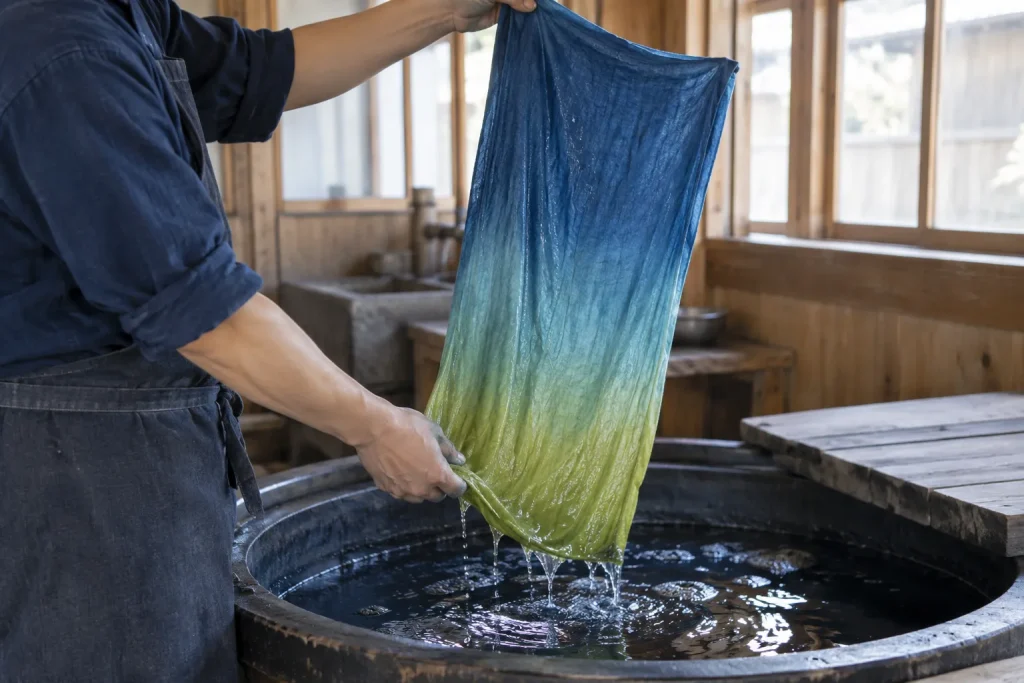
What happens after the cloth leaves the vat?
The cloth does not leave the liquid in its final shade. Reduced indigo can initially make the wet fiber look yellowish or green because the soluble form has not yet fully reacted with oxygen. Exposure to air converts it back into insoluble blue indigo within and around the fiber. This visible change is oxidation, not a separate blue pigment being applied afterward. A dyer waits for that reaction before deciding whether the cloth needs another immersion.
Deeper color is usually built through repeated cycles rather than one extremely long soak. Each return to the vat adds another opportunity for reduced indigo to enter the fiber, and each period in the air restores the blue form. The result still cannot be predicted by counting dips alone because vat strength, fiber type, preparation and handling affect uptake. Cotton, linen, silk and wool do not behave as interchangeable surfaces. An experienced dyer therefore judges the developing cloth as well as the nominal recipe.
After the intended shade is reached, the textile is rinsed to remove material that has not fixed securely to the fiber. Workshops may then wash, neutralize or finish the cloth according to their own process and the material being dyed. Some blue can appear in rinse water or rub from a new textile, but that observation alone does not prove whether its pigment was natural or synthetic. Likewise, color variation can reflect handwork without authenticating the origin of the sukumo. The reliable evidence remains a clear account from the maker covering the indigo source, vat method and finishing process.
Did BASF destroy Japan’s natural indigo trade in 1897?
MOSTLY TRUE — synthetic indigo broke the old market, but not in one year.
BASF launched “Indigo Pure BASF” commercially in 1897 after a long industrial research program. The new product offered scalable supply and more consistent dye content than an agricultural material whose yield depended on land, weather and months of processing. Imported synthetic indigo then undercut the economic structure that had supported large-scale Japanese leaf cultivation and sukumo production. Tokushima’s official history records a steep decline from the prefecture’s former production peak, while natural indigo survived in a far smaller craft economy. It is more accurate to describe a rapid structural displacement than a trade disappearing on the product’s launch date.
Synthetic and natural indigo share the principal blue colorant, indigotin, but not a production chain. One starts with industrial synthesis; the other with a crop and microbial processing. Natural origin does not guarantee durability, and synthetic origin does not prove inferiority. “Chemical-free indigo” is meaningless because alkali, reduction and oxidation are chemistry. Compare origin and process, not purity and contamination.
Are only a handful of natural aishi left?
UNCERTAIN — very few specialists remain, but no current official count was verified.
JNTO describes Kenta Watanabe as one of “very few” remaining aishi who produce their own dye. That supports scarcity, not an exact national headcount. The category itself can shift: some people grow indigo, some make sukumo, some maintain vats and dye, and a smaller group does all three. Without a dated registry defining who qualifies, “only five,” “only six” or any similar number would create false precision. The defensible statement is that natural sukumo production now depends on a small specialist base.
This is the chain’s breaking point. Less cultivation means fewer leaves. Without sukumo knowledge, preserving a vat is insufficient. Weak demand also makes apprenticeship harder to sustain. If provenance matters, ask who made the sukumo and which reduction method was used.
Is every aizome textile made by the same traditional method?
FALSE — the label aizome does not identify one complete recipe.
Japan has multiple indigo materials, vat traditions, fibers and regional practices. Even within sukumo dyeing, workshop decisions change the preparation of the cloth, the alkaline source, vat maintenance and number of dye cycles. Products may also combine hand dyeing with industrially woven cloth, or use synthetic indigo while drawing on traditional patterns. That does not automatically make them fraudulent; it means the sales language must be read precisely. “Hand-dyed,” “natural indigo,” “Awa sukumo” and “traditional craft” answer different questions.
The cloth’s use is a separate craft decision. How a Square of Cloth Carries a Bottle covers furoshiki, while Folds That Ended Up in Space and Surgery follows engineered folding. For personalization, the name converter with 898 checked katakana names can assist with spelling. It cannot authenticate a textile or its dye. Provenance must come from the maker.
Believe this instead: natural indigo dyeing is a managed biological and chemical process whose longest work happens before the cloth reaches the vat. Tokushima’s hundred-day sukumo cycle is well documented, and BASF’s 1897 launch explains the industry’s collapse more accurately than a story about a timeless blue untouched by modern manufacturing. What remains uncertain is the precise number of active aishi, so scarcity should be stated without manufacturing a statistic.