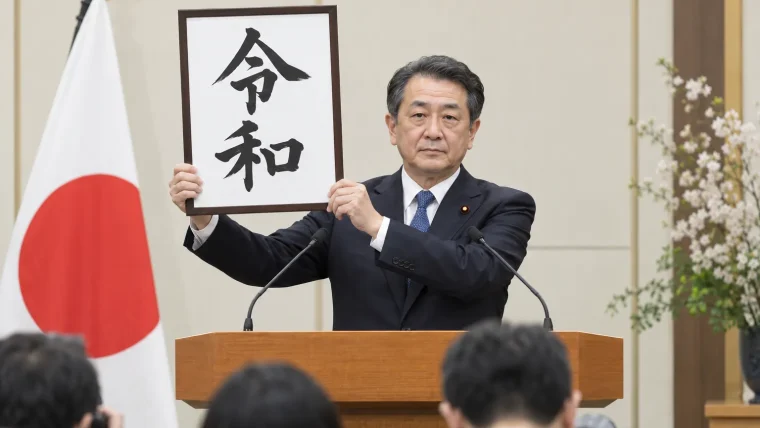
Japan runs two calendars side by side. One is the Gregorian calendar you already use. The other counts years from the start of each emperor’s reign, resets to one when a new emperor takes the throne, and is still what a great many official forms ask for.
If you have ever been handed a Japanese document with 令和 printed on it and a blank box after it, this is the article you need. It takes about four minutes and involves one subtraction.
The five eras you need
The system is called gengō, 元号. Since 1868 the rule has been one era per emperor — before that, eras changed for all sorts of reasons: an auspicious omen, a disaster, the turn of a sixty-year cycle. That older system produced hundreds of eras and is why historical dates are a specialist subject.
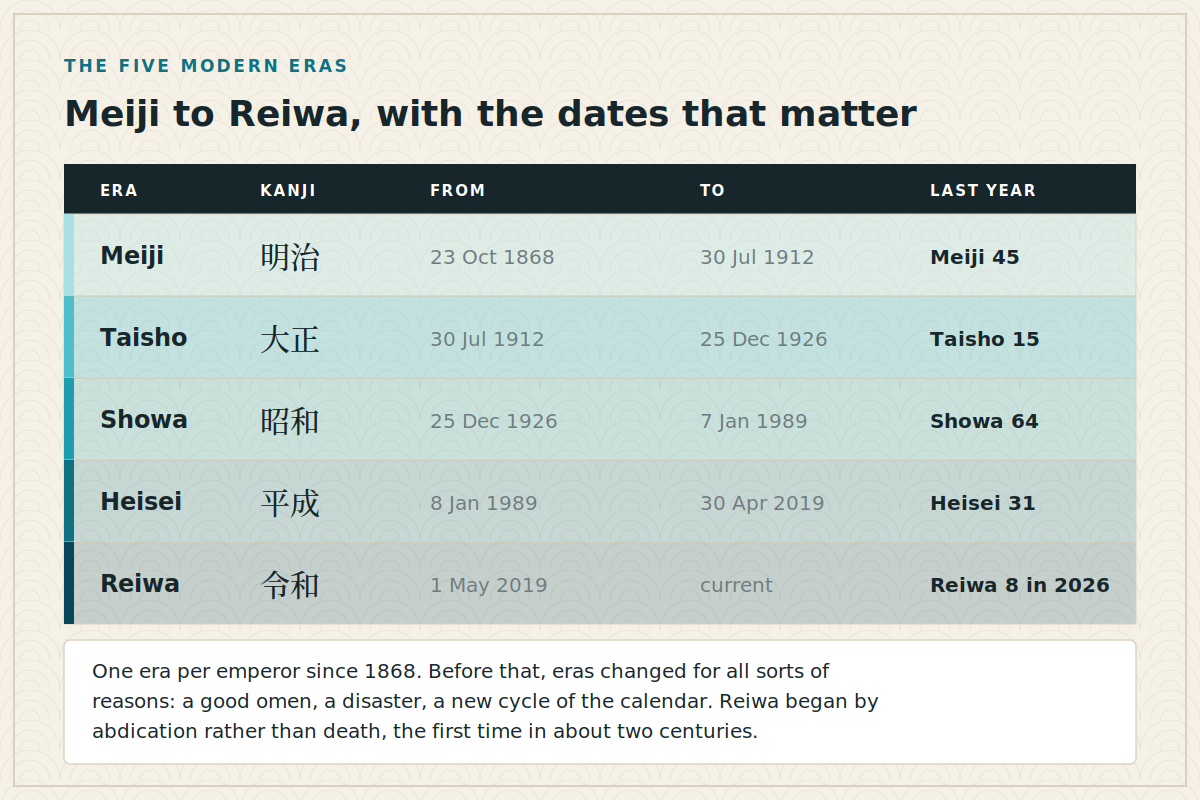
For anything involving a living person, five eras is the whole list:
| Era | Kanji | Ran from | To |
|---|---|---|---|
| Meiji | 明治 | 23 October 1868 | 30 July 1912 |
| Taishō | 大正 | 30 July 1912 | 25 December 1926 |
| Shōwa | 昭和 | 25 December 1926 | 7 January 1989 |
| Heisei | 平成 | 8 January 1989 | 30 April 2019 |
| Reiwa | 令和 | 1 May 2019 | current |
2026 is Reiwa 8, written 令和8年.
The arithmetic
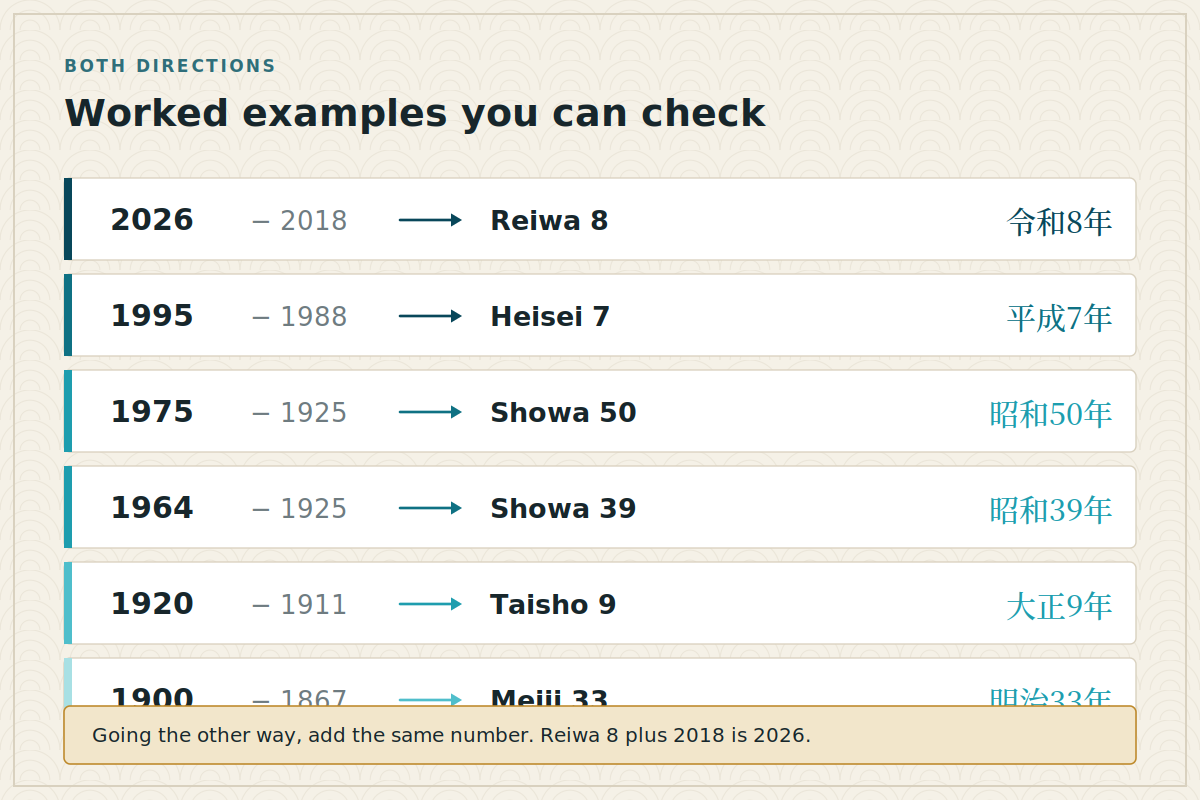
Each era has one number. Subtract it from the Western year and you have the era year:
- Reiwa — subtract 2018. So 2026 − 2018 = Reiwa 8.
- Heisei — subtract 1988. So 1995 − 1988 = Heisei 7.
- Shōwa — subtract 1925. So 1975 − 1925 = Shōwa 50.
- Taishō — subtract 1911. So 1920 − 1911 = Taishō 9.
- Meiji — subtract 1867. So 1900 − 1867 = Meiji 33.
Going the other way, add. Shōwa 39 plus 1925 is 1964, the year of the Tokyo Olympics — a date Japanese people refer to as Shōwa 39 as readily as by the Western year.
The two things that catch people out
The era does not change on 1 January. It changes on the day the reign changes, which means four calendar years in the modern period belong to two eras each. 1989 is both Shōwa 64 and Heisei 1; 2019 is both Heisei 31 and Reiwa 1. Converting a January 1989 birthday as Heisei gives the wrong answer by a whole era. The dates and how to handle them are in our article on transition years.
The first year is written 元年, not 1. Gannen means “origin year,” and every era’s first year uses it: 2019 is 令和元年, never 令和1年. A form filled in with the numeral will look wrong to whoever reads it.
Subtract one number and you have the year. Get the month wrong at a transition and you have the wrong era entirely.Where era conversion actually goes wrong
Why the system is still in use
A fair question, given that Japan has used the Gregorian calendar since 1873.
Partly it is administrative inertia: the family register, property records and much of the legal system are built on era dates going back generations, and rewriting them is not worth the cost. Partly it is genuinely useful shorthand. Shōwa names a period the way “the sixties” does in English, and with more precision — say “a Shōwa building” or “very Shōwa” in Japan and everyone knows what you mean.
And partly it is that eras carry a social texture the Gregorian calendar lacks. Shōwa ran sixty-two years and contained the war, the occupation and the economic miracle. Heisei is remembered as the decades after the bubble burst. Reiwa is still being written.
Government policy since 2019 has pushed Western years — seireki, 西暦 — onto more forms, and many now offer both. But the era year has not gone anywhere, and if you live in Japan you will write one this year.
Where you will actually meet it
- Driver’s licences and residence cards, where the expiry date is printed in era years.
- The family register, koseki, which is the foundational identity document.
- Bank and insurance forms, especially date-of-birth fields.
- Medical records, contracts and property paperwork.
- Newspapers and public notices, which often give both.
How to read one of these fields character by character, including the order Japanese puts dates in, is covered in reading dates on Japanese documents.
Eras as everyday shorthand
The part that a converter cannot give you is what the era names mean socially, and in Japan they mean quite a lot.
Shōwa functions as an adjective. A Shōwa building, a Shōwa café, a Shōwa way of doing things — it carries a specific nostalgia for the post-war decades, somewhere between “mid-century” and “old-fashioned but warm.” There is an entire retro aesthetic built on it, and a generation of bars and coffee shops trading on the association.
Heisei is the era of the burst bubble and the long stagnation that followed, and “Heisei generation” carries roughly the weight “millennial” does in English. Reiwa is still being defined, and people use it mostly to mean “now.”
Because eras track reigns rather than decades, they also map cleanly onto life stages in conversation. Saying you were born in Shōwa 55 tells a Japanese listener your rough age, the economy you grew up in, and the school system you went through, in three syllables.
The software problem
Worth a note, because it explains why the 2019 transition was managed the way it was.
Every system in Japan that stores a date — payroll, banking, hospital records, ticketing, government databases — has to know the era table, and a new era means a patch. In 1989 the change came overnight after a death, and the scramble was considerable. In 2019 the abdication was scheduled, the name was announced a month ahead, and the industry had a deadline it could work to.
Even so, a great deal of software still handles the transition years incorrectly, converting from the year alone and producing plausible-looking wrong answers. If a date matters, check the month.
One historical caution
If you are converting a date before 1873, the arithmetic above is not enough. Japan adopted the Gregorian calendar on 1 January 1873, which was declared to be Meiji 6 — the preceding lunisolar year was cut short. Meiji 1 through 5 were lunisolar years, so their months and days do not line up with Western ones at all. Genealogy and historical research need a proper conversion table rather than a subtraction, and that is a real specialist task rather than a caveat we can wave away.
And the other age question
While you are converting dates, there is a second Japanese counting system worth knowing: the traditional age, kazoedoshi, in which you are one at birth and gain a year at New Year rather than on your birthday. It can put you two years above the age you would give in English, and it still decides which shrine ceremonies apply to you. That one has its own article.
Our era converter does all of this in both directions, handles the transition years properly, and gives both ages for a birth date. If you want the year tables rather than a tool — for looking up a birth year, or reading a document at speed — they are in the Shōwa, Heisei and Reiwa year tables.