Four years in the modern Japanese calendar belong to two eras at once. If your birth year is one of them, or you are converting a document dated in one of them, the arithmetic in every conversion table is not enough — you need the month, and sometimes the day.
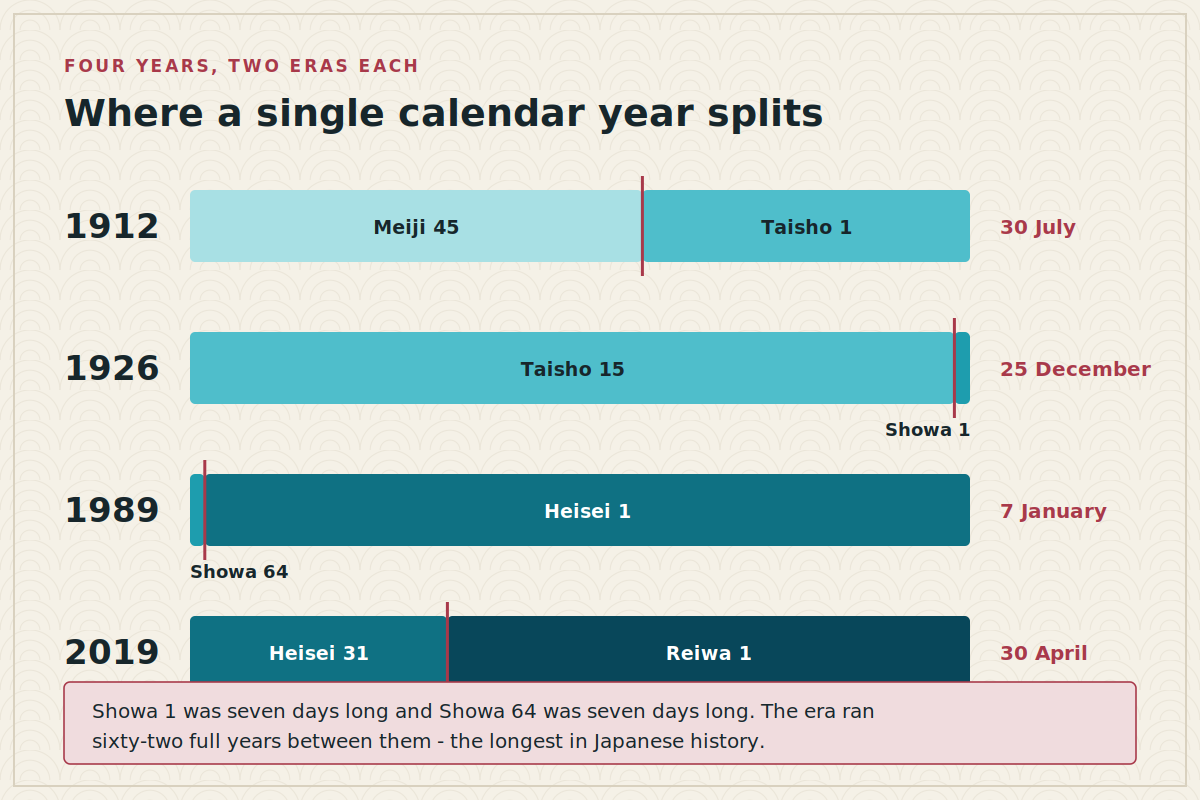
These are the four, and the exact boundaries.
1912 — Meiji 45 and Taishō 1
The boundary is 30 July 1912. Before it, Meiji 45; on and after it, Taishō 1.
Meiji 45 is therefore a real year that only ran seven months, and Taishō 1 only five. Documents from either half exist in quantity, and genealogical records from 1912 need the month read carefully.
1926 — Taishō 15 and Shōwa 1
The boundary is 25 December 1926, which makes Shōwa 1 exactly seven days long.
A document dated Shōwa 1 was written in the last week of December 1926, and that is a genuinely useful piece of information — it narrows a date to seven days without any other evidence.
1989 — Shōwa 64 and Heisei 1
The boundary is 7 January 1989. Shōwa 64 covers 1 to 7 January; Heisei 1 begins on the 8th.
So Shōwa 64, like Shōwa 1, lasted a week — the era is bracketed by two seven-day fragments and sixty-two full years in between. Items dated Shōwa 64 are collectible for exactly that reason; coins minted with the date are a known curiosity.
This is the transition that trips up birth-date conversion most often, because a January 1989 birthday is Shōwa, not Heisei, and every table that lists 1989 as “Heisei 1” will get it wrong.
2019 — Heisei 31 and Reiwa 1
The boundary is 30 April 2019. Heisei 31 covers 1 January to 30 April; Reiwa 1 begins on 1 May.
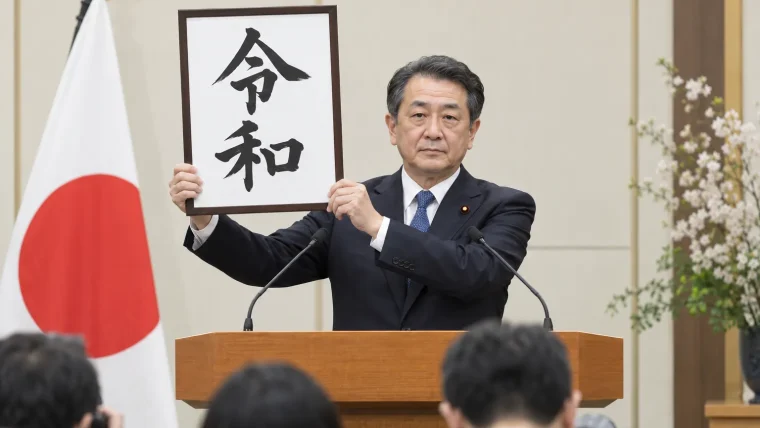
This one was different in kind from the other three. Emperor Akihito abdicated rather than died — the first Japanese abdication in about two centuries — so the date was fixed in advance, the new era name was announced on 1 April, and the entire country had a month to update forms, software and printed calendars.
| Calendar year | First era | Changes on | Second era |
|---|---|---|---|
| 1912 | Meiji 45 | 30 July | Taishō 1 |
| 1926 | Taishō 15 | 25 December | Shōwa 1 |
| 1989 | Shōwa 64 | 7 January | Heisei 1 |
| 2019 | Heisei 31 | 30 April | Reiwa 1 |
Why the first year is written 元年
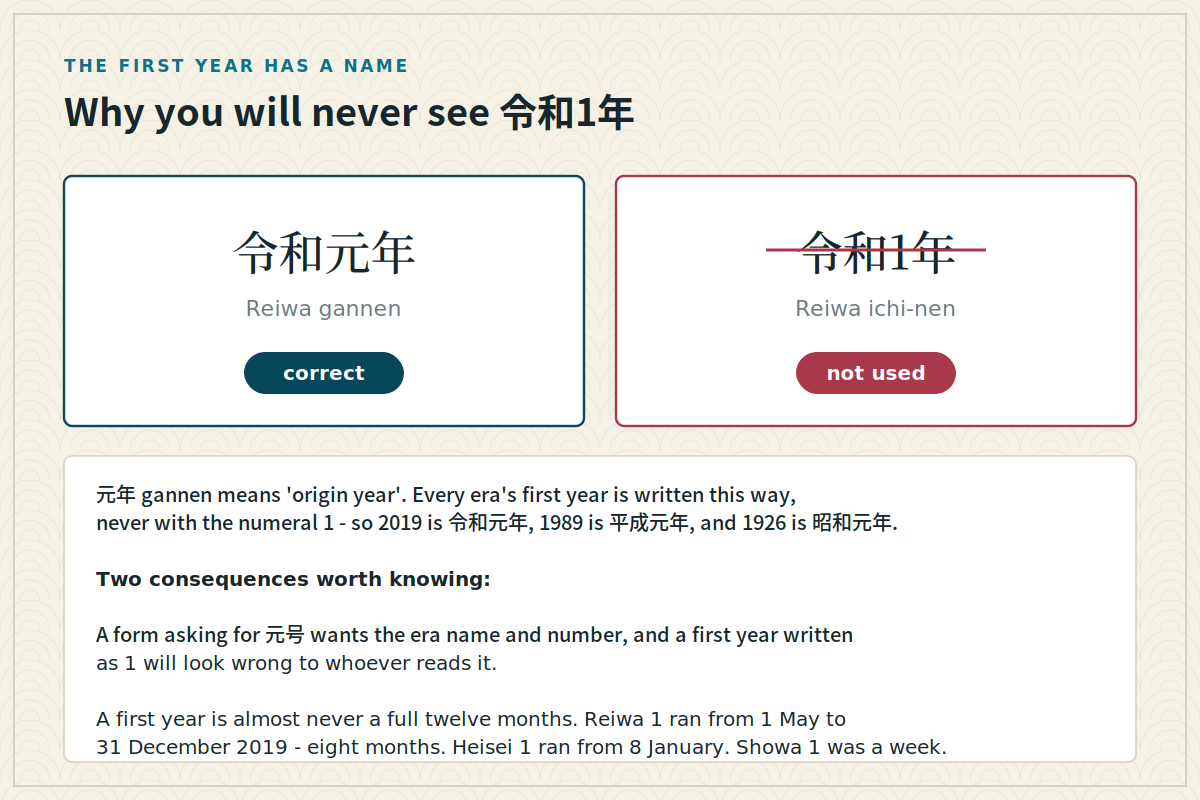
Gannen, 元年, means “origin year,” and it replaces the numeral 1 in every era. 2019 is 令和元年. 1989 is 平成元年. 1926 is 昭和元年.
Two consequences follow. A form filled in as 令和1年 will read as wrong to whoever processes it. And a first year is almost never twelve months — Reiwa 1 was eight, Heisei 1 was just under twelve, Shōwa 1 was a week — so “the first year of Reiwa” is not a synonym for 2019.
Shōwa 1 lasted seven days and Shōwa 64 lasted seven days. The era in between ran sixty-two full years, the longest in Japanese history.The shape of the Shōwa era
What this means in practice
Three situations where the boundaries matter, in rough order of how often they come up.
Filling in a birth date. If you were born in January 1989 or between January and April 2019, use the earlier era. This is the single most common conversion error, and it is easy to make because the year-based tables are right for eleven months out of twelve.
Reading an old document. A date given as Shōwa 64 or Shōwa 1 pins the document to a single week. Meiji 45 puts it before August 1912. This is genuinely useful for archival work.
Software and forms. Systems that convert by year alone quietly produce wrong output for these years, and the errors are invisible because the result looks plausible. It is the same failure pattern we found when we measured name transliteration and zodiac calculators: a rule that is right most of the time and systematically wrong on a predictable subset.
Before 1912
The one-era-per-emperor rule only dates from 1868. Before that, an era could be changed at almost any point in a reign — on an auspicious sign, after a disaster, or at the turn of a sixty-year cycle — which produced hundreds of eras, many of them short, and a great many transition years.
Converting pre-modern dates also runs into the calendar change: Japan adopted the Gregorian calendar on 1 January 1873, declared to be Meiji 6, and the years before that were lunisolar. A date from Meiji 3 cannot be converted by arithmetic at all. That is specialist territory, and the honest answer is to use a proper conversion table rather than any tool aimed at general readers, including ours — the reasoning is on our tools page.
The 1989 transition in particular
Worth a closer look, because it is the boundary most likely to affect a reader.
Emperor Hirohito died in the early morning of 7 January 1989, and the new era was proclaimed to take effect the following day. That gave Japan a single week of Shōwa 64 and then an immediate switch, with no notice whatsoever — every form, calendar, coin die and computer system in the country had to change at once.
The practical residue is that Shōwa 64 items are scarce and mildly collectible, that anyone born in that first week of January 1989 has a birth year most software gets wrong, and that the 2019 planning was shaped by the memory of it.
What happens next time
There will be another transition, and the shape of it is already fairly predictable.
The 2019 change established a workable template: an abdication rather than a death means the date is known in advance, the new name is announced roughly a month ahead, and every system that stores a date has a deadline rather than a surprise. Whether the next one follows that template depends on circumstances nobody can schedule.
What is certain is the mechanics. The new era will begin on a specific date rather than on 1 January, so that calendar year will split like the four above. Its first year will be written 元年 and will be a partial year. The name will be two kanji, previously unused, and will not begin with M, T, S, H or R.
The practical lesson for anyone building or filling in anything date-shaped is the same either way: store the full date, not the era year. A date stored as “Heisei 31” is ambiguous the moment you need to know whether it was before or after 30 April.
What our converter does
It asks for the full date rather than the year, applies the correct boundary, writes the first year as 元年, and tells you when your date sits inside a transition year rather than silently picking one. The year tables for everything else are in the Shōwa, Heisei and Reiwa tables, and the overall system is explained in the era converter guide.