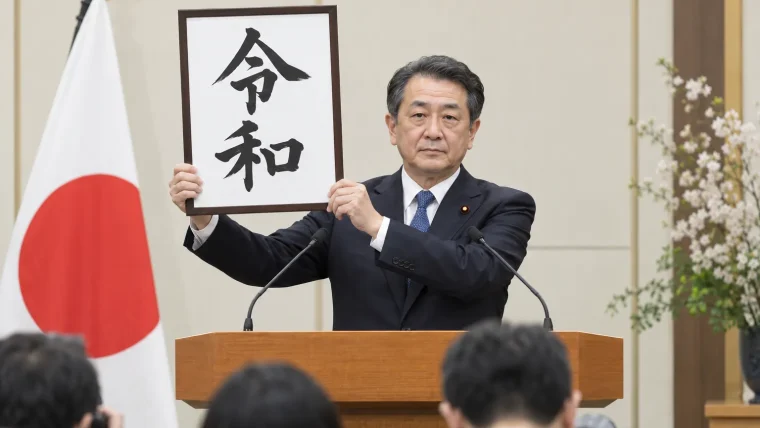
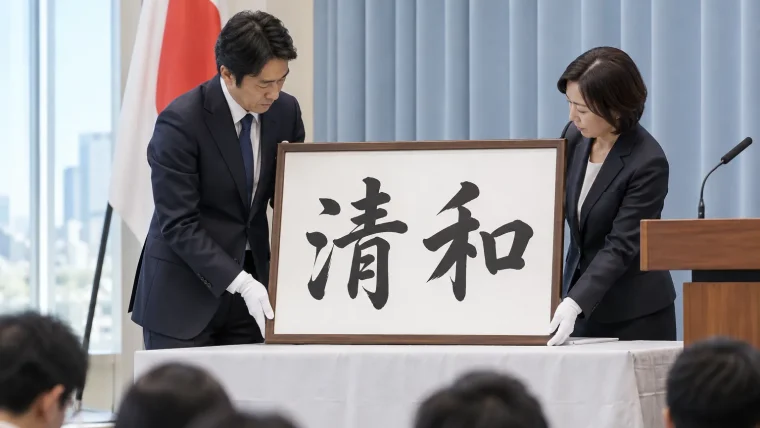
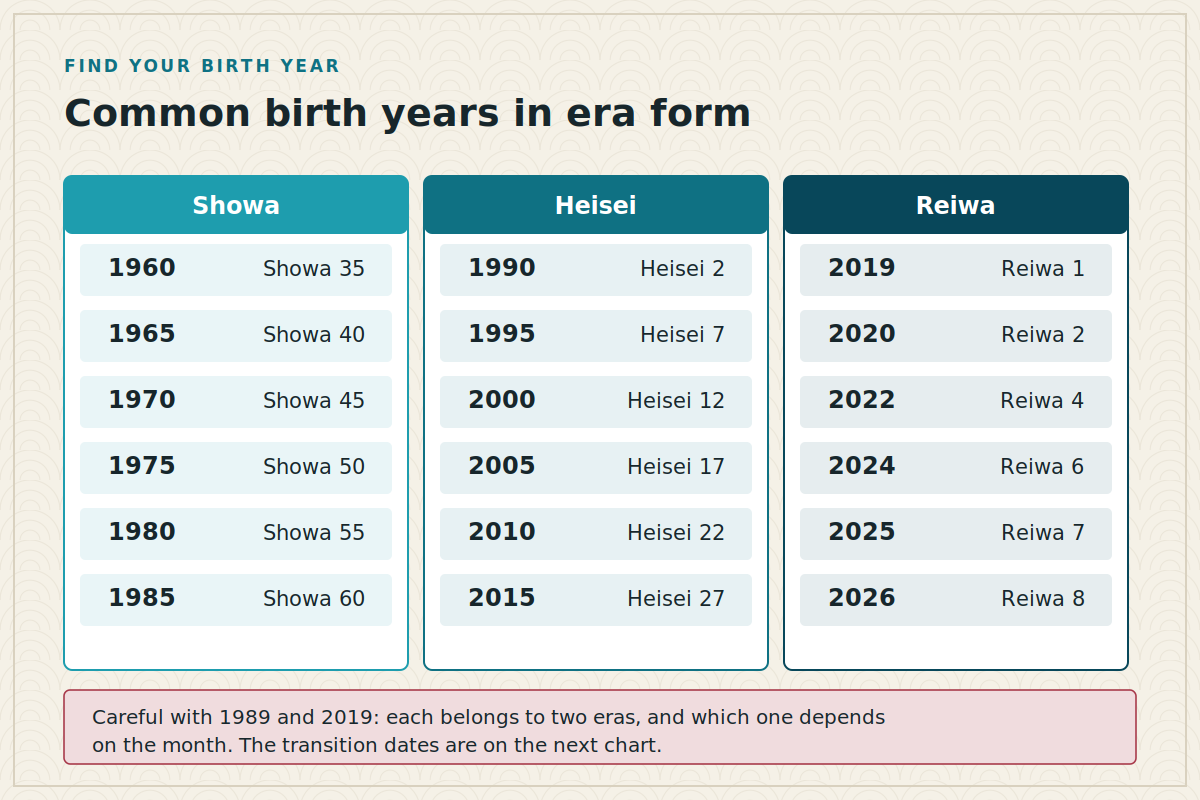
Sometimes you don’t want a converter, you want a table you can scan. Filling in a form, reading a document, checking a birth year against a residence card — these are all faster with the numbers in front of you.
So here are the tables, along with the thing worth knowing behind them: how a new era name gets chosen, and why the answer explains several details that otherwise look arbitrary.
Reiwa — 2019 onward
Subtract 2018. Reiwa 1 is written 令和元年 and covers only 1 May to 31 December 2019.
| Era year | Western | Era year | Western |
|---|---|---|---|
| 令和元年 (1) | 2019 | Reiwa 6 | 2024 |
| Reiwa 2 | 2020 | Reiwa 7 | 2025 |
| Reiwa 3 | 2021 | Reiwa 8 | 2026 |
| Reiwa 4 | 2022 | Reiwa 9 | 2027 |
| Reiwa 5 | 2023 | Reiwa 10 | 2028 |
Heisei — 1989 to 2019
Subtract 1988. Heisei 1 began on 8 January 1989; Heisei 31 ended on 30 April 2019.
Useful anchors: Heisei 7 is 1995, Heisei 12 is 2000, Heisei 20 is 2008, Heisei 30 is 2018. Anyone in Japan who describes themselves as “Heisei generation” was born between those first and last years, and it carries roughly the connotation “millennial” does in English.
Shōwa — 1926 to 1989
Subtract 1925. Sixty-two full years plus two seven-day fragments at either end, and by a distance the longest era in Japanese history.
Anchors worth memorising if you deal with older documents: Shōwa 20 is 1945, Shōwa 39 is 1964 and the Tokyo Olympics, Shōwa 45 is 1970 and the Osaka Expo, Shōwa 60 is 1985. Shōwa 20 is the single most referenced era year in Japanese public life, and you will see it constantly in anything historical.
Taishō and Meiji
Taishō, 1912 to 1926, subtract 1911. Fifteen years, and the era most associated with a brief liberal, cosmopolitan moment — “Taishō romance” is a design style you’ll see referenced in cafés and fashion.
Meiji, 1868 to 1912, subtract 1867. Forty-five years covering the whole modernisation of the country. Meiji 6 is 1873, the year Japan switched to the Gregorian calendar — dates before that need real conversion rather than arithmetic, as noted in our guide to the era system.
How an era gets its name
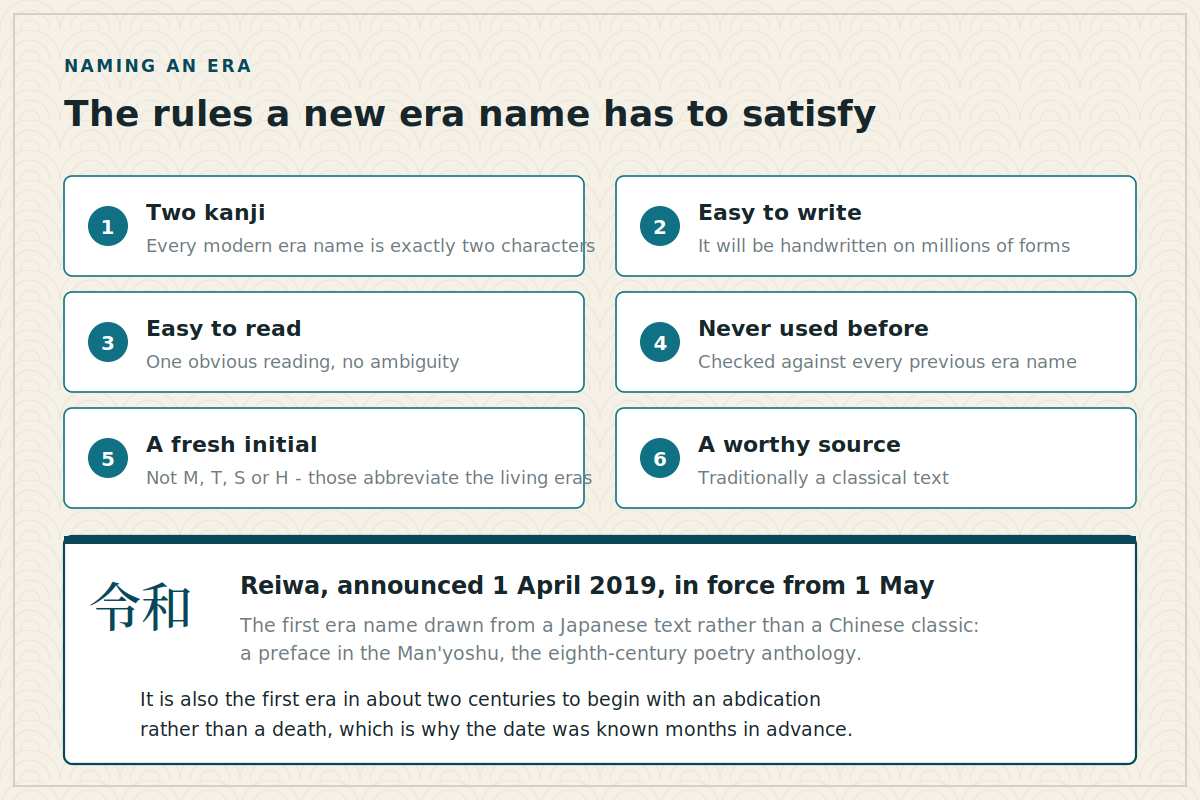
The constraints are unwritten in places and firm in practice:
- Two kanji. Every modern era name is exactly two characters.
- Easy to write and read. It will be handwritten on millions of forms by people in a hurry, and it must have one obvious reading.
- Never used before. Checked against the full historical list, which runs to several hundred.
- A fresh initial letter. This is the practical one: forms abbreviate the eras as M, T, S and H, so a new name starting with any of those would collide. Reiwa gave R.
- A worthy source. Traditionally a Chinese classic.
That last point is where Reiwa broke with precedent. It is the first era name drawn from a Japanese text rather than a Chinese one — a preface in the Man’yōshū, the eighth-century poetry anthology, describing plum blossoms in a gentle spring wind. The choice was noticed and discussed at length in Japan, and it was clearly deliberate.
Forms abbreviate the eras as M, T, S, H and R. That single practical constraint rules out a large fraction of otherwise good names.Why the initial matters more than the poetry
Reiwa was also announced in advance
Every previous modern era began with a death. Emperor Akihito abdicated instead — the first Japanese abdication in about two centuries — which meant the date was known months ahead and the new name could be announced on 1 April 2019 for a 1 May start.
That month of notice mattered enormously in practice. Software, forms, calendars, ticketing systems and bank records all had to be updated, and the industry had a deadline rather than a surprise. The 1989 transition, by contrast, arrived overnight.
What the tables cannot tell you
One limitation worth stating. These tables map a calendar year to an era year, and for eleven months out of twelve that is all you need. For the four transition years it is not enough, and no year-based table can be.
1912, 1926, 1989 and 2019 each belong to two eras, split on a specific day. A birth date in January 1989 converts to Shōwa 64 even though every list of years shows 1989 as Heisei 1. The full boundaries are in the transition years article, and they are the single most common source of conversion errors — in printed tables, in software, and in forms filled in by hand.
Reading an era year at speed
If you handle Japanese documents regularly, memorising a few anchors is faster than doing arithmetic each time.
For Reiwa, the offset is small enough to hold in your head: add 18 to the era year and you have the last two digits of the Western year. Reiwa 8 → 26 → 2026.
For Heisei the trick is similar. Add 88 to the era year: Heisei 7 → 95 → 1995. Heisei 12 → 2000, which is a useful pivot because everything after it is straightforward.
For Shōwa, the offset of 25 makes a neat pattern with the decades. Shōwa 25 is 1950, Shōwa 35 is 1960, Shōwa 45 is 1970, Shōwa 55 is 1980. Learn those four and any Shōwa year is a short step from one of them.
| Anchor | Western | Why it is worth knowing |
|---|---|---|
| Shōwa 20 | 1945 | Referenced constantly in anything historical |
| Shōwa 39 | 1964 | Tokyo Olympics and the first shinkansen |
| Shōwa 45 | 1970 | Osaka Expo |
| Heisei 12 | 2000 | A clean pivot for mental arithmetic |
| Reiwa 8 | 2026 | The current year |
Using the tables
Three practical notes:
- Check the month at a boundary. A birthday in January 1989 or in early 2019 sits in the previous era, and the tables above will mislead you. The boundary dates are in the transition years article.
- Write the first year as 元年. Not 1. This applies on any form.
- Look for a 西暦 option. If the form offers seireki, that is the Western year and you may use it — increasingly common since 2019.
Our converter handles all three automatically and shows both the era year and the traditional age. Where those pages get their facts, and what we do when a source is disputed, is set out on the editorial standards page. And if the form in front of you also wants an age, be aware Japan has two of those — see the article on kazoedoshi.