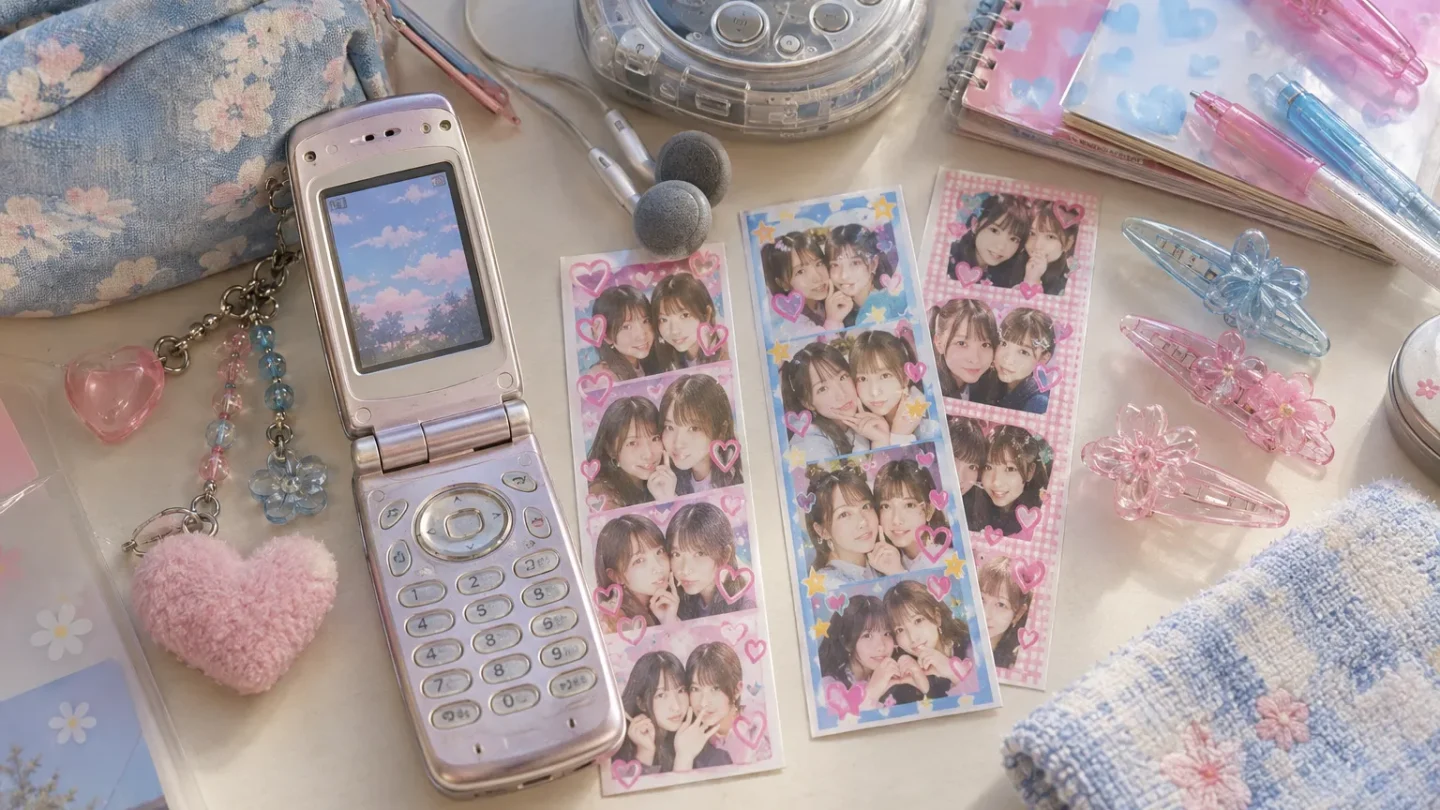
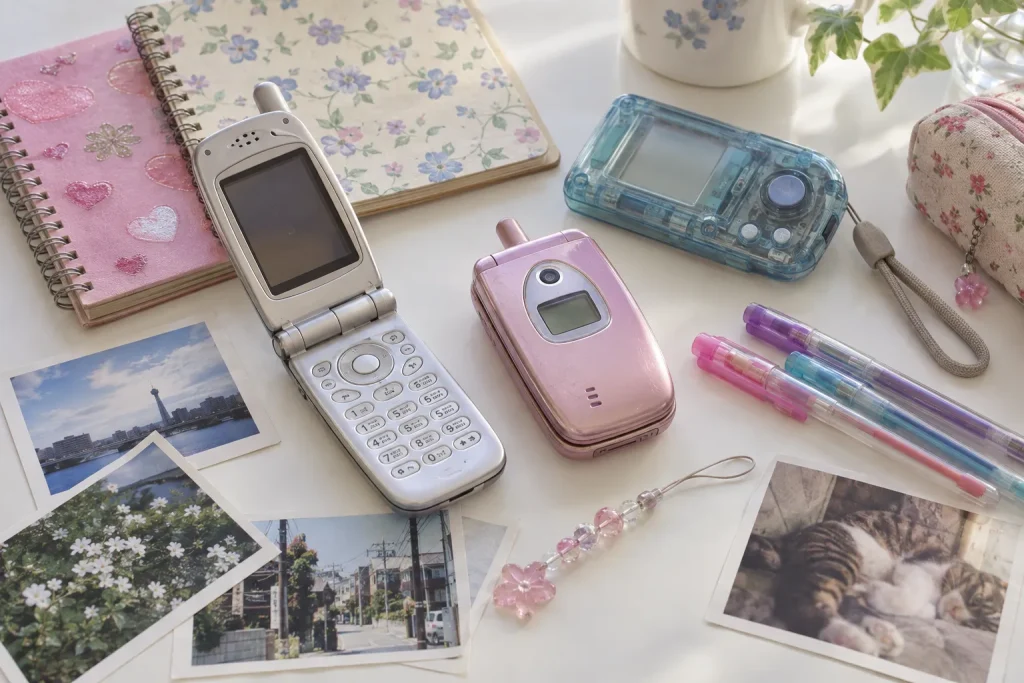
You will meet 平成レトロ Heisei retoro, “Heisei retro,” on fashion videos, secondhand listings, themed exhibitions, purikura posts, and shelves of revived character goods. The phrase heisei retro japan does not simply mean “everything Japanese from the 1990s.” It turns the Heisei era into a visual category: flip phones, decorated photographs, loose socks, translucent electronics, colorful stationery, and the crowded graphics of the early consumer internet. Teenagers can feel attached to that category without remembering its original moment. What they inherit is a selected image of the period, not the period itself.
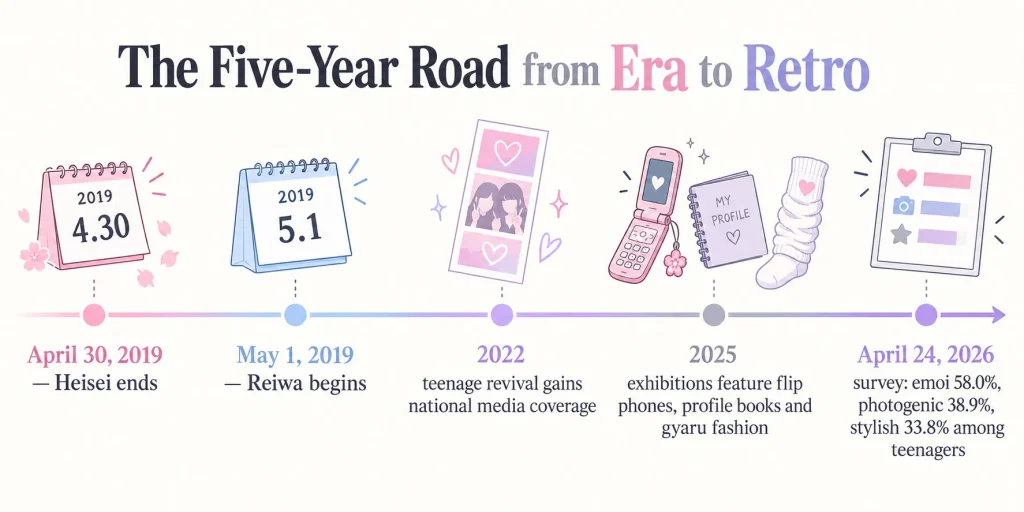
There is also a factual problem with saying that today’s teenagers were born after Heisei. The era ended on April 30, 2019, so people born entirely in Reiwa are no older than seven during 2026. Current teenagers lived through part of Heisei, but the youngest have no personal memory of its defining 1990s and early-2000s objects. That distinction matters because it shows how quickly an era can become “retro”: not after everyone who experienced it is gone, but after its technology and styling stop feeling current.
The two era words beneath the trend
平成 — Heisei — “achieving peace”
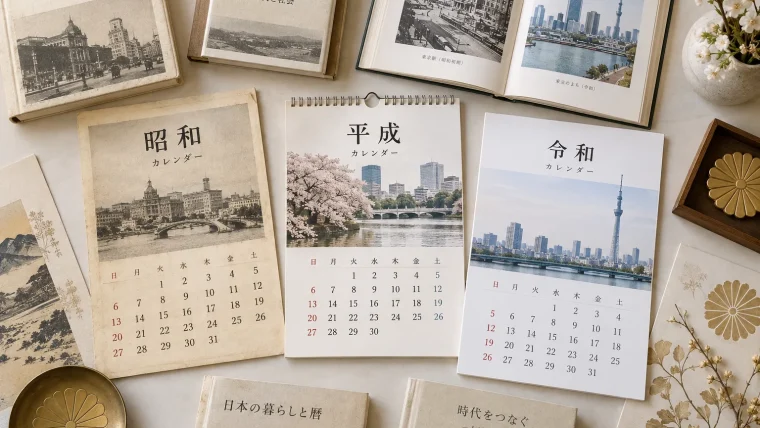
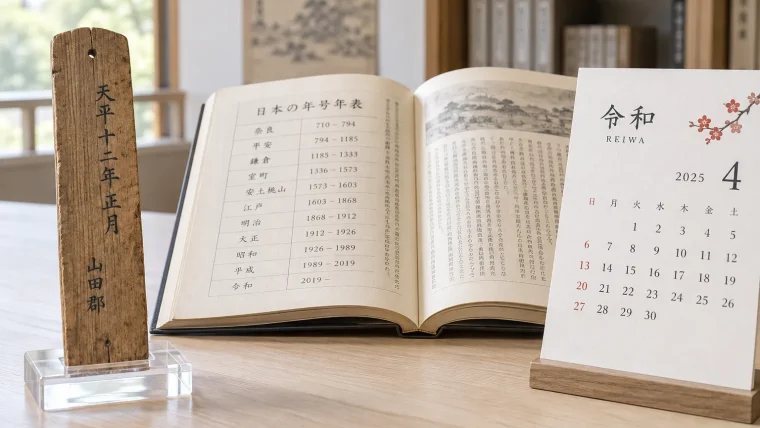
平成 Heisei, conventionally interpreted as “achieving peace,” was the era from January 8, 1989 through April 30, 2019. You meet the word on dates, official records, retrospective television programs, product descriptions, and social-media labels. The common mistake is treating it as the Japanese name for the 1990s. Heisei also covered the first decade and most of the second decade of the twenty-first century. If you need the calendar rather than the aesthetic, Japanese Era Years: Meiji to Reiwa, Explained shows how the numbering works.
A worked example makes the difference clear. The Gregorian year 1998 was 平成10年 Heisei jūnen, “Heisei year ten,” because 1989 counted as Heisei 1. The site’s era converter covering every year from 1868 through 2050 and all five modern eras performs that conversion without turning the article into another date table. The published Showa, Heisei and Reiwa Year Tables provides the complete lookup reference. In cultural use, however, “1998” evokes a narrower set of images than “Heisei.”
令和 — Reiwa — “beautiful harmony”
令和 Reiwa, officially rendered in English by Japan’s government as “beautiful harmony,” began on May 1, 2019. You meet it on current documents, calendars, coins, announcements, and phrases that contrast present taste with recent history. The usual mistake is assuming that Reiwa culture replaced Heisei culture overnight. Era boundaries are exact on official documents but fuzzy in fashion, language, and memory. A flip phone did not become retro because the calendar changed on one morning.
The relationship between an emperor’s reign and the era name is covered in Why Japan Renames Its Emperors After Death. The longer history is stranger than the modern sequence suggests: From Taika to Reiwa, With Some Lasting Months explains why earlier era names could change without a new reign. Those articles supply the political and chronological structure. Here, Reiwa matters because it created a clear “before” against which Heisei could be packaged.
Where heisei retro Japan appears as a label
平成レトロ — Heisei retoro — “Heisei retro”
平成レトロ Heisei retoro, “Heisei retro,” is the umbrella term you meet in exhibitions, resale shops, trend reports, television features, and hashtags. It often points most strongly toward the 1990s and early 2000s rather than distributing attention equally across the era’s entire thirty-year span. That is the first warning that this is a cultural label, not a historical classification. Objects survive because they photograph well, can be resold, or still have recognizable characters attached to them. An office printer or an ordinary household router from the same period rarely receives the same affectionate treatment.
The second mistake is reading “retro” as proof that the object is genuinely old or unchanged. A newly manufactured pouch with pixel hearts can be sold as Heisei retro even though neither the pouch nor its owner existed in that period. The label describes a relationship to remembered design. It can include authentic used objects, faithful reproductions, and entirely new products that borrow only a few visual cues. You have to check the production date separately if authenticity affects the price.
レトロ — retoro — “retro”
レトロ retoro comes from English “retro,” but its Japanese use can be broader and faster. You meet it attached to cafés, packaging, cameras, trains, neighborhoods, toys, and clothing from several different periods. The loanword does not require an antique object or a museum-quality reconstruction. It can mean deliberately old-fashioned, warmly familiar, or simply unlike the current streamlined norm. This is one of the terms whose meaning has moved away from what an English-speaking shopper may expect.
A comparison with 昭和レトロ Shōwa retoro, “Showa retro,” makes the compression visible. Showa ended on January 7, 1989, while Heisei ended on April 30, 2019. By the middle of the 2020s, both names could function as retail and design categories even though their historical distance was very different. The trend does not wait for a fixed anniversary. It begins when a newer visual system makes the older one look distinct.
懐かしい — natsukashii — “dear and remembered”
懐かしい natsukashii describes the warm recognition of something connected with the past. You hear it when adults encounter an old snack package, television theme, ringtone, school notebook, or toy they genuinely remember. The beginner’s mistake is translating it only as “I miss it.” It often works more like “That takes me back” or “I remember this fondly.” The feeling normally implies some personal or shared connection.
A teenager can call a design cute without finding it 懐かしい, while an adult who used the original object may use both words. That difference separates firsthand nostalgia from fascination with an unlived past. Marketing often places the groups together because they can buy the same revived product for different reasons. The surface agreement hides two kinds of memory. One remembers use; the other recognizes a circulating image.
What the 2026 survey says about the age split
A survey released by Nippon Information in April 2026 gives the distinction numbers. Among teenage respondents, 58.0% associated the trend with エモい emoi, “emotionally evocative,” while 38.9% selected “photogenic for social media” and 33.8% selected “stylish.” Among respondents in their thirties, 72.1% emphasized nostalgia. These figures do not prove that every teenager likes the trend, but they show that different age groups can value the same objects for different reasons. The younger response is led by mood and presentation; the older response is led more clearly by memory.
| Age group or response | Association reported in April 2026 | What it suggests |
|---|---|---|
| Teenagers | Emoi: 58.0% | The past is approached as an emotional style |
| Teenagers | Social-media photogenic: 38.9% | Objects gain value through new images |
| Teenagers | Stylish: 33.8% | Old design is evaluated as current fashion |
| Respondents in their thirties | Nostalgic: 72.1% | Personal memory remains the main connection |
The uncomfortable correction is therefore straightforward. Japanese teenagers in 1998 and Japanese teenagers interested in 1998 during 2026 are not the same audience. The first group used the objects as contemporary tools; the second receives them as edited cultural signs. Calling both experiences nostalgia erases that difference. “Retro attraction” is often the more accurate phrase for the younger group.
The words you meet in photo booths and phone drawers
プリクラ — purikura — “Print Club”
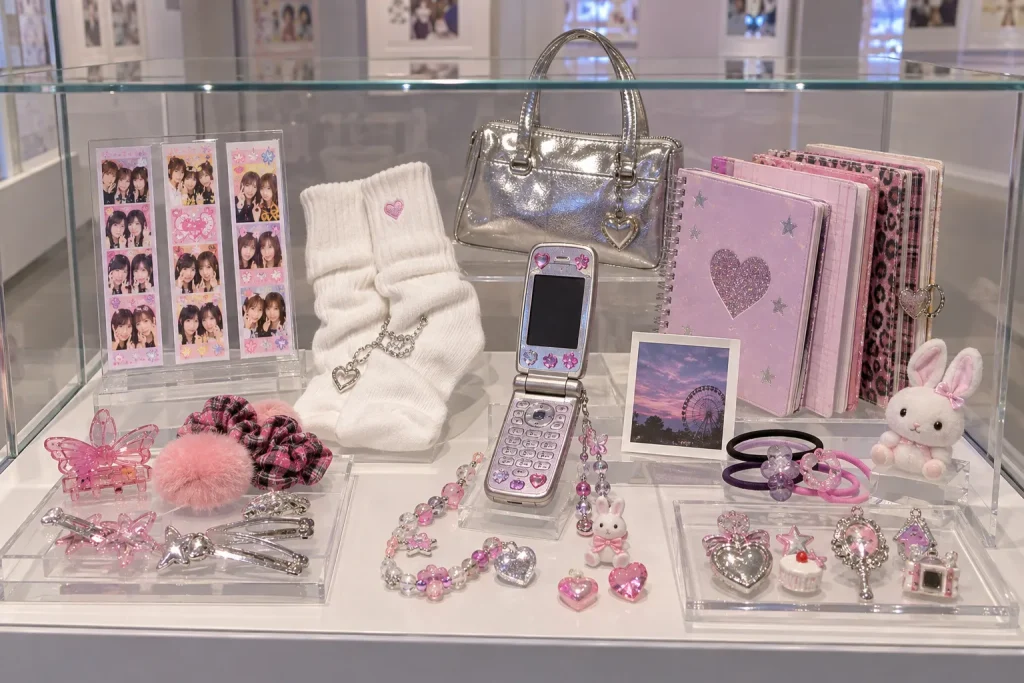
プリクラ purikura is a shortened form of プリント倶楽部 Purinto Kurabu, “Print Club.” You meet it at photo-booth arcades, in albums, on phone cases, and in posts reproducing dense handwritten decorations. The English word “club” may suggest a membership organization, but that is not what the term means in ordinary use. It refers to the booth experience and the resulting sticker photographs. This is the second loan-based term whose everyday meaning is not predictable from English alone.
Modern booths can alter facial proportions, skin appearance, lighting, and eye size much more aggressively than early machines. A “retro” purikura image may therefore be produced with new equipment, then decorated to imitate an older visual language. The point is not technological accuracy. It is the abundance of handwritten marks, hearts, stamps, dates, nicknames, and friendship signals. Purikura Japan is a social artifact as much as a photograph.
ガラケー — garakē — “Galápagos mobile phone”
ガラケー garakē abbreviates ガラパゴス携帯 Garapagosu keitai, “Galápagos mobile phone.” You meet it in used-electronics shops, fashion shoots, music videos, and discussions of Japan’s pre-smartphone mobile culture. English articles often translate it as “flip phone,” but the terms are not exact equivalents. Many Japanese feature phones flipped open, yet the name refers to a domestically specialized technological ecosystem rather than to one hinge design. The mistake is treating any folding phone as culturally identical to a Japanese model from that period.
Camera placement, straps, charms, infrared sharing, email conventions, and carrier-specific services all contributed to the object’s cultural identity. A dead handset now used as a fashion accessory cannot reproduce that network. It can reproduce the silhouette, tactile buttons, decorated exterior, and act of flipping the screen open. That is enough for retro styling but not for historical reconstruction. The object returns more easily than the infrastructure around it.
デコる — dekoru — “to decorate”
デコる dekoru, “to decorate,” turns the borrowed deco into a Japanese verb. You meet it when phones, notebooks, photographs, bags, and profiles are covered with stickers, rhinestones, drawings, charms, or text. The common mistake is looking for a formal decorative tradition behind every example. In this context, the word often describes playful personalization and visual accumulation. More can be the point.
A related object is the デコ電 dekoden, “decorated phone,” particularly a handset covered with gems or molded pieces. Contemporary recreations sometimes leave the device nonfunctional because it serves as a prop. The loss of function is not necessarily accidental; visibility has replaced communication as the object’s main job. This is how obsolete technology survives as Japanese nostalgia. Its interface becomes an ornament.
The fashion words attached to the revival
ギャル — gyaru — “gal”
ギャル gyaru comes from English “gal,” but in Japanese it names changing fashion and youth subcultures rather than any young woman. You meet it in discussions of makeup, hair, tanning, school fashion, magazines, Shibuya, and several distinct substyles. The common mistake is using it as a neutral Japanese translation of “girl.” It can signal a recognizable style, attitude, commercial category, or historical scene. The exact implication changes with the decade and speaker.
The renewed interest in gyaru fashion often extracts visible features—high-volume hair, strong eye makeup, long nails, short skirts, or decorated accessories—without rebuilding the social context of the original subcultures. That does not make the revival fake. It makes it selective, as revivals usually are. A copied silhouette travels more easily than magazine distribution, school rules, employment conditions, or neighborhood identity. Fashion remembers through reusable parts.
ルーズソックス — rūzu sokkusu — “loose socks”
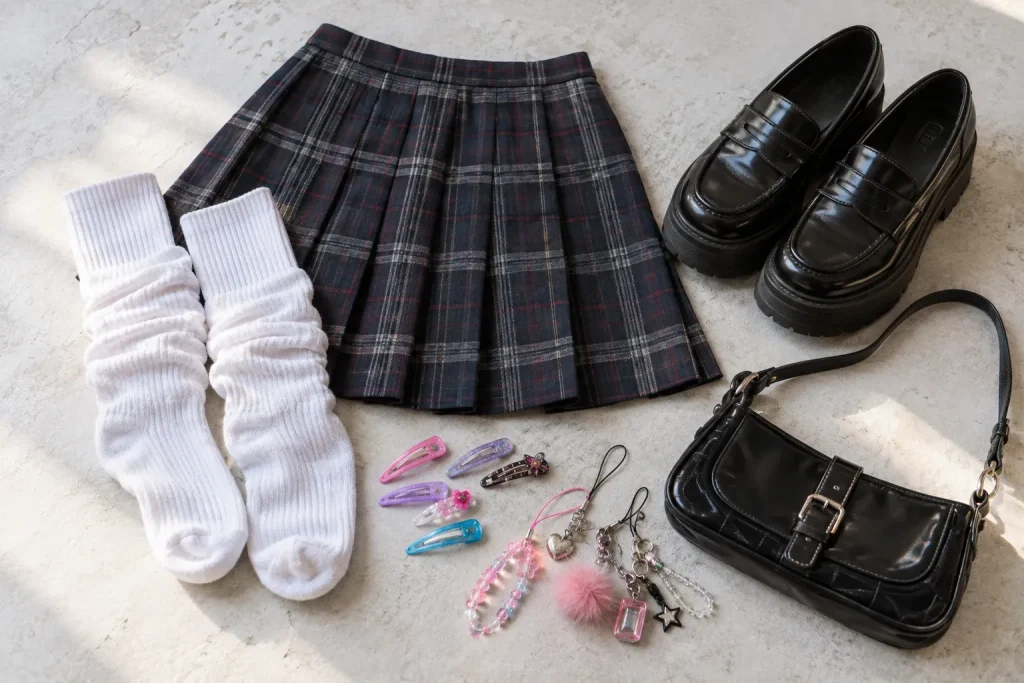
ルーズソックス rūzu sokkusu, literally “loose socks,” refers to the thick, slouching socks strongly associated with Japanese schoolgirl fashion of the 1990s. You meet them in costume collections, fashion revivals, school-style outfits, themed photo shoots, and accounts of gyaru culture. The word “loose” is English, but the complete fashion reference is specifically Japanese. The beginner’s mistake is assuming they were part of the official school uniform. They were often an alteration or addition rather than a school-issued standard.
The revived sock can carry the entire historical reference even when the rest of the outfit is current. That efficiency helps explain why certain items dominate retro imagery. They are legible at a glance and inexpensive to reproduce. Ordinary clothing from the same year may be more historically representative but less immediately recognizable. Cultural labels reward objects that identify the category quickly.
The words for feelings you did not personally remember
エモい — emoi — “emotionally evocative”
エモい emoi developed from “emotional,” but it does not simply mean belonging to the emo music or fashion subculture. You meet it under blurry night photographs, old digital-camera images, sunset train windows, handwritten messages, and objects that create an inexact ache for another time. The mistake is translating it as either “sad” or “nostalgic” in every sentence. It can cover tenderness, atmosphere, poignancy, longing, or an aesthetically pleasing emotional charge. Context supplies the direction.
The 2026 survey finding that 58.0% of teenage respondents connected Heisei retro with emoi is especially revealing. They do not need an adult’s autobiographical memory to find an old image emotionally loaded. Repetition on social platforms teaches viewers which visual cues belong together. Low resolution, flash glare, date stamps, and handwritten decoration begin to signify a past. The emotion can be culturally learned before it is personally remembered.
The teenager is not remembering 1998; the teenager is recognizing what 1998 has been made to mean.
エモかわ — emokawa — “emotional-cute”
エモかわ emokawa, “emotional-cute,” combines エモい emoi with かわいい kawaii, “cute.” You meet it in event promotion, product marketing, exhibition captions, and social-media descriptions of revived objects. The beginner’s mistake is reading it as a stable historical category from the Heisei era itself. It is better understood as a newer label applied to older-looking material. The compound explains why melancholy and commercial cuteness can occupy the same display.
An old-looking phone can be emoi because it suggests vanished communication habits and kawaii because its shape and charms remain appealing. A decorated photograph can evoke lost friendships while also working as bright social content. The combination is useful to marketers because it connects feeling with a purchasable object. That does not make the feeling insincere. It shows how emotion is organized for circulation.
The generation words that need careful handling
平成女児 — Heisei joji — “Heisei-era girl child”
平成女児 Heisei joji, “Heisei-era girl child,” appears around toys, stationery, character goods, games, and designs associated with girls growing up during Heisei. You meet it in resale listings, themed cafés, product revivals, and adults revisiting childhood objects. The mistake is treating it as another name for every woman born between 1989 and 2019. In trend use, it normally points toward a gendered childhood consumer world rather than a legal birth cohort. The boundaries depend on the object being discussed.
Someone may use the label because she owned the original toy, while a younger viewer may recognize the same toy through resale videos. Those relationships should not be collapsed into a single “generation.” One is autobiographical and the other curatorial. Both can sustain demand, but they attach different stories to the item. The distinction is easy to lose when hashtags place every user on the same screen.
Z世代 — Z sedai — “Generation Z”
Z世代 Z sedai, “Generation Z,” is a marketing and demographic label rather than a Japanese era category. You meet it in surveys, trend reports, advertising presentations, and explanations of who supposedly drives Y2K Japan revivals. The common mistake is assuming every source uses the same birth years. Definitions differ, so an article should report the range used by its source rather than presenting “Gen Z” as a legally fixed group. It is also misleading to say that all Japanese members were born after Heisei.
A Japanese teenager in 2026 was born between 2007 and 2013, depending on whether the person has had a birthday and on how “teenager” is being used. Every member of that band was born during Heisei, although the youngest remembers little or none of its consumer culture. Children born after April 30, 2019 belong wholly to Reiwa and are still below their teens in 2026. This arithmetic directly contradicts the brief’s strongest formulation. The supported claim is that young people are nostalgic for a version of a time they did not experience consciously.
The compact glossary
| Term | Reading | Literal or source meaning | Where you meet it |
|---|---|---|---|
| 平成 | Heisei | Achieving peace | Dates, documents, retrospectives |
| 令和 | Reiwa | Officially “beautiful harmony” | Current dates and era comparisons |
| 平成レトロ | Heisei retoro | Heisei retro | Exhibitions, resale, hashtags |
| 懐かしい | natsukashii | Dear and remembered | Personal reactions to old objects |
| プリクラ | purikura | Print Club | Photo booths and sticker albums |
| ガラケー | garakē | Galápagos mobile phone | Used phones and fashion styling |
| デコる | dekoru | To decorate | Phones, notebooks, photographs |
| ギャル | gyaru | Gal | Fashion and youth subcultures |
| ルーズソックス | rūzu sokkusu | Loose socks | 1990s school-fashion references |
| エモい | emoi | Emotionally evocative | Social posts and visual criticism |
| エモかわ | emokawa | Emotional-cute | Marketing and themed events |
| 平成女児 | Heisei joji | Heisei-era girl child | Childhood-goods revivals |
| Z世代 | Z sedai | Generation Z | Surveys and marketing reports |
What changed only a few years after 2019
Heisei became available as a label because Reiwa supplied a visible boundary. The change did not make everything before May 1, 2019 aesthetically coherent, but it gave sellers, media, and users a short name under which to collect selected objects. Social platforms then removed the need to have owned those objects originally. A purikura strip, flip phone, or pair of loose socks can now circulate as an image before it is encountered as a physical thing. Recognition no longer depends on memory.
| Historical layer | Relationship to the objects | Typical language |
|---|---|---|
| Used during the original period | Personal experience | Natsukashii |
| Seen in family storage or older media | Indirect familiarity | Retro, cute |
| Discovered through social media | Curated visual recognition | Emoi, emokawa |
| Purchased as a new reproduction | Contemporary consumption | Heisei-style, revival |
| Collected as an original item | Material authenticity | Period item, used item |
The speed is the important result. Heisei ended in 2019, the phrase was already widely circulating in the early 2020s, and a 2026 survey could measure different emotional responses by age group. An era did not have to recede for several decades before becoming a shelf label. It only had to acquire a successor, an identifiable group of obsolete technologies, and a visual vocabulary that reproduced well online. That is a much shorter route from calendar to culture than the word “nostalgia” suggests.
The three terms worth memorizing
Memorize 平成レトロ Heisei retoro for the overall revival, 懐かしい natsukashii for genuine fond recognition, and エモい emoi for the emotionally charged mood that does not require firsthand memory. Keep purikura, garakē, gyaru, and Heisei joji recognizable so you know what kind of object or subculture is being discussed. The rest can remain reference vocabulary until you meet it repeatedly. This division prevents every colorful old object from being misread as personal nostalgia. It also preserves the article’s essential distinction: remembering Heisei and consuming “Heisei” are not the same act.