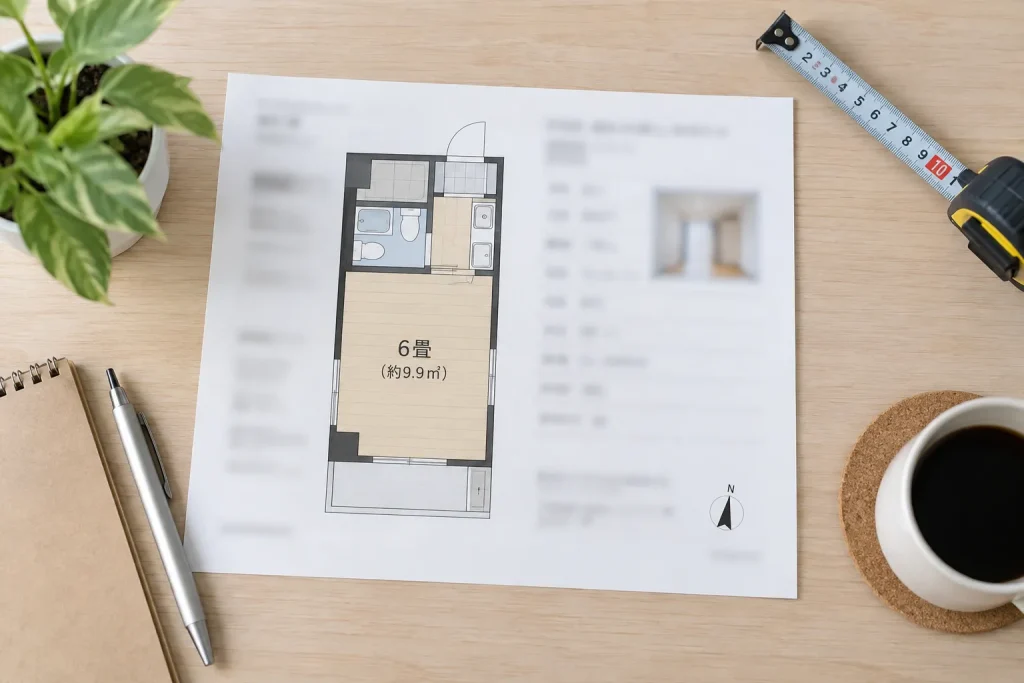
1.62 square meters—about 17.4 square feet—is the figure to start with. Under Japan’s real-estate advertising rules, a room advertised in 畳/帖, jō, “mat units,” must use at least that much floor area for each unit, even though a physical tatami mat may be larger or smaller.
That distinction is the entire tatami room size jo problem. A rental listing is describing area through a standardized conversion, while an actual 和室, washitsu, “Japanese-style room,” may contain mats produced to another regional or building-specific size.
Where does the 1.62-square-meter figure come from?
The Real Estate Fair Trade Council Federation’s enforcement rules define one jō in a property advertisement as at least 1.62 square meters. The calculation uses the room’s wall-center area divided by the advertised number of mat units.
This is an advertising convention, not a national manufacturing standard for physical mats. It allows listings to describe rooms with wood, vinyl, or carpet floors in jō even when there is no tatami in the room. You may therefore see 洋室6帖, yōshitsu roku-jō, “Western-style room of six mat units,” without a single woven mat on the floor.
The standard also explains why counting visible mats is not a reliable way to audit every floor plan. A listing’s figure refers to calculated room area, while real mats must fit between walls, columns, trim, closets, and thresholds. In traditional construction, mats could even be made for a particular room rather than the room being designed around one universal product.
The site’s guide to Reading 1LDK, Jo and the Move-In Bill explains where room labels sit within the rest of a Japanese listing. Here, the important part is that “6帖” is a unit of advertised area before it is a promise about six physical mats.
| Advertising input | Amount | Calculation | Result |
|---|---|---|---|
| Minimum area per advertised jō | 1.62 m² | Set by the advertising rules | 17.44 sq ft |
| Advertised room | 6 jō | 1.62 × 6 | 9.72 m² |
| Conversion to US units | 9.72 m² | 9.72 × 10.7639 | 104.63 sq ft |
| Total minimum represented area | 6 jō | Advertising calculation | 9.72 m² / 104.63 sq ft |
The square-foot conversion uses the National Institute of Standards and Technology value of 1 square meter equaling approximately 10.7639 square feet. All calculations were checked on September 13, 2026.
How large are actual tatami mats?
畳, tatami, “folded and piled mat,” does not have one universal footprint. Several traditional and modern sizes are commonly described, and their distribution is associated with region, construction method, and building type.
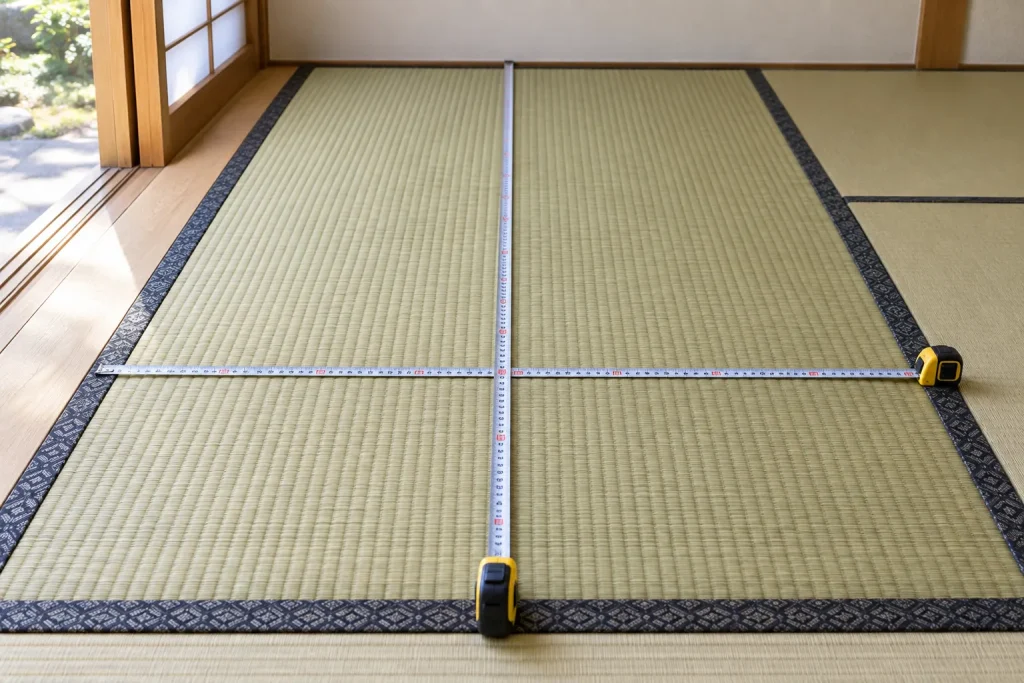
京間, kyōma, literally “Kyoto interval,” is among the largest widely cited formats. A common reference dimension is approximately 191 centimeters by 95.5 centimeters, producing about 1.82 square meters, or 19.6 square feet.
団地間, danchima, “housing-complex interval,” is considerably smaller. A commonly cited dimension is approximately 170 centimeters by 85 centimeters, producing about 1.45 square meters, or 15.6 square feet. It is associated with postwar apartment and housing-complex construction rather than one historical region.
江戸間, edoma, “Edo interval,” is often given as approximately 176 centimeters by 88 centimeters. That produces about 1.55 square meters, or 16.7 square feet. 中京間, chūkyōma, “central-capital interval,” is commonly listed at approximately 182 centimeters by 91 centimeters, or about 1.66 square meters and 17.9 square feet.
| Mat convention | Common dimensions | Approximate area | Approximate US area |
|---|---|---|---|
| Kyōma | 191 × 95.5 cm | 1.82 m² | 19.63 sq ft |
| Chūkyōma | 182 × 91 cm | 1.66 m² | 17.87 sq ft |
| Edoma | 176 × 88 cm | 1.55 m² | 16.68 sq ft |
| Danchima | 170 × 85 cm | 1.45 m² | 15.61 sq ft |
| Advertising jō | Not a physical mat size | At least 1.62 m² | At least 17.44 sq ft |
These dimensions are conventional reference sizes, not a guarantee that every mat sold under a familiar name matches them exactly. Real rooms may use custom-cut mats, half mats, borderless mats, or dimensions adjusted to the building.
What does six jo work out to in practice?
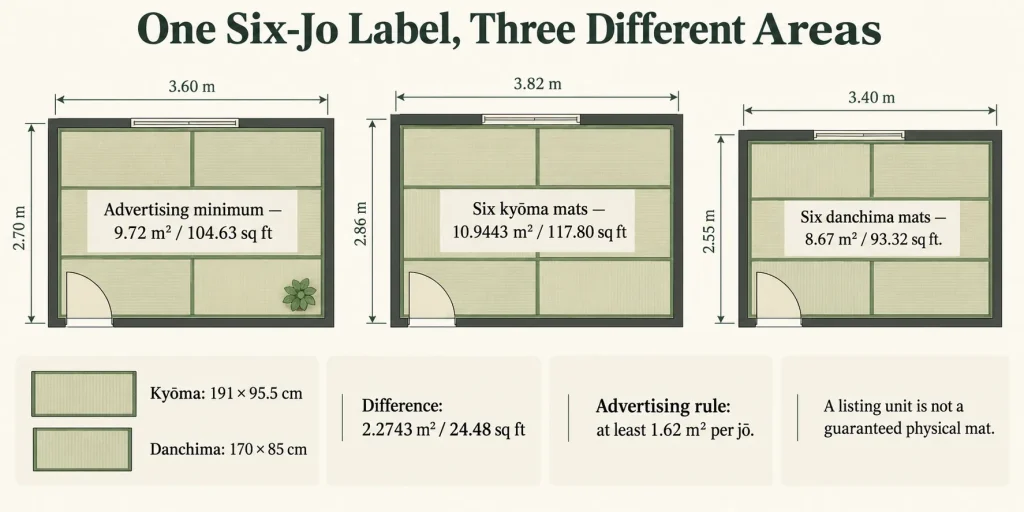
Start with the number printed in the listing. Multiply it by 1.62 square meters to obtain the minimum area represented under the advertising convention. Then multiply the square-meter result by approximately 10.7639 to convert it to square feet.
For a six-jō listing, the calculation is:
- 6 × 1.62 m² = 9.72 m²
- 9.72 × 10.7639 = approximately 104.63 sq ft
Now compare that standardized listing figure with six physical mats made to the two sizes at the ends of the common range:
- Six kyōma mats: 6 × 1.82405 m² = 10.9443 m², or approximately 117.80 sq ft.
- Six danchima mats: 6 × 1.445 m² = 8.67 m², or approximately 93.32 sq ft.
- Difference: 2.2743 m², or approximately 24.48 sq ft.
That difference is larger than the floor area occupied by one danchima mat. Put another way, a room covered by six large kyōma mats can offer about 26 percent more mat area than one covered by six danchima mats. The percentage is calculated from the conventional dimensions above and should not be transferred automatically to a specific apartment.
This is why six jo room size cannot be reduced to one mental picture. Six jō in an advertisement, six visible kyōma mats, and six visible danchima mats answer different questions.
| Six-unit comparison | Area in m² | Area in sq ft | Difference from listing minimum |
|---|---|---|---|
| Six kyōma mats | 10.9443 | 117.80 | +1.2243 m² / +13.18 sq ft |
| Six advertising jō | 9.72 | 104.63 | Reference value |
| Six danchima mats | 8.67 | 93.32 | −1.05 m² / −11.30 sq ft |
| Kyōma-to-danchima total gap | 2.2743 | 24.48 | Full comparison gap |
What changes the usable size of the room?
The advertised jō count is only the start. Room shape, wall thickness, structural columns, door movement, storage, and the method used to calculate area all affect what the room feels like after you move in.
A long narrow room and a nearly square room can have the same stated area but accept different furniture. A bed may technically fit while blocking a closet, balcony door, or the route from the entrance. A structural column projecting into one corner can remove the exact space where a desk or dresser would otherwise go.
The wall-center method also deserves attention. 壁芯面積, kabeshin menseki, “wall-center area,” measures to the center line of surrounding walls rather than only the floor surface you can touch. That means the usable internal floor can be smaller than the headline multiplication suggests.
These variables do not have a reliable universal deduction. There is no defensible rule that says every six-jō room loses a fixed number of square feet to walls or columns. For a specific rental, the dimensions on the plan and an in-person measurement are more informative than the room label alone.
Before comparing homes, record:
- The advertised jō count
- The total square-meter figure
- The room’s internal length and width
- The position of closets and doors
- Any projecting columns
- Whether the room actually contains tatami
- The clear route through the room
The neighboring guide Why the Floor Steps Up Inside the Door explains another place where floor geometry affects daily use. The genkan’s lower floor and raised threshold can occupy more of a compact apartment plan than a US renter initially expects.
How does the listing compare with an American bedroom?
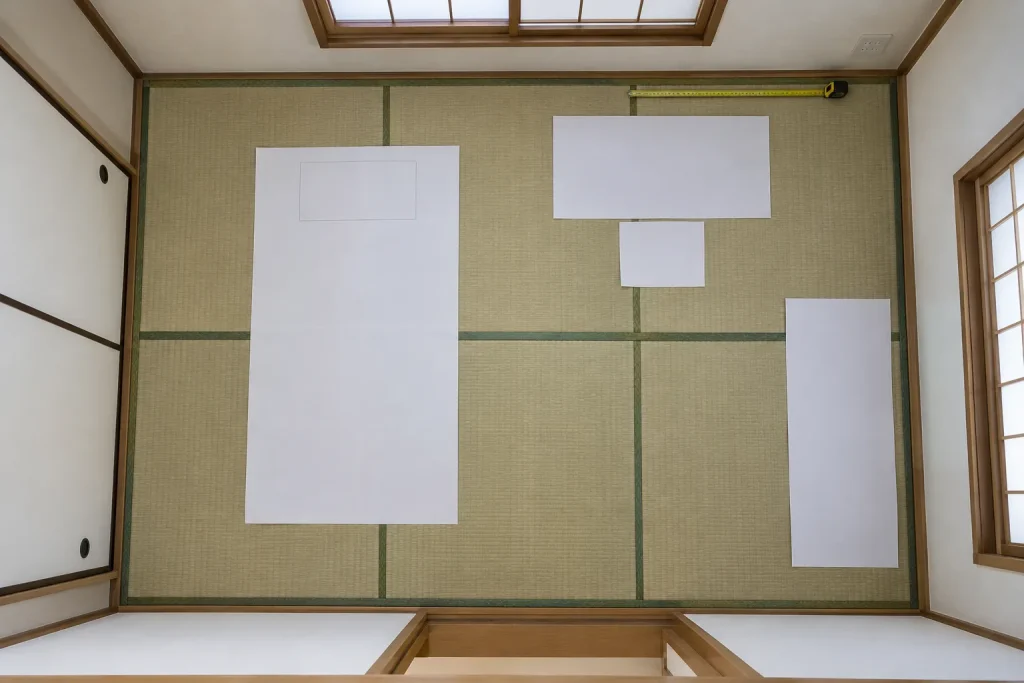
The advertising minimum for six jō is about 104.63 square feet. That gives an American reader a useful scale, but it should not be treated as a legal equivalence to a US bedroom.
US rules differ by state, city, housing program, and building code. Requirements may address floor area, ceiling height, windows, ventilation, emergency escape, or occupancy. A Japanese room described as six jō is not automatically a code-compliant bedroom under the rules where you live.
The more useful comparison is furniture. A six-jō room can often function as a compact bedroom or private living space, but the result depends heavily on shape and storage. A Western bed, desk, chair, and freestanding wardrobe consume the area differently from folded bedding and built-in storage.
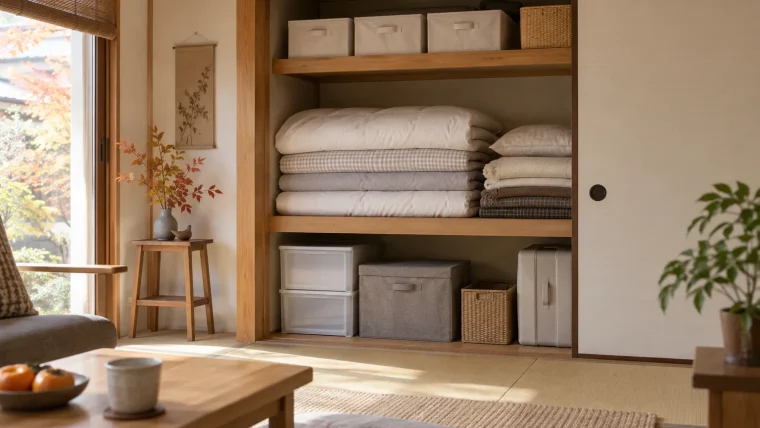
Tatami rooms were not designed around the assumption that one permanent piece of furniture defines the room all day. 布団, futon, literally “padded bedding,” can be stored after use, allowing the same floor to support sleeping, sitting, and other activities. That flexibility explains part of the mismatch between a small numerical area and how the room may be used.
The uncomfortable part for renters is simple: Japanese apartment room size is easy to overestimate from a floor plan. The jō label provides a comparison unit, not a promise that your furniture will fit.
Is the four-corner tatami layout really only used at funerals?
The short answer is no—not literally and not today. The claim contains a real traditional association, but “only at funerals” is too absolute.
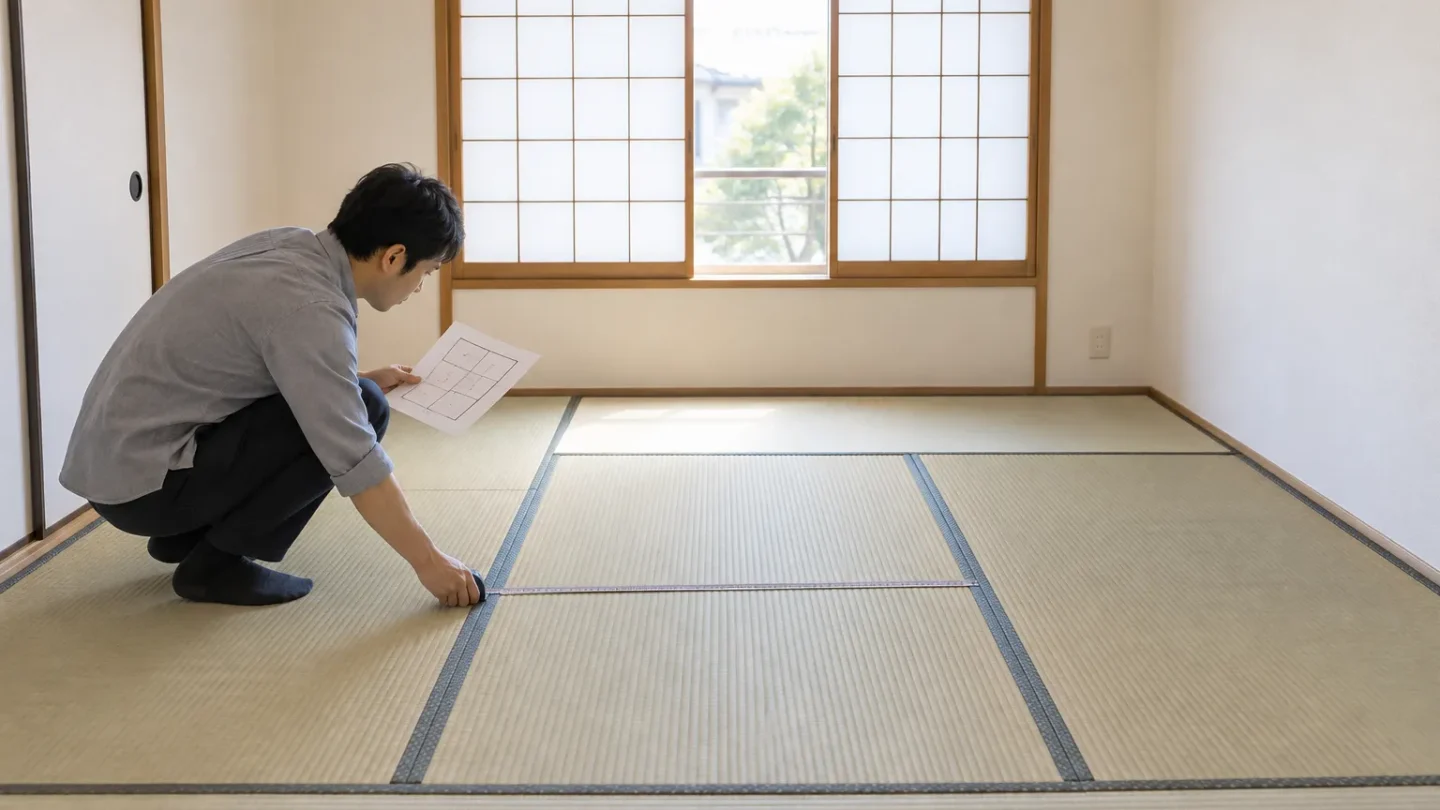
A common residential arrangement is called 祝儀敷き, shūgi-jiki, “auspicious-event laying.” Mats are arranged so that the corners of four mats do not meet at one cross-shaped point. The layout creates broken seams rather than a continuous grid.
The contrasting arrangement is called 不祝儀敷き, fushūgi-jiki, “inauspicious-event laying.” Mats may be laid in parallel or in a pattern that creates cross-shaped meetings. Japanese tatami businesses and housing references associate this style with funerals and other mourning occasions, when mats were historically rearranged.
“No four corners should meet at one point” is the recognizable rule behind an auspicious tatami arrangement.
However, the funeral explanation is a tradition, not a building law. Parallel or cross-seam layouts also appear in temples, inns, banquet rooms, and other large spaces where practicality can matter more than residential symbolism. Some contemporary homes use unconventional layouts or square borderless mats that do not follow the old pattern cleanly.
You therefore should not describe every cross joint as evidence that a room was prepared for a funeral. Nor should you promise that every Japanese observer regards the pattern in exactly the same way. The accurate version is that tatami mat arrangement traditionally avoids four-corner intersections in ordinary residential rooms because the alternative is associated with mourning.
Which number should you trust before renting?
Use the total area in square meters as the main comparison between listings. Treat the jō count as a quick room label and any visible tatami as a separate physical feature.
If a listing gives both square meters and jō, redo the arithmetic. Dividing the stated room area by the jō count shows the conversion used by the advertiser. Under the fair-advertising rule checked in September 2026, the result should not be below 1.62 square meters per advertised jō.
For furniture planning, request or measure internal wall-to-wall dimensions. The phrase 寸法を確認できますか, sunpō o kakunin dekimasu ka, “Can I confirm the dimensions?” is more useful than asking whether the room is “big.” The site’s phrasebook with 337 everyday phrases can help with rental and daily-life exchanges without duplicating the full tool here.
A workable checking sequence is:
- Read the jō count.
- Find the square-meter area.
- Multiply jō by 1.62.
- Compare the two figures.
- Check internal dimensions.
- Map your furniture onto the usable floor.
The figure to remember is one jo equals at least 1.62 square meters in a Japanese property advertisement. That standard was checked on September 13, 2026 and should be rechecked against the Real Estate Fair Trade Council Federation rules before publication on October 20, 2026.
Mini-FAQ
Is one jo the same as one physical tatami mat?
Not necessarily. In a property advertisement, jō is an area conversion using at least 1.62 square meters per unit. A physical mat may follow kyōma, edoma, danchima, or another size.
How many square feet is a six-jo room?
Using the advertising minimum, six jō represents 9.72 square meters, or approximately 104.63 square feet. The usable floor can differ because of wall-center measurement, shape, columns, and other structural details.
Are tatami mats always rectangular?
Traditional full mats are generally rectangular, and half mats may be used to complete a layout. Contemporary rooms may also use square borderless mats, so the visible arrangement is not always a grid of identical full-length mats.