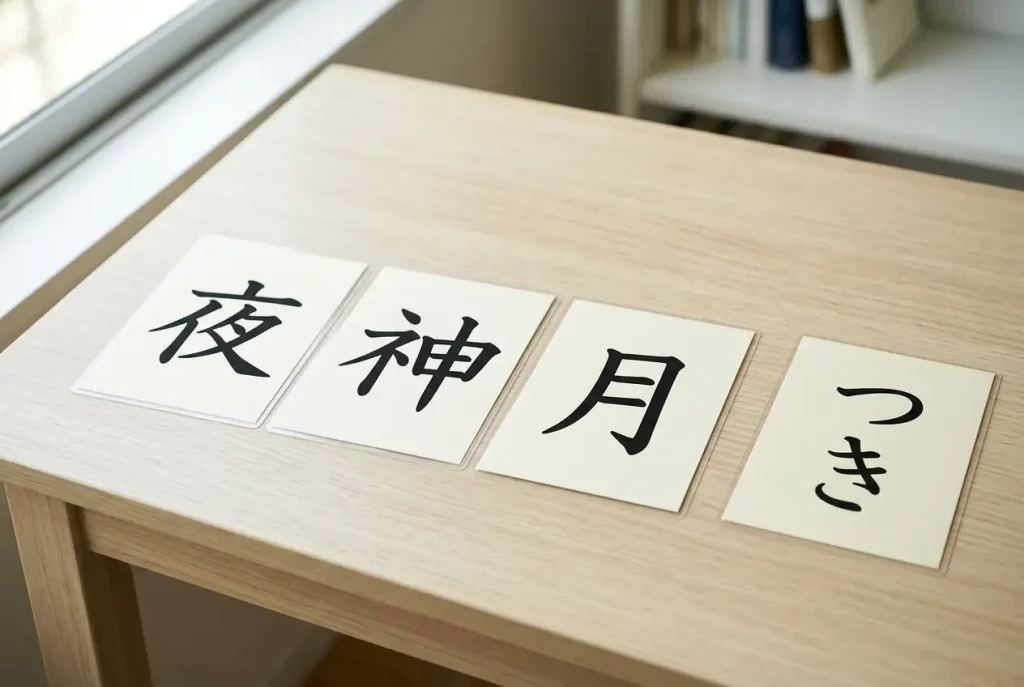
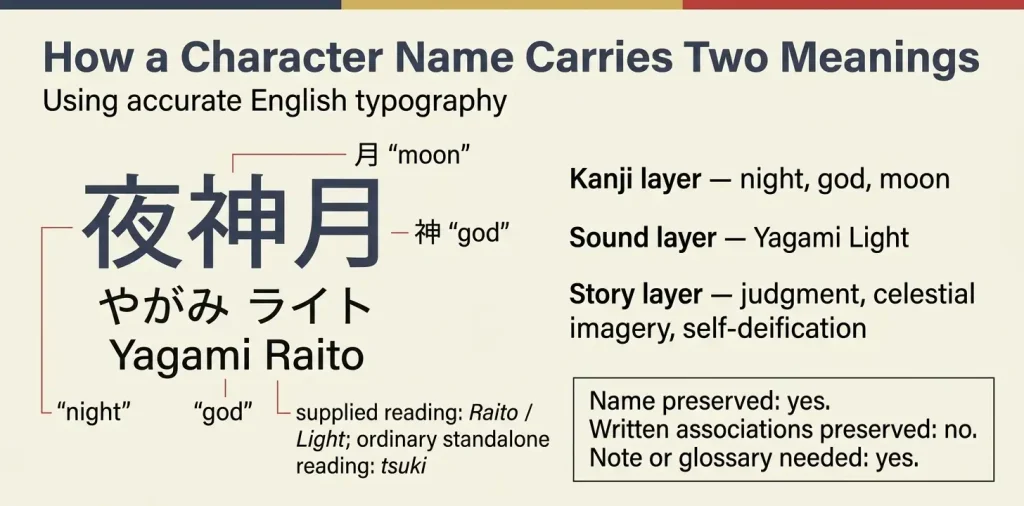
Japanese authors can assign a character name a reading that the written characters do not normally produce. That is the mechanism behind much of the kanji meaning in anime names: you hear one name, see another layer on the page and understand a third idea when the two are placed together. 夜神月 is officially read Yagami Raito—Light Yagami—even though 月 ordinarily means “moon” and does not give you the English-derived reading Raito.
This is not a secret code in which every stroke predicts personality. It is a controlled gap between writing and pronunciation. Manga can show the kanji with small reading text beside it, while anime supplies the pronunciation through dialogue. A viewer using English subtitles usually receives “Light Yagami” and loses the moment when moon, light, night and god occupy the same written name.
The wider mechanics of surnames, given names and multiple legitimate readings belong in Character Names in Japanese: Meaning, Kanji and Readings. Here the question is narrower: how does an author make the written name carry a joke or judgment that its sound cannot carry alone?
The reading and the spelling are separate channels
Japanese names written in kanji have at least two channels. The characters contribute visual meaning and associations; the reading tells other people what to say. Those channels often correspond, but not as mechanically as a beginner expects.
A character such as 月, tsuki, “moon,” has established word readings and conventional appearances in names. Writing 月 and declaring the reading Raito, the Japanese approximation of English “Light,” is something more aggressive. The written symbol supplies moonlight and celestial imagery, while the pronunciation supplies the English concept of light.
Manga makes this possible through 振り仮名, furigana, literally “assigned kana,” printed beside or above kanji to state the intended reading. Furigana can provide an ordinary pronunciation, help younger readers or override the expected reading entirely. Once the author prints the override, that reading is canonical inside the work even if a dictionary would never produce it.
This separation explains why searching only for the pronunciation fails. Looking up Raito may lead you to the borrowed English word ライト, raito, “light.” Looking up 月 leads to the moon. The name works because the story asks you to hold both results at once.
Nanori is the normal complication, not a license for anything
名乗り, nanori, literally “name declaration,” refers to readings associated specifically with personal names. Kanji dictionaries often list name readings separately because a character can behave differently in a name than it does in an ordinary word.
This is the first mechanism outsiders encounter, and it can create the mistaken idea that every surprising fictional reading is simply nanori. It is not. A genuine name reading belongs to an established naming tradition, even if it is uncommon or difficult to predict. An authorial override may instead be 義訓, gikun, “meaning-based reading,” in which the printed reading expresses the intended idea rather than the normal sound of the characters.
The boundary is not always tidy. Some creative names reuse rare established readings, while others combine a conventional name sound with kanji selected mainly for meaning. Modern naming practice also allows parents and authors to stretch familiar correspondences without abandoning them entirely.
For 夜神月, calling Raito an ordinary nanori of 月 would be misleading. The published reading is real for the character, but it is not a standard personal-name reading that lets you identify an unrelated person named 月. The choice behaves more like an authored gloss built around English “Light.”
| Mechanism | What determines the sound | What the characters contribute | Common misunderstanding |
|---|---|---|---|
| Ordinary reading | Established Japanese word reading | Lexical meaning | Every name follows it |
| Nanori | Conventional personal-name reading | Meaning plus naming tradition | It can be predicted easily |
| Meaning-based override | Reading deliberately supplied by the author | Image, theme or joke | It must appear in a dictionary |
| Sound-based pun | Similar pronunciation between expressions | Kanji may reinforce or redirect it | The spelling is irrelevant |
The practical lesson is that nanori readings explain many real names, but they do not explain every flamboyant fictional one.
Why 夜神月 carries more than “Light Yagami”
夜神 combines 夜, yoru or ya, “night,” with 神, kami or gami, “god.” As a surname, it is read Yagami. 月 means “moon,” but the given name is supplied as Raito, “Light.” On the page, the name can therefore suggest a light or moon placed beside a night god.
That does not prove one authorized English sentence such as “the moonlight god of night.” Kanji compounds do not become full translations merely because their component meanings are evocative. The safer claim is that the chosen forms create a cluster of associations unusually appropriate to a character who judges others and imagines himself remaking the world.
The name also changes depending on the medium:
| Medium | What the audience receives | What is easy to miss |
|---|---|---|
| Japanese manga | 夜神月 plus the supplied reading | Very little if the reader notices both layers |
| Japanese anime | Spoken Yagami Raito; kanji may appear on screen | The written construction when the name is only heard |
| English subtitles | Usually “Light Yagami” | Night, god and moon associations |
| English dub | Spoken “Light Yagami” | The same written contrast |
| Translator’s note | Reading and components can be explained | Timing, surprise and visual elegance |
An English subtitle cannot display all of those meanings naturally every time the name is spoken. Writing “Light ‘Moon’ Night-God” would stop being a name and start becoming commentary. A translator can preserve the official name or replace it with an explanation, but cannot make one short English label perform both jobs invisibly.
The problem is not finding an English word for 月. The problem is preserving a written moon that is pronounced “Light.”
Kanji choice can build a character before the plot does
Authors can choose among homophones—different kanji with the same or similar pronunciation—to make a name feel gentle, ominous, mechanical, old-fashioned or conspicuously artificial. The audience hears the same syllables but reads a different set of implications.
That technique is especially useful in manga because the name appears beside the character before the story has explained much. A kanji connected with victory can suggest competitiveness. A character associated with fire or explosions may receive characters that visually reinforce power or combustion. An unusually grand name can signal the parents’ ambition, the character’s ego or the deliberately heightened world of the series.
The risk is overreading. A kanji’s broad dictionary meaning is not a complete personality diagnosis. Characters can share a kanji without sharing temperament, and authors sometimes choose a spelling for rhythm, appearance or family consistency rather than prophecy.
This is why a reliable explanation begins with three pieces of evidence:
- The official written form.
- The officially supplied reading.
- A story connection strong enough to justify mentioning.
Without all three, an online “name meaning” can become fan speculation presented as translation. Anime character name meanings are strongest when the orthography and the narrative independently point in the same direction.
The name can hide a sentence-like joke
Some character names become funny only when you read several components together. The surname may set up a location or category, and the given name completes the phrase. 月野うさぎ, Tsukino Usagi, can be heard like 月の兎, tsuki no usagi, “rabbit of the moon,” the familiar Japanese image connected with the moon.
The written surname 月野 means “moon field,” while うさぎ, usagi, “rabbit,” is written in hiragana in the character’s name. The sound creates a phrase-like bridge: Tsuki no Usagi. Romanization preserves the sound reasonably well but not the instant recognition of the Japanese expression.
Other names lean more heavily on sound. 斉木楠雄, Saiki Kusuo, resembles サイキックス, saikikkusu, “psychics,” when manipulated as a running sound joke. That is not the same mechanism as 月 read Raito. One places an unexpected pronunciation onto a character; the other assembles a pun from the sound of the full name.
This distinction matters because not every Japanese name pun is hidden inside individual kanji. Sometimes the characters add a second joke, while the primary mechanism is phonetic. Sometimes the name is written in kana specifically to keep the sound more visible.
Subtitles must choose which layer survives
A subtitle appears while the scene continues. It cannot pause for an etymological paragraph every time a name enters the dialogue. The translator normally preserves the official romanized name, because consistency matters more than explaining the joke repeatedly.
A footnote, translator’s note or separate glossary can explain that 月 means “moon” while the supplied reading is Raito. Manga editions have more physical room for such a note than streaming subtitles. Even there, editorial policy may avoid notes because they interrupt the page or assume knowledge the original reader was never formally taught.
A dub has less room. The actor needs a pronounceable name that matches established branding and lip timing. Rewriting Light as “Moonlight” would expose one association while destroying the official identity, and translating 夜神 literally would make the surname sound like a title.
Anime Speech Styles, and What Subtitles Cannot Carry explains the parallel problem in dialogue: pronouns, sentence endings and register can identify a speaker even when the English sentence sounds neutral. Japanese Honorifics in Anime: -san, -kun, -chan and the Rest covers the relationship information attached after the name. A name pun combines both translation problems because the loss begins before the character has completed a sentence.
The consequences go beyond one hidden joke
First, two viewers can know the same character by different amounts. The viewer hearing only the dubbed name knows who Light is. The reader who also sees 夜神月 receives a visual argument about him every time the name appears.
Second, a reveal can happen through typography rather than dialogue. A story may withhold the kanji, display a different spelling or use furigana that changes the apparent meaning. Translating only the sound removes the mechanism by which the reveal occurs.
Third, search results become unreliable. Romanized names collapse different kanji spellings into the same Latin letters. A fan searching for the “meaning” of a name may find a real person’s conventional spelling and incorrectly attach it to a fictional character.
Fourth, pronunciation is not proof of spelling. Hearing Haruka, Akira or Yūki does not tell you which kanji the author selected—or whether the name is written in kanji at all. The site’s name converter with 898 checked names in katakana solves a different task: representing foreign names by sound. It does not manufacture a meaningful kanji identity for them.
Finally, learning these jokes from anime can create false confidence. What Anime Teaches and What It Quietly Skips explains why repeated exposure helps listening while leaving writing conventions unexplained. You may hear a name correctly for an entire series and still have no basis for writing it.
Not every meaningful name is a pun
A transparent name is not automatically a joke. An author may select kanji whose meanings fit a character without building a second reading or comic phrase. That is symbolism or characterization, not necessarily wordplay.
A rare reading is not automatically invented either. Real Japanese names contain established nanori that a general learner’s dictionary may omit. Declaring every unfamiliar reading “anime nonsense” confuses limited dictionary coverage with authorial invention.
The reverse mistake is treating every fictional spelling as a realistic naming model. Authors control furigana and can assign readings for thematic effect. A legally registered real-world name operates under administrative rules and social expectations that a manga panel does not have to obey.
Names written only in katakana or hiragana can still carry wordplay. Kana removes the direct semantic layer of kanji but preserves homophones, foreign-language echoes and visual tone. The games discussed in The Games Behind Clannad, Fate and Steins;Gate often have enough text space to exploit repeated name spellings, route-specific reinterpretations and interface typography.
A footnote explains the mechanism but cannot recreate it
A note can state that 月 means “moon” and is read Raito. It can explain 夜神 as “night” plus “god.” What it cannot reproduce is the original reader’s experience of seeing familiar characters, encountering an impossible-looking reading and understanding that the mismatch itself describes the character.
Localization therefore has three imperfect options:
- Preserve the official name and lose the visible semantic layer.
- Add a note and interrupt the scene or page.
- Rewrite the joke and risk changing the character’s identity.
The first is usually the least damaging for a recurring proper name. Notes work well in an article, glossary or annotated edition precisely because those formats allow the reader to stop. Subtitles generally do not.
The rule of thumb is this: when an anime name seems unusually perfect, check the official kanji and its supplied reading before translating either one.
Full FAQ
Is Light a normal reading of 月?
No. 月 commonly means “moon” and has established Japanese readings such as tsuki, getsu and gatsu. The character’s supplied reading Raito derives from English “Light” and is not an ordinary dictionary or traditional name reading of 月.
Is Raito a nanori reading?
It is better described as a creative, meaning-based authorial reading in this case. Nanori refers to readings conventionally used in personal names; it should not become a catch-all label for every fictional furigana override.
What does 夜神月 literally mean?
Its components are associated with “night,” “god” and “moon,” but the name is not a normal sentence with one mandatory literal translation. “Night god moon” is a component gloss, not natural English and not an official character title.
Why not translate the surname as Nightgod?
Because the official character name is Yagami, and proper names are normally preserved rather than converted into English compounds. “Nightgod Light” would expose one layer while changing the identity used throughout the franchise.
Are all meaningful anime names jokes?
No. Some are puns, some are symbolic choices, some use ordinary name readings, and others merely sound suitable. A meaning becomes persuasive when the official spelling, official reading and story function support it together.
Can subtitles preserve a kanji pun?
They can explain it with a note or additional on-screen text, but a normal subtitle cannot make one English name carry both the Japanese pronunciation and the visual meanings of several kanji. Something usually has to be explained outside the spoken line.
Can you determine a character’s kanji from the spoken name?
Usually not with certainty. Many Japanese names have several possible spellings, and fictional authors may use kana, uncommon name readings or deliberately assigned furigana.