Shojin ryori temple food, ordinary vegan food, and vegetarian Japanese cooking are often treated as interchangeable. They are not. 精進料理, shōjin ryōri, literally “devotional cuisine,” developed as part of Buddhist practice rather than as a modern dietary label. It excludes meat and fish, normally replaces fish-based dashi with plant-based stock, and traditionally avoids the five pungent roots. That makes it one of the most dependable plant-based meals you can seek out in Japan—but the word “reliably” still depends on the kitchen, the booking plan, and any allergies you need the staff to manage.
The clearest comparison uses five practical axes: purpose, excluded ingredients, stock, meal structure, and where you can eat it. These matter because they determine what reaches your plate. Broader questions about nutrition or personal ethics may matter to you, but they do not tell a Japanese cook whether bonito stock, garlic, eggs, or dairy belong in the dish.
If you are still learning how Japanese restaurants signal ordering and payment, read Ordering, Paying and the Rules Nobody States first. It explains the transaction systems around a Japanese meal; this guide deals with what the kitchen is actually preparing.
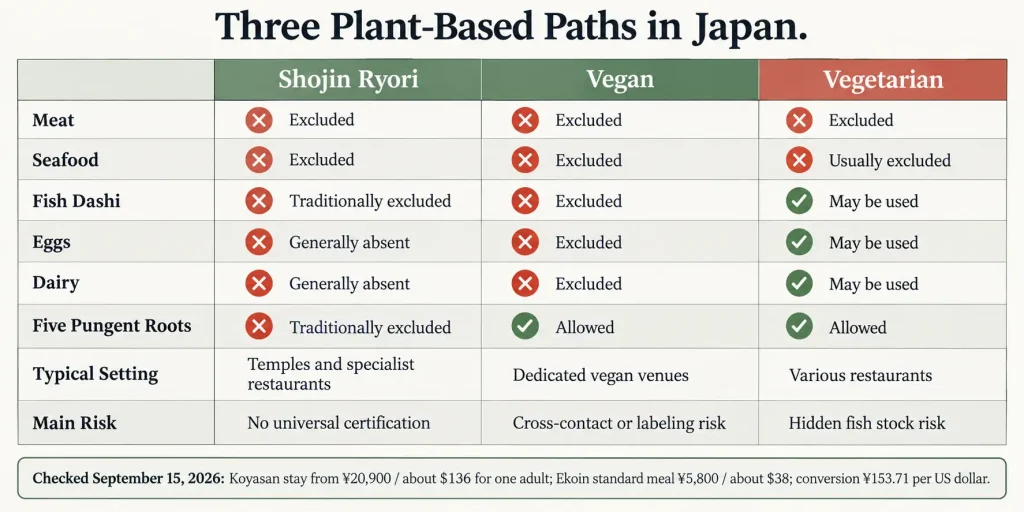
| Axis | Shojin ryori | Vegan food | Vegetarian food |
|---|---|---|---|
| Primary purpose | Buddhist discipline expressed through cooking | Avoidance of animal-derived ingredients | Avoidance of meat, with definitions varying |
| Meat and seafood | Excluded | Excluded | Usually excluded |
| Fish-based dashi | Traditionally excluded | Excluded | May be included in Japan |
| Eggs and dairy | Traditionally absent | Excluded | Often permitted |
| Five pungent roots | Traditionally avoided | Permitted | Permitted |
| Typical setting | Temples, temple lodgings, specialist restaurants | Vegan restaurants and clearly labeled menus | Specialist restaurants or negotiated dishes |
| Main practical risk | Assuming every commercial version follows identical rules | Cross-contact or incorrect labeling | Hidden fish stock |
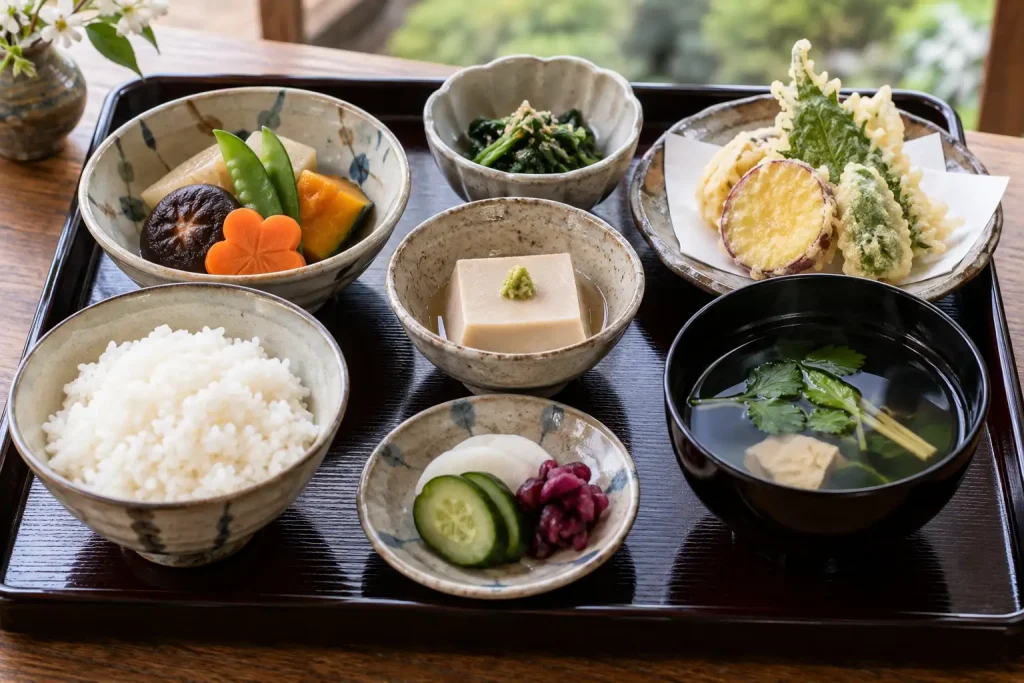
The comparison begins with the reason the meal exists
The term 精進, shōjin, refers to diligent spiritual practice or disciplined devotion. 料理, ryōri, means cooking or cuisine. Shojin ryori is therefore better understood as Japanese Buddhist temple cuisine than as an old Japanese synonym for veganism. Its restrictions belong to a culinary and religious framework, not to a consumer certification system.
The cooking aims to handle ingredients carefully, reduce waste, respect seasonality, and create a balanced meal without relying on animal flesh. Tofu, sesame, sea vegetables, mushrooms, grains, beans, seasonal produce, and preserved foods do much of the work. These are not consolation ingredients standing in for meat. They form the cuisine’s own vocabulary of textures, temperatures, colors, and cooking methods.
“Vegetarian” tells you what may have been removed. Shojin ryori also tells you what kind of cooking replaced it.
A temple meal may appear visually restrained, but it is not necessarily plain. Sesame tofu can be dense and creamy. Mountain vegetables may be simmered, dressed, fried, pickled, or served fresh. Dried shiitake and kombu create depth without bonito flakes, while miso, soy sauce, nuts, seeds, and careful browning supply richness.
Shojin ryori: discipline first, ingredients second
Purpose: Shojin ryori grew from Buddhist food practice. A restaurant may now serve it to travelers as a cultural meal, but its structure still comes from temple cooking rather than the international vegan movement.
Exclusions: Meat, fish, and seafood do not belong in the traditional form. Eggs and dairy are also generally absent. The cuisine traditionally avoids 五葷, gokun, literally “five pungent plants,” although the exact plant list can differ among Buddhist traditions and explanations.
Common Japanese descriptions identify pungent members of the allium family, including garlic, onions, green onions, chives, and leeks or related plants. The reason is not that these vegetables are animal products. They are omitted because Buddhist dietary teachings regard strong smells and stimulating qualities as distractions from disciplined practice.
Stock: This is where shojin ryori differs most usefully from a merely meatless Japanese meal. Traditional stock is based on ingredients such as kombu and dried shiitake rather than 鰹節, katsuobushi, dried bonito. A bowl containing only tofu and vegetables can still be non-vegan when ordinary fish dashi sits underneath it. Shojin preparation is designed to avoid that contradiction.
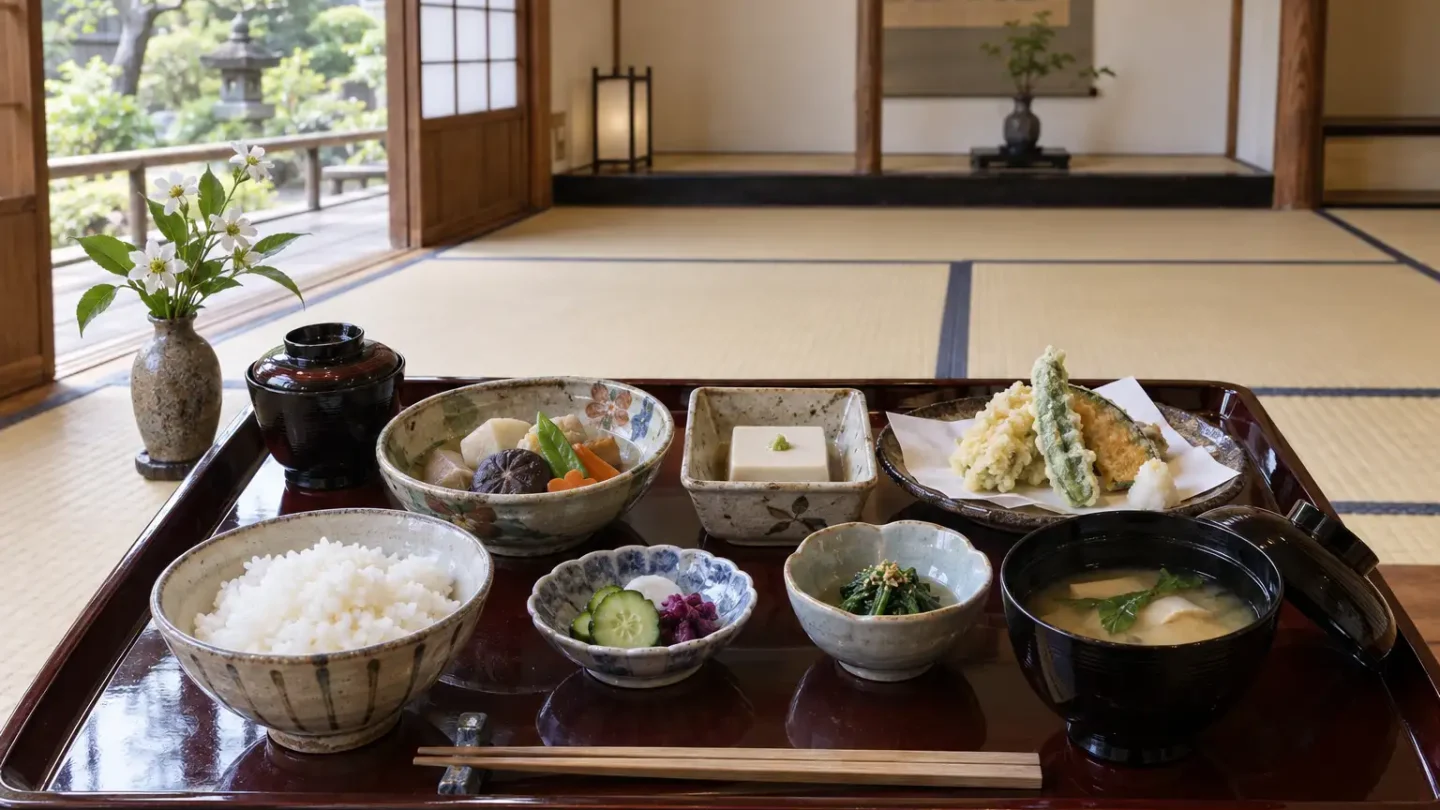
Structure: A meal is commonly built from rice, soup, pickles, tofu or another protein-rich preparation, and several vegetable dishes. The exact arrangement depends on the temple, season, price, and occasion. You should expect a composed course or tray rather than one oversized centerpiece.
Where to eat it: The most coherent setting is a temple lodging, especially on Mount Koya. Specialist shojin restaurants also operate in cities and near major temple districts, but their menus and interpretations must be checked individually.
Choose shojin ryori when you want the cuisine itself, not simply the shortest possible route to a meat-free lunch.
Vegan food: the strict ingredient test
Purpose: Vegan cooking is defined by the absence of animal-derived ingredients. It can reproduce Japanese dishes, borrow temple techniques, or ignore traditional Japanese formats entirely.
Exclusions: Meat, seafood, eggs, dairy, honey, and other animal-derived ingredients are normally excluded under contemporary vegan definitions. Garlic, onions, and the other pungent plants are allowed. A vegan ramen bowl can therefore contain flavors that would be inappropriate in a strict temple preparation.
Stock: Fish stock is excluded, but the alternative does not have to be traditional kombu-and-shiitake dashi. A modern vegan kitchen may use vegetable stock, soy milk, nutritional yeast, tomato, spices, infused oils, or commercial vegan seasonings.
Structure: Vegan food is not tied to a formal course. It can be ramen, curry, a burger, sushi, dessert, or a tasting menu. For help reading common dish types and cooking terms, Japanese Food for Beginners: How to Read a Menu explains how Japanese menus are organized instead of repeating the same menu vocabulary here.
Where to eat it: Look for explicitly vegan restaurants, verified menus, or advance reservations that confirm the kitchen’s policy. The word “vegetable” on a menu is not enough. Nor is a photograph of tofu, mushrooms, or greens.
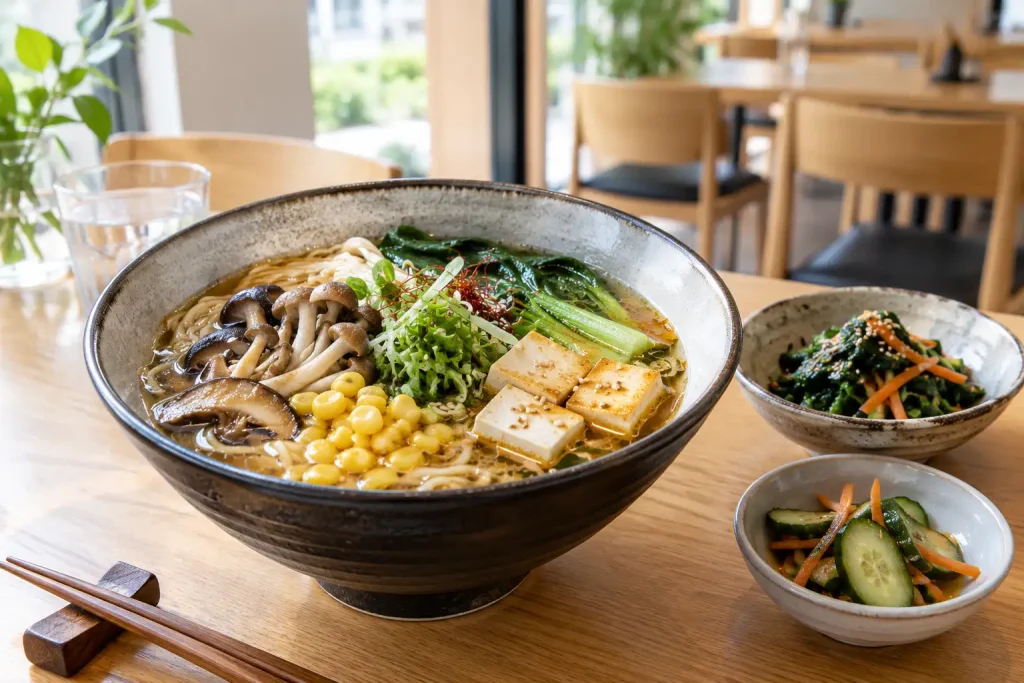
Vegetarian food: the widest and least predictable category
Purpose: Vegetarian food removes meat, but the boundary varies by person, restaurant, and country. In Japan, staff may understand “no meat” literally and still regard fish stock as acceptable.
Exclusions: Some vegetarian diners eat eggs and dairy. Some accept fish stock even if they do not eat visible fish. Others use “vegetarian” when they actually require a completely vegan meal. A restaurant cannot reliably infer which definition you mean.
Stock: Ordinary dashi is the practical problem. Bonito, small dried fish, or mixed fish-and-kelp stock can appear in soup, simmered vegetables, dipping sauce, noodle broth, and seasoning bases. Removing a visible topping does not remove stock already used during cooking.
Structure: There is no standard vegetarian course in Japan. A meal might be assembled from side dishes, adjusted by the kitchen, or prepared from a dedicated menu. That flexibility can be useful, but it also means the label tells you less than “vegan” or “shojin ryori.”
Where to eat it: Vegetarian restaurants and internationally oriented hotels are easier places to make detailed requests. In a small specialist shop, the base broth or sauce may have been prepared before you arrive and may be impossible to replace.
The site’s guide to vegetarian, vegan, and allergy needs in Japan covers hidden stock and the limits of restaurant labeling. Use that article for risk management; use this one to decide whether temple cuisine is the meal you actually want.
The course is small dishes working together
A proper shojin meal is not best understood as a plate of vegetables. It works through contrast. Soft tofu may sit beside crisp tempura. A mild simmered dish may be followed by a sharper pickle. Rice and soup stabilize the meal while seasonal vegetables provide color and variation.
Several techniques commonly appear:
- simmering vegetables in plant-based stock;
- dressing greens with sesame, tofu, or miso;
- frying seasonal vegetables as tempura;
- grilling tofu, eggplant, mushrooms, or wheat gluten;
- pickling vegetables to add acidity and texture;
- preparing soup with kombu and dried mushroom stock.
The course also makes practical use of soybeans in different forms. Tofu, fried tofu, miso, soy sauce, and yuba—湯葉, yuba, literally “hot-water leaf,” or the skin formed on heated soy milk—can appear without making every dish taste alike. Wheat gluten may provide another texture, while sesame paste gives body to dressings and tofu-like preparations.
A visitor accustomed to an American entrée may keep waiting for the “main dish.” That is the wrong map. The meal’s center is the relationship among the bowls, not the largest object on the tray.
| Course element | Likely role | Typical plant-based foundation | What to confirm |
|---|---|---|---|
| Rice | Neutral base | White, mixed, or seasonal rice | Seasonings in mixed rice |
| Soup | Warm savory element | Kombu, shiitake, miso | No bonito or fish stock |
| Tofu dish | Texture and substance | Tofu, sesame tofu, yuba | Sauce and garnish |
| Simmered dish | Seasonal vegetables | Root vegetables, mushrooms, greens | Dashi source |
| Fried or grilled dish | Crispness or deeper flavor | Vegetables, tofu, wheat gluten | Shared fryer if relevant |
| Pickles | Acidity and contrast | Seasonal vegetables | Alcohol or unusual additives if restricted |
Where shojin ryori belongs on a Japan trip
You can eat this cuisine at specialist restaurants, temples offering daytime meals, and 宿坊, shukubō, literally “lodging quarters,” operated by temples. The strongest destination association is Mount Koya, or 高野山, Kōyasan, the major Shingon Buddhist center in Wakayama Prefecture.
The official Koyasan Shukubo Association booking site represents temple lodgings across the mountain and lists meals as part of many accommodation plans. The experience is closer to a traditional Japanese lodging than to checking into a conventional American hotel. Rooms, bathrooms, curfews, meal service, and participation in morning worship vary by temple.
Before reserving, check the following rather than assuming every lodging operates identically:
- Confirm whether both dinner and breakfast are included.
- Read whether the quoted rate is per person or per room.
- Check the room’s bathroom and toilet arrangements.
- Tell the property about allergies before arrival.
- Ask whether alcohol, honey, shared fryers, or cross-contact matter to your definition of vegan.
- Confirm the dinner time, because late arrival can mean missing the meal.
These operational details matter as much as the menu. If the booking includes dinner at a fixed hour, the temple cannot necessarily hold a multi-dish meal while you finish sightseeing. For the wider mechanics of paying and ordering, Paying Before You Sit Down explains prepaid noodle-shop systems, while The Small Dish You Never Ordered and Must Pay For covers izakaya charges. Neither system should be assumed at a temple lodging.
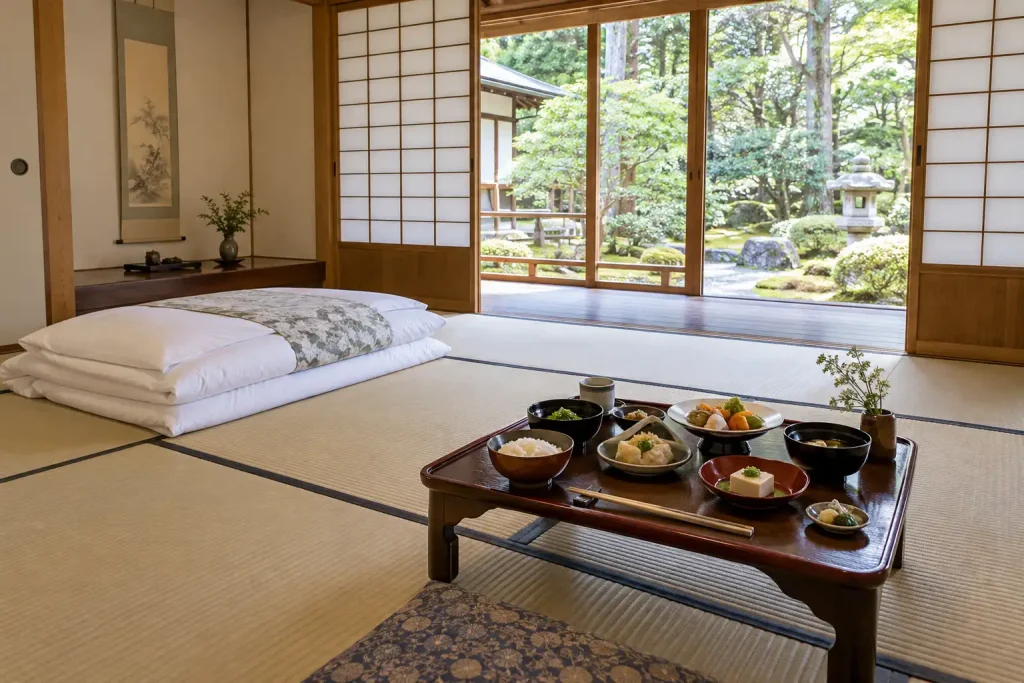
What a night with dinner actually costs
There is no honest single price for a Koyasan temple stay. Rates change with the temple, room, occupancy, season, meal level, and booking date. The official association’s standard-room listing showed rates beginning at ¥20,900 per adult for single occupancy and ¥19,800 per adult when two guests shared, including tax, when checked on September 15, 2026. Using the Federal Reserve’s September 11, 2026 reference rate of ¥153.71 per US dollar, those amounts were approximately $136 and $129.
Those figures are examples, not a mountain-wide tariff. Upgraded rooms, private facilities, larger meal courses, and peak dates can cost considerably more. The official booking portal displayed multiple temple plans rather than one standardized package, so Koyasan temple lodging prices must be checked for your exact date and party size.
Ekoin’s official meal page separately listed standard shojin dinner courses from ¥5,800, approximately $38 at the same exchange rate, and a deluxe course at ¥7,800, approximately $51, when checked on September 15, 2026. Those meal-only examples should not be confused with the cost of an overnight stay.
The uncomfortable part is that the lowest price shown in search results may assume two people sharing, while a solo traveler pays a higher per-person rate.
Where the differences stop mattering
For an ordinary traveler without allergies, the distinction may not matter when a reputable restaurant clearly promises a fully plant-based meal and you are comfortable eating garlic or onions. A dedicated vegan restaurant may be more convenient than crossing a city for temple cuisine. It may also offer easier communication, longer service hours, and familiar online reservations.
The difference also becomes less important when your goal is simply to avoid visible meat for one casual meal. In that situation, a clearly explained vegetarian choice may be enough. You still need to decide whether fish stock matters to you, because that is the point at which a relaxed preference becomes a specific ingredient requirement.
Shojin ryori remains the better choice when you want the traditional course, seasonal temple cooking, or a meal naturally designed without ordinary fish dashi. Vegan dining is the better choice when your rule is ingredient-based and includes exclusions that a temple may not discuss automatically, such as honey or cross-contact.
The hidden stock problem that catches visitors
The consequential mistake is ordering a vegetable-looking Japanese dish and treating appearance as proof. A bowl of noodles with mushrooms and greens may use bonito broth. Simmered daikon can absorb fish dashi. A tofu dish may arrive under a sauce prepared from the same stock.
This is why is shojin ryori vegan does not have a perfectly automatic answer. Traditional shojin cooking closely aligns with vegan ingredient rules, but “shojin” is not a government vegan-certification mark. Commercial restaurants can use the term broadly, and individual temples may need advance notice for allergies or stricter personal requirements.
If certainty matters, ask about ingredients before booking or ordering. The site’s Japanese phrasebook contains 337 checked phrases, including ordering and allergy situations. It is safer to use a prepared, specific sentence than to rely on the English word “vegetarian.”
Useful points to communicate include:
- no meat or poultry;
- no fish or seafood;
- no bonito, fish stock, or fish-based seasoning;
- no eggs or dairy;
- any allergy and the seriousness of the reaction;
- whether shared equipment is acceptable.
Do not present a dietary preference as an allergy. At the same time, do not soften a genuine allergy into “I do not like this.” The kitchen needs accurate information to tell you whether it can serve you safely.
Which meal should you choose?
Choose authentic shojin ryori in Japan when you want to experience a complete cuisine shaped by temple practice. Koyasan is the clearest place to connect the food with its setting, particularly through a temple stay that includes dinner and breakfast.
Choose a dedicated vegan restaurant when complete avoidance of animal-derived ingredients is your main goal and you want a kitchen organized around that promise. This can be easier for dessert, casual meals, modern ramen, or diners who actively want garlic and onion.
Choose a vegetarian option only after deciding whether fish stock, eggs, and dairy are acceptable. If they are not, the word “vegetarian” does too little work. The more precise your requirement, the less useful a broad label becomes.
For a first temple meal, reserve in advance, confirm the meal plan, arrive before the stated dinner time, and explain allergies during booking. Then let the meal be what it is: not a substitute for meat, but a cuisine built around grains, soy, vegetables, preservation, seasonality, and restraint.
FAQ
Is all shojin ryori vegan?
Traditional shojin ryori excludes meat, seafood, and fish stock and generally contains no eggs or dairy. However, the term is not a universal vegan certification. Confirm ingredients directly if honey, alcohol, cross-contact, or allergies are relevant.
Does shojin ryori contain garlic or onions?
Traditional versions avoid the five pungent roots, including garlic and several onion-family plants. Exact lists and modern restaurant practices can vary, so do not use this rule as an allergy guarantee.
Can you eat shojin ryori without staying overnight?
Yes. Some temples and specialist restaurants serve daytime meals, while temple lodgings commonly include the cuisine with accommodation. Availability and reservation requirements depend on the venue.
Is shojin ryori expensive?
A specialist meal can cost less than an overnight temple stay, but there is no standard price. On September 15, 2026, checked examples ranged from ¥5,800, about $38, for a standard dinner course at Ekoin to ¥20,900, about $136, for a single-occupancy temple-stay plan listed through the official Koyasan portal.