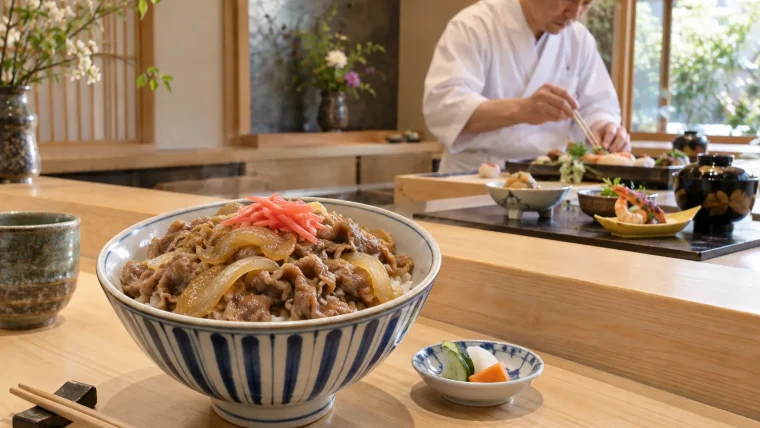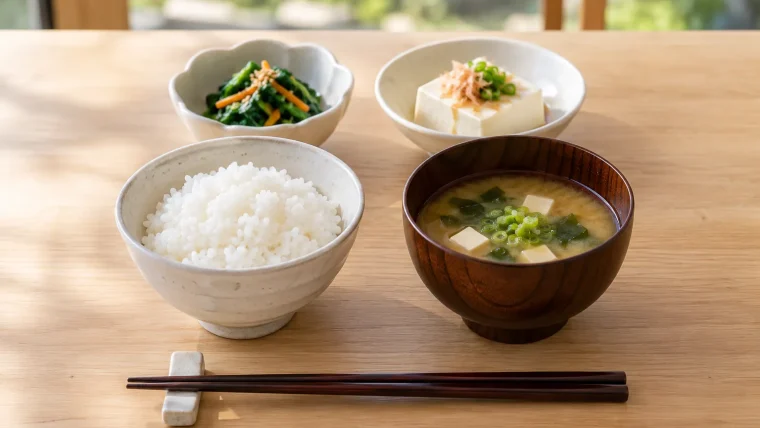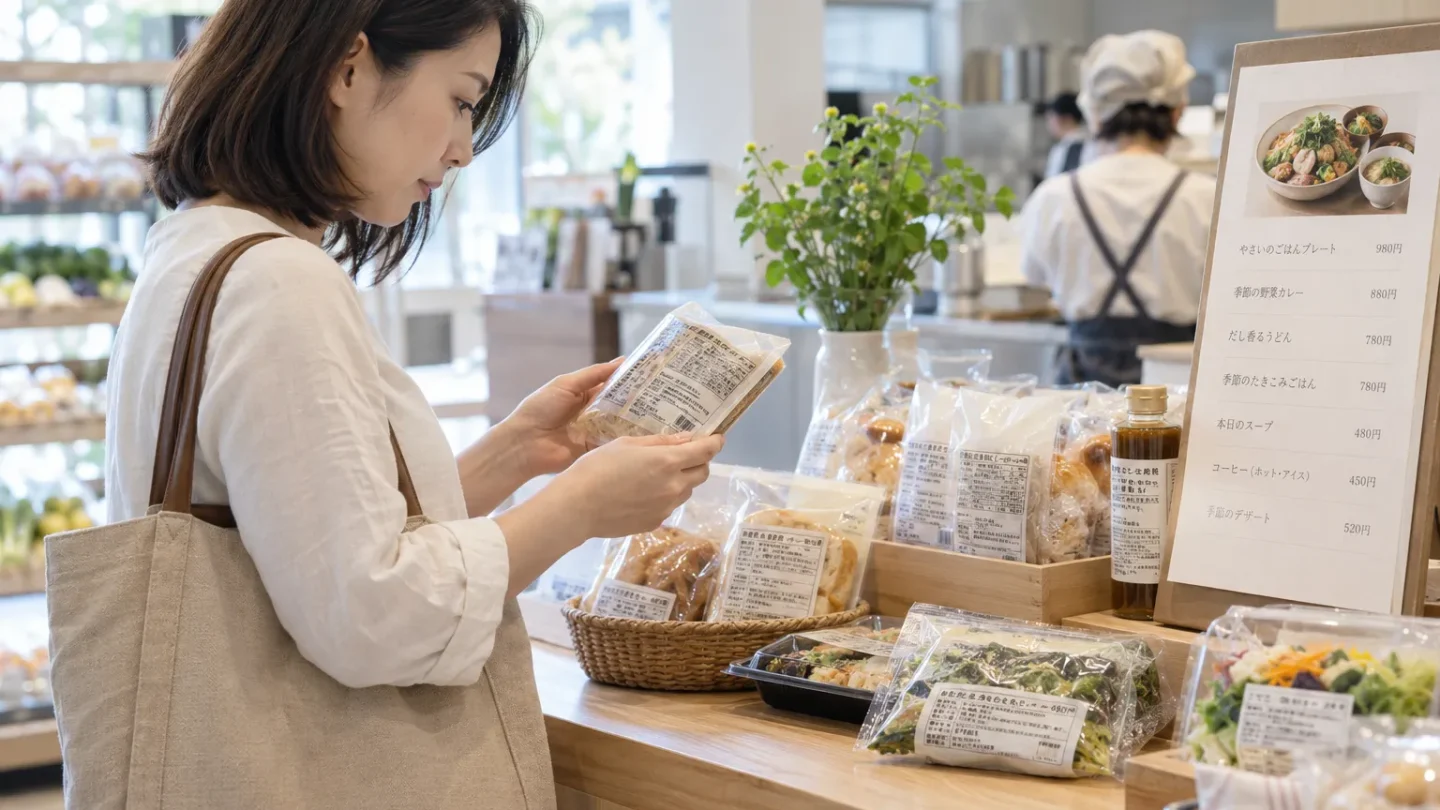
“Japan requires restaurants to disclose major allergens” is false. The national mandatory system behind food allergen labels Japan applies principally to packaged processed foods, while restaurants and other food-service businesses are outside that labeling obligation.
Some restaurants voluntarily publish allergy charts or ingredient information, but that is practice, not a legal guarantee. A blank menu icon, an uncertain staff answer, or the absence of a warning cannot establish that a dish is suitable for someone with a food allergy. This article describes the labeling system as checked on September 13, 2026; it does not determine whether an individual product or meal is safe.
“Japanese restaurants have to list all allergens”
Japanese restaurant allergen rules: FALSE
Japan’s mandatory allergen-labeling rules do not generally cover meals prepared and served by restaurants. The Consumer Affairs Agency has explicitly identified the absence of a mandatory allergy-labeling requirement for 外食, gaishoku, “eating out,” as information consumers need to understand.
This does not mean restaurants never provide information. Large chains may maintain detailed charts, while smaller restaurants may answer questions about ingredients. Neither practice changes the legal boundary: the standardized mandatory system belongs to packaged processed food, not every bowl, plate, or tray prepared after an order.
The gap can be particularly difficult in restaurants where the visible ingredient is only one part of the dish. Broth, sauce, seasoning powder, frying oil, marinades, and ready-made components may come from another supplier. Front-of-house staff may know what the cook adds but not every ingredient in a commercial base.
The broader guide to ordering, paying, and the rules nobody states explains the service conventions surrounding a Japanese meal. Those conventions can help you communicate, but politeness and attentive service should not be mistaken for a medically reliable allergen-control system.
“Japan has eight mandatory food allergens”
Mandatory allergens in Japan: OUTDATED
This was accurate after walnuts joined the mandatory list in March 2023, subject to a transition period that ended in March 2025. It is no longer current for an article scheduled in October 2026.
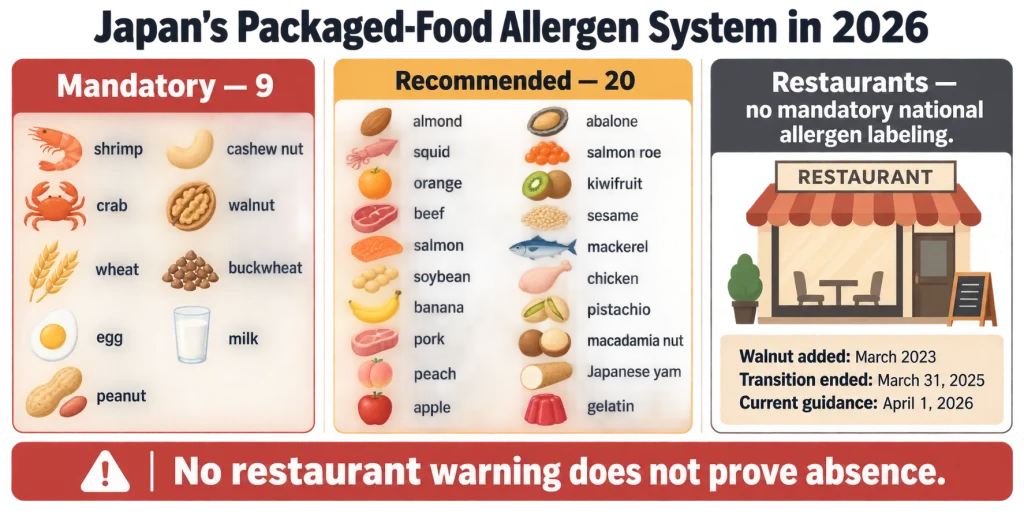
Consumer Affairs Agency guidance published in April 2026 lists nine 特定原材料, tokutei genzairyō, “specified ingredients,” for which labeling is mandatory. Cashew nuts moved into the mandatory group, changing the previous total of eight.
The current mandatory list is:
| Japanese label | Romaji | English |
|---|---|---|
| えび | ebi | Shrimp |
| カシューナッツ | kashū nattsu | Cashew nut |
| かに | kani | Crab |
| くるみ | kurumi | Walnut |
| 小麦 | komugi | Wheat |
| そば | soba | Buckwheat |
| 卵 | tamago | Egg |
| 乳 | nyū | Milk |
| 落花生(ピーナッツ) | rakkasei (pīnattsu) | Peanut |
The uncomfortable part is that the brief’s proposed article title—“Egg, Milk, Wheat, Buckwheat, Peanut, Shrimp, Crab, Walnut”—would omit cashew nuts and present an obsolete count. The original SEO title should therefore not be published unchanged.
“If an allergen is present, it will always be easy to spot”
Japanese food allergy labels: MOSTLY FALSE
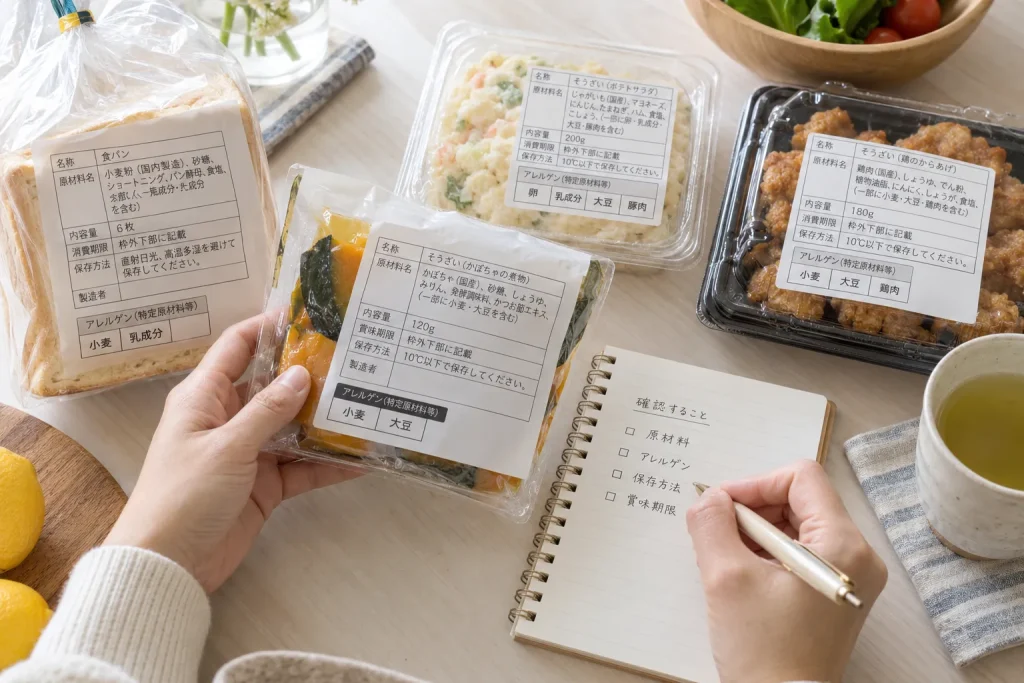
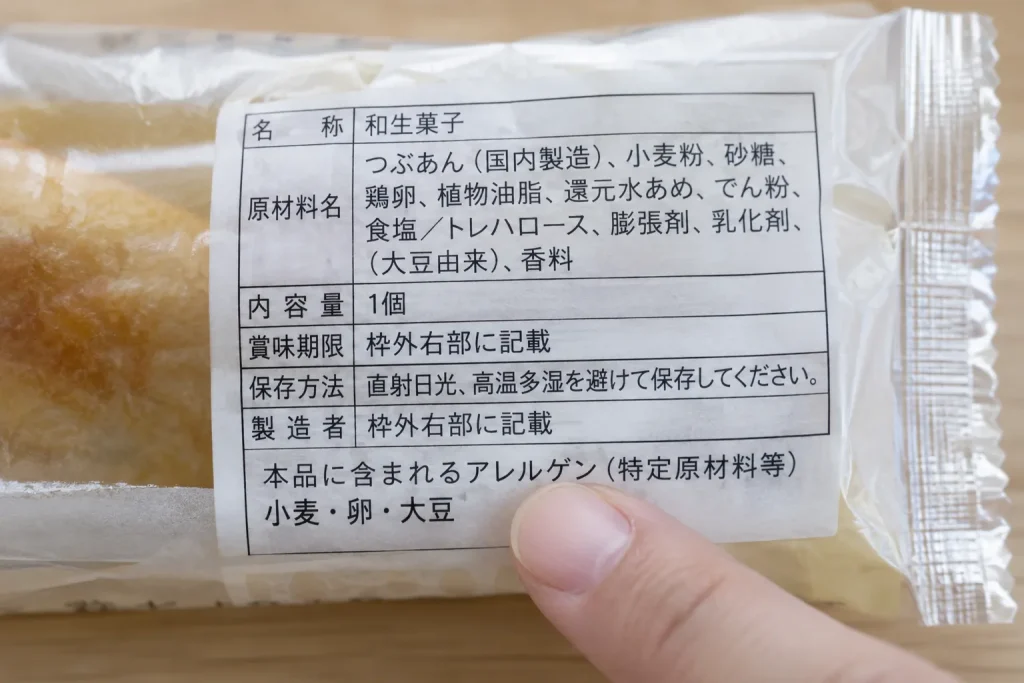
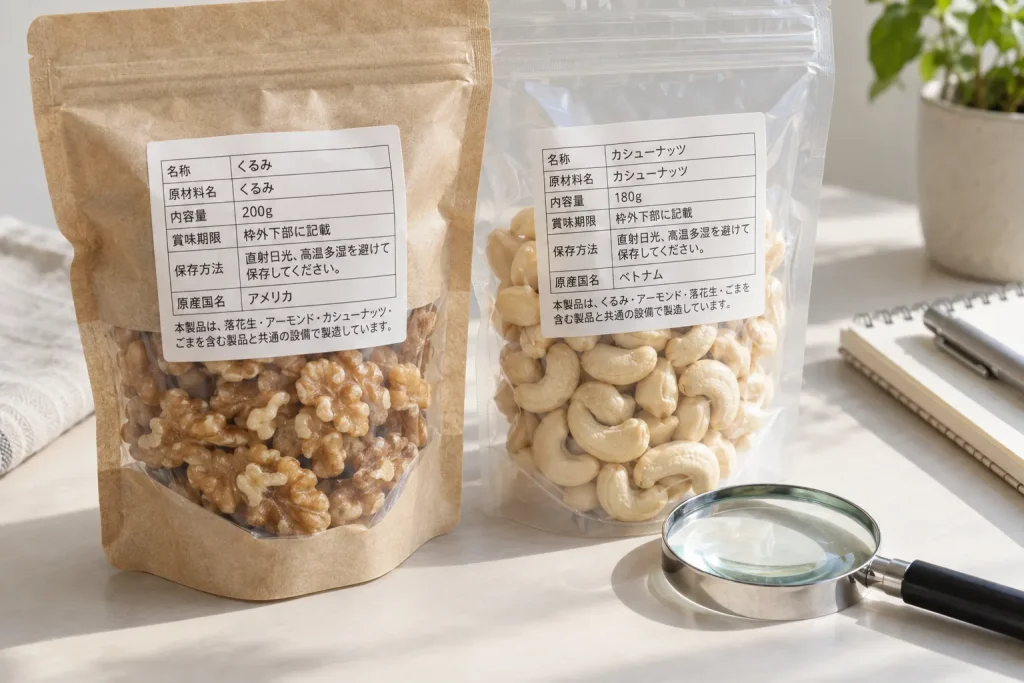
Mandatory allergens must be declared on covered foods, but the declaration may not look like a separate American-style “Contains” box. Japan permits ingredient-by-ingredient identification and, in specified circumstances, a collective statement at the end of the ingredient list.
Look for 原材料名, genzairyōmei, “ingredient names,” and phrases such as 一部に〜を含む, ichibu ni … o fukumu, “contains … in part.” The allergens may appear in parentheses after individual ingredients or together in a concluding parenthetical statement. The layout depends on the product.
Some legally recognized alternative terms can also satisfy the requirement. A label may use a familiar ingredient name that clearly identifies the allergen rather than repeating the standard category word. This makes vocabulary knowledge useful, but it also makes a simple search for one exact kanji string incomplete.
A package may additionally carry voluntary statements about shared manufacturing equipment or possible unintended contact. Those statements are not a substitute for the ingredient declaration, and their wording should be read exactly as printed. If a product’s label is unclear, the descriptive next step is to contact the manufacturer using the number on the package rather than infer safety from the design.
“The other twenty allergens do not have to be mentioned”
Recommended allergen labeling: MOSTLY TRUE
Japan maintains a second group called 特定原材料に準ずるもの, tokutei genzairyō ni junzuru mono, “items equivalent to specified ingredients.” Labeling these ingredients is recommended rather than legally mandatory under the same rule applied to the specified group.
As of the Consumer Affairs Agency guidance issued in April 2026, the recommended group contains twenty items:
| Category | Recommended items |
|---|---|
| Nuts and seeds | Almond, macadamia nut, pistachio, sesame |
| Seafood | Abalone, squid, salmon roe, salmon, mackerel |
| Meat | Beef, chicken, pork |
| Fruit | Orange, kiwifruit, banana, peach, apple |
| Other | Soybean, Japanese yam, gelatin |
The phrase “do not have to be mentioned” is legally close to the truth, but it can mislead readers about actual packaging. Many manufacturers voluntarily declare these allergens, especially when they already maintain structured allergen information. The absence of a recommended allergen from a label, however, does not carry the same legal meaning as the absence of a mandatory one.
The list itself has changed. Macadamia nuts entered the recommended group in 2024, while cashews later moved from the recommended group into the mandatory group and pistachios appeared in the recommended group in the April 2026 guidance. This is why screenshots and travel cards copied from older articles can become unreliable.
The separate article on vegetarian, vegan, and allergy-related food questions in Japan covers hidden animal-derived stock and the difference between dietary preference and allergy communication. Those issues overlap, but they are not interchangeable with the statutory allergen list.
“Walnuts only became mandatory because Japan copied another country”
Why walnuts were added: FALSE
Walnuts were moved into the mandatory category through Japan’s domestic review process. Consumer Affairs Agency materials connect the change to national evidence showing an increase in reported immediate-type reactions involving tree nuts, particularly walnuts and cashews.
The Food Labeling Standards were amended in March 2023 to add くるみ, kurumi, “walnut,” to the mandatory list. A transition period for enforcement continued through the end of March 2025 so businesses could update packaging and production systems.
That history explains why an older package photograph may show seven mandatory allergens and a more recent guide may show eight. It does not mean an expired label is necessarily being sold unlawfully: packaging dates, transition provisions, and the rules applicable when a product was manufactured can matter. A current product should be assessed against current official guidance, not against the number printed in a travel blog from several years earlier.
The addition of cashew nuts demonstrates that the list is still responsive to new evidence. Consumer Affairs Agency documents state that specified and recommended items can be reviewed as patterns of reported reactions and severity change.
“A restaurant allergy chart means the meal is guaranteed safe”
Restaurant allergy charts: MOSTLY FALSE
A restaurant’s voluntary chart can provide useful information about standardized recipes. It cannot, by itself, establish that accidental contact, substitutions, supplier changes, or preparation errors are impossible.
Businesses differ in what their charts cover. Some identify ingredients intentionally included in the standard recipe; others also discuss shared fryers, grills, utensils, or production facilities. A symbol beside “egg” may therefore answer a narrower question than a customer assumes it does.
Restaurant formats also change the information path. At a ramen shop, the meal may be ordered through a vending machine before you speak with a cook. Paying Before You Sit Down explains that ordering sequence; the machine’s buttons and photographs should not be treated as a complete ingredient statement.
At an izakaya, a small appetizer can arrive without having been selected from the menu. The Small Dish You Never Ordered and Must Pay For explains the お通し, otōshi, “through-dish” or table appetizer. Its automatic arrival is another reason restaurant communication needs to cover the entire service, not only the main dish ordered.
Where a misunderstanding could cause harm, the Consumer Affairs Agency’s research materials emphasize the importance of obtaining reliable information and not consuming food when that information cannot be confirmed. Travelers with a diagnosed allergy can discuss an individual plan with their allergist before travel and show written information to restaurant staff, but staff may still be unable to confirm that a dish meets the requested conditions.
“The word ‘allergy’ is enough to explain what I cannot eat”
Allergy communication in Japan: UNCERTAIN
アレルギー, arerugī, “allergy,” is widely understood, but whether a short statement communicates your particular risk depends on the listener, the setting, the ingredient, and the information available to the business. There is no evidence-based basis for promising that one sentence will work in every restaurant.
A useful exchange separates the ingredient from the restaurant’s ability to verify it. You may need to distinguish “this dish normally contains no peanut” from “the kitchen can confirm that peanut and shared equipment are not involved.” Those are different claims.
Printed cards and translation tools can reduce language ambiguity, but they cannot reveal an ingredient unknown to the person answering. The site’s phrasebook with 337 checked phrases, including ordering and allergies can help you prepare wording without reproducing the entire tool here.
Likewise, Japanese Food for Beginners: How to Read a Menu explains dish names and menu structure. A menu-reading guide can tell you what is usually in a dish; it cannot certify the recipe used by a particular kitchen.
For reference, these phrases ask for information rather than declaring a meal safe:
- 卵は入っていますか, tamago wa haitte imasu ka, “Does this contain egg?”
- 乳製品は使っていますか, nyūseihin wa tsukatte imasu ka, “Do you use dairy products?”
- 同じ油で揚げていますか, onaji abura de agete imasu ka, “Is it fried in the same oil?”
- 原材料を確認できますか, genzairyō o kakunin dekimasu ka, “Can you check the ingredients?”
- わからない場合は食べられません, wakaranai baai wa taberaremasen, “If it cannot be confirmed, I cannot eat it.”
These are communication tools, not safety assurances. If a restaurant cannot verify an ingredient or preparation condition, the uncertainty remains even when the Japanese sentence was understood correctly.
“No warning on the front means the product contains no allergen”
Reading Japanese packaged food labels: FALSE
The front of a package is marketing space, not the complete legal declaration. An allergen may appear only in the ingredient panel on the back or side.
You should distinguish three types of information:
- Mandatory disclosure of specified allergens in covered packaged processed foods.
- Voluntary disclosure of the twenty recommended allergens.
- Precautionary information about production lines, equipment, or possible unintended contact.
These categories do not make equal claims. A mandatory declaration identifies a regulated allergen included within the scope of the labeling rules. A precautionary statement describes another kind of potential exposure and must not be read as though it were a standardized probability.
The Japanese system also does not correspond perfectly to the U.S. list. Japan separately mandates buckwheat, shrimp, and crab, while its current categories and terminology follow Japanese food-labeling law. Travelers should not assume that an American allergy card or knowledge of U.S. labels maps item for item onto Japanese packaging.
The Consumer Affairs Agency publishes official food-labeling material, but rules and item classifications can change. For a packaged product whose statement is damaged, obscured, or unclear, use the manufacturer’s contact information. For a medical question about a personal allergy or emergency medication, contact a qualified clinician or pharmacist rather than relying on a translated label guide.
Mini-FAQ
Does Japanese law require allergen labels in restaurants?
No. The mandatory national allergen-labeling system applies to covered packaged foods, while restaurant meals are outside that requirement. Restaurants may provide voluntary information, but its scope and detail vary.
Is cashew now a mandatory allergen in Japan?
Yes. Consumer Affairs Agency guidance published in April 2026 places cashew nuts among the nine mandatory specified ingredients. Older sources that list eight mandatory allergens are no longer current for an October 2026 publication.
Does an allergen-free menu icon guarantee there was no cross-contact?
No such guarantee follows from the icon alone. You need to know what the restaurant’s chart covers and whether staff can confirm the ingredients and preparation conditions relevant to the request.
What should you believe instead? Japan has a defined and useful allergen-labeling system for covered packaged foods, consisting of nine mandatory and twenty recommended items as checked on September 13, 2026. Restaurants fall outside that mandatory system, so voluntary charts, spoken answers, and translated phrases provide information but cannot promise safety.