A Japanese menu is not organised the way a Western menu is. It does not list starters and mains, and it often does not group things by ingredient either. It lists techniques — and once you can read six characters, most of a menu explains itself.
That single shift is worth more than memorising fifty dish names.
The six characters
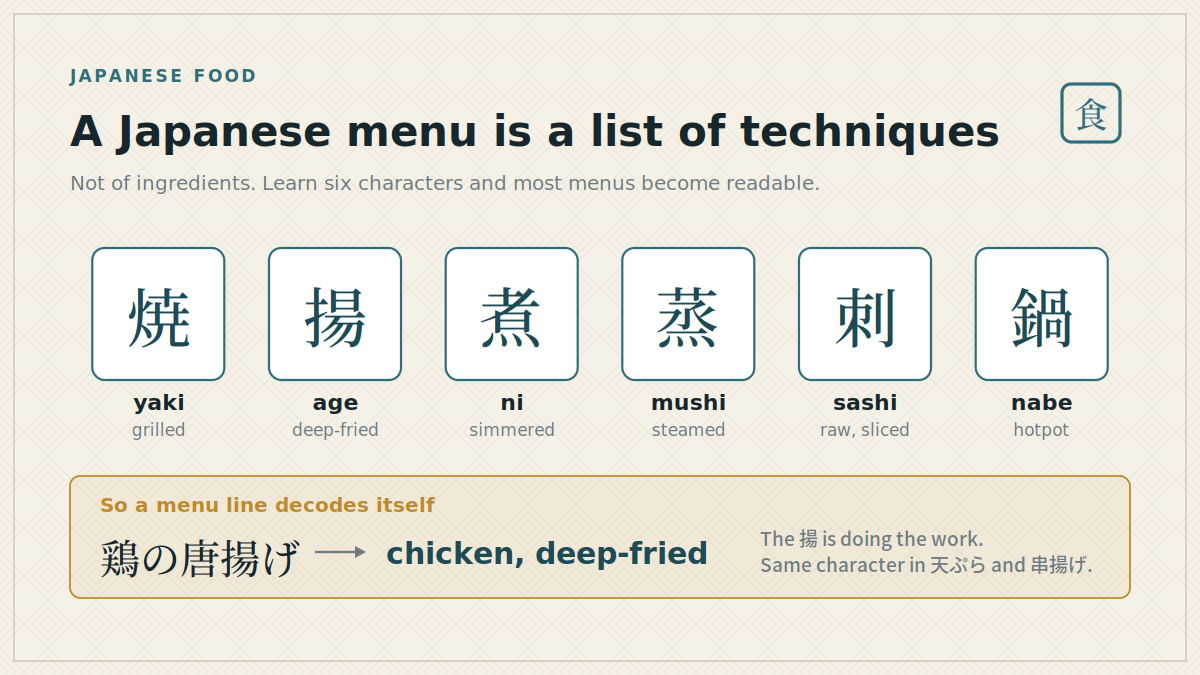
Almost every cooked dish in Japan carries one of these, and it tells you what will physically arrive.
- 焼 yaki — grilled. Yakitori, yakiniku, okonomiyaki, teriyaki.
- 揚 age — deep-fried. Karaage, kushiage, agedashi tofu.
- 煮 ni — simmered in seasoned stock. Nimono, nikujaga.
- 蒸 mushi — steamed. Chawanmushi.
- 刺 sashi — raw and sliced. Sashimi.
- 鍋 nabe — hotpot, cooked at your table. Sukiyaki, shabu-shabu.
So 鶏の唐揚げ decodes as chicken, deep-fried. You did not need to know the word karaage; the 揚 did the work.
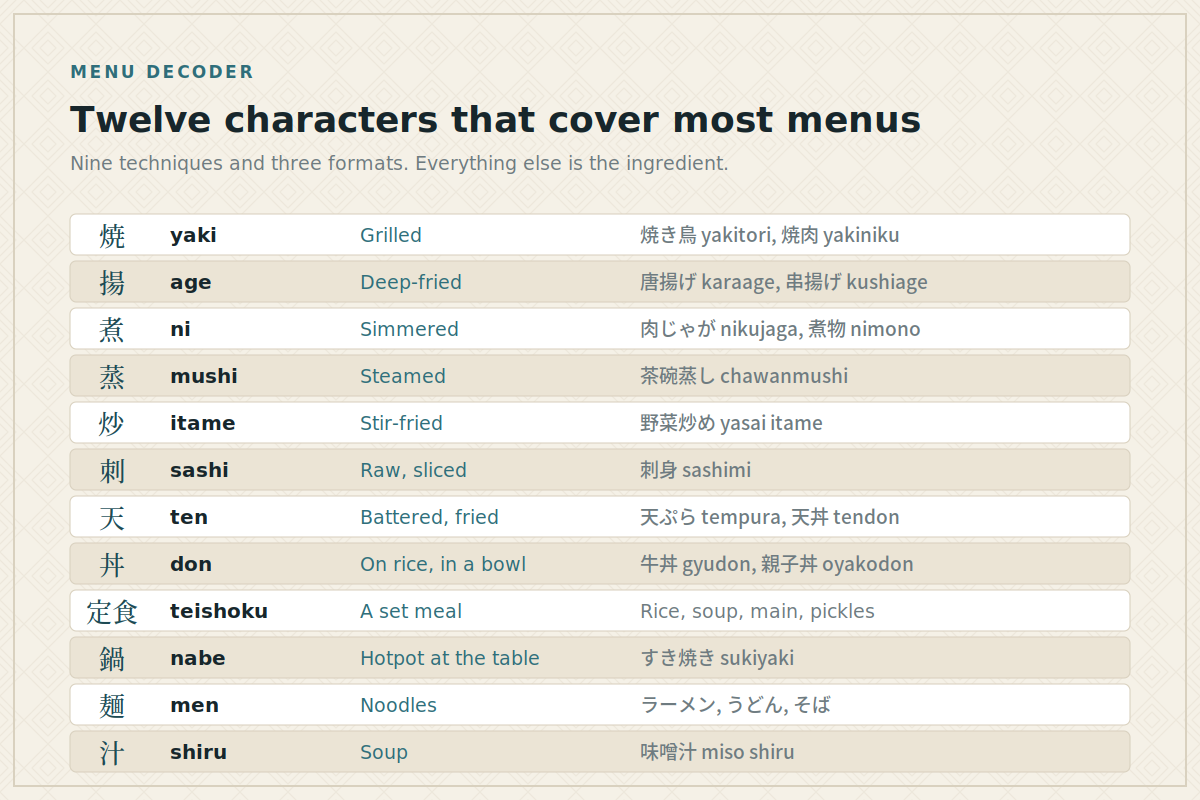
Three more characters are formats rather than techniques, and they are worth knowing because they tell you the size of what is coming.
丼 don means it arrives on rice in a bowl — a single dish, filling, cheap. 定食 teishoku means a set: rice, soup, a main and pickles together. 麺 men means noodles.
Where you eat changes what you do
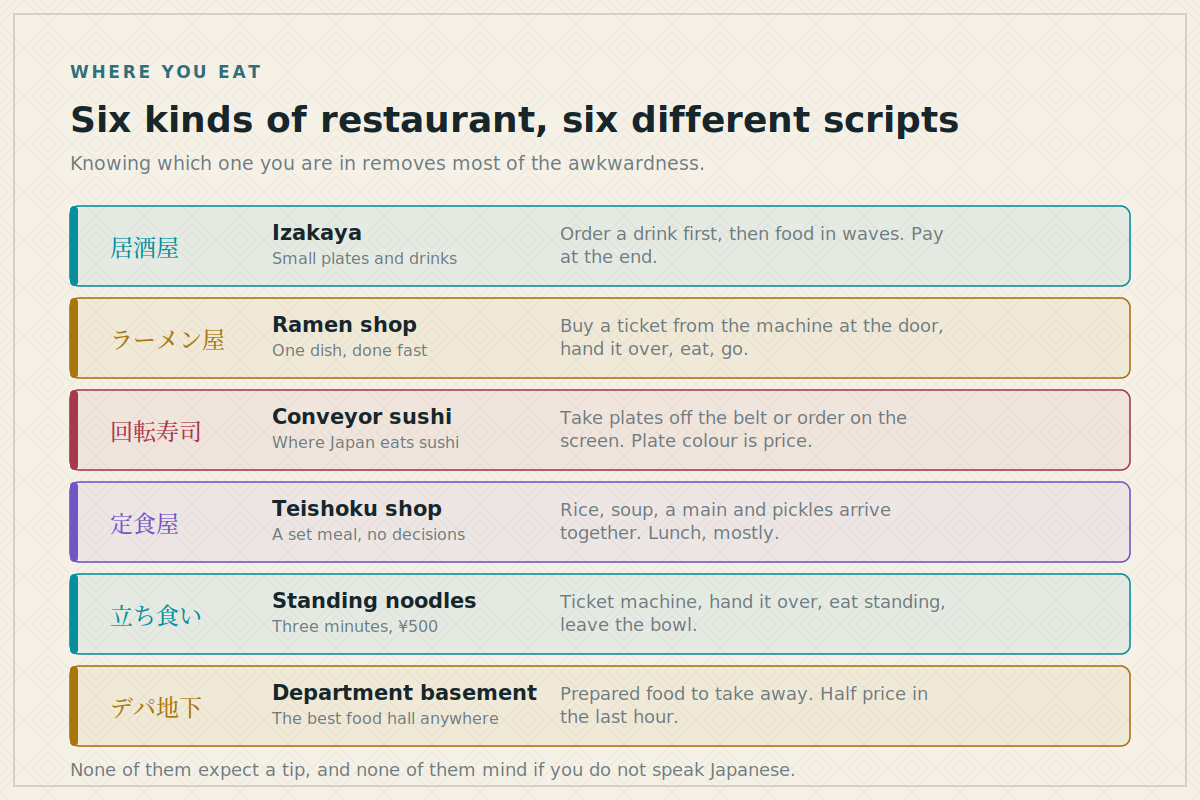
Japanese restaurants specialise to a degree that surprises people. A ramen shop sells ramen. A tempura restaurant sells tempura. There is no all-purpose Japanese restaurant, because that is not how the trade organises itself.
The practical consequence is that each type has its own script, and the script is short.
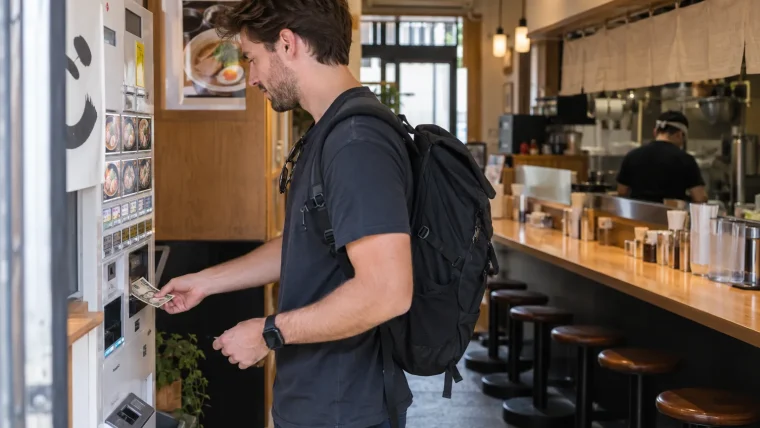
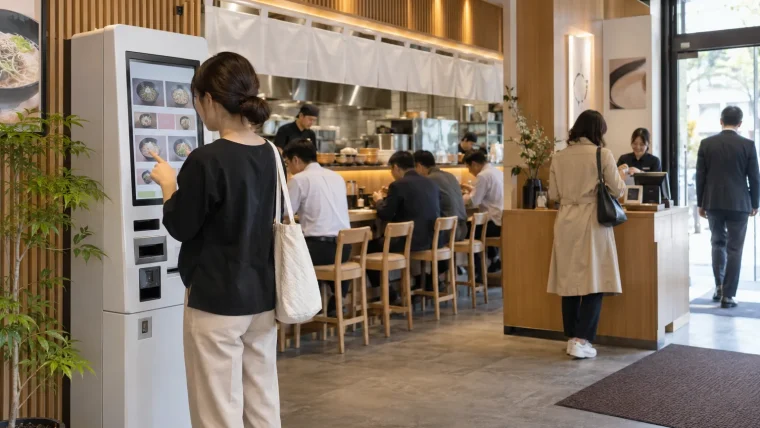
The ticket machine catches most visitors out. At ramen shops and standing noodle bars there is a vending machine by the door: you buy a ticket, hand it to the cook, and sit down. Many now have an English button. If not, the pictures are reliable and the top-left button is usually the house standard.
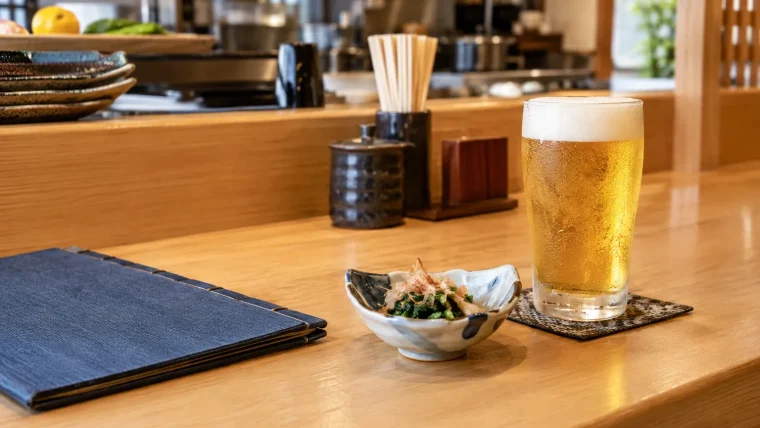
Izakaya are the closest thing to a pub, and the rhythm is: drink first, then food in waves, then pay at the till on the way out. Small plates keep arriving as you order them. Many charge a small cover, otōshi, which comes with a snack you did not order — this is not a scam, it is the table charge.
What to eat first
If you have a week and want the range rather than the highlights, this is a defensible order.
| Dish | What it is | Roughly |
|---|---|---|
| Ramen | Noodles in seasoned stock, wildly regional | ¥900–1,300 |
| Conveyor sushi | Where most Japanese people actually eat sushi | ¥1,500–3,000 |
| Tonkatsu teishoku | Breaded pork cutlet, as a set with rice and soup | ¥1,200–1,800 |
| Yakitori | Grilled chicken on skewers, ordered by the piece | ¥150–300 each |
| Soba or udon | Buckwheat or wheat noodles, hot or cold | ¥600–1,000 |
| Okonomiyaki | Savoury cabbage pancake, often cooked at your table | ¥1,000–1,600 |
| Kaiseki | The formal multi-course meal. Once, deliberately | ¥8,000+ |
Note the prices. Japan is the only wealthy country where the cheap food is reliably excellent, and the gap between a ¥1,000 lunch and a ¥10,000 dinner is smaller than anywhere comparable.
Ordering without Japanese
Five things make this easy.
- Plastic food. Restaurant windows display astonishingly accurate models of every dish. Point at the one you want, then point at the model again when the waiter comes.
- Picture menus. Common, and no one thinks less of you for using one.
- The number system. Menu items are numbered at chain restaurants; say the number.
- Sumimasen. Say it to call a waiter. Japanese restaurants do not check on you unprompted, and waiting to be noticed can take a very long time.
- Kore o kudasai — “this one, please,” with a finger. It works everywhere.
More of the vocabulary is in our guide to ordering food in Japanese.
Six things that surprise people
Slurping noodles is fine, and at speed it is genuinely functional — it cools the noodles and pulls the broth with them. Nobody will mind either way.
Water and tea are free, brought unasked, and refilled. So is the hot towel.
There is no tipping. None, anywhere, in any form.
You pay at the till. Take the slip from your table to the register on the way out. Waiting for the bill at the table will not work.
Lunch is the bargain. The same restaurant will do at lunch, for ¥1,200, something close to what it charges ¥4,000 for at dinner.
Splitting the bill is normal among friends but awkward for staff to process at some places. Cash makes it simple.
Japanese restaurants specialise. That is why there is no general Japanese restaurant — and why the ramen shop’s ramen is worth going out of your way for.The organising principle
About dual pricing, since you will have read about it
A story that circulated in 2026 was that Japanese restaurants had begun charging foreigners more. The checked version is narrower than the headlines.
Two-tier pricing exists, it is legal, and it is spreading — but it is concentrated at flagship attractions rather than restaurants. Himeji Castle charges residents ¥1,000 and non-residents ¥2,500. Some ski lifts and theme parks do something similar. The Japan Tourism Agency is expected to publish formal guidelines.
Two things are worth knowing. It is based on residency, not nationality — a foreign resident with a residence card pays the local rate, a Japanese tourist from Tokyo does not. And in restaurants it remains rare. Across a two-week trip the realistic difference is a few thousand yen.
Where the food actually is
Department store basements, the depachika, are the best food halls in the world and almost nobody tells visitors to go. Prepared food, regional specialities, and everything discounted sharply in the last hour before closing.
Convenience stores are not a compromise. The sandwiches and rice balls are genuinely good, and the reason is covered in our article on konbini food.
Standing noodle bars at stations serve a decent bowl of soba in three minutes for ¥500.
Under the railway tracks. The arches beneath elevated lines in Tokyo and Osaka are full of small grill restaurants, and they are as good as they look.
If you cannot eat something
This deserves stating early rather than late, because it is the one area where Japanese food is genuinely hard to navigate.
Dashi — a stock made from dried fish — is the base of an enormous amount of Japanese cooking, including things that look entirely vegetable. Asking for a dish without meat does not remove it.
Allergies are harder still, because Japan’s labelling law covers packaged food but not restaurant meals. If either applies to you, read our article on eating in Japan as a vegetarian or with allergies before you travel, not after.
Where to go from here
Two dishes are worth their own explanation, because the standard foreign understanding of both is wrong in a specific way.
Sushi is not a word about fish — it is a word about rice, which is why sashimi is not sushi and why an inari pouch is. That is in sushi versus sashimi.
And ramen is not one dish with a few variants. It has four independent variables, which is why names like “tonkotsu shoyu” look contradictory until you see the structure. That is in our article on regional ramen.