The Small Dish You Never Ordered and Must Pay For: Otoshi Charge Izakaya Guide
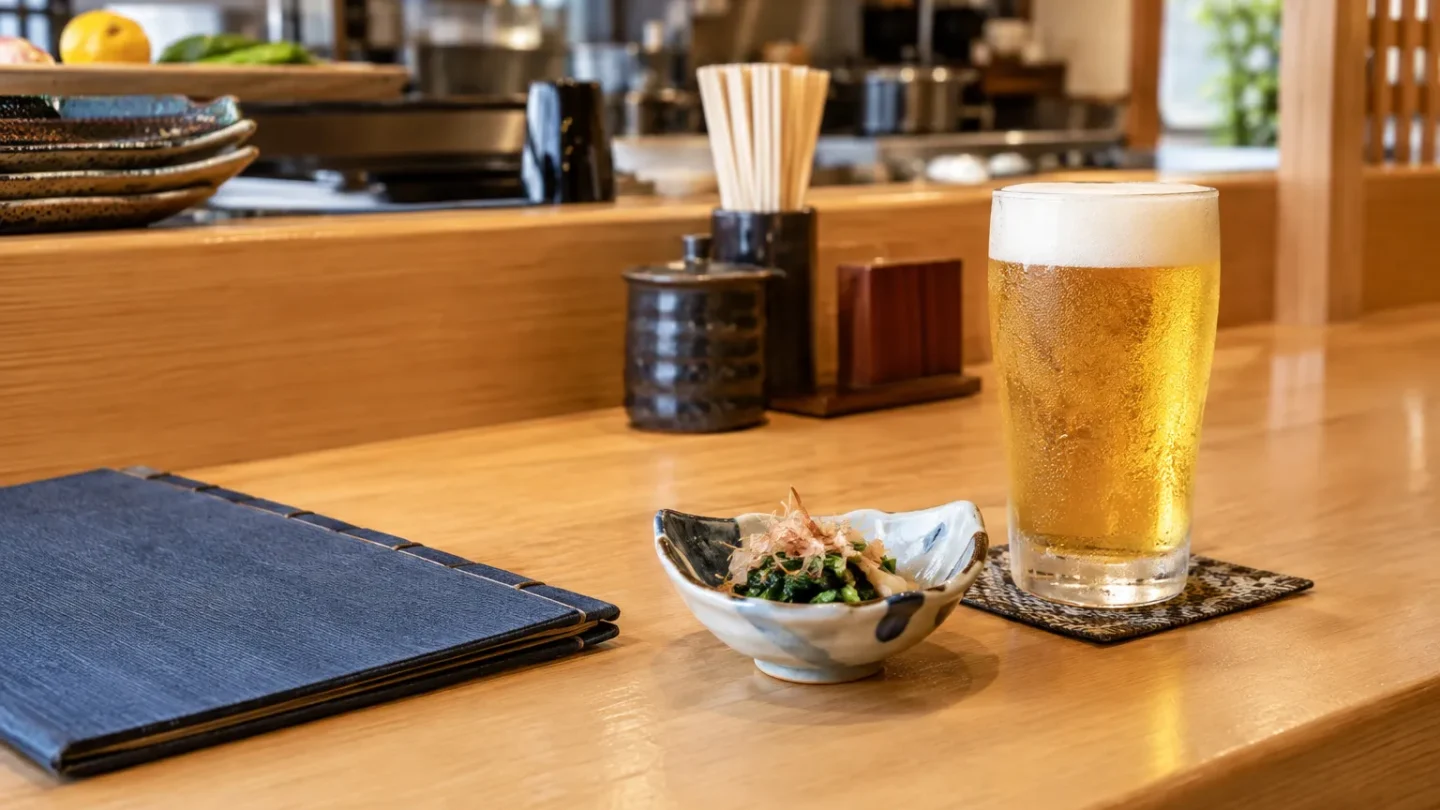
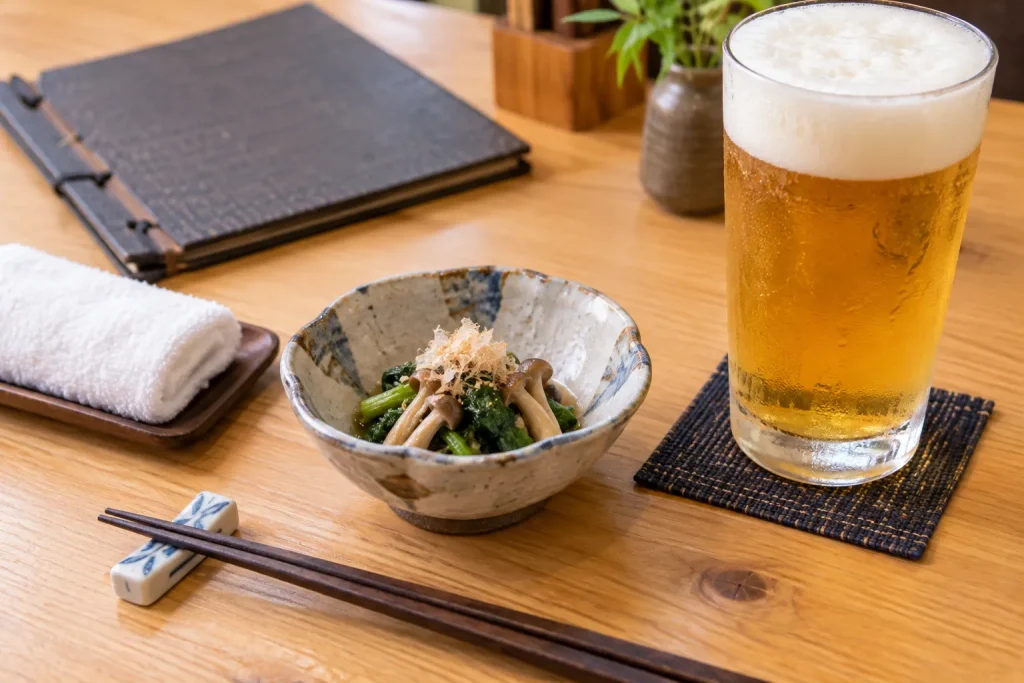
You sit down, receive a damp hand towel, and start opening the menu. Before you have chosen anything, a small bowl arrives. You did not order it, but you will probably see a charge for it on the bill. That is the central fact behind the otoshi charge izakaya visitors need to understand before their first night out.
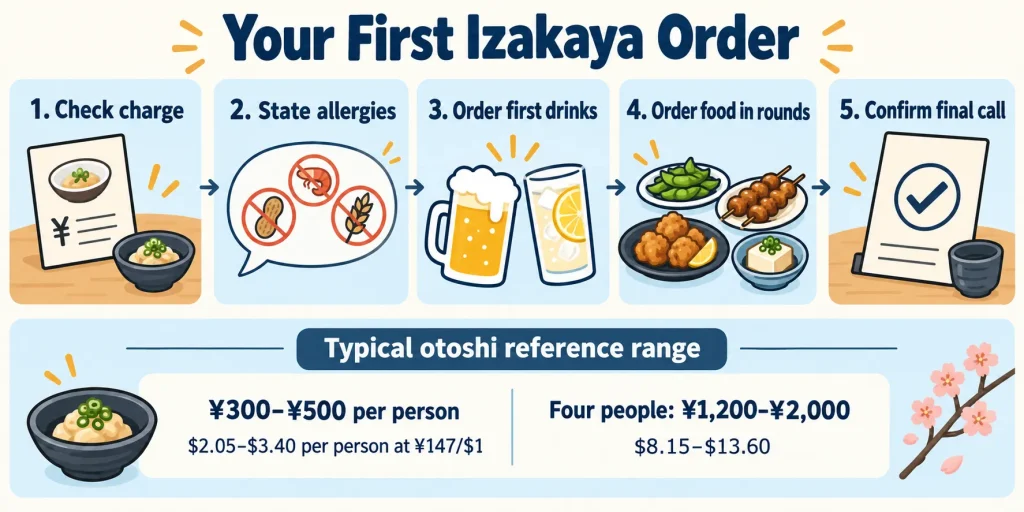
お通し, otōshi, literally suggests something “passed through” to the customer. In an izakaya, it usually means a small prepared dish connected to a per-person seating charge. The commonly reported range is ¥300 to ¥500 per guest, approximately $2.05 to $3.40 at ¥147 to $1. The price varies by business, and the dish is not necessarily optional merely because you did not select it.
Otoshi is not a complimentary appetizer. It is the edible form of a cover or seating charge.
The charge is not aimed specifically at visitors. Local customers pay it too when the establishment uses the system. However, its presentation can feel uncomfortable to an American traveler because the restaurant may serve the dish without first explaining the price in English.
How the otoshi charge at an izakaya fits into your order
The least stressful way to handle an izakaya is to follow the meal in the order it actually unfolds. You do not need perfect Japanese or advance knowledge of every dish. You do need to check the conditions before committing to a table, especially if your budget or dietary restrictions leave little room for surprises.
- Read the entrance notices before sitting down. Look for お通し代, otōshi-dai, “otoshi fee”; 席料, sekiryō, “seat charge”; or チャージ, chāji, “charge.” What it looks like may be a note on the menu, booking page, wall, or tablet. If you remain after learning the condition and begin ordering, expect the charge to appear on the bill.
- Ask about the fee if the information is unclear. Say お通しはいくらですか, otōshi wa ikura desu ka, “How much is the otoshi?” Ask before placing a drink order, not after the dish is eaten. The restaurant should then tell you whether it charges per guest and, ideally, the amount.
- State allergies immediately. The otoshi may contain fish, shellfish, eggs, soy, sesame, meat, or 出汁, dashi, “soup stock.” Because the dish can arrive quickly, do not wait for the main order to mention a serious allergy. The site’s phrasebook with ordering and allergy language provides ready-to-use wording among its 337 phrases.
- Order the first drinks. At many izakaya, the server asks for drinks before the group has finished studying the food menu. Order water or a nonalcoholic drink if you do not drink alcohol. You do not have to order beer merely because other guests do.
- Accept the otoshi unless the restaurant agrees otherwise. The dish is usually placed in front of each guest or supplied for the table while the drinks are prepared. Sending the food back does not automatically remove the charge. If you do not want it, ask before it is served and listen for a clear confirmation.
- Begin with a small food round. Order several dishes for the table rather than attempting to design the entire meal at once. Quick dishes can bridge the wait for grilled or fried food. For help identifying unfamiliar menu categories, Japanese Food for Beginners: How to Read a Menu covers the menu-reading problem without repeating the ordering protocol here.
- Order another round after seeing portion sizes. Izakaya plates are often shared, but their size is not standardized. A photograph can also make a dish look larger than it is. Add food gradually, including something substantial once you know how much the first round provides.
- Check the bill rather than guessing. The otoshi may appear under お通し, otōshi; 突き出し, tsukidashi, “a dish set out”; 席料, sekiryō; or a general charge description. Ask while you are still at the restaurant if the number of charges does not match the number of guests. Ordering, Paying and the Rules Nobody States explains the wider payment sequence and other restaurant rules.
| What appears | What it normally means | What you should check |
|---|---|---|
| お通し | Small dish associated with a cover charge | Price per person and allergens |
| 突き出し | Regional or alternative term for a starter served automatically | Whether a charge applies |
| 席料 | Charge for occupying the seat | Whether food is included |
| チャージ | General cover or table charge | Amount and whether it is separate from otoshi |
| サービス料 | Service charge | Percentage and tax treatment |
The rules that change under nomihodai
飲み放題, nomihōdai, literally “unlimited drinking,” is a time-limited drink plan rather than permission to order without conditions. The included beverages, ordering window, price, minimum food order, and final call are determined by the restaurant. Read the plan itself; there is no single national izakaya rule that overrides the printed conditions.
A common plan advertised as 120 minutes may stop accepting drink orders after 90 minutes, leaving the last 30 minutes for finishing drinks and preparing to leave. Those figures must not be treated as universal. Some venues set a different final-call interval, begin the clock with the first drink, or start it at the reservation time even if members of the group arrive late.
Many plans also use グラス交換制, gurasu kōkan-sei, “glass-exchange system.” You finish or return the current glass before receiving the next drink. Ordering several drinks at once to defeat the final call may be refused and can conflict with the conditions you accepted.
Before choosing nomihodai in Japan, confirm these points:
- Which drinks are included and which require a supplement.
- Whether everyone at the table must buy the same plan.
- When the clock begins.
- When the last order is taken.
- Whether the table must be vacated at the end of the advertised period.
- Whether a food course or minimum number of dishes is required.
- Whether unfinished drinks can trigger an additional charge.
| Plan wording | Practical meaning | Question to ask |
|---|---|---|
| 90分飲み放題 | Time-limited plan advertised as 90 minutes | When is the last order? |
| 120分飲み放題 | Time-limited plan advertised as 120 minutes | Does the 120 minutes include finishing time? |
| ラストオーダー30分前 | Final orders close 30 minutes before the end | May each guest order one final drink? |
| グラス交換制 | A replacement drink is supplied in exchange for the current glass | Must the glass be empty? |
| 全員注文 | Every eligible member of the party must join | Are children and nondrinkers treated differently? |
Ordering food in rounds without losing control of the bill
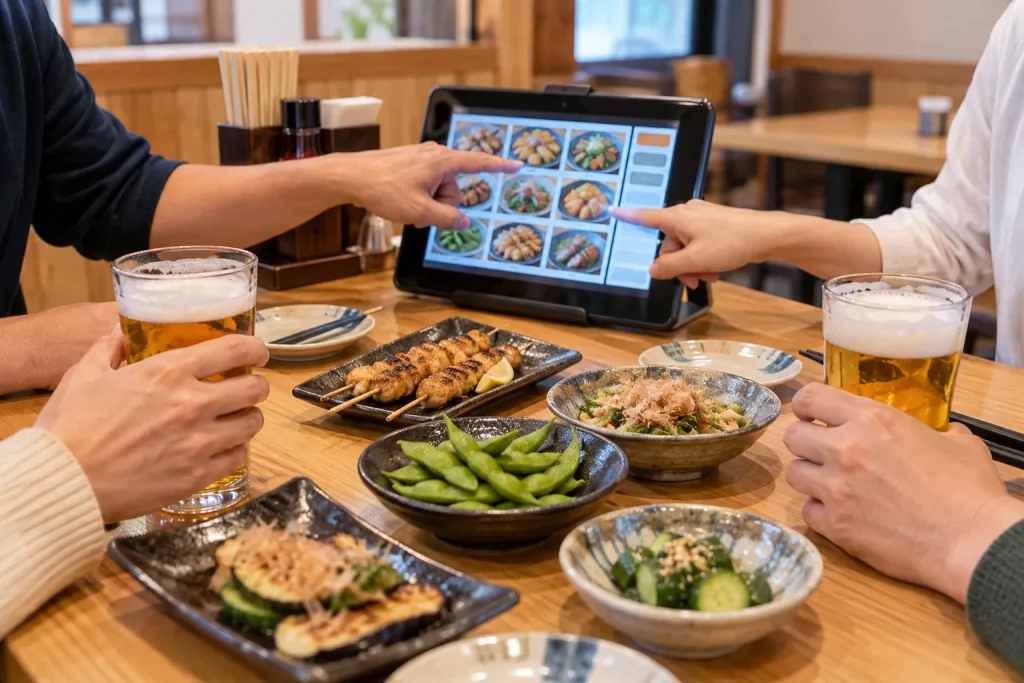
The English phrase “buying a round” can imply that one person purchases drinks for the whole group. That is not the useful model here. At an izakaya, ordering food in rounds means placing a modest shared order, eating it, and then deciding what the table needs next.
Start with enough food to occupy the table while slower dishes cook. The next round can respond to what people enjoyed, what arrived in smaller portions than expected, and whether anyone needs rice or noodles. This rhythm reduces waste and prevents the tabletop from filling with cooling plates.
You can order the same drink again with 同じものをください, onaji mono o kudasai, “the same thing, please.” For food, pointing to a menu item is normal when pronunciation is difficult. If raw fish terminology is causing the hesitation, Sushi vs Sashimi: The Difference Is the Rice handles that distinction in one focused guide.
Do not wait until every plate is empty before thinking about the next order. Busy kitchens need time, particularly for grilled skewers and fried items. Place the next round while the table still has something to share, but stop adding dishes once the group’s appetite begins to slow.
Where visitors most often stall
The first stall happens when the otoshi arrives. A visitor assumes there has been a mistake and refuses to touch it, but waits until the bill comes to question the charge. Ask immediately instead. Whether or not you eat the dish usually does not decide whether the fee applies.
The second happens when one guest has an allergy. The party assumes that a tiny starter is harmless or merely decorative. It is neither. Ask about ingredients before tasting it, and request a safe alternative without assuming that substitution is possible.
The third occurs during nomihodai. Guests hear “all you can drink” and overlook the final-call time, the included-drink list, or the glass-exchange rule. Photograph or reread the plan conditions when the order begins, then set a quiet phone reminder before the stated last order.
The fourth stall comes when the group tries to calculate an exact individual share at the table. Unless the restaurant has agreed to separate checks, pay according to the restaurant’s process and settle private differences afterward. The broader guide to Ordering, Paying and the Rules Nobody States covers payment mechanics beyond the Japanese izakaya etiquette discussed here.
What changes from one establishment to another
Otoshi is common, not universal. Some low-cost chains advertise that they do not serve it, while independent izakaya may change the dish daily. A standing bar may have different rules from a seated pub, and a formal restaurant may use a service charge instead of an otoshi system.
The name changes regionally as well. In Osaka and parts of western Japan, you may hear 突き出し, tsukidashi, literally “something pushed out.” The practical question remains the same: is it complimentary food, or is it attached to a per-person charge?
The dish can also follow the season. Chilled vegetables or tofu may appear in warm weather, while simmered vegetables can appear in colder months. Seasonal ingredients change the allergy question, but they do not alter the basic payment principle.
Formality affects how directly the condition is presented. A large chain may print the fee on a tablet or booking page, while a small local shop may treat it as familiar background knowledge. If no amount is displayed, asking before ordering is careful budgeting, not bad manners.
What nobody at the table is grading
Nobody minds if you point at a menu photograph. Nobody expects a traveler to pronounce every dish correctly. Nobody cares whether your first drink contains alcohol, and switching to tea or a soft drink is ordinary.
You also do not need to imitate a theatrical version of Japanese dining etiquette. A quiet “sumimasen” to call the server is enough. You do not need to produce an elaborate speech before each additional order.
It is fine to ask what the otoshi contains. It is also fine to leave an ingredient you cannot eat, although leaving the dish untouched usually does not cancel its charge. The useful distinction is between politely asking and insisting that an established fee must disappear because the system is unfamiliar.
People will notice behavior that burdens the staff: hiding unfinished nomihodai drinks, ordering wastefully just before final call, or arguing about a posted condition after consuming the order. They are unlikely to notice whether you hold a menu, point, or use a translation screen.
Frequently asked questions
Is otoshi a scam aimed at tourists?
No. An establishment using otoshi normally charges local and international guests alike. The genuine problem for a traveler is often inadequate explanation, not a tourist-only price. Ask about the amount before ordering if it is not displayed.
Can I refuse the otoshi?
You can ask before it is served, but refusal is not an automatic right to use the seat without the associated charge. Policies vary by establishment. If the restaurant says the charge is mandatory and you do not accept it, leave before ordering rather than contesting it after the meal.
Do I pay even if I do not eat the dish?
Usually, yes, because the fee is linked to seating rather than consumption of every bite. Leaving the food untouched does not normally remove the line from the bill. Allergies should be raised immediately so the staff can say whether a substitution is available.
Is nomihodai always two hours?
No. Plans have establishment-specific limits, menus, and final-call rules. Even when a plan is advertised as 120 minutes, ordering may close earlier, so check the written conditions before paying.
Should the whole meal be ordered at once?
Usually not. Several smaller orders let you judge portion sizes and keep hot food from cooling on a crowded table. Begin with quick shared dishes, add cooked dishes, and place a final modest order only if the group is still hungry.