Japan is harder than it looks for anyone with a dietary restriction, and the difficulty is not where visitors expect. It is not that Japanese food is full of meat. It is that the foundation stock of the entire cuisine is made from fish, and it is invisible.
This article is written to be useful rather than reassuring. If you have a severe allergy, read the last section too.
The dashi problem
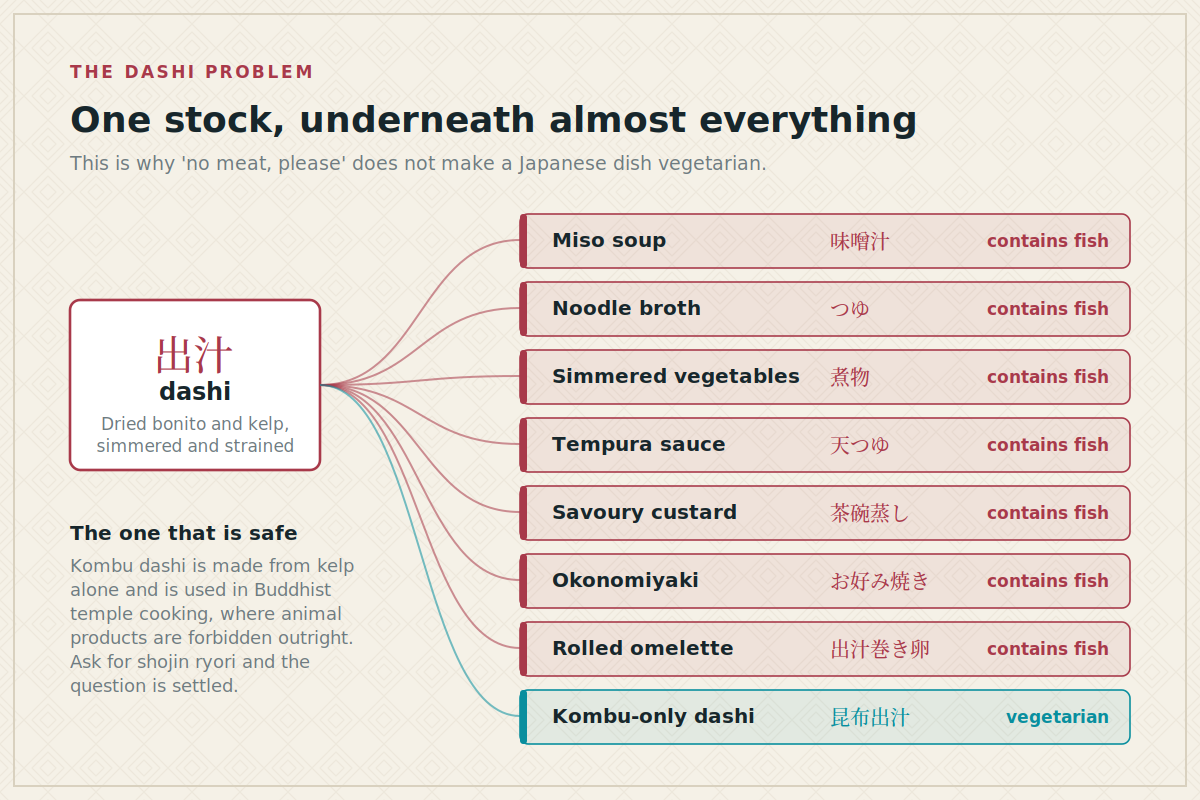
出汁 dashi is a stock made by steeping dried bonito flakes and kelp in hot water, and it is the base layer of Japanese cooking in the way stock is in French cooking — except that it is in far more things, including things that read as entirely vegetable.
Miso soup. Every noodle broth, hot or cold. Simmered vegetables. The dipping sauce for tempura. Savoury egg custard. Rolled omelette. The batter for okonomiyaki. Rice cooked for a set meal.
This is why “no meat, please” does not produce a vegetarian meal, and why a well-meaning kitchen can hand you a plate of vegetables that is not one. The cook has not misunderstood you. Dashi is not, in their mental model, an ingredient you add — it is what liquid is.
The one that is safe
昆布出汁 kombu dashi is made from kelp alone, with no fish, and it exists as a standard preparation.
Where you can rely on it is 精進料理 shōjin ryōri, Buddhist temple cuisine, which excludes all animal products by doctrine — no fish, no dashi, and traditionally no onion or garlic either. It is not a modern accommodation; it is a centuries-old tradition with its own restaurants, many attached to temples, particularly around Kyoto and on Mount Koya. If you can build a couple of meals around it, the question is simply settled.
Sorting the everyday menu
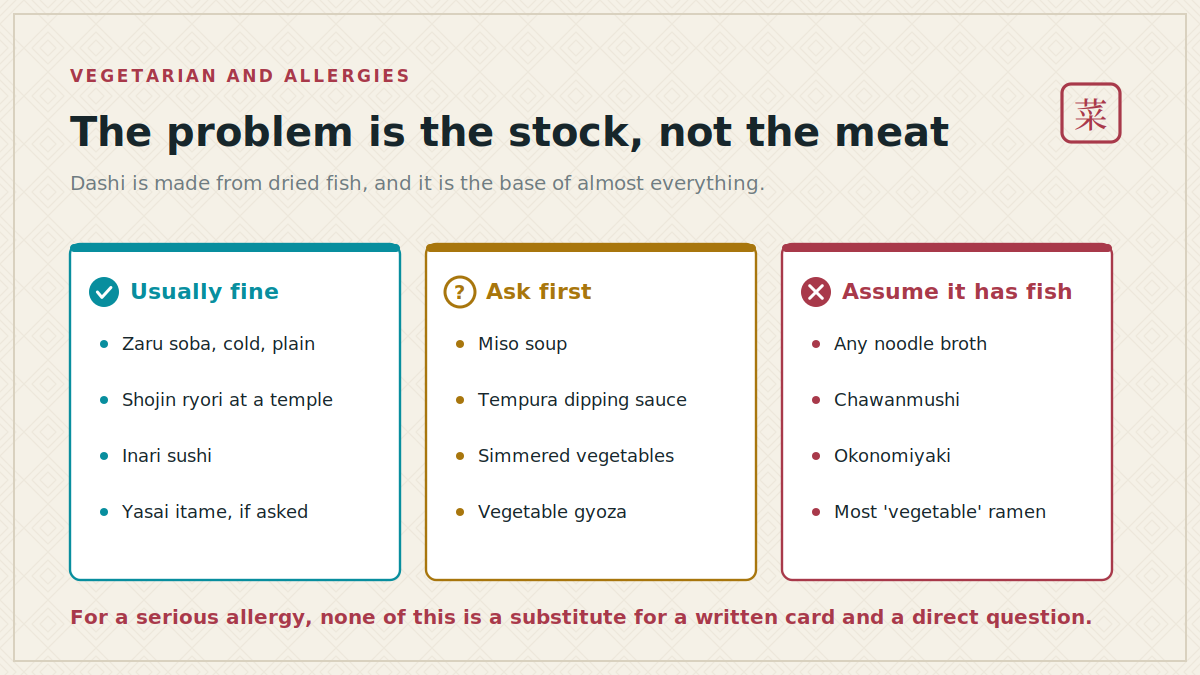
Rough working categories, from a vegetarian’s point of view:
| Usually fine | Ask first | Assume it has fish |
|---|---|---|
| Inari sushi | Miso soup | Any noodle broth |
| Cucumber and avocado rolls | Vegetable gyoza | Chawanmushi |
| Plain zaru soba, sauce aside | Simmered vegetables | Okonomiyaki |
| Shōjin ryōri | Tempura dipping sauce | Most “vegetable” ramen |
| Onigiri with ume or kombu | Yasai itame, stir-fried veg | Takoyaki, obviously |
Two traps in the middle column are worth naming. Bonito flakes as a garnish appear on cold tofu, okonomiyaki and many vegetable dishes, and they are the thin pink shavings that move in the steam. And vegetable gyoza frequently contain chicken stock or pork fat in the filling.
Saying it
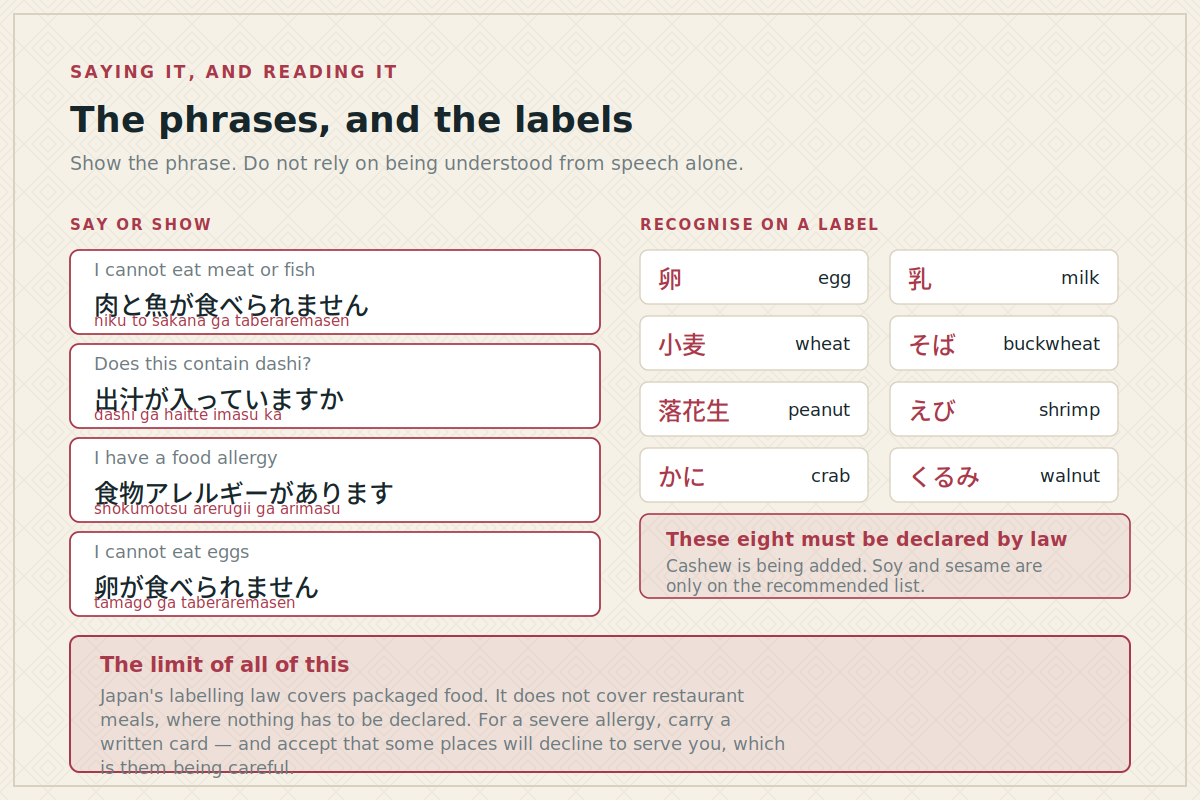
The most useful lines, worth having on your phone in Japanese rather than trying to pronounce:
- 肉と魚が食べられません — niku to sakana ga taberaremasen. “I cannot eat meat or fish.”
- 出汁が入っていますか — dashi ga haitte imasu ka. “Does this contain dashi?” This is the one that actually gets you an accurate answer.
- 食物アレルギーがあります — shokumotsu arerugii ga arimasu. “I have a food allergy.”
- ベジタリアンです — bejitarian desu. Understood, though “vegetarian” is interpreted loosely by people who have not met many.
Say “cannot eat” rather than “do not eat.” Taberaremasen reads as a constraint; a preference is much easier to accommodate around rather than through, and you will get the fish stock anyway.
Allergies, and where the law stops
Japan requires a specific set of allergens to be declared, and the list is shorter than the European one.
Eight must be labelled: egg 卵, milk 乳, wheat 小麦, buckwheat そば, peanut 落花生, shrimp えび, crab かに, and walnut くるみ. Cashew is being added following a national survey that found tree-nut cases rising sharply. Around twenty more — including soy 大豆 and sesame ごま — are on a recommended list, which means many manufacturers declare them and some do not.
Now the part that matters most:
The labelling law covers packaged food. It does not cover restaurant meals. A restaurant in Japan has no general legal obligation to tell you what is in a dish, and many will not know with certainty, because their supplier’s sauce has its own ingredients.
The practical consequence is counter-intuitive. A convenience store sandwich is the easier case, because the pack carries a complete ingredient list. A small restaurant is the harder one.
Packaged food in Japan tells you everything. Restaurant food tells you nothing, and is not required to. Plan around that asymmetry rather than against it.The rule that shapes everything else
Buckwheat deserves its own warning
そば soba allergy is treated seriously in Japan in a way it is not in most Western countries, because it is common there and reactions can be severe.
The complication is cross-contamination. A soba restaurant cooks noodles in shared water and mills flour on site; many will tell you plainly that they cannot serve you safely, and that is a responsible answer rather than an unhelpful one. Buckwheat also turns up in udon blends, some tempura batter and certain teas.
What actually works
Six strategies, roughly in order of reliability.
- Carry a written card. A clear Japanese sentence naming exactly what you cannot eat, printed and laminated. Show it on arrival, before ordering. This is worth more than any phrase you can pronounce.
- Eat at places built for it. Vegan ramen shops, Indian restaurants, shōjin ryōri temples and a growing number of vegan cafés in Tokyo, Kyoto and Osaka. HappyCow’s Japan coverage is genuinely good.
- Use convenience stores and supermarkets when a restaurant is too uncertain. Complete labelling, and a translation app’s camera handles the Japanese.
- Book ahead for ryokan and kaiseki. Both will accommodate restrictions given several days’ notice and essentially cannot on the night.
- Ask at the hotel desk. Staff will phone a restaurant and ask on your behalf, and this works far better than asking in person at the door.
- Accept a refusal. A restaurant that says it cannot serve you safely is being careful, not rude, and pressing will not improve the outcome.
Halal and kosher, briefly
Halal-certified restaurants exist in the larger cities and near mosques, and a number of ramen and curry shops now advertise it. Outside those, pork stock and mirin are pervasive enough that the same dashi logic applies.
Kosher provision is very limited outside a small number of establishments in Tokyo. Self-catering is the realistic approach.
The honest limits of this page
Everything above is written to help you eat well and avoid the common traps. It is not medical advice and it is not a safety guarantee.
If you have an allergy that could put you in hospital: talk to your doctor before travelling, carry your own medication with documentation, have your card written by a native speaker rather than by an app, and know that a restaurant’s “probably fine” is not a clearance. Japan’s emergency number for an ambulance is 119, the service is free, and the phrases for an emergency are in our article on what to say when things go wrong.
Where this site gets its facts, and what we do when we cannot verify something, is set out on our editorial standards page. For the rest of the cuisine — including the six characters that let you read most of a Japanese menu — start with our beginner’s guide to Japanese food.