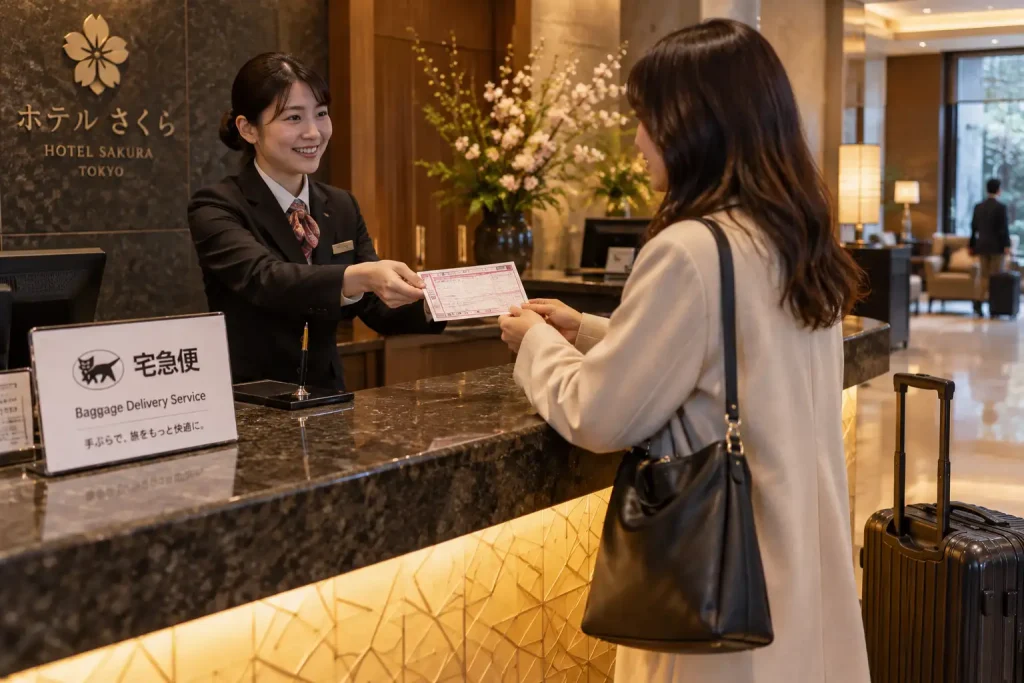
¥2,780. That’s roughly what Yamato Transport charged, as of an August 2026 check, to move a mid-size suitcase from a Tokyo hotel to a Kyoto hotel overnight — call it $18 at the exchange rate that week. Luggage forwarding japan travelers rely on runs on that kind of number: a small flat fee, one firm deadline, and a bag that shows up the next day without you touching it.
What Actually Makes Up That Number?
The price isn’t one flat rate — it’s built from three inputs that any Yamato counter or hotel front desk plugs into the same calculator: the size category of the bag, the distance between the two postal codes, and whether you’re paying cash or by card (cashless runs a few yen cheaper per bag).
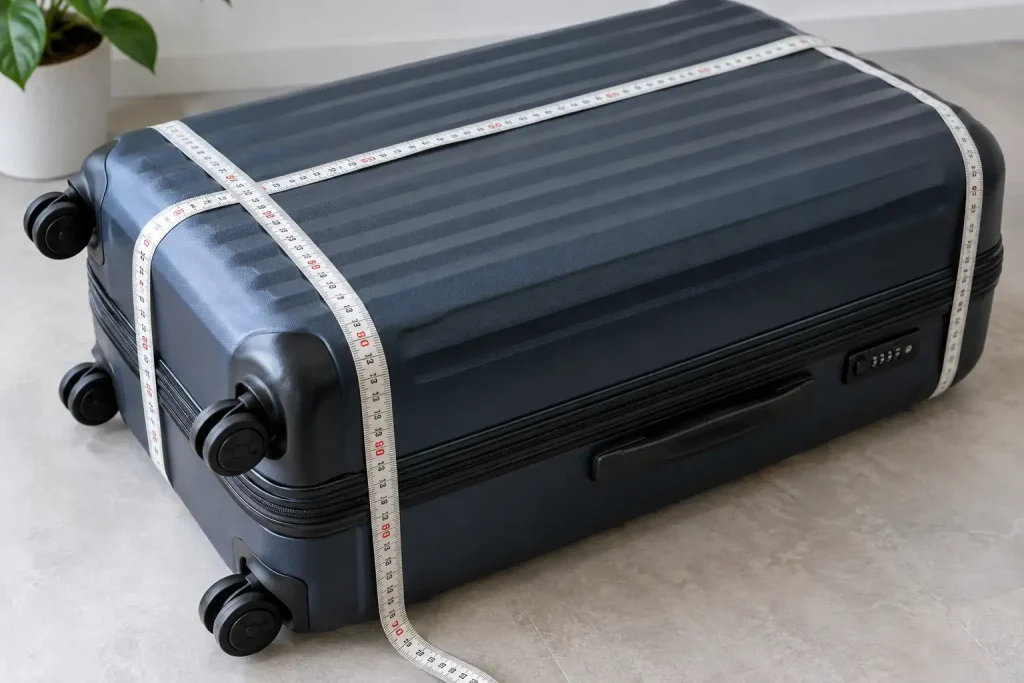
Size is measured as the sum of length + width + height, not weight, up to a 30 kg cap. Yamato’s own size brackets, as reported by third-party guides quoting its published rate chart, run roughly like this for a same-region move within the Kanto area:
- Size 140 (roughly a 24-inch checked suitcase): about ¥2,190, per a July 2026 check of Yamato’s rate table.
- Size 160 (a full 28–30-inch suitcase): about ¥2,510, same source and date.
Cross a bigger distance — say Kanto to Kansai, the Tokyo-to-Kyoto move most first-timers actually make — and the same sizes were quoted at roughly ¥2,310 and ¥2,630 in that July 2026 check, rising to roughly ¥2,780 and ¥3,160 in a separate August 2026 check of the same route. Both are third-party reports of Yamato’s public rate chart rather than a single locked-in figure from Yamato itself, which is exactly why the range matters more than any one number here — confirm your own exact quote at the counter before you pay.
The pillar piece on How Japan’s Rail Fares Are Actually Built covers the same distance-plus-size logic behind train pricing, if the pattern looks familiar — it’s the same idea Yamato applies to a suitcase instead of a seat.
The Arithmetic, Worked Through With Real Numbers
Here’s how a two-city trip actually adds up, using the Tokyo-to-Kyoto route and the higher of the two checked price sets, so the number doesn’t undersell what you might actually pay:
| Leg | Bag size | Price (JPY) | Approx. USD* | Source, date checked |
|---|---|---|---|---|
| Tokyo hotel → Kyoto hotel | Size 140 | ¥2,780 | ~$18 | Third-party Yamato rate report, Aug 2026 |
| Kyoto hotel → Osaka hotel | Size 140 | ¥2,190 (same-region) | ~$14 | Third-party Yamato rate report, Jul 2026 |
| Osaka hotel → Narita Airport | Size 140 | ¥2,780 (est., cross-region) | ~$18 | Estimated from same rate pattern; confirm at counter |
| Total, 3 legs, one suitcase | — | ≈ ¥7,750 | ≈ $50 | — |
*USD approximate at ¥155 = $1, the mid-market rate as of September 16, 2026 — this will drift, so treat it as a rough conversion, not a quote.
Redo that math with your own itinerary: count the number of hotel-to-hotel legs, price each one at the size bracket your suitcase actually falls into, and add. A two-city trip with one bag runs about $18–20 total. A five-city trip with two bags starts adding up fast — which is exactly the kind of total a takkyubin user should work out before assuming it’s “cheap.”
What Moves the Price Up or Down?
Four variables shift that base number, each in a specific direction:
- Bag size — moving from Size 140 to Size 160 adds roughly ¥300–400 per leg, based on the rate brackets above.
- Distance category — a same-region move (Tokyo to Yokohama, say) prices meaningfully lower than a cross-region one (Tokyo to Kyoto), often by ¥100–500 depending on the specific route.
- Payment method — cashless payment runs a handful of yen cheaper than cash per bag, a small but consistent discount reported across multiple 2026 rate summaries.
- Peak season — Yamato doesn’t publish a surge fee, but travel guides consistently note that counters get fully booked around Golden Week, Obon, and New Year’s, which doesn’t raise the price but can mean no slots left at all if you book late.
If a rail pass is part of the trip, it’s worth checking whether the pass itself changes the calculus on which cities you’re even moving a bag between — The Break-Even Math on Kansai, JR East and Hokkaido works through when a regional pass earns back its cost, which indirectly decides how many hotel-to-hotel legs you’re actually paying takkyubin for.
The Deadline That Decides Whether You See Your Bag Tomorrow
This is the number that actually runs the whole system: drop the bag off before roughly noon, and it arrives the next day, essentially anywhere on Honshu. Multiple independent 2026 travel guides — checked between May and July 2026 — converge on that same practical cutoff for hotel and convenience-store drop-offs, though Yamato’s own FAQ is explicit that the exact cutoff time varies by the specific pickup location and route, checked through its own online calculator rather than fixed company-wide. Treat “before noon” as the reliable rule of thumb, and confirm the exact time with your hotel’s front desk, since some counters cut off earlier.
Miss that window and the bag typically still arrives the next day in most cases — Yamato’s network runs on daily cycles, not hard same-day-or-bust logic — but a next-day guarantee is what you’re buying by hitting the deadline, not what you’re owed if you don’t. Deliveries to Hokkaido, Kyushu, or Okinawa run on a longer clock regardless of when you drop off, typically two to three days, since they cross a strait the standard Honshu network doesn’t have to.
What Actually Goes in the Overnight Bag?
Since the suitcase won’t reach the next hotel until the following day, everything needed between drop-off and pickup travels with you instead. Pack it like a one-night trip, not a day trip:
- A full change of clothes, including socks and underwear
- Toiletries and any medication you take daily — never forward prescription medication in the checked suitcase
- Phone charger and any other device charger you’ll actually need overnight
- Passport, travel documents, and payment cards — these should never leave your person, forwarded or not
- A layer for weather, since the suitcase (and any seasonal gear in it) won’t be there to adjust to a surprise change
Takkyubin vs. the Free Alternative on the Shinkansen
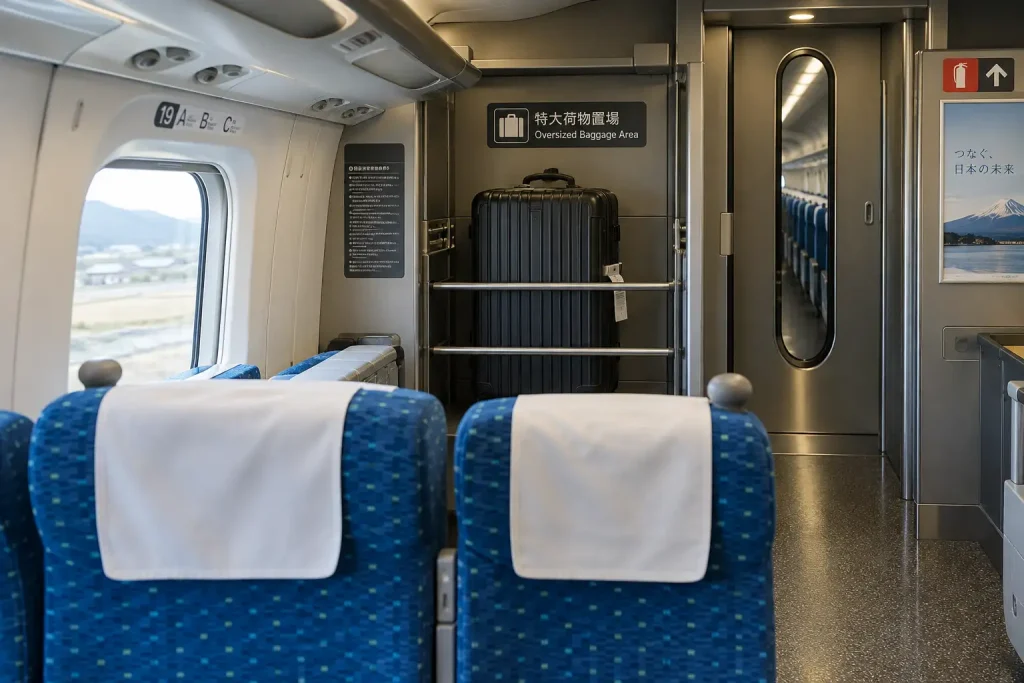
Here’s the uncomfortable part most takkyubin guides skip: on the Tokaido, Sanyo, Kyushu, and Nishi-Kyushu Shinkansen lines, a bag over 160 cm (combined length, width, and height) requires a seat reservation with an oversized-baggage area — and that reservation costs exactly the same as any other reserved seat. Zero extra yen. Skip the reservation with an oversized bag, and the conductor moves it and charges a ¥1,000 fee instead.
So by pure arithmetic, reserving the right seat is the cheaper option every time — takkyubin’s ¥2,200–3,200 loses to a free reservation on price alone. What takkyubin actually sells isn’t a cheaper trip; it’s a hands-free one. It wins when the oversized-baggage seats are already booked out, when a bag runs past the 250 cm absolute ceiling those seats allow, or when carrying nothing at all through a train station is worth more to you than the roughly $18 it costs not to. Machines, Apps and the Ticket Counter covers how to actually book that oversized-baggage seat, since it isn’t always the obvious button on a ticket machine.
Takkyubin vs. Coin Lockers — Which Actually Solves Your Problem?
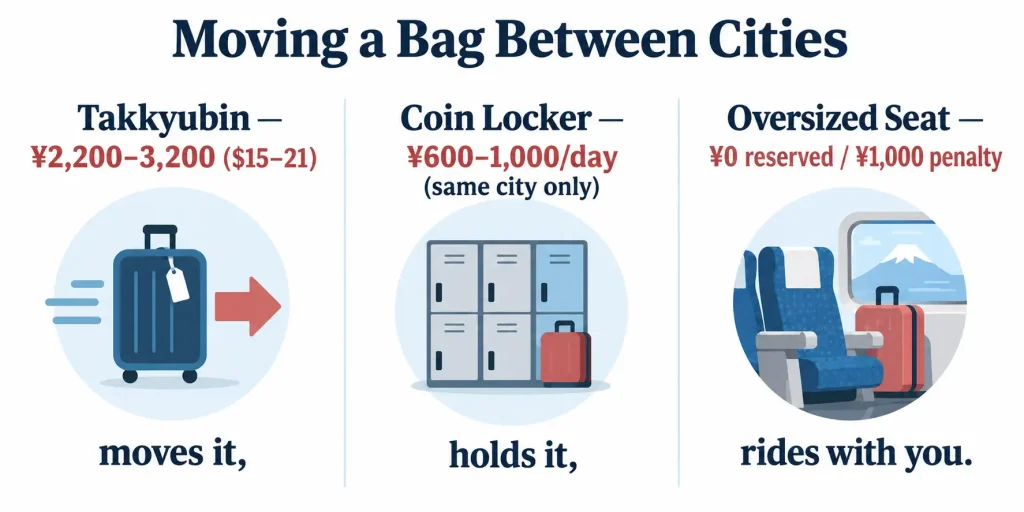
The comparison people actually reach for is coin lockers, and it’s the wrong comparison for a hotel-to-hotel move — the two solve different problems. A large station coin locker runs roughly ¥600–1,000 per calendar day, cheaper per day than takkyubin’s flat per-bag fee. But a coin locker keeps a bag in the city you’re already in; it doesn’t move it anywhere. Using one to bridge a same-city gap (early checkout, late flight) makes sense. Using one to solve a Tokyo-to-Kyoto move means paying for a locker in Tokyo and then still hauling the bag onto the train yourself — which defeats the entire point.
Filling out the hotel’s takkyubin form in English is usually straightforward, but if a front-desk conversation needs a phrase or two of Japanese, the site’s phrasebook has 337 phrases sorted by exactly this kind of situation.
| Option | Typical cost | What it actually solves |
|---|---|---|
| Takkyubin (hotel to hotel) | ¥2,200–3,200 per bag | Moves the bag to a different city, hands-free |
| Large coin locker | ¥600–1,000 per day | Holds the bag in the same city, same day |
| Shinkansen oversized-baggage seat | ¥0 (reserved) / ¥1,000 (unreserved penalty) | Lets the bag ride with you, no shipping delay |
| Same trip, priced at the cheapest correct option | ≈ ¥0–3,200 depending on need | — |
As Craig Mod put it, describing the same math from a traveler’s side rather than a spreadsheet:
“To send a giant suitcase to your next hotel — arriving next day, waiting in your room, handled with utmost care and gentleness — costs about $13 USD.”
— Craig Mod, Why Is This Interesting? newsletter
Exchange rates move that $13 figure around — it’s closer to $15–20 at the September 2026 rate — but the shape of the claim holds: it’s a small, predictable cost for what it buys.
Where this actually fits into a wider itinerary — which cities to visit in what order, and where a takkyubin leg makes sense versus wastes money — is exactly what Planning a First Trip to Japan: The Order That Works walks through.
Frequently Asked Questions
Can I get same-day delivery instead of next-day?
Sometimes, on short intra-city routes only, and it’s a separate, pricier service tier — not the standard hotel-to-hotel product this article prices out. Same-city same-day delivery (for example, one Tokyo hotel to another) is commonly available if dropped off before roughly noon, arriving by evening, per multiple 2026 travel guides. It does not apply to intercity moves like Tokyo to Kyoto.
What if my next hotel won’t accept the bag before I check in?
Most hotels will hold a forwarded bag at the front desk even if you arrive after it does — this is routine, and staff expect it. Confirm directly with the receiving hotel when you book the forwarding, since a small number of guesthouses and Airbnb-style stays without 24-hour reception can’t accept a daytime delivery.
Is a forwarded suitcase insured if it’s lost or damaged?
Yamato’s standard TA-Q-BIN service carries built-in compensation coverage, commonly cited around ¥300,000 per parcel in third-party guides, though the exact terms and any exclusions should be confirmed at the counter when you send the bag, not assumed from a blog post.
Does the Japan Rail Pass cover the ¥1,000 oversized-baggage penalty fee?
No — the fee is a baggage surcharge, not a fare, and rail pass coverage doesn’t extend to it. If a rail pass is part of the trip, Is the Japan Rail Pass Worth It in 2026? is worth reading before deciding how much luggage flexibility the pass actually buys.
Do I need cash, or can I pay by card?
Both work at most counters, and cashless payment is typically a few yen cheaper per bag than cash, per Yamato’s published rate structure. If cash is the plan for the trip generally, How Much Money to Bring to Japan covers how much to actually carry.
The One Number to Remember
Budget roughly ¥2,200–3,200 (about $15–21) per bag, per hotel-to-hotel move, and get it to the counter before noon if next-day delivery matters. That figure is built from third-party reports of Yamato’s public rate chart checked between July and August 2026 — recheck it against Yamato’s own calculator before a trip booked much past early 2027, since rates and cutoff times both move without much notice.