Can you simply follow a route app and tap through every station? For local trips, usually yes; for a Shinkansen or limited express, you may also need a separate surcharge or a combined ticket.
That distinction is the foundation of this Japan train travel guide. Japan does not have one national railway operator, one universal booking site or one price covering every train. The nationwide JR network is divided among six passenger companies, while private railways, city subways, trams and local operators sit alongside it. Many systems accept compatible IC cards, but accepting the same card does not make them one company. Once you understand who operates the route and which parts of the fare you are paying, the network becomes far less mysterious.
Can I use one card for every train in Japan?
No single card or ticket covers every railway in every situation. Major IC cards are interoperable across large parts of the country, but exceptions remain, particularly on rural lines, at stations without compatible equipment and when crossing certain operating boundaries.
An IC card stores value and deducts an ordinary local fare when you tap in and out. It is not automatically a Shinkansen ticket, a reserved-seat ticket or a nationwide pass. Some online Shinkansen products can be linked to a registered IC card, but that is a separate booking arrangement. If the station lacks a compatible reader, you may need a paper ticket or another payment method. Check the operator shown in your route results before assuming your card will work.
Is JR the same company everywhere?
JR is a group, not one passenger railway. The nationwide Japan Rail Pass is jointly offered by the six passenger companies in the JR Group, but each regional company also manages its own trains, booking products and regional passes.
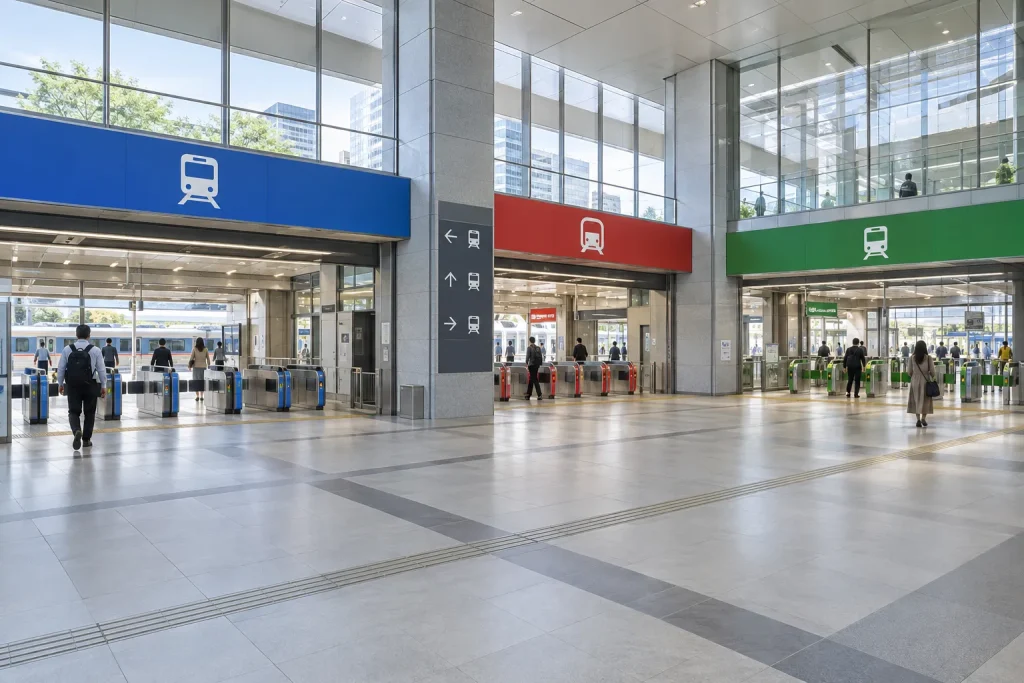
That division matters when you reserve a ticket online or collect it at a station. A reservation system operated by JR East does not necessarily sell every JR Central or JR West product under the same conditions. Private operators are separate again, even when their trains share a station complex with JR. Tokyo alone requires you to distinguish JR lines from subway and private railway services. The logo beside the route is often more useful than the station name.
What exactly am I paying for on a Japanese train?
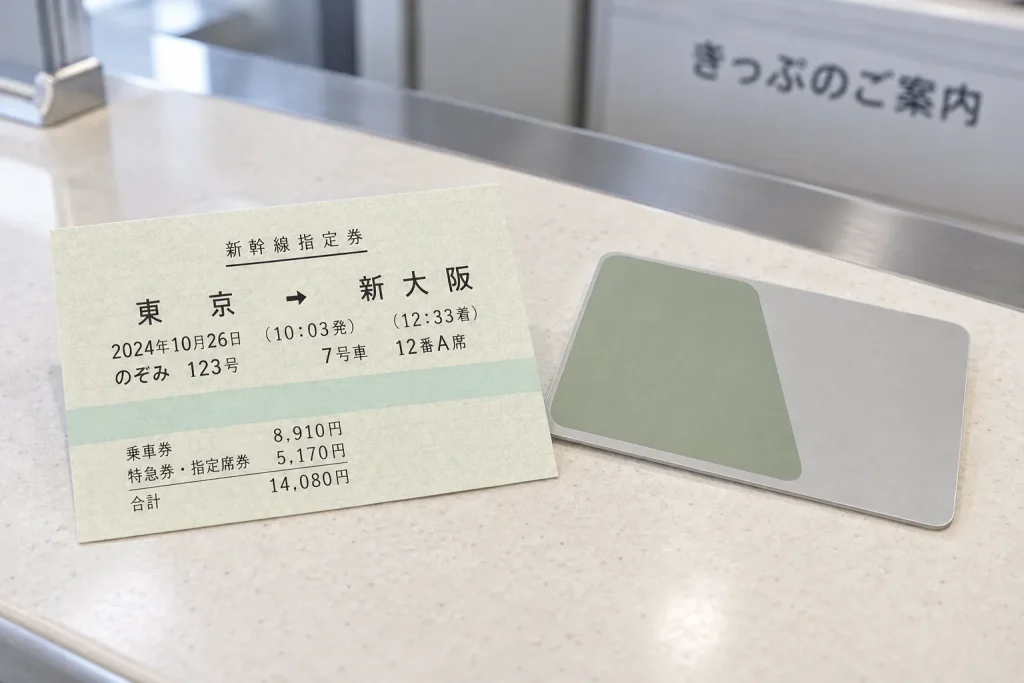
A regular JR fare begins with a 乗車券, jōshaken, literally “boarding ticket.” This is the basic fare for traveling from your origin to your destination, calculated primarily from the route and distance.
Local and rapid trains generally require only that basic fare. A Shinkansen or conventional limited express adds a 特急券, tokkyūken, literally “special express ticket.” That second ticket pays for the faster service and, where applicable, the seat type. A Green Car or another premium accommodation can add another charge.
The formula is simple:
Basic fare + train or seat surcharge = total railway price
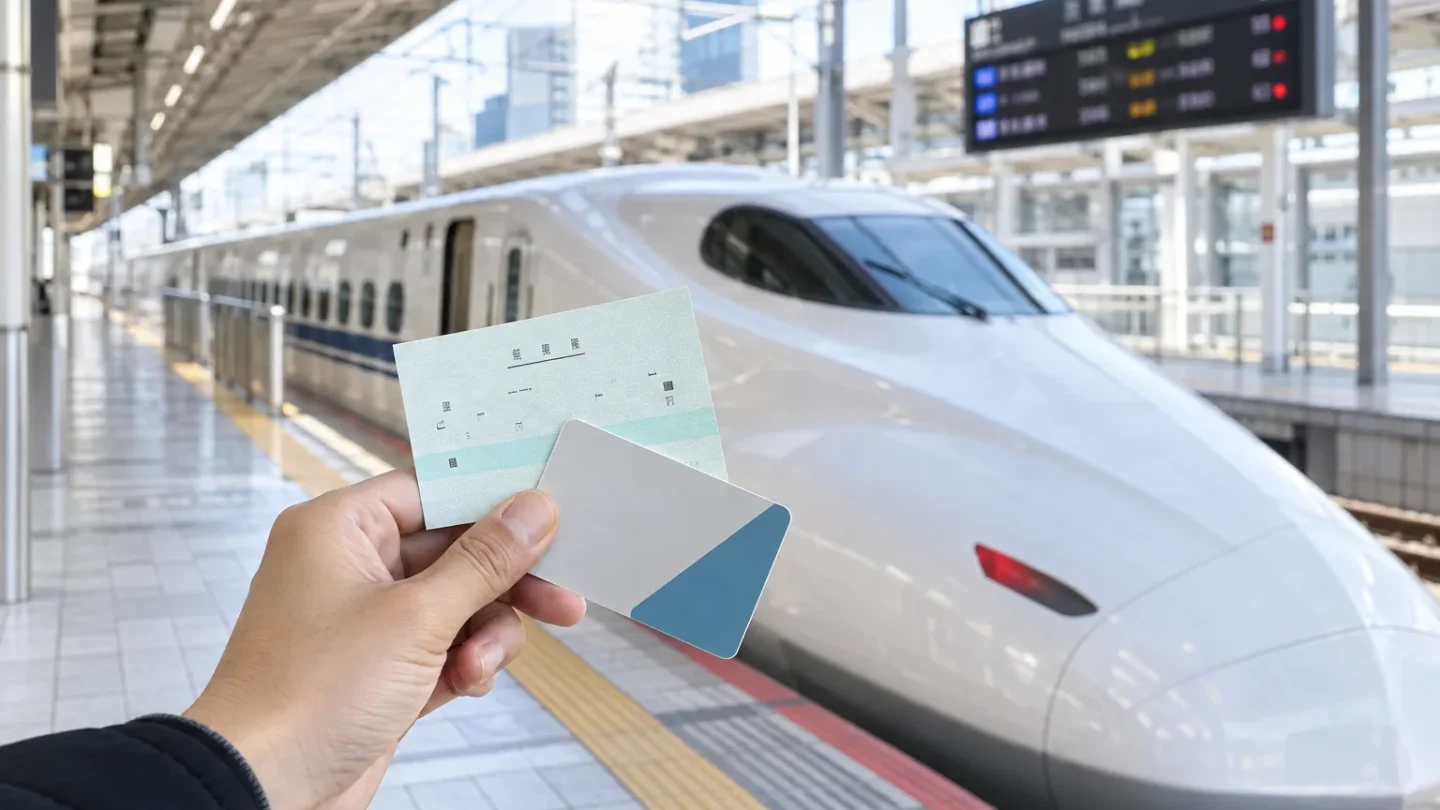
JR Central’s ticket rules state that a passenger using a Shinkansen or limited express needs a limited-express ticket in addition to the basic-fare ticket. The machine may print the components on one piece of paper, or it may issue separate tickets. A booking screen may also display only the combined total until you open the fare details. The physical format does not change the underlying Japanese train fare system.
| Train or service | Basic fare needed | Additional ticket normally needed |
|---|---|---|
| Ordinary local train | Yes | No |
| Rapid train in an ordinary unreserved car | Yes | Usually no |
| Local or rapid reserved seat | Yes | Reserved-seat ticket |
| Conventional limited express | Yes | Limited-express ticket |
| Shinkansen ordinary car | Yes | Shinkansen limited-express ticket |
| Green Car | Yes | Relevant express and/or Green Car charge |
Table basis: JR Central ticket rules, checked September 11, 2026. Individual trains can have special products or reservation requirements.
Why does the price change when the route stays the same?
The basic fare can remain unchanged while the express component changes. A reserved seat may cost more than an unreserved seat, and the fastest Shinkansen service can have a different surcharge from a slower service over the same section.
Reserved-seat pricing can also depend on the travel date. JR calendars distinguish ordinary, off-peak, peak and busiest travel periods for applicable tickets. Discounted online products introduce another price, often with restrictions on train choice, changes or refunds. A route app that displays the cheapest option may therefore be showing an unreserved seat, a slower service or a special product rather than the train you intend to take. Compare the train name, seat type and ticket conditions—not only the headline number.
For ordinary Shinkansen tickets, remember the two layers:
- 乗車券, jōshaken: the basic transport fare;
- 特急券, tokkyūken: the Shinkansen or limited-express surcharge;
- 指定席, shiteiseki: a reserved seat;
- 自由席, jiyūseki: a non-reserved seat;
- グリーン車, gurīn-sha: Green Car, JR’s premium class.
Those terms explain most apparent contradictions between ticket machines, websites and fare tables. Two prices can both be correct because they describe different seats or different purchase products. The date of travel can change the reserved-seat total again. Always reproduce a comparison using the same assumptions.
Do I need to reserve a seat?
Not on every train. Local trains generally work like urban transit: you pay the fare, enter the station and take an available place.
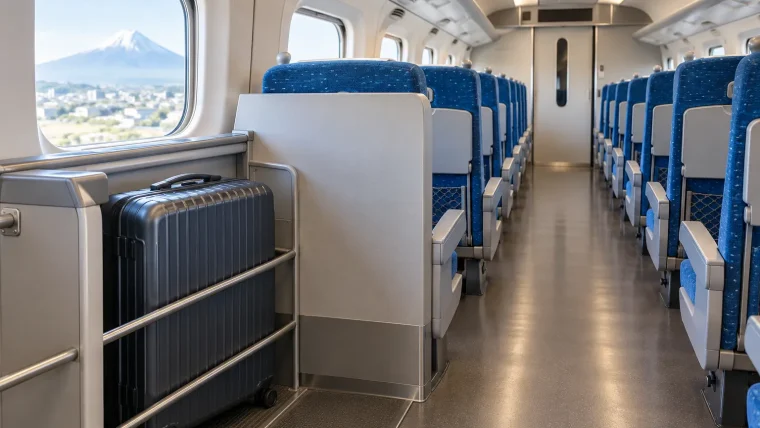
Reservations become more useful on long-distance limited expresses and Shinkansen services. Some trains are entirely reserved, while others normally include both reserved and non-reserved cars. JR may also make particular services all-reserved during specified high-demand periods. If you travel with oversized baggage on the Tōkaidō, San’yō or Kyūshū Shinkansen, designated baggage space requires the corresponding seat reservation.
Reserve when you must arrive on a particular train, when your party wants to sit together or when the operator’s rules require it. Do not assume that “reserved” means you can board any departure that day. Your ticket identifies a train, date, car and seat. If your plans are uncertain, check the change rules before choosing a discounted product.
How much is Tokyo to Kyoto to Hiroshima and back?
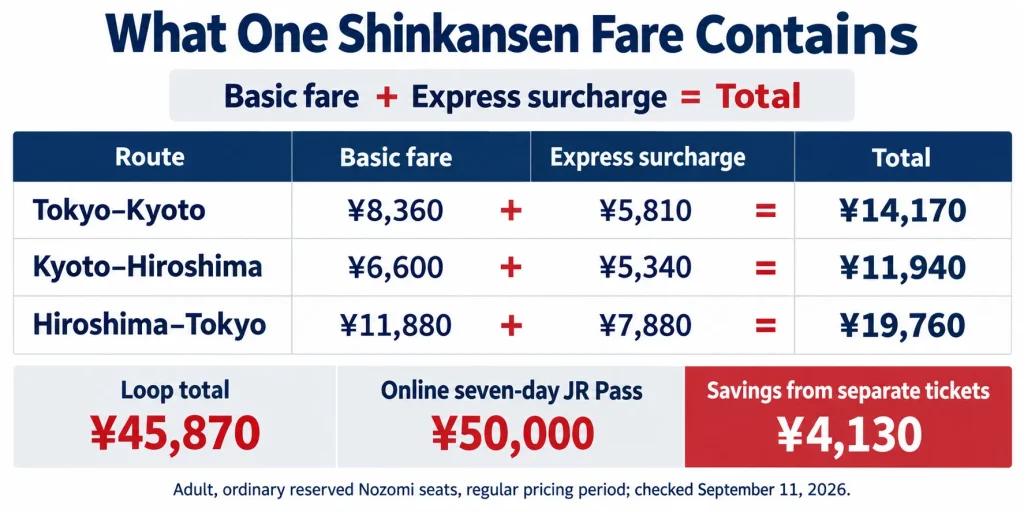
Using three separate adult tickets in an ordinary reserved seat on Nozomi trains during a regular pricing period, the checked total is ¥45,870, approximately $298 at the Bank of Japan’s September 9, 2026 central rate of ¥153.72 per US dollar. The supplied figure of ¥44,760 could not be reproduced under those consistent assumptions.
Here is the calculation checked on September 11, 2026:
| Journey | Basic fare | Nozomi reserved-seat surcharge | Total |
|---|---|---|---|
| Tokyo to Kyoto | ¥8,360 | ¥5,810 | ¥14,170 |
| Kyoto to Hiroshima | ¥6,600 | ¥5,340 | ¥11,940 |
| Hiroshima to Tokyo | ¥11,880 | ¥7,880 | ¥19,760 |
| Entire loop | ¥26,840 | ¥19,030 | ¥45,870 |
The table deliberately uses separate tickets because that is the easiest reproducible comparison for a first-time visitor. A ticket office may be able to construct the itinerary differently, including a longer-distance basic-fare ticket with a permitted stopover. Online discounts, non-reserved seats and date-based adjustments can also reduce or increase the amount. Those alternatives must be quoted with their conditions rather than silently mixed into one total.
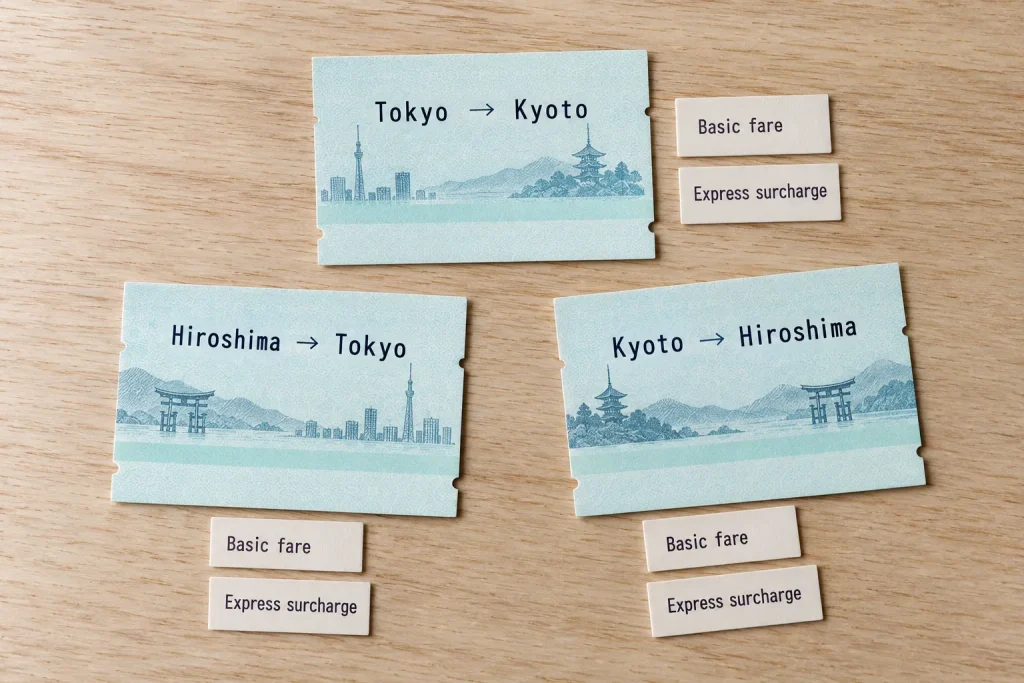
The worked example reveals why the two-part fare matters. Tokyo to Kyoto is not one indivisible ¥14,170 product: ¥8,360 buys transportation over the route, while ¥5,810 buys the selected Shinkansen service and reserved seat. The same distinction appears on the other legs. Change the seat or train, and the surcharge may change even when the underlying route does not.
The arithmetic is only meaningful when every leg uses the same fare assumptions.
Does the seven-day JR Pass save money on that loop?
No. The official online price for an adult ordinary-car seven-day Japan Rail Pass is ¥50,000, approximately $325 using the same September 9, 2026 exchange rate. Three separate reserved Nozomi tickets total ¥45,870, approximately $298, leaving the pass ¥4,130—about $27—more expensive before considering any restrictions.
The comparison becomes even less favorable for an Exchange Order purchased through an overseas JR-designated agency on or after October 1, 2026. The official price page lists that seven-day ordinary pass at ¥53,000, approximately $345 at the cited exchange rate. The agency price is therefore ¥7,130, or about $46, above the three-ticket calculation. The official online price remains listed separately at ¥50,000 on the page checked September 11, 2026.
There is another cost beyond the headline price. The standard nationwide pass does not let you simply board Nozomi or Mizuho under its ordinary coverage; the official rules require a special pass-holder ticket for those services. Without that supplement, you select eligible alternatives such as Hikari, Sakura or Kodama where available. Paying more for a pass while accepting a slower or less convenient itinerary is not a bargain.
The pass could still become worthwhile if you add enough eligible long-distance travel inside its validity period. Local JR rides, airport transfers or another substantial excursion may change the calculation. But those journeys must be trips you genuinely intend to take. Adding unnecessary rides to “recover” the price is spending time to defend a purchase.
For a route-by-route calculator and the exceptions, Is the Japan Rail Pass Worth It in 2026? handles the pass decision in full. This pillar establishes the mechanism: calculate ordinary tickets first, then compare the pass. JR Pass value comes from covered travel, not from the number of cities written in your itinerary.
Can I buy one basic ticket and stop in Kyoto? This is the question beginners do not know to ask
Possibly—and this is the question people often discover only after pricing every leg separately. A long-distance JR basic-fare ticket may permit a stopover, while the Shinkansen limited-express portions are handled separately.
That means Tokyo to Kyoto and Kyoto to Hiroshima do not always have to be treated as two unrelated basic-fare journeys. Under the applicable ticket rules, a through basic-fare ticket to Hiroshima may allow you to leave the system in Kyoto and continue later while it remains valid. You would still need the appropriate Shinkansen surcharges for the trains you ride. The result can be lower than purchasing every component as a completely separate journey.
Do not construct this by guesswork at a crowded gate. Ask a JR ticket office to price the exact itinerary, dates, stopover and train choices as one plan. Discounted online products may follow different conditions from ordinary paper tickets. City-zone rules and the validity period can also affect where the ticket begins, ends and remains usable.
This is why ¥44,760 cannot be presented as a universal cost merely because it is below the separate-ticket total. A valid lower quote needs an identifiable ticket construction. Without that construction, the reader cannot reproduce it. The correct editorial rule is to publish the assumptions beside the number.
Do IC cards make long-distance tickets cheaper?
Usually, an IC card is a convenience tool rather than a nationwide discount card. It saves you from buying a small paper ticket for each compatible local journey and automatically calculates the stored-value fare when you exit.
That does not mean every local fare is identical to the paper-ticket fare in every region. Nor does it turn a limited express or Shinkansen into a tap-only journey unless you have registered and purchased the required product. Keep sufficient balance, and do not discard separate reservation or express tickets simply because you tapped a card. If the gates reject the combination, use the staffed gate instead of tapping repeatedly.
An IC card is most useful for urban trains, subways, buses and small purchases where accepted. It is less useful as a planning tool for intercity costs. Put major reserved journeys in your itinerary as explicit tickets. Treat the IC balance as local transport spending.
Which booking system should I use?
Use the system belonging to the railway and route you are actually traveling. JR West’s online reservation service sells basic-fare and limited-express tickets across its stated coverage area, while JR Central promotes its own services for the Tōkaidō Shinkansen.
The practical sequence is straightforward:
- Find the route and identify its operator.
- Confirm the exact train name and whether it requires a reservation.
- Compare the ordinary fare with an official online product.
- Read the collection, change and refund conditions.
- Register an IC card only if the selected product supports it.
- Keep the booking confirmation until the trip is complete.
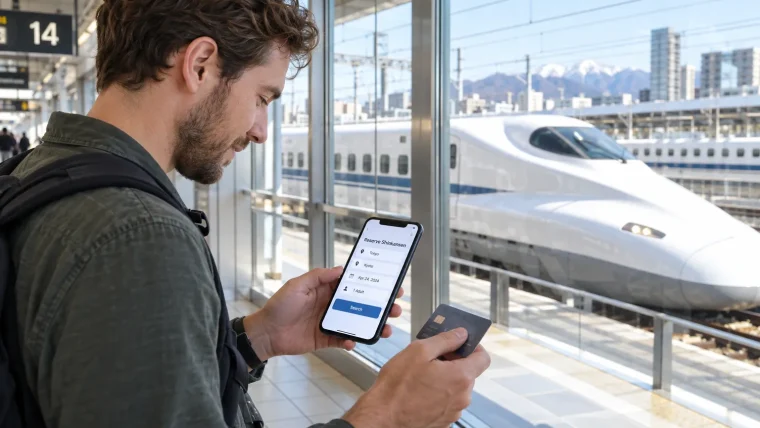
Do not assume that the cheapest search result includes the same flexibility as a regular ticket. Some products bind you to a particular train or purchase deadline. Others require collection from compatible machines or specified stations. Before departure, confirm where you will receive or activate the ticket. An apparent saving is useless if you cannot collect the product along your route.
You will also need data access for reservations, disruption notices and platform changes. Two Ways to Get Online and One Bill to Pick compares eSIM and pocket Wi-Fi without pretending that every traveler needs the same setup. For the rest of the practical sequence, Planning a First Trip to Japan: The Order That Works places transport decisions after your route and overnight stops. This avoids buying a pass before you know what journeys it must cover.
When should I take a domestic flight instead?
A train is not automatically the best choice simply because Japan has excellent railways. When the journey is long, a domestic flight may offer a lower fare or a more useful schedule, especially if your airports are convenient.
Compare the entire trip rather than the time shown between takeoff and landing. Include travel to the airport, check-in requirements, baggage, arrival transport and the risk created by separate international and domestic tickets. A Shinkansen normally connects city centers and allows a later arrival at the station. A flight may still win when the rail distance is very long or a fare sale is available.
The comparison must use the final airline price, not the first number in the search result. What the Cheaper Ticket Quietly Leaves Out explains baggage and fare restrictions that can change the apparent saving. Rail and air are not competing abstractions; they are two door-to-door itineraries. Price both on the same date before choosing.
What should I learn before I board?
Learn how to identify the operator, distinguish a basic fare from a surcharge and recognize your train’s departure time, car and seat. Those habits prevent more problems than memorizing every pass name.
For spoken help, the site’s phrasebook contains 337 phrases sorted by situation, including transport questions you can keep open at the counter. Save the Japanese station names from your booking because different stations in the same city may not be interchangeable. Confirm the last connection when traveling late, and check live notices on the operating railway’s official site. For overall budgeting beyond tickets, How Much Money to Bring to Japan covers cash and daily spending rather than duplicating the fare calculation here.
Your next subject should be ticket validity: when an ordinary long-distance ticket allows a stopover, when a discounted product does not, and what happens if you miss the named train. That is the layer that turns basic fare knowledge into a usable itinerary. Start with ordinary tickets, then compare passes, online products and flights. This order keeps Shinkansen ticket prices attached to real journeys instead of marketing claims. It also prevents a ¥50,000 purchase from dictating a vacation that did not need it.
Frequently asked questions
Can I tap an IC card directly onto every Shinkansen?
No. You need an eligible Shinkansen product, and some services allow it to be linked to a registered IC card. Simply carrying a Suica, PASMO or ICOCA does not create a Shinkansen reservation.
Are Nozomi trains included in the ordinary Japan Rail Pass?
Not under the pass’s standard coverage alone. The official Japan Rail Pass site states that Nozomi and Mizuho require a special ticket issued to pass holders.
Is an unreserved seat always available?
No. Some trains are entirely reserved, and operating rules can change during high-demand periods. Check the specific train and date before relying on a non-reserved car.
Can I buy Shinkansen tickets after arriving in Japan?
Yes, subject to availability. You can use eligible ticket machines or staffed offices, while official online systems let you arrange certain journeys in advance.
Should I buy a rail pass before planning my route?
No. Build the overnight itinerary first, price the journeys you will actually take and only then compare passes. A pass is a payment product, not a route-planning method.
Why did two websites give me different fares?
They may be showing different train types, seats, travel dates or discounted products. Open the breakdown and compare like with like: route, train, basic fare, surcharge and ticket conditions.