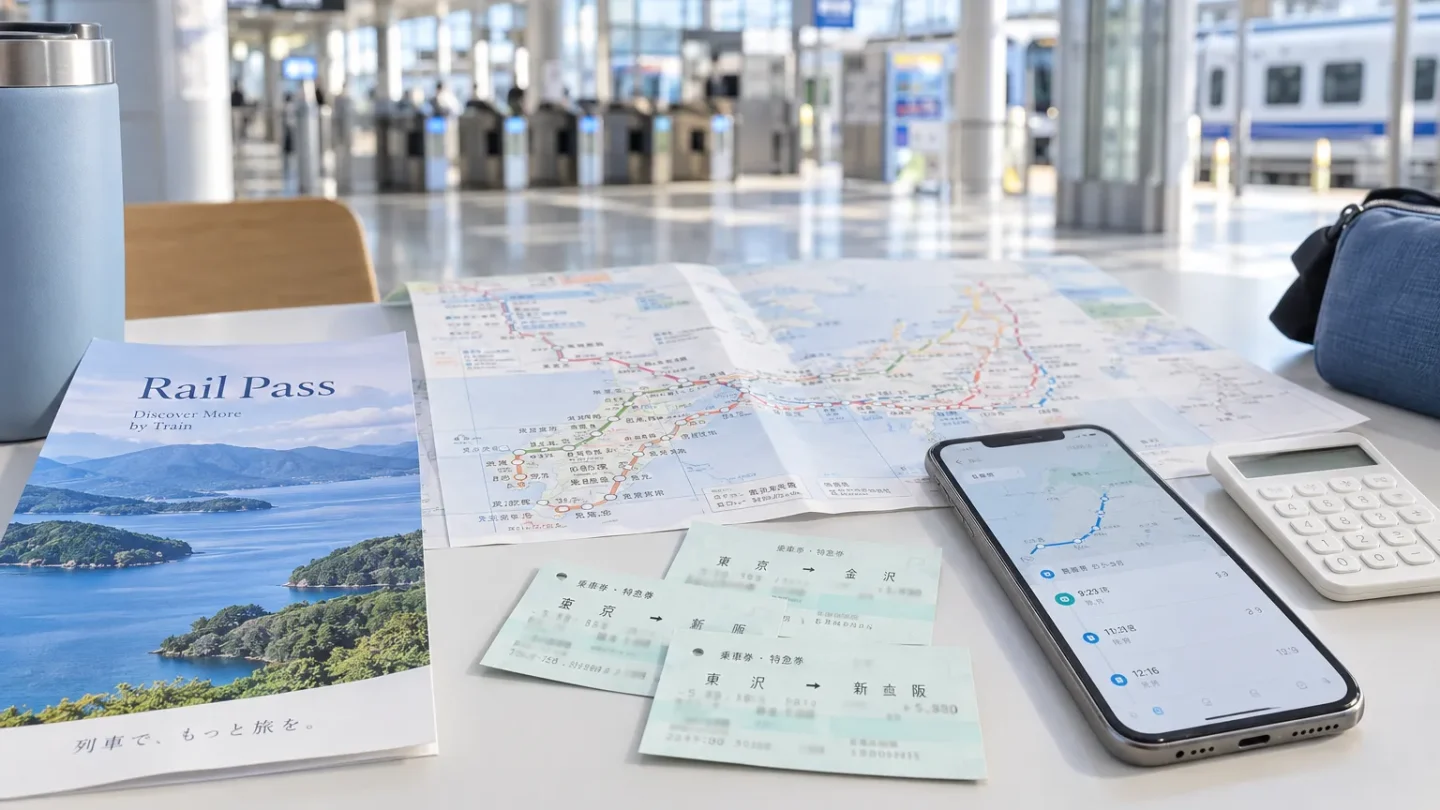
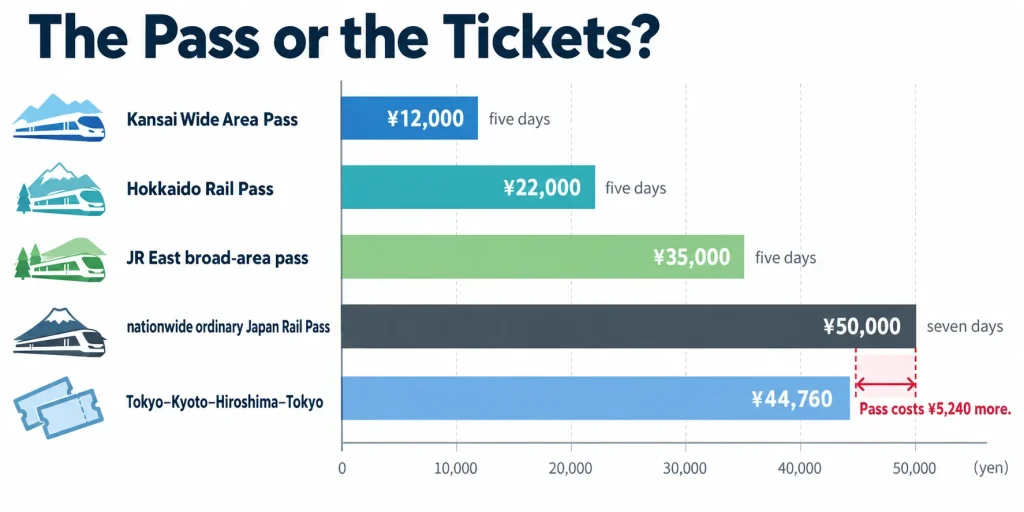
The most expensive mistake is buying the nationwide pass before adding up your actual trains. If you are asking whether a japan regional rail pass worth it, the answer depends on distance, coverage, and how many expensive journeys fit inside the pass period. The ordinary seven-day Japan Rail Pass costs ¥50,000 ($325 at ¥154 per $1), while the frequently proposed Tokyo–Kyoto–Hiroshima–Tokyo itinerary totals about ¥44,760 ($291). You spend approximately ¥5,240 ($34) more for flexibility that this itinerary does not use. Regional passes can break even after two or three long intercity legs, but two or three subway rides will not get remotely close.
Mistake 1: Buying the ¥50,000 national pass by instinct
Travelers still remember when the nationwide pass was an automatic recommendation for a fast circuit through Japan. Buying it feels reasonable because the price is fixed, reserved seats are available, and most of the itinerary uses JR trains. The current arithmetic is less forgiving: ¥13,970 from Tokyo to Kyoto, about ¥11,300 from Kyoto to Hiroshima, and approximately ¥19,490 from Hiroshima to Tokyo produce the ¥44,760 planning total used here. Against the official ¥50,000 online price checked on September 12, 2026, that leaves the pass ¥5,240 behind. An overseas agency exchange order issued from October 1, 2026 can cost ¥53,000, widening the gap to ¥8,240.
The separate guide Is the Japan Rail Pass Worth It in 2026? covers the national product in detail. The important point here is that adding inexpensive city rides rarely closes a five-figure gap. Tokyo Metro, Osaka Metro, private railways, and many buses are not covered simply because they are trains or public transportation. Flexibility has value, but it should appear in your decision as a benefit rather than as imaginary fare savings. If your itinerary changes daily, decide how much you are willing to pay for that freedom.
What to do instead: Price the three or four costliest JR journeys first, add only covered local trips, and buy the national pass only when the total clearly exceeds its purchase price.
Mistake 2: Comparing a regional pass with the wrong tickets
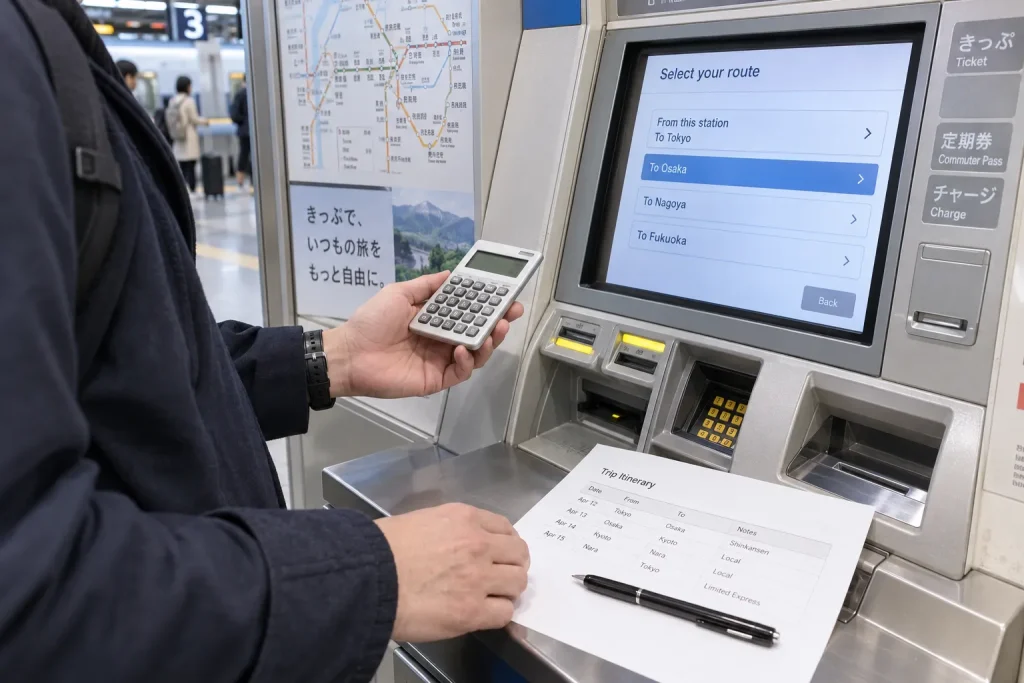
A half-informed traveler often performs a calculation but compares the pass against the most expensive possible collection of individual tickets. The pass may cover an ordinary reserved seat, while the comparison uses premium seating, a faster service requiring an extra ticket, or a booking product with different conditions. The opposite mistake also occurs when a discounted advance fare is compared with a flexible pass without acknowledging that the cheaper ticket may restrict changes. These are not equivalent products, even when the departure and destination are identical. How Japan’s Rail Fares Are Actually Built explains how base fares, limited-express charges, and seat categories combine.
A pass comparison should use the train and seat you would genuinely buy without it. If you normally choose an ordinary reserved seat, compare that seat on both sides. If you would accept a nonreserved seat, do not inflate the ticket total with unnecessary reservations. Likewise, do not assign monetary value to unlimited travel unless you expect to use it. The break-even figure must represent your trip, not the pass seller’s most flattering scenario.
What to do instead: Keep the train, seat class, route, and booking flexibility identical on both sides of your calculation.
Mistake 3: Treating “regional” as a promise of complete coverage
The Kansai Wide Area Pass costs ¥12,000 ($78) for five consecutive days and covers specified JR services from Kansai toward destinations including Okayama, Takamatsu, Kinosaki Onsen, Tottori, and Shirahama. It includes the Sanyo Shinkansen between Shin-Osaka and Okayama, but it does not include the Tokaido Shinkansen between Tokyo and Shin-Osaka. It also does not turn every subway, private railway, highway bus, or local attraction transport service into a free ride. A traveler can therefore own the correct regional pass and still pay several operators during the day. The problem is not hidden fraud; it is assuming that a geographical name overrides the published route map.
The same issue appears in Hokkaido, where the island-wide JR product covers JR trains but not every bus needed to reach national parks, lakes, ski areas, or rural accommodations. In eastern Japan, certain partner lines are included only under defined conditions. A pass may be geographically broad and operationally narrow at the same time. That distinction matters most when your hotel or attraction is far from a covered station. The final connection can erase part of the expected saving.
What to do instead: Mark every journey by operator, not merely by city, and count only the segments explicitly shown on the pass’s official coverage map.
Mistake 4: Assuming every regional pass breaks even after two rides
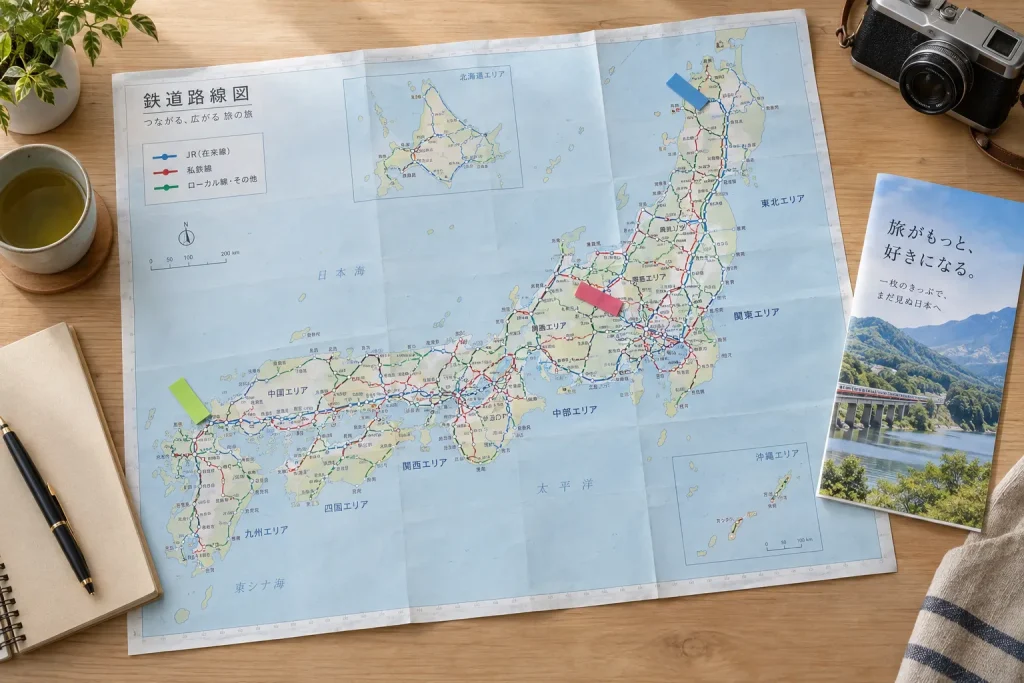
The slogan that regional passes pay for themselves after two or three rides is accurate only when “ride” means a substantial limited-express or Shinkansen journey. The ¥12,000 Kansai Wide pass can approach break-even with an Osaka-area departure to a distant covered destination and the return journey. A ¥22,000 ($143) five-day Hokkaido Rail Pass needs more expensive ground travel, such as a long round trip across the island, rather than two short hops from Sapporo. JR East’s broad five-day product was listed at ¥35,000 ($227) in September 2026, so even a Tokyo–Sendai round trip alone does not recover its full price. The distance threshold changes with each product.
| Pass checked | Adult price | Validity | Break-even implication |
|---|---|---|---|
| Kansai Wide Area Pass | ¥12,000 ($78) | Five consecutive days | One distant round trip can approach or exceed the price |
| Hokkaido Rail Pass | ¥22,000 ($143) | Five consecutive days | Usually needs two or three long intercity legs |
| JR East broad-area pass | ¥35,000 ($227) | Five consecutive days | Requires a genuinely long regional itinerary |
| National ordinary pass | ¥50,000 ($325) | Seven consecutive days | Tokyo–Kyoto–Hiroshima–Tokyo remains about ¥5,240 short |
These are not interchangeable break-even targets. Kansai has several dense, fast corridors where expensive rides can be concentrated into a short period. Hokkaido’s distances are large, but its schedules may prevent you from collecting multiple destinations efficiently. JR East covers valuable high-speed routes, yet staying in Tokyo with a few nearby excursions does not use them. A lower pass price does not help when it covers the wrong direction.
What to do instead: Divide the pass price by the cost of your planned long-distance legs, not by the total number of times you expect to enter a station.
Mistake 5: Asking “Japan regional rail pass worth it?” after fixing the wrong base
Another half-informed mistake is selecting a pass first and bending the vacation around it. Travelers add distant day trips because an unused pass feels wasteful, even when the extra ride consumes most of the day. A nominal saving of ¥1,000 ($6.50) is poor compensation for hours spent returning to the same hotel simply to exploit unlimited travel. The better planning order appears in Planning a First Trip to Japan: The Order That Works: choose places and nights before transportation products. A pass is the last layer of itinerary design, not the foundation.
Consider the practical difference between three bases. Osaka works well for covered trips west toward Okayama or north toward Kinosaki within the Kansai Wide area. Tokyo works for JR East only when your plans extend far beyond ordinary city travel and short suburban excursions. Sapporo can anchor a Hokkaido itinerary, but repeated returns become time-consuming when the route reaches Hakodate, Abashiri, or Wakkanai. The spreadsheet may show a profit while the calendar shows an exhausting trip.
What to do instead: Build the trip you want without a pass, then test whether a pass reduces the cost of that unchanged itinerary.
Mistake 6: Activating the clock on the airport day
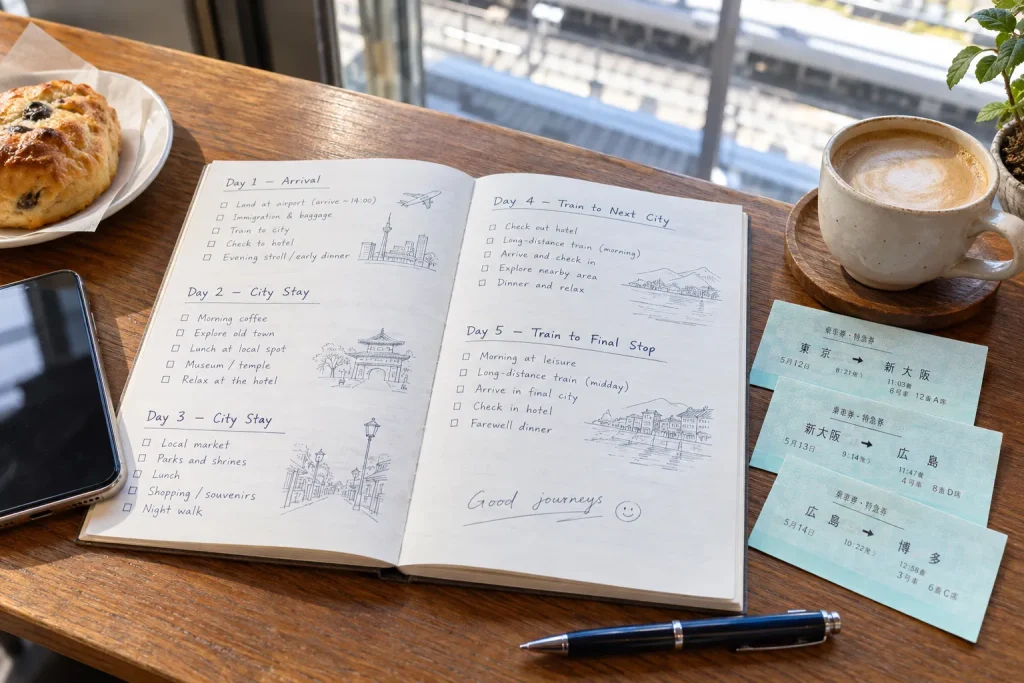
Regional passes generally use consecutive calendar days, not a chosen number of separate travel days. Activating a five-day pass for one airport train and then spending the next two days in the arrival city wastes a large part of its useful period. The choice looks sensible because the airport station sells or exchanges the product and the traveler wants to finish all ticket tasks immediately. What it actually causes is an expensive long-distance journey falling just outside the validity window. The problem is especially costly when that final journey was supposed to create the saving.
A stored-value transit card or separate airport ticket may be cheaper on arrival, even when you already possess a pass exchange order. The start date should align with the first cluster of expensive covered trains. There is no prize for activating the product at the earliest possible moment. Coverage and duration begin according to the pass rules, not according to how many journeys you have taken.
What to do instead: Start the pass on the first day of concentrated intercity travel, not automatically on the day you land.
Mistake 7: Ignoring the trains the pass makes less convenient
The nationwide pass does not automatically provide ordinary access to the fastest Nozomi and Mizuho services. JR’s official rules require a special additional ticket for those trains, while covered Hikari, Sakura, and other eligible services may involve a different departure time or journey pattern. Regional passes also specify which Shinkansen sections, limited expresses, buses, and seat types are included. A pass that saves ¥2,000 ($13) but forces an inconvenient departure can be the wrong purchase for a tightly scheduled day. Timetable value belongs beside fare value.
Connectivity matters here because route changes, seat reservations, and service notices often need to be checked while traveling. Two Ways to Get Online and One Bill to Pick compares eSIM and pocket Wi-Fi without pretending that either changes the railway rules. If you need to ask station staff about a platform, reservation, or missed connection, the phrasebook’s 337 phrases sorted by situation provides language support rather than duplicating a route-planning tool. The pass is useful only when the covered train works at the time you need it.
What to do instead: Check the actual departure you intend to take and confirm that its service, seat, and route are covered before assigning its fare to the pass.
Mistake 8: Counting reservations you have not secured
Unlimited travel does not mean unlimited seat inventory. A pass can allow reservations without an extra ordinary-seat charge, yet the train you want may already be full. This matters during holiday periods, major events, and on services with no nonreserved cars. Travelers who did careful fare research can still fail here because their calculation assumes every preferred departure remains available. The result can be a later train, a longer connection, or a separately purchased alternative.
JR West states that reserved seats must be booked before boarding and identifies trains that operate entirely with reserved seating. It also opens many reservations one month before travel, beginning at 10:00 a.m. Japan Standard Time on the corresponding date in the previous month. That rule was checked on September 12, 2026 and can change. The timetable is therefore part of the pass calculation rather than an administrative detail. A theoretical covered ride has no value if you cannot use it as planned.
What to do instead: Reserve essential long-distance seats as soon as the operator permits and keep a covered backup departure in the itinerary.
Mistake 9: Treating the smallest saving as proof
A pass that beats separate tickets by ¥500 ($3.25) has technically broken even, but the margin is too thin to absorb a changed train, an uncovered connection, or a day when you decide not to travel. This mistake seems rational because the spreadsheet displays a positive number. It actually converts a flexible vacation into an obligation to follow every planned ride. Regional passes are strongest when the saving survives ordinary changes. A narrow victory is not the same as a robust purchase.
| Calculation result | Practical reading |
|---|---|
| Individual fares exceed the pass by less than ¥1,000 ($6.50) | Too close to call; convenience and restrictions decide |
| Pass saves ¥1,000–¥5,000 ($6.50–$32) | Useful only if the core journeys are firm |
| Pass saves more than ¥5,000 ($32) | A meaningful margin, provided coverage is correct |
| Pass costs more than individual tickets | Buy separate tickets unless flexibility justifies the premium |
These thresholds are editorial decision bands, not JR rules. They make uncertainty visible instead of claiming that a one-yen advantage settles the question. Weather, fatigue, missed trains, and an appealing unscheduled stop can all change a trip. The pass should support the itinerary rather than police it.
What to do instead: Require a comfortable saving margin, not merely a total that is a few yen above the pass price.
The habit that prevents most pass mistakes
Write every intercity leg in a table before buying anything. Give each row a date, operator, train, ordinary ticket price, pass coverage status, reservation requirement, and realistic alternative. Add only the covered rows, compare that result with the correct purchase-channel price, and leave short city trips out unless they materially change the result. This one habit catches wrong regions, wrong operators, expired validity, excluded trains, and invented savings. It also shows when no pass is the cheapest answer.
The worked comparison below demonstrates why the national product loses on the brief’s route. The ¥44,760 total is approximately $291 at the rounded editorial exchange rate used throughout the article. The official online seven-day price is ¥50,000, or approximately $325. The difference is ¥5,240, meaning the listed itinerary recovers about 89.5% of the pass price. You need another ¥5,240 in covered travel merely to reach zero.
Unlimited travel is valuable only after the limited itinerary has been priced.
The shortest version is straightforward:
- List the expensive rides.
- Match the operators.
- Check the pass map.
- Align the valid days.
- Demand a real margin.
FAQ
Do regional rail passes always pay off after two rides?
No. Two expensive Shinkansen or limited-express legs may be enough for a lower-priced regional product, but two local rides are not. The relevant measure is the combined individual fare, not the number of times you board. A Kansai Wide pass has a much lower threshold than a broad JR East pass. Always calculate your actual route.
Is the seven-day Japan Rail Pass worth buying for Tokyo and Kyoto?
A standard Tokyo–Kyoto round trip is well below the official ¥50,000 online price checked on September 12, 2026. Adding Hiroshima raises the sample circuit to about ¥44,760, which still leaves a ¥5,240 shortfall. Additional covered travel could change the result, but ordinary city transit should not be assumed to be included. Buy on arithmetic, not on the number of famous cities.
Can I use a Kansai pass between Tokyo and Osaka?
The Kansai Wide Area Pass does not cover the Tokaido Shinkansen between Tokyo and Shin-Osaka. Its covered Shinkansen section runs between Shin-Osaka and Okayama. Separate tickets are required for travel outside its zone. The official map should be checked immediately before purchase. A pass name is not a substitute for its boundary.
Does a Hokkaido Rail Pass include buses?
It is primarily a JR rail product, and travelers should not assume that local sightseeing buses or non-JR transportation are included. Many Hokkaido attractions require an additional connection from the nearest station. That connection must be priced separately. The published coverage list controls, not the fact that both services operate in Hokkaido. Rural access should be checked before building the rail itinerary.
Can I ride Nozomi with the national JR Pass?
Not with the basic pass alone under the rules checked in September 2026. JR requires a separate special ticket for Nozomi and Mizuho services. Other eligible Shinkansen services remain covered within the published conditions. Compare the timetable before deciding whether the covered alternative is practical. Rules and supplements must be rechecked before publication.