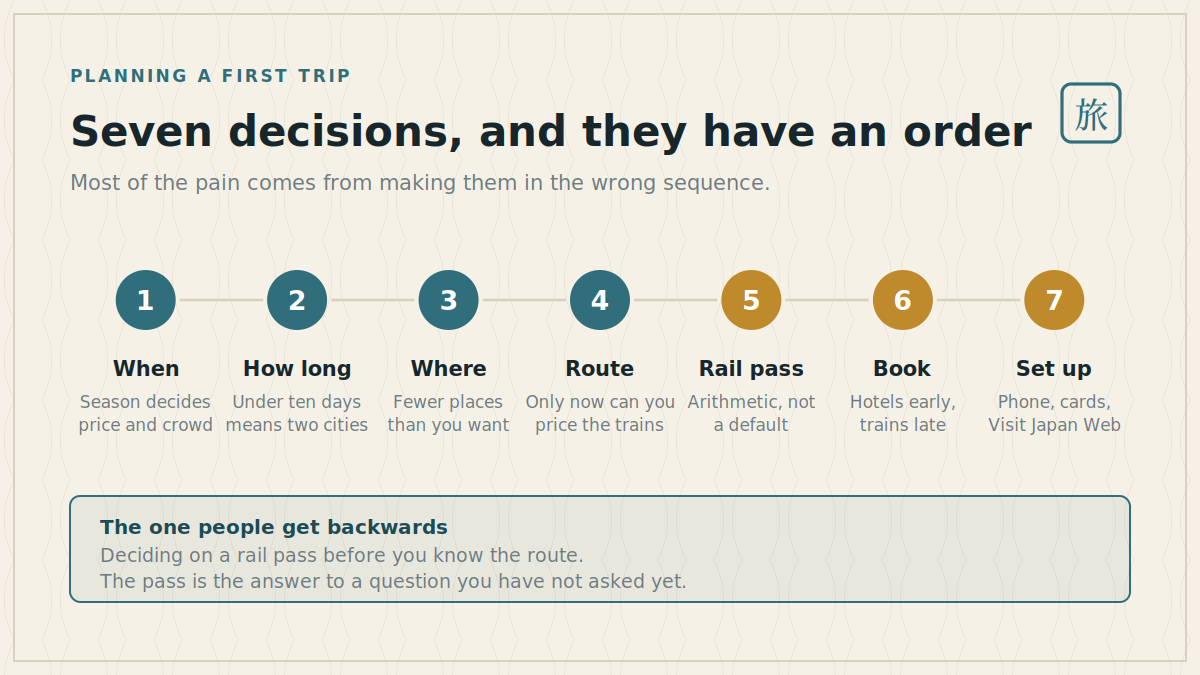
Most of what goes wrong on a first trip to Japan is not a mistake about Japan. It is a decision made in the wrong order — usually buying something before knowing whether it was needed.
This is the sequence, and the four things that changed in 2026 and quietly made a lot of older advice wrong.
Start with the season, not the itinerary
When you go changes the price of everything else, so it goes first.
Late October and November are the best weather of the Japanese year, and the crowds are heavy only in the last two weeks of November when the leaves turn. Late March to early April is the cherry blossom, which is genuinely worth seeing and comes with the highest prices and the thickest crowds of the year.
June is the rainy season, July and August are hot and very humid, and September brings typhoons. Winter is cold, dry and by a distance the cheapest.
Three windows to avoid outright if you can move your dates: Golden Week at the start of May, Obon in mid-August, and the New Year period. These are domestic holidays, not tourist seasons — the whole country travels at once. The full month-by-month picture is in our guide to when to visit.
Then decide how long, and be honest about it
The single most common first-trip error is trying to see too much. Japan rewards depth, the trains are fast but the transfers and check-ins are not, and a day spent moving is a day not spent anywhere.
A working rule:
- Seven days or fewer — one city, with day trips. Tokyo or Kyoto, not both.
- Eight to twelve days — two cities. Tokyo and Kyoto is the standard, and it is standard because it works.
- Two weeks or more — three cities, or two plus a rural stretch.
Count the first and last days as half days. A long-haul arrival costs you an afternoon, and a morning flight home costs you a whole day.
Only now, price the trains
This is the step people skip, and it is the one that decides whether you spend fifty thousand yen you did not need to.
Look up the actual fares for your actual route. Tokyo to Kyoto is ¥13,850 for a reserved seat. Tokyo to Hiroshima is ¥18,910. Add them up. Then compare that number to the price of a rail pass — and only then decide.
For most first trips, the arithmetic now says no. A Tokyo–Kyoto round trip is about ¥27,700 against a ¥50,000 pass. Even Tokyo–Kyoto–Hiroshima–Tokyo comes to roughly ¥44,760, which still does not reach it. The full working is in our article on whether the Japan Rail Pass is worth it.
Four things that changed in 2026
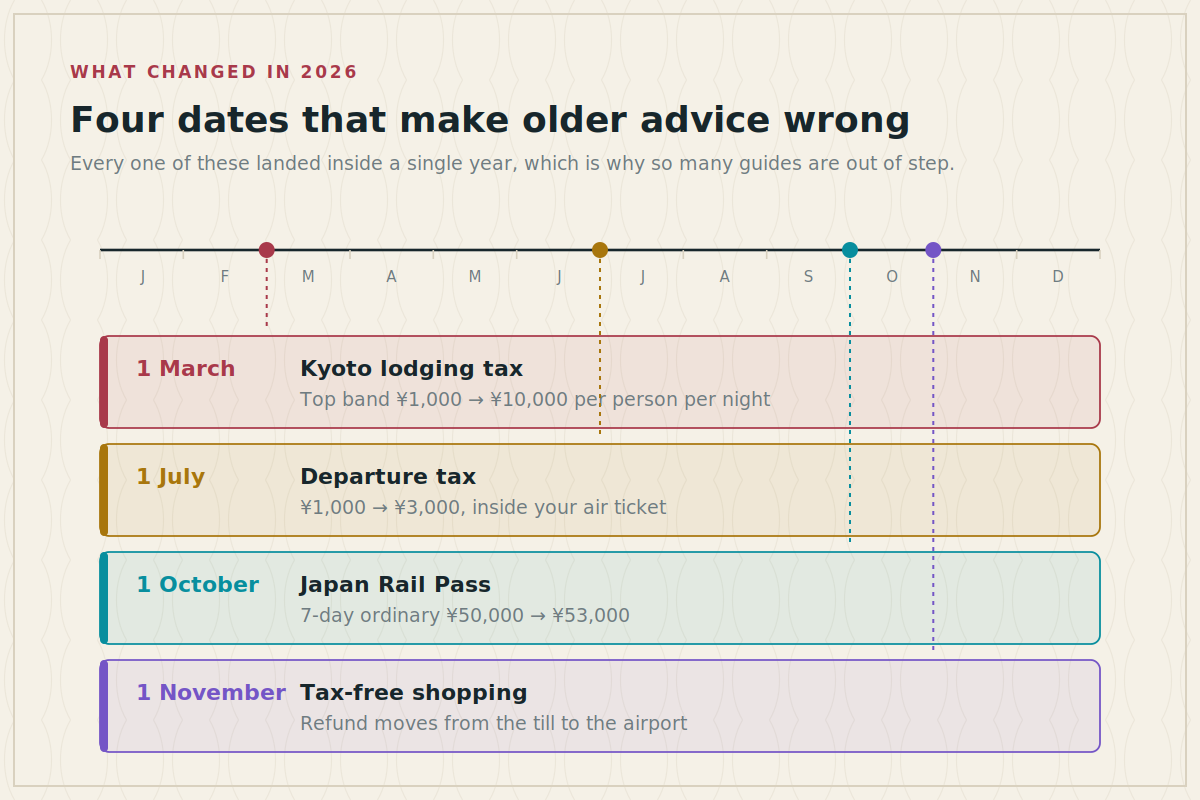
If you are reading advice written before this year, check it against these.
1 March. Kyoto’s lodging tax was restructured. The top band went from ¥1,000 to ¥10,000 per person per night, and the middle bands roughly doubled. Most visitors will pay ¥400 or ¥1,000 a night rather than ¥200.
1 July. The international departure tax tripled, from ¥1,000 to ¥3,000. It is collected inside your air ticket, so you will not see it separately, but it is there.
1 October. The Japan Rail Pass rises. The 7-day ordinary pass goes from ¥50,000 to ¥53,000, the 14-day from ¥80,000 to ¥84,000, the 21-day from ¥100,000 to ¥105,000. The change applies to purchases from that date.
1 November. Tax-free shopping changes shape entirely. Instead of the tax being taken off at the till, you pay the full price and claim the 10% back at the airport before departure. The sealed-bag rule for consumables disappears, and so does the split between consumables and general goods. The details are in our article on money in Japan.
Book in this order
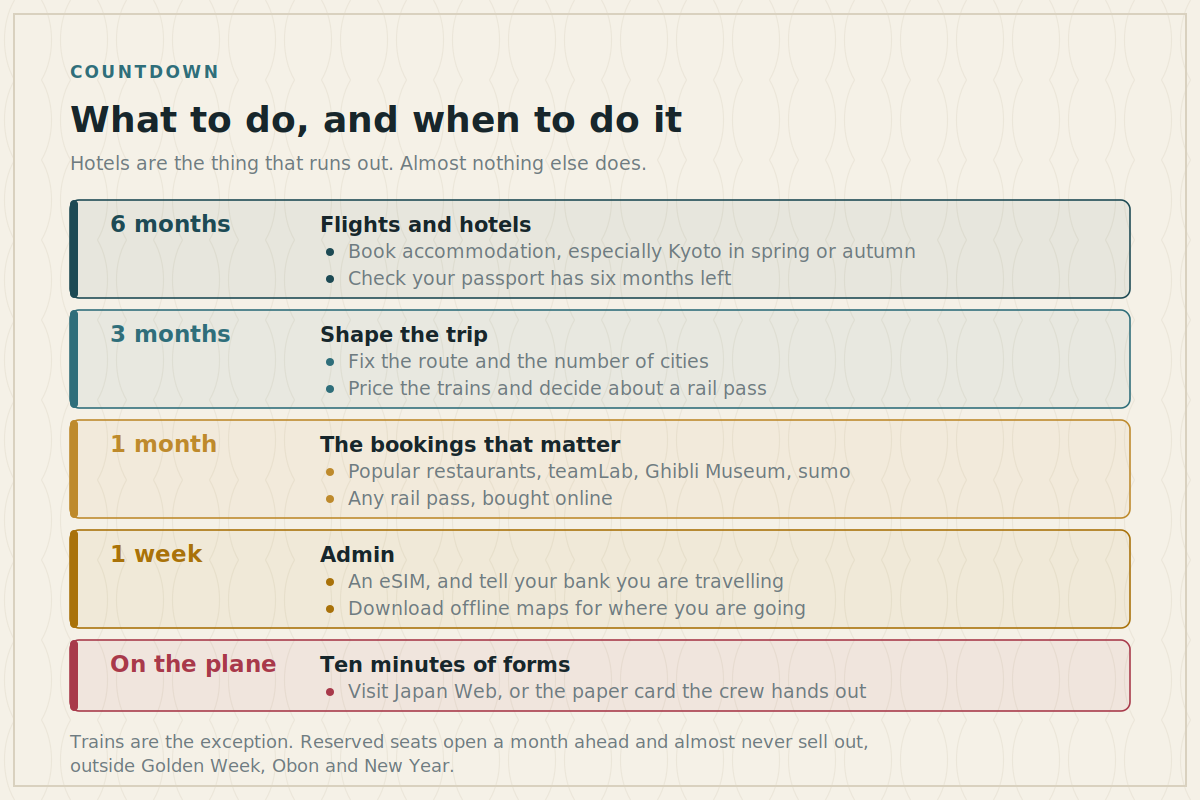
Accommodation is the constraint. Kyoto in blossom season and in late November sells out months ahead, and prices roughly double. Book that first and build around it.
Trains are the opposite. Reserved seats open a month before departure and almost never sell out outside the three holiday windows. There is no advantage to booking them early, and there is a real disadvantage to locking in a schedule you may want to change.
The things that do need booking a month out are specific attractions: teamLab, the Ghibli Museum, sumo tournaments, and any restaurant with a reputation.
Book hotels early and trains late. Almost every first-timer does the opposite, and pays for the privilege of being unable to change their mind.The booking rule
Entry, and the form you can skip
US, Canadian, UK, EU and Australian passport holders get 90 days visa-free for tourism. Your passport should have six months of validity, and you will need an onward ticket.
Visit Japan Web is optional. It is a website, not an app, and it turns your immigration card and customs declaration into QR codes. At Haneda, Narita and Kansai the newest kiosks read both in one tap. It saves real time — but the paper forms are still handed out on the plane and accepted at every airport, so if the site will not cooperate, take the paper.
One useful 2026 addition: the site now also carries a digital code for tax-free shopping, which replaces the paper slips stapled into passports.
Money, briefly
Japan is far more cashless than its reputation. Contactless cards work at convenience stores, chains, department stores and most tourist-facing businesses. What still wants cash: small restaurants, shrines and temples, festival stalls, and rural buses.
Carry about ¥10,000 and top up at a 7-Eleven ATM, which takes foreign cards around the clock in English. The yen has been weak — around 160 to the dollar through 2026 — which is doing a lot of work for American visitors. Daily budgets and what things actually cost are in the money article.
Set up the phone before you land
An eSIM bought before departure is the least painful option, and airport wifi is the worst possible place to be configuring one.
The short list is Google Maps, a train app, Google Translate with camera mode, and — if you have an iPhone — Suica in Apple Wallet, which turns the phone into a train ticket. Android users mostly cannot do this, because Mobile Suica needs hardware that non-Japanese phones lack. The full list, and what each app is actually for, is in our article on apps.
A route that works
For ten days, first trip, no strong preferences:
| Days | Where | Why |
|---|---|---|
| 1–4 | Tokyo | Arrive, adjust, and see the city at its own pace |
| 5 | Hakone or Nikko | A day trip out, mountains or shrines |
| 6–9 | Kyoto | Temples, and Nara or Osaka as day trips |
| 10 | Fly from Osaka | Do not backtrack to Tokyo for the flight |
Fly into Tokyo and out of Osaka. Airlines call this an open-jaw ticket, it usually costs no more, and it saves you a full day and a shinkansen fare.
Five things nobody tells you
Luggage forwarding is a real service and it is cheap. Takkyubin moves a suitcase from one hotel to the next overnight for a couple of thousand yen. Use it and travel between cities with a day bag; hauling a large case through a rush-hour station is a genuinely bad afternoon.
Large suitcases on the shinkansen need a reservation. On the Tokaido, Sanyo and Kyushu lines, bags over 160 cm in total dimensions require a seat with a luggage space, booked in advance and free — but there is a fee if you turn up without one.
Hotel rooms are small. A business hotel room is compact by any Western standard, and immaculate. Book on room size if that matters to you, not on star rating.
Convenience store food is good. Not a compromise, not a joke — the sandwiches, onigiri and coffee are genuinely decent, and they are how a lot of Japan eats breakfast.
Trash bins barely exist. Carry your rubbish until you find one, usually beside a vending machine or inside a convenience store.
What to actually worry about
Very little. Japan is safe, clean, punctual and remarkably forgiving of visitors who do not know what they are doing.
The two things worth preparing are the etiquette rules that genuinely matter — which are fewer than most guides suggest, and are set out in our etiquette guide — and enough language to be polite. You do not need to speak Japanese. You need about fifteen phrases, and they are in our list of essential phrases.
Everything else is logistics, and logistics in Japan work better than anywhere else you have been.