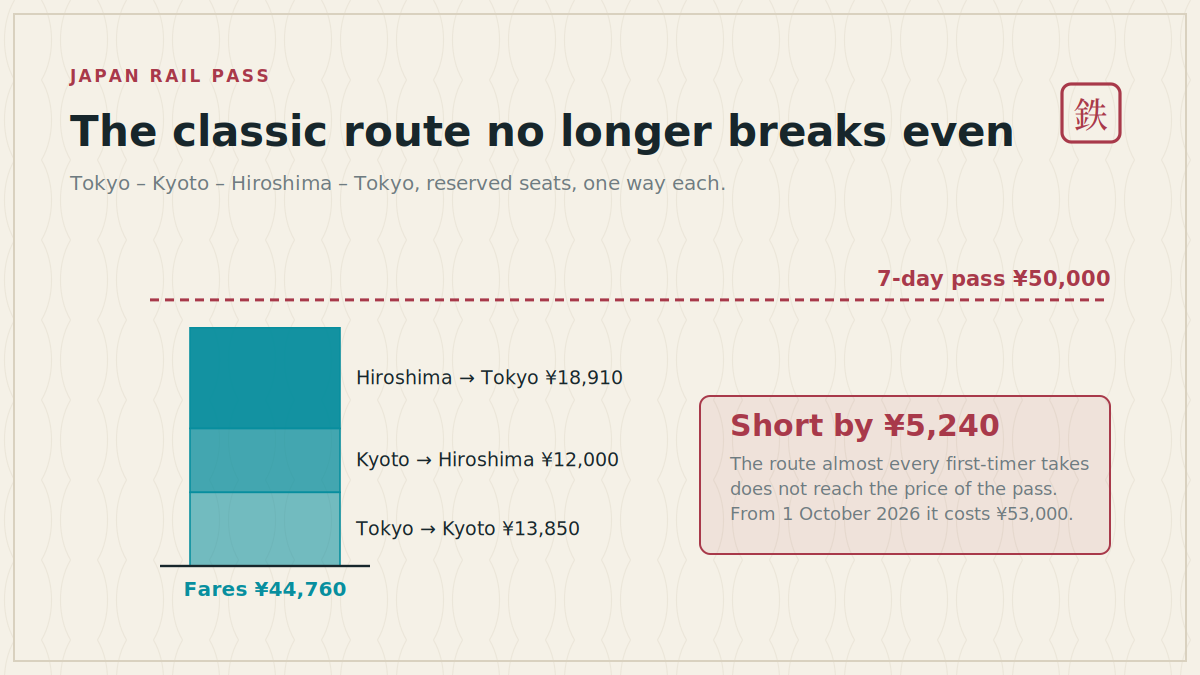
For twenty years the answer was yes, automatically, for almost every visitor. It stopped being automatic in October 2023, when the price rose by about 70% overnight, and it gets a little further from automatic on 1 October 2026.
Here is the arithmetic, which is the only honest way to answer this.
What it costs now, and what it will cost
The pass covers almost all JR trains nationwide, including most shinkansen, for a fixed number of consecutive days.
| Pass | Now | From 1 October 2026 |
|---|---|---|
| 7 days, ordinary | ¥50,000 | ¥53,000 |
| 14 days, ordinary | ¥80,000 | ¥84,000 |
| 21 days, ordinary | ¥100,000 | ¥105,000 |
| 7 days, green car | ¥70,000 | ¥74,000 |
| 14 days, green car | ¥110,000 | ¥116,000 |
| 21 days, green car | ¥140,000 | ¥147,000 |
Children aged 6 to 11 pay half. The increase applies to purchases made on or after 1 October, so a pass bought before that date at the old price is still valid for travel afterwards.
The break-even, on real routes
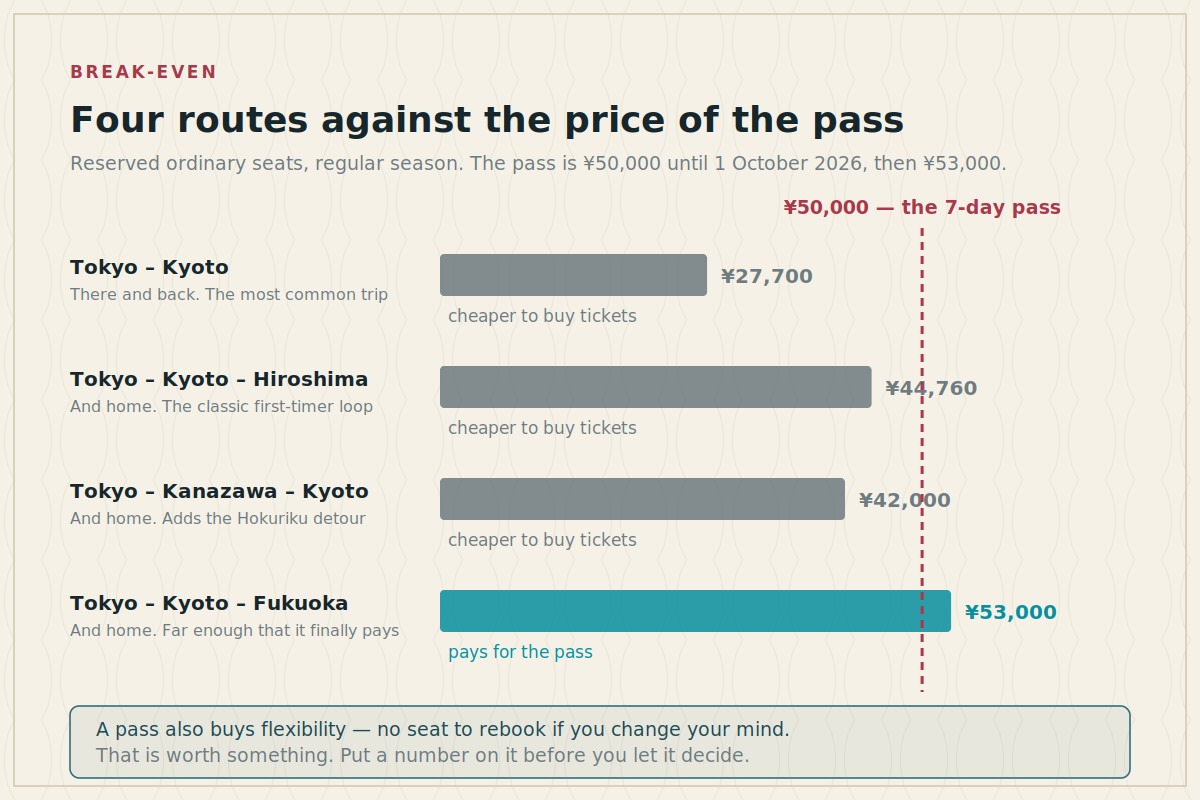
Reserved ordinary seats, regular season, one way each:
- Tokyo → Kyoto → Tokyo — about ¥27,700. The most common trip anyone takes, and it is barely half the pass.
- Tokyo → Kyoto → Hiroshima → Tokyo — about ¥44,760. This is the classic first-timer loop, and it still falls roughly ¥5,000 short of the pass.
- Tokyo → Kanazawa → Kyoto → Tokyo — about ¥42,000. Also short.
- Tokyo → Kyoto → Fukuoka → Tokyo — about ¥53,000. Now it pays, and only just.
The pattern is clear enough to state as a rule. The national pass makes sense when you are going as far as Kyushu or Hokkaido, or covering a lot of ground in a short window. For the standard two-city trip, it does not.
The Nozomi problem
The pass does not include Nozomi and Mizuho, the fastest services on the Tokaido, Sanyo and Kyushu shinkansen. It covers Hikari, Kodama and Sakura instead.
Since 2023 you can pay a supplement to ride Nozomi with a pass — about ¥4,960 for Tokyo to Kyoto or Shin-Osaka. That is a substantial addition, and it changes the arithmetic if you plan to use it.
Whether it matters depends on your patience. Tokyo to Kyoto is about 2 hours 15 minutes on Nozomi and about 2 hours 40 on Hikari. Twenty-five minutes, once or twice a trip, for five thousand yen a leg.
Regional passes are usually the better answer
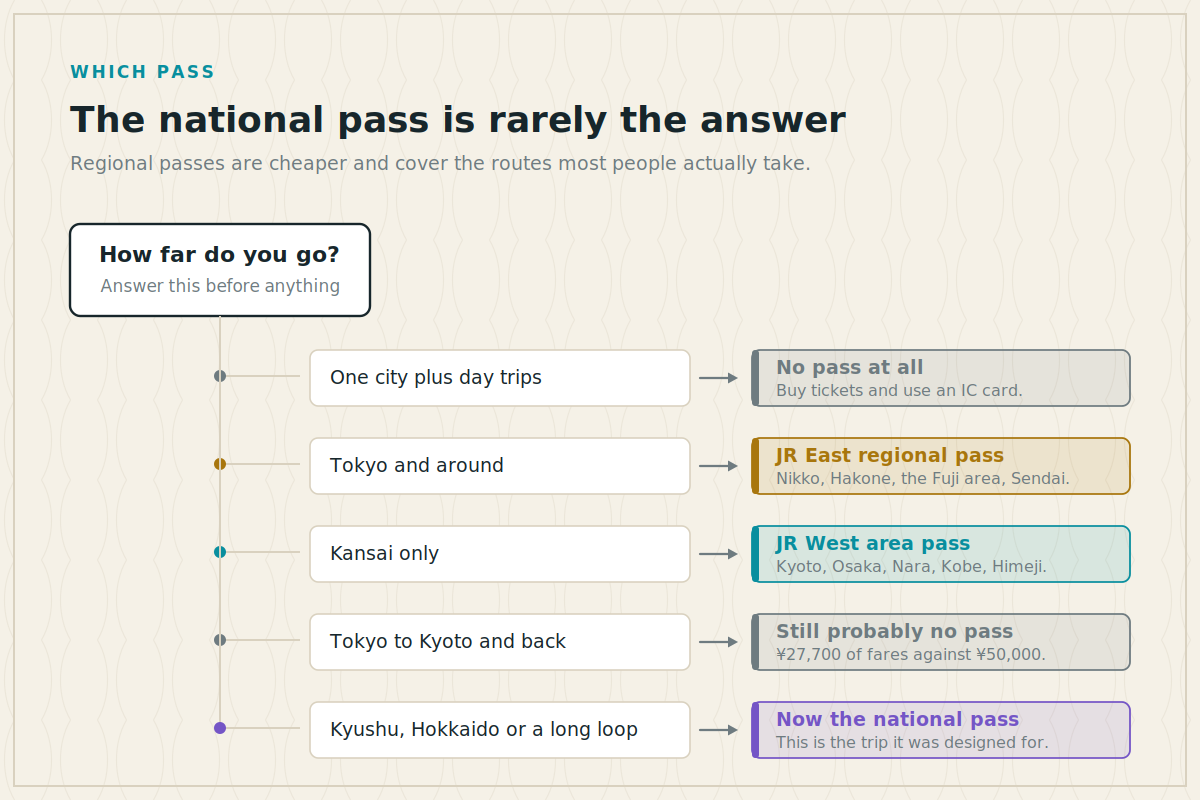
This is the part the national pass conversation usually crowds out. JR runs a large family of regional passes, they are far cheaper, and they cover the areas most visitors spend their time in.
Broadly:
- JR East passes cover Tokyo and the north — Nikko, the Fuji area, Sendai, Tohoku, and in some versions Nagano and Niigata.
- JR West passes cover Kansai — Kyoto, Osaka, Nara, Kobe, Himeji — with wider versions reaching Hiroshima and the San’in coast.
- JR Central and the Hokuriku Arch Pass cover the Tokyo–Kanazawa–Kyoto arc.
- JR Kyushu and JR Hokkaido passes cover those islands.
Prices move, so check them at the time rather than trusting a number in an article. The method matters more than the figure: price your route, then price the pass, then compare.
When the pass is genuinely right
Four situations where the answer is yes without much arithmetic:
- A long north–south trip. Hokkaido to Kyushu, or anything that crosses several JR regions.
- Two weeks with a lot of movement. If you are changing city every two or three days, the fares accumulate fast.
- A trip you want to keep loose. With a pass you can walk to a station and get on a train, which has a value that is real even if it is not a number.
- Travelling with children. The half-price child pass is a better deal than half-price fares, because children’s discounts on individual tickets are less generous than they look.
The pass used to be a default. It is now a calculation — and for the most popular Japanese itinerary of all, the calculation says no.What actually changed
The things people get wrong about it
It does not cover the subway. Tokyo Metro, Toei, Osaka Metro and every private railway are outside it. In Tokyo the JR Yamanote line is covered and the metro is not, and the metro is often the faster way across the city.
It does not cover private railways to the places you want. Hakone, Nikko’s private line, Mount Koya and much of the Kansai countryside run on non-JR track.
Consecutive days, not travel days. A 7-day pass is seven calendar days from activation, including the ones you spend in a single city. Activating it on a day you are not travelling is throwing a day away.
Reserved seats are free with it, and worth taking. Reserve at a machine or a counter; there is no reason to stand.
How to actually decide
Fifteen minutes with a fare calculator settles it.
- Write down every long-distance leg you actually intend to take, with dates.
- Look up each fare for a reserved ordinary seat. Ignore local trains — they are small change.
- Add them up.
- Compare to the pass price for the shortest pass that covers your travel window.
- If the total is within about ¥5,000 either way, buy the pass for the flexibility. If it is well below, buy tickets.
One thing to watch in step 4: the pass has to cover the span between your first and last long journey, and that span is usually longer than people expect. A trip with a shinkansen on day 2 and another on day 9 needs a 14-day pass, not a 7-day one, and that changes everything.
Buying it
You can buy online and collect in Japan, or buy an exchange order abroad and swap it at a JR office. Online purchase is now the normal route, and JR has said online prices stay at the old level for a limited promotional period after the October increase — worth checking at the time, because it may be the one way to pay less.
You need a foreign passport with a temporary-visitor entry stamp. Residents of Japan cannot use it.
The short answer
If you are doing Tokyo and Kyoto, do not buy the pass. Buy tickets, use an IC card for local transport, and put the difference toward a better hotel.
If you are going further — Kyushu, Hokkaido, a two-week loop through several regions — price it properly, because it probably does pay, and it certainly makes the trip simpler.
The wider planning sequence this fits into, including why this decision belongs at step five rather than step one, is in our guide to planning a first trip to Japan. And the other travel costs that moved in 2026 — the departure tax, Kyoto’s lodging tax, the tax-free change — are in the money article.