Japan has spent three years being unusually cheap for anyone earning dollars, and 2026 has spent the year quietly adding charges back. Both things are true at once, and the net effect is still favourable.
Here are the actual numbers.
Three budgets
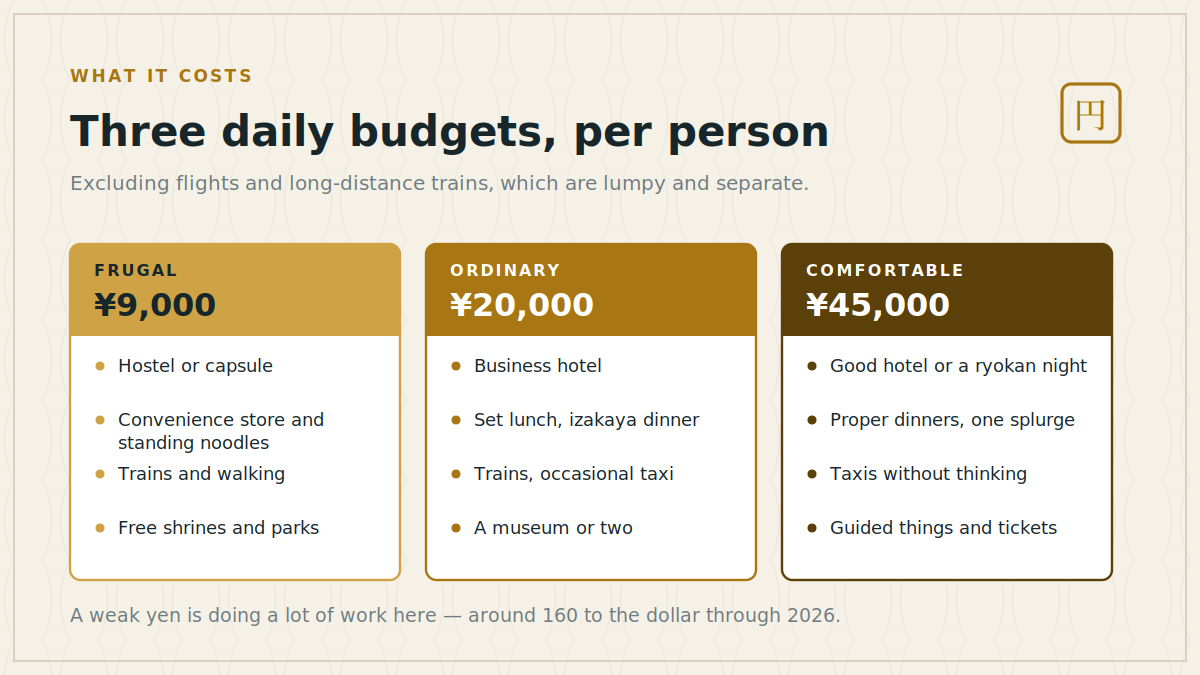
¥9,000 a day is frugal and entirely liveable. Hostel or capsule hotel, convenience store breakfast, standing noodles for lunch, a cheap dinner, trains and a lot of walking. Shrines and parks are free, and the walking is the point.
¥20,000 a day is the ordinary tourist rate. A business hotel, a set lunch, an izakaya dinner, trains with the occasional taxi, and a museum or two. This is what most visitors actually spend.
¥45,000 a day is comfortable. A good hotel or the occasional ryokan night, proper dinners, taxis without thinking about them, guided experiences and tickets.
At around 160 yen to the dollar — roughly where the rate has sat through 2026 — those come to something like $56, $125 and $280.
Where the money goes
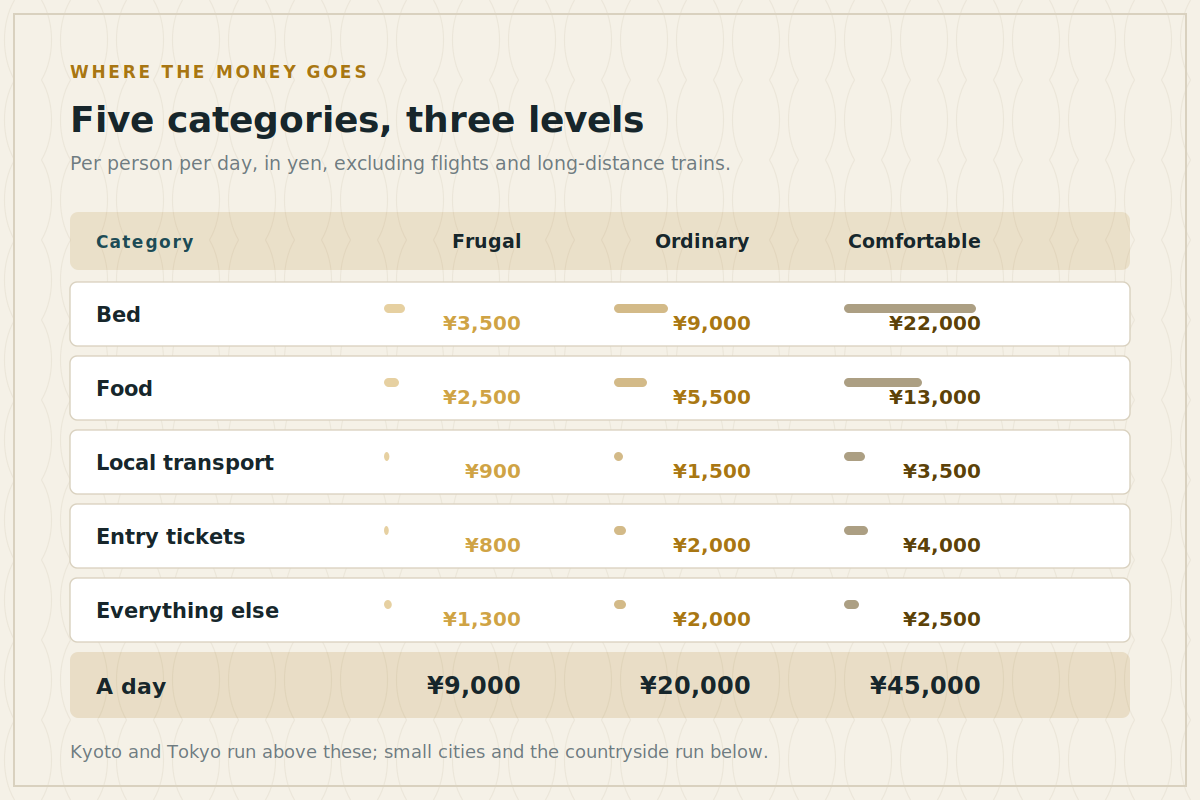
Two things stand out in that breakdown.
The first is that the bed is the whole story. Food, local transport and tickets vary by a factor of three or four between levels; accommodation varies by six. If you want to spend less in Japan, that is the lever.
The second is that food is cheap at every level. A good bowl of ramen is ¥1,000. A set lunch at a decent restaurant is ¥1,200. Convenience store food is genuinely good and costs a few hundred yen. You can eat extremely well in Japan on a budget that would get you nothing in New York.
What individual things cost
| Thing | Yen | Roughly |
|---|---|---|
| Bowl of ramen | ¥900–1,300 | $6–8 |
| Set lunch at a restaurant | ¥1,000–1,600 | $6–10 |
| Coffee at a chain | ¥400–600 | $3–4 |
| Convenience store onigiri | ¥150–250 | $1–2 |
| Beer at an izakaya | ¥500–700 | $3–4 |
| Subway ride in Tokyo | ¥180–330 | $1–2 |
| Temple or garden entry | ¥400–800 | $3–5 |
| Business hotel, one night | ¥9,000–16,000 | $56–100 |
| Airport train into Tokyo | ¥1,300–3,300 | $8–20 |
The taxes and fees nobody mentions
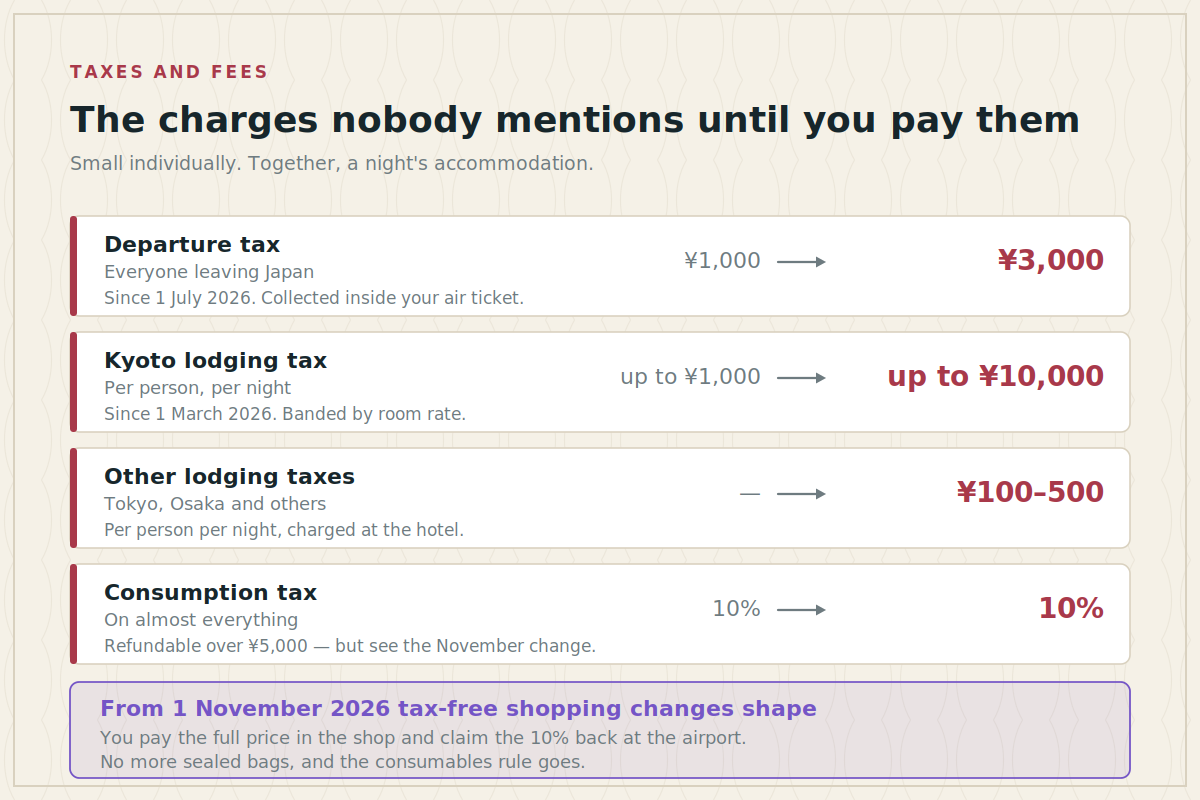
Four of them, and two moved this year.
The departure tax tripled on 1 July 2026, from ¥1,000 to ¥3,000. Everyone aged two and over leaving Japan by air or sea pays it, and it is collected inside your ticket price rather than at the airport, so you will never be asked for it directly.
Kyoto’s lodging tax was restructured on 1 March 2026, and the change is dramatic at the top. The bands, per person per night:
- Under ¥6,000 a night — ¥200, unchanged
- ¥6,000 to ¥20,000 — ¥400, doubled
- ¥20,000 to ¥50,000 — ¥1,000, doubled
- ¥50,000 to ¥100,000 — ¥4,000, up from ¥1,000
- ¥100,000 and over — ¥10,000, up from ¥1,000
For a couple in a ¥25,000 room for four nights in Kyoto, that is ¥8,000 rather than ¥4,000. Not ruinous, but not nothing, and it is charged at the hotel rather than included in the booking price.
Other cities have smaller lodging taxes — Tokyo, Osaka and a growing list charge ¥100 to ¥500 per person per night in the same banded way.
Consumption tax is 10% on almost everything, and it is already included in displayed prices.
Tax-free shopping changes on 1 November
This one is worth understanding before you plan any serious shopping.
Until then, the system works the way it always has: show your passport at a tax-free counter, spend at least ¥5,000, and the 10% comes off at the till. Consumables get sealed in a bag you are not supposed to open until you leave.
From 1 November 2026, you pay the full price in the shop and claim the refund at the airport before departure. The consumables category disappears, the sealed-bag rule goes with it, and the ¥500,000 daily cap is removed — though purchases over ¥1,000,000 need itemised registration.
Two practical consequences. You need more cash or credit headroom during the trip, because you are fronting the tax. And you need to allow time at the airport, plus one to four weeks for the refund to reach your card or bank.
Until 1 November the discount happens at the till. After it, you pay the tax and get it back at the airport. Same money, very different cash flow.What the tax-free change actually means
Cash or card
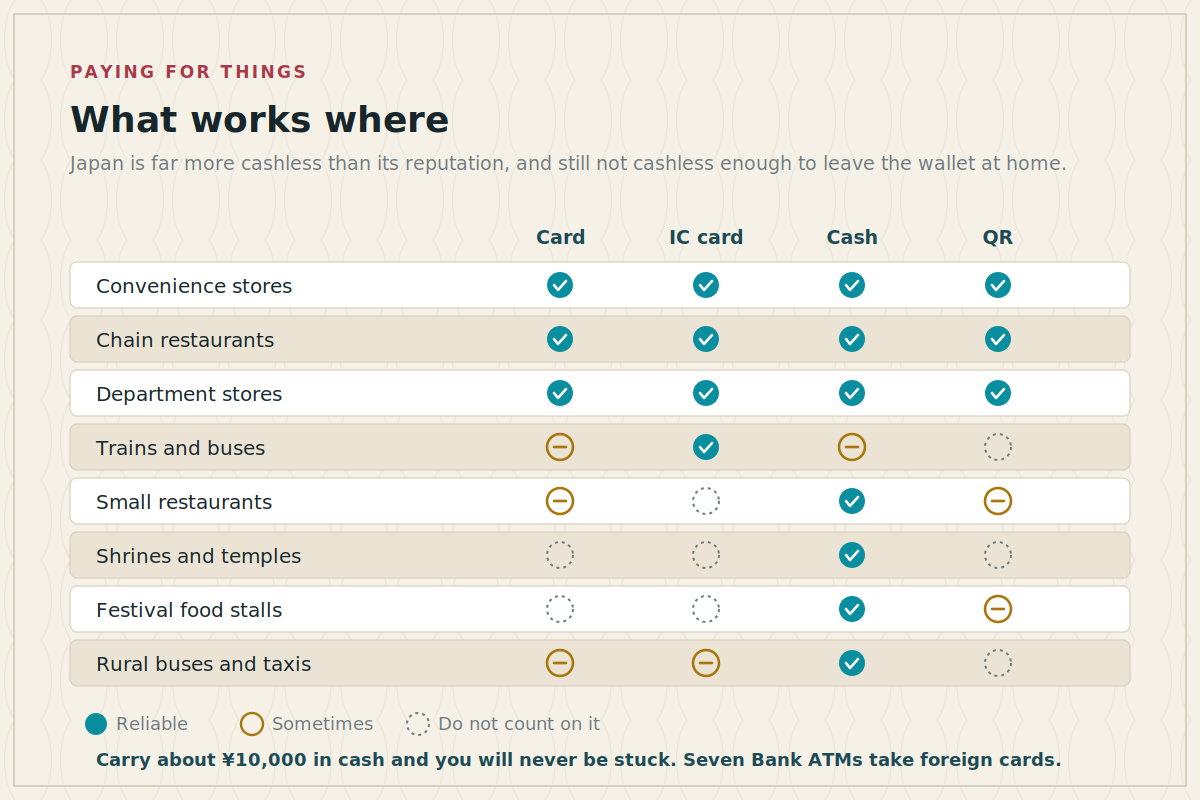
Japan’s reputation as a cash economy is a decade out of date, and its reputation as fully cashless is premature.
Contactless Visa and Mastercard work at convenience stores, chain restaurants, department stores, hotels and essentially anything aimed at visitors. What still wants cash: small owner-run restaurants, shrines and temples, festival stalls, some rural buses and taxis, and the occasional stubborn ticket machine.
Carry about ¥10,000 and you will never be stuck. Top up at a 7-Eleven ATM — they take foreign cards, run 24 hours, and have an English interface. Japan Post ATMs also work.
An IC card — Suica, Pasmo or a regional equivalent — is the third payment method and the one that gets used most. It covers trains, buses, vending machines and convenience stores with a tap. Visitors can get a Welcome Suica or Pasmo Passport at the airport with no deposit; both run 28 days and any leftover balance is not refundable, so top up in small amounts near the end. iPhone users can put Suica in Apple Wallet instead, which has no expiry and is simpler. Most non-Japanese Android phones cannot.
What to bring, and how
Three sensible things:
- Two cards from different networks, kept in different places. Japanese terminals are occasionally particular, and a second card solves it.
- Enough cash for the first day. ¥10,000 to ¥20,000, exchanged before you go or drawn at the airport ATM.
- Tell your bank. A card frozen on day one in Osaka is a bad afternoon.
Do not exchange large sums at home — home-country exchange rates are usually worse than a Japanese ATM withdrawal, and the ATMs are everywhere.
What Japan does not charge you for
Worth stating, because it offsets the list above.
There is no tipping, anywhere, ever. Not restaurants, not taxis, not hotels. The price is the price, and service is included in a way that is cultural rather than accounting.
Water is free and brought to your table without asking. Wet towels come with the meal. Public toilets are free, clean and everywhere, including in every convenience store and station. Refills of green tea in many restaurants are free. And the service you get at a ¥1,000 lunch is the same service you get at a ¥10,000 dinner, which is not true in most countries.
So how much for a trip?
For ten days, one person, ordinary comfort, excluding international flights:
- Ten days at ¥20,000 — ¥200,000
- Shinkansen Tokyo–Kyoto and Kyoto–Osaka airport — about ¥15,000
- Lodging taxes and the departure tax — about ¥7,000
- Total: roughly ¥222,000, or about $1,400 at current rates
Frugal, the same trip runs near ¥110,000. Comfortable, near ¥480,000.
Whether a rail pass belongs in that second line is a calculation rather than a default, and it is worked through in our article on the Japan Rail Pass. The rest of the planning sequence — and where in it money decisions belong — is in our guide to planning a first trip.